"There's a question about your boarding pass. Do you have a second form of ID?"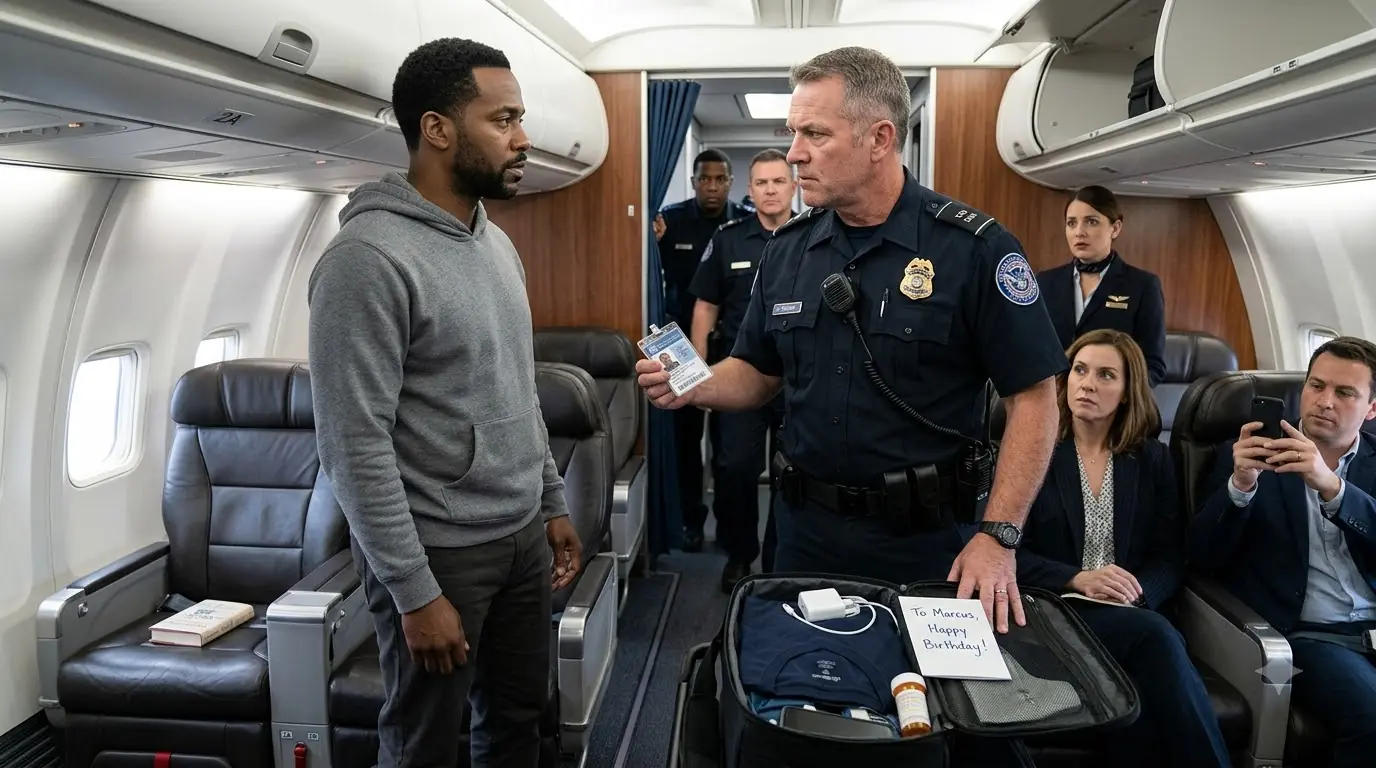
Marcus Reed lowered his book. He was in seat 2A, a window. A plain gray hoodie, old sneakers, a paperback gone soft from his jacket pocket. 90 seconds ago, he'd tipped a tired barista $10 on a $4 coffee and lifted an old woman's bag onto the escalator step without a word. Nobody had looked at him twice. That was how he liked it.
"It's 2A," Marcus said. "Want to scan it again?"
The gate agent, Kyle Foster, late 20s, a lanyard and a clipboard he didn't really need, barely looked. "This is first class. I just need to verify you're in the right seat."
Marcus pulled his driver's license and held it out. Foster studied it far longer than necessary, turning it in the light, glancing from the photo to his face and back. Across the aisle, a woman in pearls sipped champagne in 3C; a man in a wrinkled suit shoved a bag overhead. Nobody asked them for anything. Marcus noticed. He always noticed.
Foster clicked his pen twice, three times, then walked toward the galley with the license still in his hand.
"That's mine," Marcus said.
"One second, sir."
Through the gap in the curtain, he watched Foster lift a radio, lower his voice, angle his shoulder away. Marcus didn't need the words. He set his mother's birthday card—the one she'd slipped into his bag at the door to read on the plane—face down on his knee, and kept his hands open and visible, the way he'd taught himself a long time ago.
The man who came through the curtain was older, 50s, thick through the shoulders, a security supervisor's badge on his belt. The tag read Brunner. He looked at Marcus the way you look at a stain: down, up, and down again.
"First class, huh?" He let it hang. "You fly up here often?"
"When I travel, yes. Is there an issue?"
"That depends." Brunner slid the license into his own shirt pocket. "20 years doing this, I get a feeling about people. And I'm getting a real strong feeling about you." He leaned on the seatback. "How does a guy like you afford a seat like this? Points? Somebody else's card?"
The cabin had gone quiet. Marcus heard the woman in pearls whisper to her husband.
"I paid for it," he said. "Same as everyone up here."
"Sure you did." Brunner straightened and keyed his radio. "Yeah, it's Brunner. Going to need a second unit at gate D7. Uncooperative individual on board."
Uncooperative. Marcus hadn't raised his voice once. He hadn't left his seat.
"While we wait," Brunner said, folding his arms, "let's clear something up. You got proof you paid for this seat?"
"The boarding pass is the proof. You're holding the ID it's booked under."
"Anybody can print a pass." Brunner nodded at his jacket. "I mean real proof. Pull up your bank. Show me the charge."
The request was so absurd it took Marcus a second to be sure he'd heard it. Across the aisle, the man in the wrinkled suit stared hard at his own phone, careful not to look. Nobody was asking him to open a banking app. Nobody ever would.
For a moment, the refusal sat right on Marcus's tongue—every reason this was wrong. Then he thought of the second unit on its way, the 40 people watching, his own bet at the end of it. So he took out his phone, opened the app, scrolled to the charge—the airline's own name, his card, the exact fare—and turned the screen toward Brunner.
"There. Paid in full. 3 days ago."
Brunner glanced at it for half a heartbeat. "Could be anybody's account."
"It has my name on it."
"Names are easy."
He'd already moved the goalposts. Because the proof had never been the point. And Marcus, lowering the phone slowly, understood exactly where this was going. He'd been here before, in a hundred smaller rooms his whole life. He just never thought it would happen on one of his own planes.
Brunner reached up, popped the overhead bin, and pulled down Marcus's carry-on like it was already evidence.
"You can't search that," Marcus said, halfway out of his seat. "I don't consent to that."
"Sit down." Brunner dropped the bag onto the empty aisle seat and unzipped it in one hard pull. "On this aircraft, I don't need your permission."
That wasn't true, and some part of Brunner probably knew it. But the cabin was full of people who weren't going to stop him. He dug through it in front of everyone: a folded shirt, a charger, a bottle of his mother's blood pressure pills Marcus had promised to refill—holding each item up a beat too long, narrating with his eyes: See what we've got here.
Then his fingers closed on something at the bottom: a laminated card on a lanyard. Marcus's executive credential. His photo. The airline's logo. The word DIRECTOR in clean capitals.
Marcus's heart lifted, just slightly. "That's my company ID. Look at it. Really look."
Brunner glanced at it. He saw the logo. He saw the title. He saw the face that matched the one in front of him. And he tossed it back in the bag.
"Fake," he said. "Or stolen. People like you don't run anything."
The cruelty of it was almost clean. The literal answer to the question he kept asking had been in his hand, and he'd thrown it away because it didn't fit the story he'd already written.
Down the aisle, the flight attendant appeared, two waters still in her hands. Naomi Webb set them down. "He hasn't caused any trouble. I've been right here the whole time."
"Stay out of it," Brunner said, not turning. "This is a security matter."
"But he's just been sitting—"
"One more word and you're off this crew." His tone snapped like a door.
Naomi's mouth closed. She caught Marcus's eye, and in her face was an apology she had no power to make good on.
The cabin door thudded. Two more officers came down the bridge, boots squeaking, radios hissing. Brunner squared his shoulders. He had his audience, and now his backup.
"All right. You're getting off this aircraft."
"On what grounds?" Marcus asked, still seated.