I was holding a piece of paper that weighed less than an ounce, but somehow it felt like it contained about 10 tons of pure, unadulterated audacity.
It was a certified letter, the kind that requires a signature from a mailman who looks at you with pity because he knows he's handing you a headache.
I stood there on my front porch, coffee in one hand, lukewarm now, thanks to the interruption, and this heavy cream-colored envelope in the other. The return address was embossed. Embossed. That little raised texture that screams, "We spent your HOA dues on stationery instead of fixing the pothole on Elm Street."
Oak Creek Estates Homeowners Association was stamped in gold foil in the top left corner. Below it in a font that I can only describe as passive-aggressive sans serif was the name of the sender. Mrs. Patricia Higgins, president.
I hadn't even opened it yet, and my blood pressure was already doing that thing where you can hear your own pulse in your ears. You know the sound whoosh, whoosh? It's the soundtrack of a man about to lose his absolute mind.
I took a sip of the cold coffee, grimaced, and tore the envelope open with my teeth because I didn't have a free hand, and I was too annoyed to put the mug down. I pulled out the single sheet of paper. It was thick, heavy stock, expensive.
I unfolded it and started to read, hoping it was just a generic newsletter about trash can placement or a reminder that Christmas lights have to be down by January 15th. It wasn't.
"Dear Mr. Michael Henderson," it began, formal and cold. "It has come to the attention of the board that your property at 402 Maple Drive contains a drainage gradient that is essential to the hydrological integrity of the neighborhood's water management system."
I stopped reading at "hydrological integrity." I'm a software engineer, not a hydrologist, but I know for a fact that my backyard is flatter than a pancake and hasn't seen standing water since the Great Flood of '98. I looked out at my lawn. It was pristine, green, dry.
I went back to the letter.
"Due to recent concerns regarding potential subsurface erosion, the board, under the direction of the Architectural Control Committee, requires immediate and unfettered access to the rear of your property for inspection and ongoing monitoring. Effective immediately, you are instructed to remove the padlock from your rear gate and leave it unlatched between the hours of 8:00 a.m. and 6:00 p.m. Monday through Friday to facilitate random compliance checks by authorized HOA representatives. Failure to comply will result in a daily fine of $150 and potential legal escalation."
I lowered the letter. I looked at the street. It was a nice street. Trees, manicured lawns, birds chirping. It looked peaceful, but it was a lie. I was living in a war zone, and the first shot had just been fired by a woman whose hairstyle probably hadn't changed since the Reagan administration.
"Unfettered access," I whispered to myself, testing the words. They tasted like bile. "Random compliance checks."
I didn't buy this house for the granite countertops or the open-concept living room. I didn't buy it for the school district or the proximity to the highway. I bought this house for exactly one reason, the six-foot cedar plank privacy fence that surrounded the backyard.
It was my fortress of solitude, my sanctuary. I work from home. I spend eight hours a day staring at code that makes my eyes bleed.
When I clock out or when I take a break, I go into that backyard. I sit on my deck. I grill steaks. I sometimes just lay in the grass and stare at the clouds like a five-year-old.
It is the only place on earth where I don't have to answer to anyone. No bosses, no clients, and certainly not Patricia Higgins. I looked down the street towards the Higgins residence. It was three houses down on the left. A pristine, terrifyingly symmetrical two-story colonial with a lawn that looked like it was cut with nail scissors.
And there she was, Mrs. Higgins. She was standing on her own driveway, arms crossed, staring directly at me. It was like she had a radar for distress.
She saw me holding the letter. She knew. She started walking toward me.
Now I'm a reasonable guy. I pay my taxes. I tip 20%.
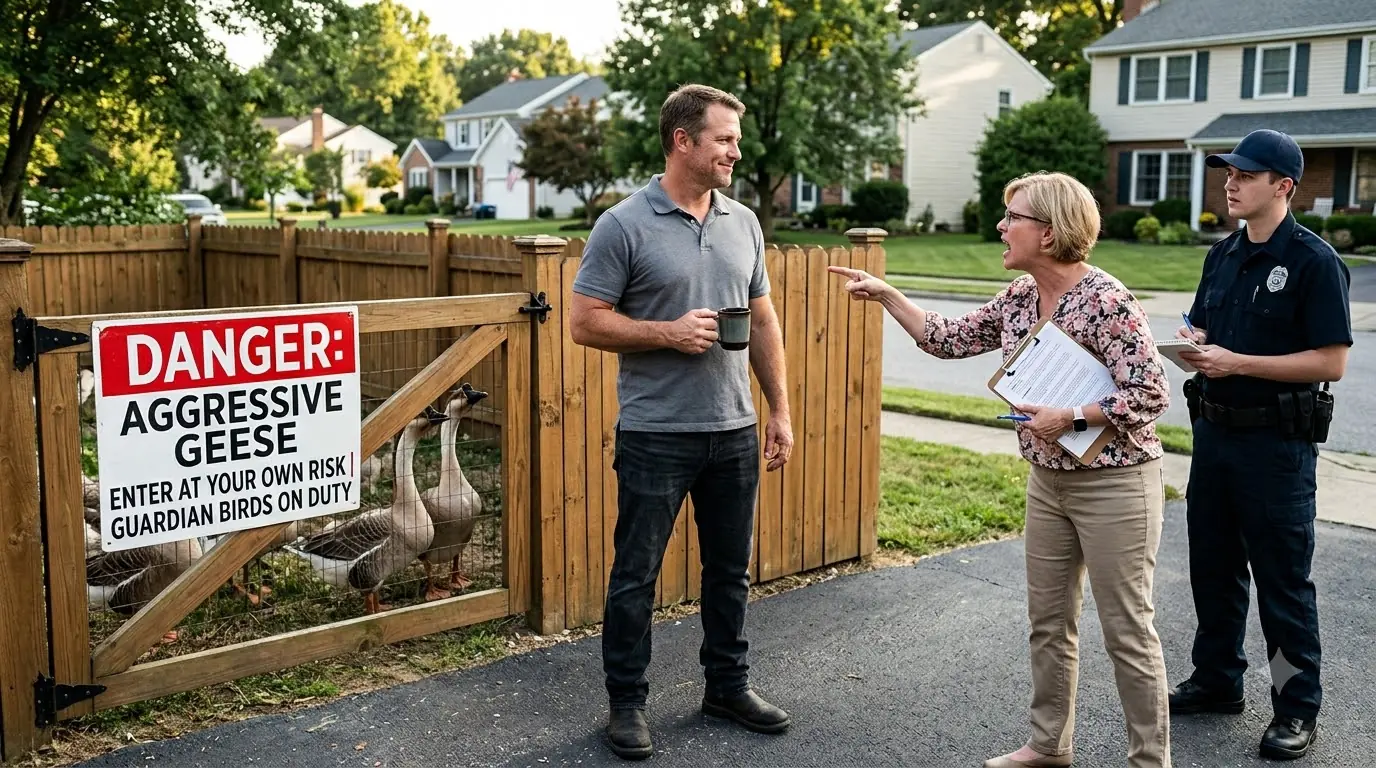
I hold doors open for people. But Mrs. Higgins tested the limits of my social contract. She was a small woman, maybe five-foot-two, but she carried herself with the authority of a four-star general inspecting the troops. She wore a floral blouse that looked like a couch from 1984 and khaki pants that were ironed so sharply they could sever a limb.
"Mr. Henderson," she called out when she was still 50 feet away. Her voice was shrill, the kind of tone that cuts through glass. "I see you received our correspondence."
I didn't move. I just waited on my porch, gripping the letter. "I did, Mrs. Higgins. Just now." She reached the edge of my driveway and stopped, respecting the property line only because stepping over it uninvited wasn't part of her current power play.
"Excellent. We've been very worried about the drainage. Very worried."
"Drainage?" I repeated flatly. "Patricia, it hasn't rained in three weeks. My yard is bone dry. There is no drainage issue."
She tutted. She actually tutted at me, shaking her head like I was a toddler trying to explain quantum physics. "Subsurface, Mr. Henderson. Subsurface."
"Just because you can't see the water doesn't mean it isn't wreaking havoc on the foundation of our community. The integrity of the soil is paramount."
"And for this invisible water," I said, stepping off the porch and walking down the driveway to meet her, "you need me to unlock my gate permanently during business hours?"
"For spot checks," she corrected, tapping a pen against a clipboard I hadn't noticed she was holding. "The board needs to be able to access the easement to measure moisture levels."
"There is no easement in my backyard," I said. "I checked the survey when I bought the place two years ago. My property line goes to the back fence. The utility easement is in the front by the sidewalk."
Her eyes narrowed. They were small, beady eyes magnified slightly by her glasses. "The HOA bylaws, Section 4, Paragraph C, state that the board reserves the right to access any property for emergency maintenance or to prevent community blight. Erosion is blight, Mr. Henderson."
"It's not an emergency if you're scheduling it between 8 and 6 Monday through Friday," I countered. "That's a job. You're asking to turn my backyard into a public park for the HOA board."
She straightened up, puffing out her chest. "We are volunteers, Mr. Henderson. We do this for the good of the neighborhood."
"And frankly, your gate being locked is a safety hazard. What if there was a fire? How would the fire department access the rear of the home?"
"They have axes, Patricia. Big ones. They don't need the combination to my master lock."
She didn't like that. Her lips pursed into a thin line, disappearing entirely. "The lock comes off by Monday morning or the fines begin, and I will be checking personally."
"You're telling me," I said, stepping a little closer and lowering my voice to that dangerous level of calm, "that you intend to enter my private property without my permission whenever you feel like it?"
"It is not private property when it concerns the association," she snapped. "You signed the covenants when you bought the house. We have the authority. If you obstruct an inspection, we can place a lien on your home."
"Do not test me, Michael. I have been on this board for 20 years. I have seen residents come and go. The ones who cooperate stay. The ones who don't..."
She let the sentence hang in the air. A threat wrapped in polyester.