At first, no one asked thirteen-year-old Malik Carter whether he could play the piano.
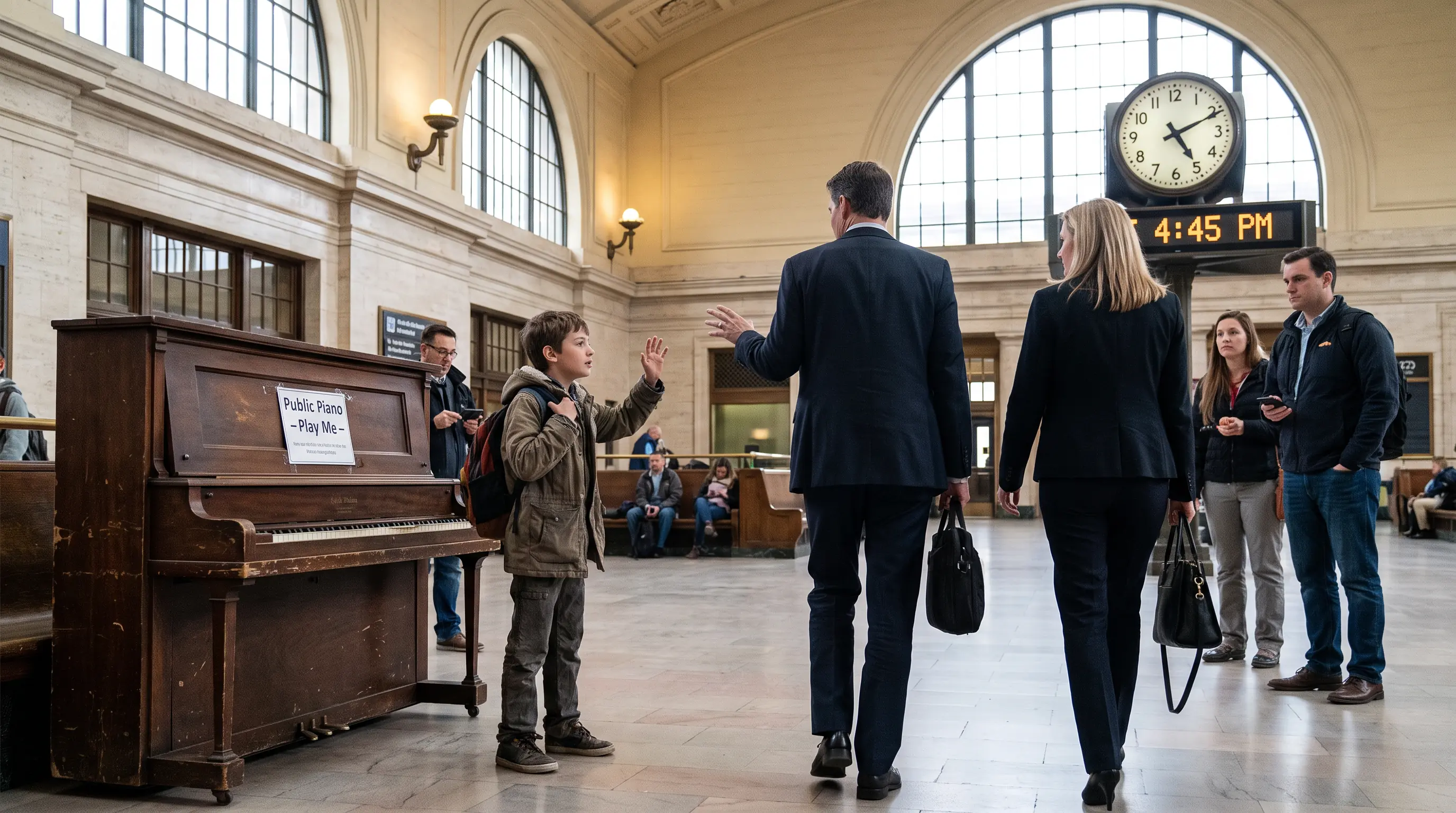
They asked him to move away from it.
The piano stood beneath the great arched windows of Philadelphia’s 30th Street Station, between a bronze information board and a temporary stage erected for the city’s autumn arts festival. It was an old black grand with a scratched lid, newly tuned for the event but permanently marked by years of public use. Commuters had touched it. Children had pounded on it. Conservatory students had played Chopin between trains. An exhausted nurse once sat there at two in the morning and played hymns for fifteen minutes before boarding a bus home.
The instrument belonged to nobody important.
That was supposed to be the point.
A brass plaque beside it read:
MUSIC BELONGS HERE.
PLAY WITH CARE.
Malik had read those words perhaps fifty times.
He knew because he came to the station almost every Saturday morning with his father.
His father, Darius Carter, worked maintenance for SEPTA and sometimes picked up weekend overtime inspecting heating and electrical systems in the older parts of the complex. Malik was not supposed to follow him into restricted work areas, so he usually waited in the public concourse with a backpack, headphones, homework, and enough vending-machine money to survive several hours.
The piano had become part of his Saturdays.
At first he only watched.
Then one morning, when he was ten, an elderly woman finished playing and noticed him staring.
“You know where middle C is?”
Malik shook his head.
She showed him.
That was all.
One note.
The following week he found it again.
By the end of the month he could pick out the melody from a song his grandmother played in church. A station employee named Hector showed him three chords. A college student corrected his left hand. Someone else explained pedal. Malik went home and watched videos, then began using the battered upright piano in the recreation room of his apartment building whenever the superintendent forgot to lock it.
By eleven, his father understood this was no longer a passing interest.
Darius bought him six used lessons from a teacher named Nadine Foster.
Six became twelve.
Then Nadine stopped charging for one lesson a month because, as she told Darius privately, “I am not doing charity. I am investing because this child actually practices.”
Malik practiced obsessively.
Not beautifully.
Obsessively.
Scales while other children played basketball outside.
Chord progressions until neighbors knocked on the wall.
Rhythms tapped against cafeteria tables.
Finger exercises on his knees while riding the bus.
He was not a prodigy.
Nadine hated the word.
“Prodigy is what adults say when they want to ignore the hours.”
So Malik never called himself gifted.
He said:
“I play piano.”
That Saturday morning in October, he was standing beside the station piano because Nadine had told him to be there at ten.
The Philadelphia Arts Partnership was holding a small public program called Sounds of the City.
Local musicians.
Student performers.
Community ensembles.
Three original compositions written by teenagers.
Malik’s piece had been selected.
He had not told many people.
Not because he was humble.
Because telling people made his stomach hurt.
His father knew.
Nadine knew.
His grandmother knew.
His math teacher knew because Malik had used rehearsal as an excuse for missing tutoring.
That was enough.
He arrived at 9:12 wearing a navy hoodie, clean jeans, black sneakers, and a gray backpack.
The stage crew was still setting microphones.
Nadine was late.
Darius had already been called downstairs by a supervisor because one of the west-concourse heating controls was malfunctioning.
“Stay here.”
his father told him.
“I know.”
“Do not leave the main concourse.”
“I know.”
“If Ms. Foster comes—”
“I know.”
Darius stared.
“You are irritating.”
“Genetic.”
His father almost smiled.
Then pointed.
“Stay.”
Malik stayed.
For twelve minutes.
Then he walked over to the piano.
Not to play.
Not yet.
He placed one hand lightly on the closed lid.
The instrument had been moved approximately six feet for the festival.
That bothered him.
Not logically.
Emotionally.
He had memories attached to where it normally stood.
An event volunteer saw him.
She was white, perhaps twenty-three, wearing a green festival T-shirt and headset.
“Hey.”
Malik looked over.
“Hi.”
“You can’t mess with that right now.”
“I’m not.”
She smiled politely.
“We have performers coming.”
“I know.”
“So we need to keep the area clear.”
Malik stepped back.
“Okay.”
Easy.
No problem.
He moved three feet away and opened his backpack.
The volunteer returned to taping cables.
Then two men in suits approached.
One was Walter Bellamy, sixty-one, president of the Philadelphia Arts Partnership’s board. The other was Jonathan Pierce, a wealthy commercial-property developer whose family foundation had contributed $250,000 to the festival’s education programs.
Neither knew Malik.
Malik knew Walter from a photograph in the program.
Jonathan he did not recognize.
Walter looked toward the stage.
“Where is the Steinway technician?”
The volunteer said:
“Finished twenty minutes ago.”
“Good.”
Jonathan glanced at Malik.
Then the piano.
“Is he with somebody?”
The volunteer looked toward Malik.
“I think his dad works here.”
Malik heard.