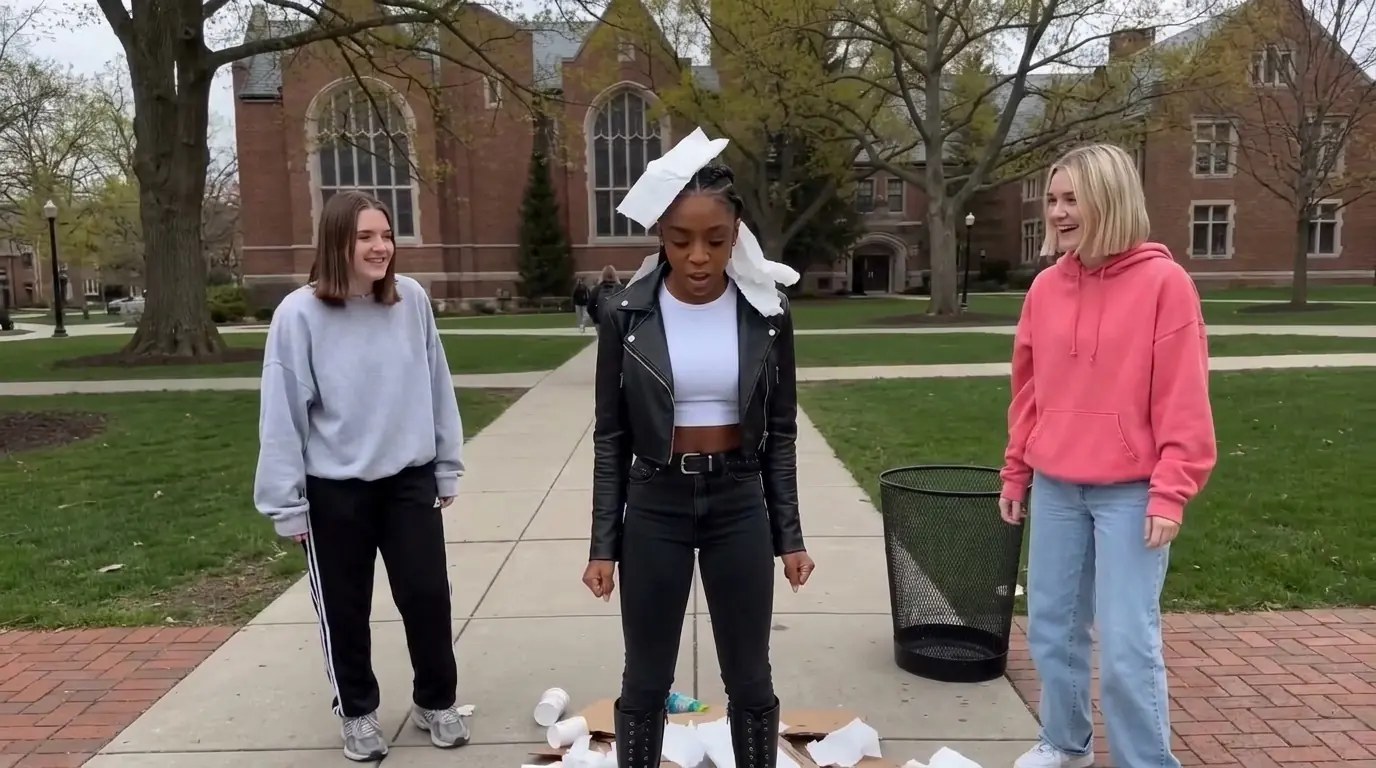
By the time the first paper cup bounced off Camille Rhodes’s shoulder, she already knew who had tipped the trash can. She did not need to turn around to recognize the laughter behind her, because she had been hearing those same two voices in classrooms, dining halls, and campus walkways for almost an entire semester. She kept walking for two more steps while napkins, empty bottles, fast-food wrappers, and a half-crushed paper bag slid down her black leather jacket and tangled in her braids. Then a white takeout container landed on top of her head, and the laughter became too loud to pretend she had not heard it.
Six months earlier, Camille had arrived at Westbridge State University believing college would be easier the second time around. She was twenty-one, entering junior year after transferring from a community college outside Richmond, Virginia, and she had already spent two years balancing classes with nearly thirty hours a week at a medical supply warehouse. Westbridge was larger than anything she knew—brick academic buildings surrounding a wide green quad, student organizations recruiting beneath white tents, bikes chained to every railing, and hundreds of people moving between classes as though they all understood where they belonged. Camille understood almost none of it, but she liked being somewhere nobody knew her history.
Her mother, Denise, had raised Camille and her younger brother in a two-bedroom apartment where money was discussed quietly but constantly. Camille’s father died when she was fourteen, and by seventeen she had learned how to compare grocery prices, work late without complaining, and tell when her mother was pretending a bill did not worry her. Transferring to Westbridge had been possible only because Camille qualified for financial aid and saved almost everything she earned during the previous summer. She wanted a degree in public administration and eventually hoped to work in city government, though she rarely told people that because saying ambitions aloud made them feel fragile.
Camille met Madison Vance during orientation week. Madison was a junior too, blond, confident, always dressed as if somebody might photograph her without warning, and one of those students who seemed to know everyone from residence-hall directors to bartenders downtown. Her closest friend, Paige Ellison, was a brunette with a round face, a gray sweatshirt permanently tied around her waist, and a laugh that usually arrived before Madison finished whatever joke she was making. Camille would later realize that Paige rarely started anything herself, but she had spent so long standing beside Madison that supporting her had become almost automatic.
Their first interaction lasted perhaps thirty seconds. Camille was standing beside the student-union map trying to find an administrative law classroom when Madison stopped behind her and said, “You know that building is literally on the other side of campus, right?” Camille turned, thanked her, and started walking. Madison called after her, “You’re welcome,” in a tone that made Paige laugh, and Camille thought nothing of it.
The next time they crossed paths, Camille was working her campus job in the student center. She had been hired to help the facilities office with evening events, which mostly meant arranging chairs, checking reservations, locking conference rooms, and occasionally reminding students that leaving pizza boxes on the floor did not qualify as cleaning. The job paid less than the warehouse but let Camille work between classes. More importantly, the facilities supervisor, Leonard Bell, was willing to schedule around exams.
Mr. Bell was sixty-two and had worked at Westbridge for twenty-seven years. He knew which elevators failed during humidity, which professors secretly carried master keys they were not supposed to have, and exactly how many students would attend an event based solely on how much free food had been advertised. He treated Camille like an employee rather than a student doing temporary work, which she appreciated. By September, she knew how to close the east wing without calling him for help.
Madison and Paige were frequent visitors to the student center because Madison served on the university’s Campus Events Council. The council organized concerts, homecoming activities, movie nights, and charity events, and membership came with access to spaces ordinary students needed reservations to enter. Madison loved that access. She loved walking through restricted doors, carrying a radio, and answering questions as if Westbridge itself had hired her to run the place.
At first, Camille and Madison remained polite. Madison would ask whether a meeting room had been unlocked, and Camille would check the schedule. Paige occasionally joked that Camille was “the serious one” because she never joined their conversations. Camille usually smiled and kept working.
The problem started during Homecoming Week.
The student center hosted events almost every night, and by Thursday everyone on the facilities staff was exhausted. After a late alumni reception, Camille found an entire hallway covered with discarded decorations, cups, pizza boxes, and pieces of a cardboard photo backdrop. Two large trash cans stood nearby, both nearly empty.
Madison and Paige were at the end of the hall taking pictures.
Camille looked at the mess, then at them.
“Is this yours?”
Madison lowered her phone.
“It’s from the event.”
“I know.”
“Then why are you asking?”
“Because your council hosted the event.”
Madison smiled.
“That’s what facilities is for.”
Camille stared at her.
“No, facilities sets up and maintains the building. Your event agreement says your group clears personal trash and decorations.”
Paige laughed.
“Seriously?”
Camille pointed toward the rolling bins.
“Seriously.”
Madison folded her arms.
“We’ve never done that before.”
“Then somebody else has been cleaning up after you.”
For a moment, nothing happened. Then Madison looked past Camille and saw Mr. Bell approaching with a custodial cart. A smile appeared.
“There. Problem solved.”
Camille turned.
Mr. Bell slowed when he saw the hallway.
His expression said enough.
Madison and Paige walked away.
Camille stayed.
She helped Mr. Bell fill six bags and break down the backdrop. Neither said much until they were almost finished, when he shook his head and said, “People get real comfortable calling work invisible when somebody else does it.”
Camille remembered that sentence.
Two weeks later, Westbridge hosted its annual Fall Service Day, an event that sent student organizations across campus and into nearby neighborhoods to clean parks, stock food pantries, paint community centers, and collect donations. Madison’s council had been assigned to campus beautification. Photos from the event would appear on the university website, and Madison had spent most of the week talking about how good the council shirts looked.
Camille was working near the student center when she saw Madison and Paige beside an outdoor trash station. A maintenance employee named Mr. Alvarez was replacing a liner while several volunteers posed nearby. Madison whispered something to Paige, picked up a bag of collected litter, and tipped part of it onto the sidewalk directly behind him.
Paige laughed.
Madison immediately raised her phone.
Mr. Alvarez turned.
“What are you doing?”
Madison smiled.
“Relax. It’s for a video.”
She filmed him looking at the scattered garbage, then filmed Paige pretending to help. Later that afternoon, a short clip appeared on Madison’s public account with the caption, WHEN COMMUNITY SERVICE GETS TOO REAL, edited to make it look as though Mr. Alvarez had accidentally spilled the trash himself.
Camille saw it that evening.
She watched it twice.
Then she walked into Mr. Bell’s office.
“Can I ask you something?”
He looked up from a work order.
“That sentence usually means trouble.”
Camille showed him the video.
Mr. Bell sighed.
“I already heard.”
“From Mr. Alvarez?”
“He got written up because somebody reported the trash station wasn’t maintained.”
Camille stared.
“Are you serious?”
“The supervisor didn’t know what happened.”
Camille thought about the afternoon. She had been standing near the service entrance when Madison tipped the bag, and the building’s exterior camera faced almost directly toward the sidewalk. If the footage still existed, it would show everything.
“Can we pull the camera?”
Mr. Bell looked at her carefully.
“You sure you want your name connected to this?”
“Why wouldn’t I?”
“Because students remember who reports students.”
Camille understood the warning.
She also understood that Mr. Alvarez had received a disciplinary note for something he did not do.
“Pull it.”
The security video was clear.
Madison deliberately dumped the trash.
Paige stood beside her laughing.
Mr. Alvarez had been blamed after both girls left.
The university reversed his disciplinary note within twenty-four hours.
Madison and Paige were called to Student Conduct.
Nobody was expelled.
Nobody was even suspended from classes.
Instead, Madison lost her seat on Campus Events Council for the rest of the semester, both girls received community-service requirements, and they were ordered to complete a conduct program about treatment of university employees.
Madison found out Camille had provided the initial statement.
That changed everything.
She waited outside the student center two days later.
Camille was walking toward class when Madison stepped in front of her.
“You reported us.”
Camille stopped.
“Yes.”
The direct answer seemed to surprise her.
“You’re not even going to pretend?”
“Pretend what?”
“That you weren’t involved.”
“I gave them the video.”
Madison laughed without humor.
“You got me kicked off council.”
“No.”
Camille adjusted the strap of her backpack.
“You dumped trash behind an employee and then posted a video making it look like he did it.”
“It was a joke.”
“He got written up.”
“That wasn’t supposed to happen.”
“It did.”
Madison stepped closer.
“You could’ve talked to me first.”
“What would you have done?”
“Deleted it.”
“Would you have told them what actually happened?”
Madison said nothing.
Camille nodded.
“That’s what I thought.”
She walked around her.
From behind, Madison called, “You’re going to regret making yourself part of this.”
Camille stopped for half a second.
Then kept walking.
At first, the retaliation was small enough that Camille wondered whether she was imagining it.
Paige began laughing whenever Camille entered the student center.
Madison referred to her as “Officer Rhodes” when passing in hallways.
A paper sign reading FACILITIES POLICE appeared taped above Camille’s work desk one evening.
She tore it down.
A week later, someone dumped coffee into the side pocket of her backpack.
That was harder to ignore.
The coffee ruined a notebook filled with research for a public-policy class. Camille sat on the floor of her dorm room separating wet pages while her roommate, Nia Franklin, watched from her bed. Nia had been telling Camille for weeks to report the harassment.
“This is getting stupid.”
“It was stupid from the beginning.”
“You know what I mean.”
Camille laid another wet sheet on a towel.
“I can’t prove who did it.”
“You know who did it.”
“That isn’t the same thing.”
Nia climbed down.
“You keep saying that like evidence is going to magically appear after they do something worse.”
Camille looked at her.
“What do you want me to do? Accuse them every time something goes missing?”
“I want you to stop pretending ignoring them is working.”
That sentence irritated Camille because it was true.
The following morning, she documented the backpack damage with campus security.
There was no camera covering the table where she had left it.
Nothing happened.
Madison and Paige continued.
One afternoon, Madison deliberately stepped into Camille’s path on the quad and waited to see whether she would move. Camille walked around her.
Another day, Paige whispered “rat” as Camille passed outside the library.
Camille kept walking.
She told herself every time that refusing to react was the mature choice.
Eventually, she stopped noticing how much effort maturity required.
By November, Camille no longer worked evening events if Madison’s friends were scheduled to attend. She used another entrance to the student center. When she saw Madison across the quad, she changed direction without thinking.
Mr. Bell noticed.
“You avoiding somebody?”
“No.”
He gave her a look.
Camille sighed.
“Yes.”
“You report it?”
“Some of it.”
“And?”
“Nothing they can prove.”
Mr. Bell nodded slowly.
“Proof matters.”
“I know.”
“So does pattern.”
Camille looked at him.