Maggie Turner smelled the tomatoes before she saw them.
The odor reached her halfway down County Road 16.
Sweet at first.
Almost pleasant.
Then sour.
Heavy.
Fermented.
Wrong.
She lowered the window of her old Ford pickup and immediately regretted it.
The smell rolled into the cab.
Tomato.
Vine.
Mud.
Rot.
Something warm and acidic beneath everything else.
Maggie frowned.
Harvest had ended almost three weeks earlier.
Nobody nearby should have had enough tomatoes left to produce a smell that strong.
Then she turned onto her farm lane.
And stopped the truck.
For several seconds, she simply stared through the windshield.
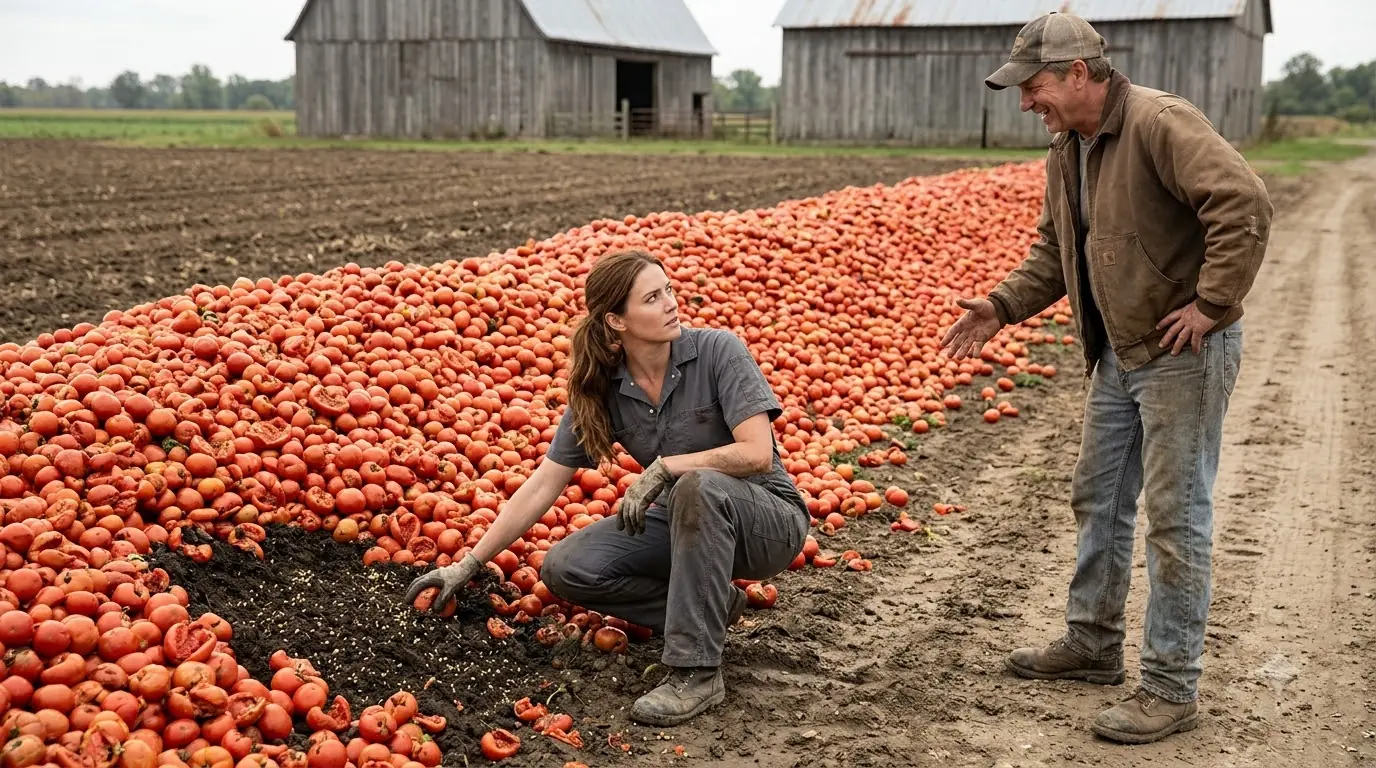
Her western field was red.
Not planted.
Not harvested.
Red.
An enormous pile of tomatoes covered the lower half of the field beside the access road.
Tens of thousands of them.
Maybe hundreds of thousands.
Soft.
Split.
Crushed beneath their own weight.
Bright red in places.
Dark burgundy in others.
Orange near the edges.
Some already collapsing into pulp.
The mound began twenty yards from the barn and stretched almost to the drainage swale.
Maggie shut off the engine.
Silence.
Then flies.
She could hear them even from the truck.
She opened the door.
Stepped out.
Mud pressed beneath her boots.
Her gray work coveralls were already dusty from repairing an irrigation pump that morning.
She walked toward the pile slowly.
One tomato rolled down the side.
Stopped near her boot.
Maggie stared at it.
Then toward the tire tracks cut deeply into her field.
Heavy trucks.
Multiple trips.
Maybe five.
Maybe six.
She followed the tracks back toward the gate.
Chain cut.
Not opened.
Cut.
Maggie's jaw tightened.
Behind her, an engine approached.
She turned.
A brown pickup rolled down the lane.
Calvin Rourke.
Of course.
He stopped twenty feet away.
Did not even bother pretending surprise.
At fifty-five, Calvin had spent thirty years buying produce across three counties.
Tomatoes.
Sweet corn.
Peppers.
Pumpkins.
Anything farmers needed moved quickly.
He owned Rourke Produce Logistics, two packing sheds, six refrigerated trucks, and enough storage capacity to make small growers dependent on him when markets tightened.
He also wanted Maggie's farm.
Especially the western eighty acres.
The soil was tired.
Drainage mediocre.
But the land sat beside the state highway and close to the processing corridor Calvin intended to expand.
He had offered Maggie $4,100 an acre.
She laughed.
He raised it to $4,500.
She refused.
Then $4,800.
Still no.
Calvin had stopped smiling after that.
Now he climbed out of the pickup wearing a brown work jacket and dirty cap.
He looked at the mountain of tomatoes.
Then at Maggie.
“Well.”
Maggie said nothing.
Calvin spread one hand.
“Looks like somebody had a delivery.”
Maggie stared.
“Cut my chain.”
His smile widened.
“Did I?”
“Your trucks left that tread.”
“Lots of companies run the same tires.”
“Your packing shed uses blue trailer mud flaps.”
Calvin looked toward the track.
One broken blue piece lay near the gate.
His smile weakened.
Maggie folded her arms.
“You're not very good at crimes.”
Calvin laughed.
“Crime?”
He pointed toward the tomatoes.
“That's produce.”
“On my land.”
“Maybe somebody thought you needed fertilizer.”
Maggie looked toward the enormous pile.
“Seventy tons?”
“Could be more.”
“Did you weigh it?”
Calvin shrugged.
Maggie's eyes narrowed.
There.
Too comfortable.
Too much information.
She took out her phone.
Calvin noticed.
“What are you doing?”
“Recording.”
His expression changed.
Slightly.
Then he recovered.
“Record whatever you want.”
Maggie held the phone low.
“You dumped this.”
“I didn't say that.”
“You knew approximately how much was here.”
“I can estimate.”
“You told me two weeks ago I'd regret refusing your offer.”
“People say things.”
“You also said my western ground would be worthless by spring.”
Calvin smiled again.
“Maybe I was right.”
Maggie looked toward the tomatoes.
“What exactly do you think this does?”
He laughed.
“You seriously don't know?”
“Tell me.”
Calvin stepped closer.
“Kills planting time.”
“Brings flies.”
“Rodents.”
“Disease.”
“Fermentation.”
“You till that mess under wrong and you'll spend next year fighting volunteer tomatoes and rot.”
He kicked one soft fruit toward her.
“And if the county decides it's waste instead of crop residue, congratulations.”
“Cleanup could cost more than that field makes in three seasons.”
Maggie looked down.
Then at him.
“So that's the plan.”
“What plan?”
“Make the land expensive enough that I sell.”
Calvin tilted his head.
“Or maybe somebody just dumped tomatoes.”
Maggie's expression hardened.
“You really think I'm selling to you after this?”
Calvin stepped back toward his truck.
“I think by February you're going to understand what tired ground is worth.”
Maggie followed him with her eyes.
He opened the driver's door.
Then paused.
“Oh.”
“What?”
“Don't wait too long.”
He pointed toward the mound.
“Heat builds fast when produce starts breaking down.”
Maggie said:
“You seem very familiar with it.”
Calvin froze for half a second.
Then climbed into the truck.
“Everybody in produce is.”
He drove away.
Maggie watched until the pickup disappeared beyond the barns.
Then she looked at the tomatoes.
A weaker person might have cried.
A louder person might have called Calvin back and started screaming.
Maggie did neither.
She walked toward the pile.
Because something he had said bothered her.
Heat.
She crouched near the edge.
Pushed aside several tomatoes with her glove.
The top layer was cool.
She dug deeper.
Warm.
Very warm.
Not surprising.
Decomposition.
But beneath the collapsing fruit, the soil looked different.
Dark.
Almost black.
Maggie rubbed some between her fingers.
Her western field was naturally pale brown silt loam.
Organic matter had fallen below two percent in the latest test.
This soil looked like garden soil.
Loose.
Moist.
Crumbly.
Then she saw green.
Tiny.
Barely an inch tall.
She leaned closer.
Seedlings.
Dozens.
No.
Hundreds.
Small cotyledons pushing upward beneath the edge of the oldest fruit.
Tomato volunteers.
Probably.
Calvin had been right about that part.
But Maggie did not feel disappointed.
She stared at the soil again.
Then pushed deeper.
Earthworms.
A surprising number.
The western field rarely had that many near the surface during dry autumn weather.
Maggie sat back on one heel.
The tomatoes had been there longer than she realized.
At least one section had.
That meant the dumping occurred in stages.
Maybe beginning days ago.
She took photographs.
Then called someone.
“Lena.”
A woman's voice answered:
“You sound angry.”
“I am.”
“Machine break?”
“No.”
“Cow?”
“Don't have cows.”
“I know.”
“Neighbor?”
“Closer.”
“What happened?”
Maggie looked at the red mountain.
“Somebody dumped an industrial amount of rotten tomatoes in my field.”
Silence.
Then:
“How industrial?”
“I’m guessing sixty to eighty tons.”
Another silence.
“Maggie.”
“Yes.”
“Don't touch anything else.”
“I already touched it.”
“Of course you did.”
“Call the sheriff.”
“I will.”
“Call county environmental.”
“I will.”
“And don't till it.”
“I wasn't planning to.”
Dr. Lena Ortiz worked for Purdue Extension in the county.
Soil specialist.
Thirty-seven.
Brilliant.
Impatient.
The type of person who carried nitrile gloves in her truck and considered soil test reports recreational reading.
She arrived forty minutes later.
One look at the pile.
Then:
“Wow.”
Maggie stood beside her.
“Scientific assessment?”
“Working on it.”
Lena pulled on gloves.
They walked the perimeter.
She took temperature readings.
Top:
58 degrees Fahrenheit.
Six inches down:
Near the oldest section:
Lena raised her eyebrows.
“Active.”
“Dangerous?”
“Not automatically.”
“Useful?”
“Maybe.”
Maggie looked at her.
“Maybe sounds expensive.”
Lena laughed.
“Farm science usually does.”
They sampled liquid near the bottom.
pH.
Organic matter.
Salts.
Potential contamination.
Because the tomatoes came from unknown processing sources, they needed to know whether cleaning chemicals, oils, plastic, or foreign material were mixed in.