The cardboard box in Ethan Hale’s arms looked almost empty.
A chipped travel mug.
A phone charger.
A small blue folder.
And a crayon drawing his daughter had made of two stick figures standing beside a tall glass building, with the words “Daddy’s new job” written crookedly across the top.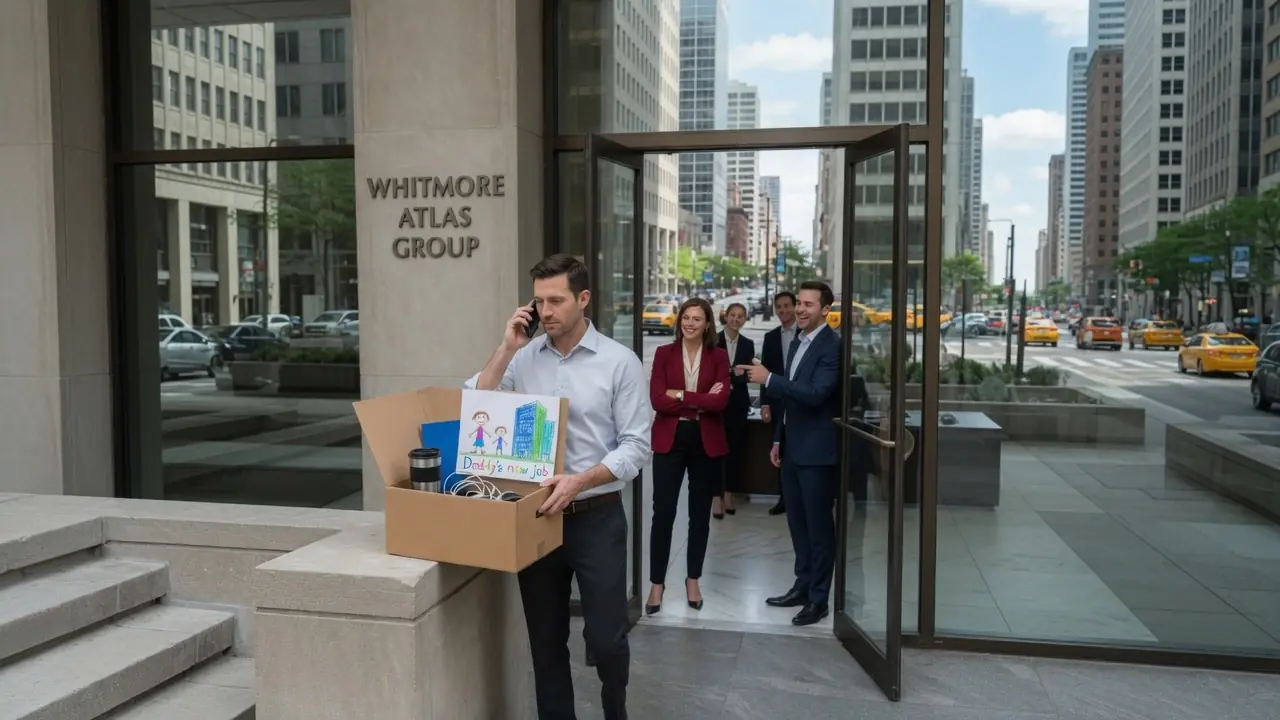
He carried the box through the lobby of Whitmore Atlas Group while people laughed behind him.
Not loud enough for security to step in.
Just loud enough for him to hear.
That was how cowards laughed in offices.
Sharp.
Safe.
Protected by glass walls, job titles, and the belief that the person leaving had no power left.
Monica Tressler stood near the entrance to the operations floor with her arms folded, watching him go. She wore a red blazer, a gold watch, and the satisfied little smile of someone who had just removed an inconvenience from her day. Beside her, Colin Price leaned against a desk and whispered something that made two analysts turn away to hide their grins.
Ethan did not look back.
He reached the front steps, set the cardboard box on the stone railing, and pulled out his phone.
Outside, traffic moved through downtown Chicago like nothing important had happened.
Inside, the building thought it had won.
Ethan tapped one contact.
When the line connected, his voice was calm enough to sound almost bored.
“Start the hold. Pull every record from the seventeenth floor. And when the board is ready, remove every person who touched this.”
He paused.
Then added, “All of them.”
By sunset, the floor that had laughed at him would be empty.
But that morning, no one at Whitmore Atlas knew who Ethan Hale really was.
That had been the point from the beginning.
Ethan had returned to the United States six weeks earlier with one suitcase, a seven-year-old daughter named Lucy, and a grief he had learned to carry quietly because children listen even when you think they are asleep.
His wife, Claire, had died two years earlier after a sudden aneurysm at thirty-four.
There had been no long goodbye.
No warning.
One normal Tuesday morning, she was packing Lucy’s lunch and reminding Ethan to buy dishwasher soap.
By dinner, he was standing in a hospital hallway with a doctor speaking softly and a little girl asking why Mommy was not coming home.
After that, Ethan became the kind of father who packed lunches at midnight and answered emails at 4:00 in the morning.
He learned hair ribbons badly, then better.
He learned which cereal Lucy would eat only on Thursdays.
He learned that grief in a child does not always look like crying. Sometimes it looks like a missing sock, a bad dream, a drawing folded too carefully, or a question asked from the back seat when traffic is already hard enough.
For almost two years, Ethan kept working overseas as an operational turnaround consultant because the work was familiar and distance made certain rooms hurt less.
Then his uncle called.
Arthur Whitmore had built Whitmore Atlas Group from a freight brokerage company into a private logistics and infrastructure giant with offices in twelve states and contracts that touched ports, warehouses, hospitals, rail lines, and retail chains across the country.
Arthur was seventy-two now.
Still sharp.
Still frighteningly precise.
But he was tired in the way founders get tired when they realize the company outgrew the culture that created it.
Ethan was not his son, but he was the closest thing to one.
Arthur had raised him after Ethan’s parents died in a car accident when he was fifteen. He paid for school, taught him balance sheets, sent him to warehouse floors before boardrooms, and told him the same thing every summer.
“Never trust a company from the top floor only. The lies get filtered before they reach the carpet.”
Now Arthur wanted to step down.
The board already knew Ethan was the successor.
The public did not.
Most employees did not.
Ethan made one request before the formal transition.
“I want a regular badge,” he told Arthur. “No executive access. No announcement. Put me where the pressure shows.”
Arthur looked at him for a long time.
Then nodded.
“The seventeenth floor.”
That was where the regional operations group worked.
Vendor compliance.
Internal reporting.
Data coordination.
Process controls.
The kind of department no magazine ever wrote about, but every major failure passed through before it became expensive enough for executives to notice.
Ethan started on a Monday morning under the title of temporary operations associate.
He wore plain shirts, dark slacks, and the same scuffed leather messenger bag he had used for years. His badge said Ethan Hale, Operations Support. No one knew the Hale family had once used Whitmore as a middle name. No one connected him to Arthur.
That was useful.
People behave honestly around those they believe do not matter.
His manager was Monica Tressler.
She was forty-six, polished, sharp, and exhausting in the way some office people become after learning that fear is faster than leadership. Monica had run the seventeenth floor for five years. She knew which executives to flatter, which reports to beautify, which mistakes to bury, and which employees could be leaned on without consequence.
Her circle was small but powerful.
Colin Price, senior analyst, loud enough to dominate meetings and careless enough to reveal what he thought of people before lunch.
Jenna Vale, documentation lead, quiet and dangerous, the kind who never raised her voice because she preferred leaving fingerprints on other people’s files.
And Aaron Bell, team coordinator, who smiled at whoever held power and treated everyone below him like weather.
On Ethan’s first day, Monica looked him over once.
Not rudely.
Worse.
Briefly.
“Temporary support?” she asked.
“Yes.”
“Fine. Sit near the printer. Jenna will send you overflow.”
That was his welcome.
He sat near the printer.
The desk wobbled if he leaned too far left. The chair had one armrest lower than the other. The monitor flickered blue every twenty minutes. Somebody had left a sticky note under the keyboard that said, “Don’t trust the shared drive.”
Ethan read it twice.
Then got to work.
By the end of the first day, he had cleaned up a vendor reconciliation file that had been passed between three people for a week. By the end of the second, he had corrected duplicate entries in a compliance tracker that had been causing late alerts across two departments. By Friday, he had finished three assignments Colin had claimed were “waiting on source data.”
The source data had been there the entire time.
Just badly labeled.
On Monday, Monica praised Colin in the morning meeting for “finally getting the vendor issue under control.”
Colin leaned back and said, “Just needed a weekend push.”
Ethan sat two chairs away and said nothing.
He had done the weekend push from his kitchen table while Lucy colored beside him and asked if grown-up homework was always boring.
He had told her yes.
She had drawn him a picture to make it less boring.
That picture was now in his desk drawer.
The pattern became clear by the second week.
Work Ethan completed became someone else’s achievement.
Mistakes made by Monica’s circle drifted toward Ethan’s desk like paper caught in bad air.
If a file was late, someone forgot to tag him on the original email.
If data was wrong, he had been given the old version.
If a meeting went badly, Monica would say, “Ethan was supposed to confirm that,” in a tone that made everyone accept it before asking whether it was true.
He watched.
He documented.
He did not react.
That confused them at first.
Then it irritated them.
Colin tried jokes.
“Careful giving Ethan too much. Temp guys get overwhelmed when Excel has more than three tabs.”
Aaron laughed.
Jenna smiled without looking up.
Ethan kept typing.
Monica tried harder things.
She gave him assignments at 4:55 p.m. that were due by 8:00 the next morning. She asked questions in meetings that were not designed to get answers, but to make him look unprepared. She told him to “circle back” on tasks she had never given him, then acted disappointed when he asked for clarification.
None of it was dramatic enough to report.
That was the brilliance of it.
Cruel offices rarely announce themselves with one terrible act.
They survive through small humiliations repeated often enough that everyone learns the room’s rules.
On his tenth day, Ethan saw the same thing happen to someone else.
Her name was Priya Nandakumar.
She was thirty-two, a compliance specialist, and the best person on the floor at catching vendor risk before it became legal exposure. Ethan knew this because her work was clean, her notes were precise, and her questions made weak reports better.
Monica publicly corrected her over a missing signature in a packet that Aaron had delayed sending.
Priya tried to explain.
Monica cut her off.
“I need ownership, not excuses.”
The floor went still.
Priya’s face did not change, but her hands did.
They folded too tightly in her lap.
That was what stayed with Ethan.
Not Monica’s tone.
Priya’s hands.
The practiced control of someone who had learned that defending herself would only become another item in her file.
That night, Lucy asked him if his new job was nice.
They were eating grilled cheese at the kitchen island because Ethan had forgotten to run the dishwasher again.
He looked at his daughter, at the gap where her front tooth had finally fallen out, at the purple marker on her fingers, at the child who still sometimes slept with Claire’s blue scarf tucked under her pillow.
“Not always,” he said.
Lucy frowned.
“Then why do you go?”
“To see what needs fixing.”
“Can you fix people being mean?”
He almost said no.
Then he thought of Arthur, the company, the seventeenth floor, Priya’s hands, and the drawing in his desk drawer.
“I can try,” he said.
Lucy considered that with the seriousness of a child who believed trying should count for something.
“Mom said trying counts if you keep doing it.”
Ethan swallowed.
“She was right.”
The setup came in his third week.
Monica assigned him to build a tracking framework for a confidential supplier audit involving several hospital distribution contracts. It was sensitive work, more advanced than anything she had given him before. She acted as if it were a test of his competence.
Ethan knew it was something else.
He built the framework carefully.
Every permission level.
Every source path.
Every timestamp.
Every audit log.
He left enough access for Monica, Colin, and Jenna to continue their assigned portions, but he kept his own parallel notes because he had spent too many years fixing broken systems to trust the surface of any one.
On Wednesday evening, he left the office at 6:40 to pick up Lucy from after-school care.
At 7:15, while standing in line at a grocery store with apples, milk, and dinosaur-shaped chicken nuggets, his phone buzzed with a login alert.
His credentials had accessed the audit framework from a device he did not recognize.
He stared at the notification.
Then he bought the groceries.
At home, he made dinner, helped Lucy with spelling words, read two chapters of a book about a cat detective, and waited until she fell asleep before opening his laptop.
He did not stop the access.
Not yet.
He preserved it.
Screenshots.
Metadata.
Time stamps.
Remote session logs.
Device ID.
Internal routing path.
Then he forwarded the encrypted packet to a private account and went to bed at 1:18 in the morning.
By 9:05 the next day, HR called him into Monica’s office.
The blinds were drawn.
That was new.
Monica sat behind her desk, composed and pale in a way that told Ethan she had rehearsed this. Colin stood by the window, arms folded. Jenna sat in the corner with a legal pad she did not write on. An HR manager named Linda Farrow had a folder open in front of her.
“Ethan,” Linda said, using the gentle tone HR people use when the decision has already been made elsewhere, “we need to discuss a serious security incident.”
He sat down.
“Of course.”
Linda explained that confidential supplier files had been accessed and exported using Ethan’s credentials. The event represented a serious breach of data security. Given the sensitivity of the contracts involved, the company had no choice but to terminate him immediately.
Ethan asked to see the logs.
Linda glanced at Monica.
Monica said, “Legal is holding the documentation.”
Ethan nodded.
“Was my device ID matched?”
Colin shifted slightly.
Linda blinked.
“I’m not sure.”
“Was there a forensic review before termination?”
Monica leaned forward.
“Ethan, this is not a negotiation.”
“I didn’t say it was.”
Linda pushed a one-page termination notice across the desk.
“If you sign here, it acknowledges receipt. Not agreement.”
Ethan read the page.
It was sloppy.
Too broad in some places.
Too specific in others.
A document built by people who expected fear to do most of the legal work.
He signed.
Linda looked relieved.
Monica almost smiled.
Security did not escort him because Monica wanted him to walk out under his own power. That was part of the performance. A man escorted out can look important. A man carrying his own little box looks finished.
So Ethan went back to his desk.
He opened the drawer.
Took the travel mug.
The charger.
A single folder.
And Lucy’s drawing.
Priya did not look at him at first.
Then she did.
Her eyes were full of something like apology, though she had done nothing wrong.
Ethan gave her a small nod.
Not reassurance exactly.
A promise.
Then he walked out.
Colin said something behind him.
A few people laughed.
Monica let them.
Ethan carried the box down the elevator, across the lobby, and through the front doors into late morning light.
Outside, the city air felt cleaner than the office had.
He set the box down.
Pulled out his phone.
And made the call.
The first person he called was not Arthur.
It was Marisol Grant, general counsel of Whitmore Atlas Group.
She answered on the second ring.
“Yes?”
“Marisol, this is Ethan.”
A pause.
“How bad?”
“Bad enough. Legal hold on the seventeenth floor. Four years. Email, chat, access logs, reviews, HR complaints, project attribution, device records. Lock it before anyone cleans house.”
“Understood.”
“I want the board convened within the hour. No announcement of my identity yet.”
“Arthur?”
“Inform him after the hold is active.”
Another pause.
“Ethan, what happened?”
“They fired me.”
Marisol exhaled once.
Quietly.
Dangerously.
“On what grounds?”
“Fabricated data breach.”
This time, the pause was longer.
Then she said, “I’ll start the hold now.”
“Good.”
Ethan looked up at the building.
“And Marisol?”
“Yes?”
“Remove every person tied to it. Not quietly. Not vaguely. With evidence.”
He ended the call.
Then he picked up the box and walked to the parking garage.
He did not go home immediately.
He sat in his car with the engine off, Lucy’s drawing resting on top of the box. The stick-figure version of him had long legs, square glasses he did not wear, and a smile bigger than his head. The building in the drawing had sunshine coming out of every window.
Children draw the world the way it should work.
Not the way it does.
At 12:40, Ethan returned to Whitmore Atlas through the executive entrance.
This time, he used the private elevator.
His badge, the ordinary one HR had issued him, no longer worked.
The executive code did.
He rode to the thirty-sixth floor, where the boardroom faced the river and the city looked expensive enough to lie to itself.
Arthur Whitmore stood at the head of the table when Ethan entered.
He looked old that day.
Older than Ethan liked.
But his eyes were sharp, and his jaw had the set of a man who had built a company with his hands and just learned part of it had grown teeth against its own people.
Marisol was there already with two attorneys from her team. Three board members appeared on the wall screen. Linda Farrow from HR sat near the far end, her folder closed now, her face pale.
She had delivered the termination.
Now she understood she had delivered it to the next chairman.
Arthur looked at Ethan.
“Tell me.”
So Ethan did.
No theatrics.
No anger.
No wounded speech.
He walked them through the three weeks.
Credit stolen.
Errors shifted.
Deadlines weaponized.
Public humiliation.
Priya.
The assignment.
The access alert.
The device mismatch.
The termination meeting.
He showed them the packet he had preserved the night before.
Marisol’s forensic team worked while he spoke.
Within thirty minutes, the first confirmation came in.
The data export had been triggered with Ethan’s credentials but from a workstation assigned to Colin Price. The credential capture appeared to come through an internal permissions request Jenna had processed. Monica had signed off on the termination recommendation before any completed forensic review.
Linda Farrow put one hand over her mouth.
Arthur did not move.
That frightened people more than shouting would have.
On the screen, a board member asked, “How far back does this go?”
Marisol answered.
“We are pulling records now. Early indicators suggest the misconduct may extend beyond this incident.”
Ethan looked at Arthur.
“I want the company-wide announcement today.”
Arthur nodded.
“You should make it.”
“No.”
The room went quiet.
Ethan continued.
“You introduce the leadership transition. I will stand where everyone can see the person they fired this morning. Then Marisol presents the investigation.”
Arthur studied him.
“You don’t want revenge.”
“No.”
“What do you want?”
Ethan thought of Priya’s hands again.
“I want them to know the truth reached the top.”
At 4:00 p.m., every employee in the headquarters gathered in the main atrium.
The space was built for announcements, with a marble floor, indoor trees, a curved staircase, and a raised platform that usually held ribbon-cutting speeches and holiday charity drives. That afternoon, it held a silence that spread before anything was said.
People knew something had happened.
They just did not know what.
The seventeenth floor arrived together, because office tribes move that way when they are nervous.
Monica stood near the front with Colin and Jenna beside her. Aaron lingered half a step behind them. Priya stood farther back, close to a column, arms folded tightly against her chest.
At 4:02, Arthur Whitmore walked onto the platform.
The room quieted instantly.
Arthur thanked the employees for their work, but his voice carried none of the usual warmth of ceremony. He said that leadership transitions reveal not only who will lead next, but what kind of company is worthy of being led. He said Whitmore Atlas had been built on trust, and that trust had been damaged.
Then he looked toward the side corridor.
“My successor has spent the past three weeks working among you without title, protection, or privilege.”
A murmur moved through the room.
Arthur continued.
“He asked for that because he believed the truth of a company is clearest where people think power is not watching.”
Monica’s face changed.
Slowly at first.
Then all at once.
Arthur said, “Please welcome Ethan Hale, incoming chairman of Whitmore Atlas Group.”
Ethan walked onto the platform wearing the same clothes he had been fired in that morning.
No suit.
No tie.
No polished transformation.
Just the man they had watched carry a cardboard box through the lobby.
The atrium went silent in a way Ethan had never heard a corporate room go silent.
Hundreds of employees seemed to stop breathing at the same time.
Colin’s mouth opened slightly.
Jenna looked down.
Aaron stepped backward.
Monica stared at Ethan like reality had become personally offensive.
Ethan stood beside Arthur and looked across the room.
He did not smile.
“My name is Ethan Hale,” he said. “Some of you met me as a temporary operations associate on the seventeenth floor.”
A few people shifted.
“I requested that placement. I wanted to understand this company without introductions, titles, or filtered reports.”
He paused.
“This morning, I was terminated for a data breach I did not commit.”
The silence hardened.
Marisol stepped forward.
She explained the legal hold, the forensic review, and the preliminary findings. She did not name every detail, but she named enough. A fabricated breach. Misuse of credentials. Retaliatory termination. Broader records under review. Immediate administrative suspension for multiple employees pending final action.
No one laughed now.
No one whispered loudly enough to be heard.
Ethan looked toward the seventeenth floor group.
His eyes found Priya for a moment.
Then moved on.
“This is not about me being fired,” he said. “If this had only happened to me, it would still matter. But it did not only happen to me.”
The room changed again.
People understood then that this was not going to be a neat executive reveal.
It was going to be an excavation.
“For years,” Ethan continued, “people in this company have been taught to stay quiet because speaking up was more dangerous than being mistreated. That ends today.”
Monica turned and walked toward the side exit.
Two legal staff members were already there.
She stopped.
The room noticed.
Ethan did not look at her again.
By 6:00 p.m., Monica Tressler, Colin Price, Jenna Vale, Aaron Bell, and three additional employees tied to the scheme had been suspended pending termination.
By the next morning, the terminations were formal.
Not vague.
Not “culture fit.”
Not “organizational restructuring.”
Each notice cited specific conduct.
Credential misuse.
Document manipulation.
Retaliatory reporting.
Misattribution of work.
Suppression of complaints.
Creation of a hostile internal environment.
Ethan insisted on that.
People deserved to know what they were being held accountable for.
And the people who had been harmed deserved to see the company name the harm plainly.
The full audit took longer.
It always does, if it is real.
Records showed four years of manipulated performance reviews. Promotions redirected away from employees who had complained. Credit rerouted through Monica’s circle. Informal HR reports marked resolved without interviews. Transfers used like quiet removals. Settlements treated as closed doors instead of warning signs.
Priya’s file was one of the worst.
Three years of strong project results.
Three years of lowered evaluation language.
“Needs stronger executive presence.”
“Can be defensive when challenged.”
“Technically strong but not leadership-ready.”
Ethan read the comments twice.
Then he read the meeting transcripts and saw what they meant.
She had asked questions Monica did not like.
That was all.
He called Priya into a conference room on Monday.
She arrived with a notebook and the guarded expression of someone who had been invited to too many meetings that turned into traps.
Ethan stood when she entered.
“Thank you for coming.”
She nodded.
“Of course.”
He did not ask her to sit first like a manager performing comfort.
He simply sat, letting the choice become normal.
She sat across from him.
“I reviewed your file,” he said.
Her face tightened.
“I assumed so.”
“It was wrong.”
She looked up.
He continued.
“Your work was strong. Your questions were appropriate. Your evaluation record was altered by people who wanted compliance, not leadership.”
Priya stared at him.
For a second, she looked more frightened by being believed than she had by being blamed.
“What happens now?” she asked.
“An independent panel will review your promotion history. But I don’t need a panel to tell me the operations compliance team needs someone who understands risk and has the courage to name it.”
She said nothing.
Ethan slid a folder across the table.
“I’d like you to serve as interim director of regional compliance while the review is completed.”
Her hand did not move toward the folder.
“Why me?”
“Because you kept doing the work even when the system punished you for it.”
Priya looked down.
When she spoke, her voice was quiet.
“I almost left.”
“I know.”
“I had the resignation letter written.”
“I’m glad you didn’t send it.”
She looked back at him then.
“So am I.”
That was the first repair.
Not the last.
Ethan spent the next month closer to the middle floors than the executive suite.
He walked departments without entourage.
He sat in meetings where nobody knew what to do with him at first.
He opened a reporting channel that went directly to legal and to an independent outside reviewer. He removed performance review authority from managers whose teams showed retaliation patterns. He reopened promotion decisions tied to the seventeenth floor. He contacted former employees who had left after complaints and offered review, apology, and restitution without asking them to sign silence in return.
Some accepted.
Some did not.
One former analyst told him, “I don’t want your money. I want you to understand I loved that job until they made me feel stupid for caring.”
Ethan told her he understood.
Then he wrote that sentence down and kept it in his desk.
Not because it made him feel noble.
Because it made him feel responsible.
Linda Farrow remained under review.
She had not created the culture, but she had failed to interrupt it. That distinction mattered, though not enough to excuse her. Ethan met with her once, after the outside review found negligence but not deliberate collusion.
Linda cried.
Ethan did not comfort her too quickly.
“I thought I was following process,” she said.
“You were,” Ethan replied. “That was part of the problem.”
She stayed at the company under a formal corrective plan and lost authority over complaint routing until new systems were built.
Some employees thought that was too lenient.
Others thought it was too harsh.
That was usually how Ethan knew he was close to the harder truth.
Justice was not the same thing as satisfaction.
At home, Lucy noticed he was tired.
Children always notice.
One night, she climbed onto the couch beside him with a blanket and asked, “Did you fix the mean people?”
Ethan looked at the cartoon playing on the television.
“Some of them.”
“Only some?”
“The rest is fixing the place that let them be mean.”
She frowned.
“That sounds harder.”
“It is.”
“Can you do it?”
He looked at her.
At Claire’s eyes in her face.
At the child who had drawn sunshine coming out of a building where grown people had hidden cruelty behind email chains and performance metrics.
“I can keep trying.”
Lucy nodded.
“Mom said that counts.”
Ethan smiled.
“She did.”
Two weeks after the firing, Ethan brought the cardboard box to the thirty-sixth floor.
He had left it in his car because some part of him had not wanted to look at it.
Now he set it on the corner of his new desk.
The office was too large.
The view was too clean.
The chair cost more than his first car.
He unpacked the box slowly.
The travel mug went beside the coffee machine.
The charger went into the outlet near the couch.
The blue folder went into a drawer.
Lucy’s drawing went in a frame on the desk.
Arthur visited that afternoon.
He stood in the doorway and looked at the picture.
“Good building,” he said.
“Too much sun.”
Arthur smiled.
“She sees better than we do.”
Ethan leaned back in the chair.
“Did you know it was this bad?”
Arthur did not answer quickly.
That was one thing Ethan respected about him.
The old man did not rush past guilt.
“I knew something was off,” Arthur said. “I told myself every large company has pockets of dysfunction.”
“And?”
“And that was a comfortable sentence for an old man who no longer wanted to walk every floor.”
Ethan looked out at the city.
Arthur stepped inside.
“You did the right thing.”
“I did the necessary thing.”
“Sometimes that is all the right thing is.”
The company changed slowly.
Not cleanly.
Not perfectly.
People tested the new rules.
Some tried to perform honesty because honesty had suddenly become useful. Some managers sent long emails about values and culture and “listening deeply” after years of doing neither. Some employees stayed skeptical, which Ethan did not resent.
Trust, once broken, does not return because leadership announces it.
It returns when consequences become predictable and protection becomes real.
Three months later, Priya presented the revised compliance structure to the board.
She was nervous at first.
Then she found her rhythm.
Her slides were clear, her reasoning sharp, and her recommendations blunt enough to make one board member shift in his chair. Ethan watched from the end of the table and said almost nothing because she did not need rescuing.
Afterward, Arthur stopped her near the door.
“I wish we had promoted you sooner.”
Priya looked at Ethan, then back at Arthur.
“So do I.”
Arthur accepted that.
He had earned it.
The seventeenth floor was rebuilt with different leadership, but Ethan refused to rename it or pretend the past could be erased by new furniture.
Instead, he had the team keep one wall open for process notes, anonymous concerns, and improvement ideas. Not a pretty culture wall with slogans. A working wall. Messy. Useful. Sometimes uncomfortable.
On the first day it went up, someone pinned a note that read:
“Don’t make people choose between honesty and rent.”
Ethan stood in front of it for a long time.
Then he wrote it down too.
A year later, Whitmore Atlas held its annual company meeting in the same atrium where Ethan’s identity had been revealed.
This time, he stood on the platform in a suit because Lucy said chairmen probably had to wear “serious pants.” Arthur sat in the front row, retired but not absent, hands folded over a cane he refused to admit he needed.
Priya sat with the senior leadership team.
Linda sat three rows back, no longer HR director, but still employed in a role built around process training and documentation safeguards.
Some people thought she should have left.
Ethan had decided that accountability without the possibility of changed behavior was just another form of disposal.
When Ethan spoke, he did not mention Monica, Colin, Jenna, or the firing.
He did not need to.
Everyone in the room remembered.
Instead, he talked about what kind of company they were still becoming.
He talked about trust as infrastructure.
Invisible when it works.
Catastrophic when it fails.
He talked about power as something that should make a room safer, not smaller.
Then he looked toward the middle of the atrium, where many of the operations employees stood.
“I learned this company from a desk near a printer that jammed twice a day,” he said.
A small laugh moved through the crowd.
“I learned that the people closest to the work often understand the company better than the people closest to the windows.”
Arthur smiled.
Ethan continued.
“I also learned that cruelty can become a process if enough people mistake silence for professionalism.”
The room grew quiet.
“So this year, we are not celebrating a perfect culture. We do not have one. We are celebrating the work of telling the truth faster, protecting it better, and making sure no employee has to become invisible in order to survive here.”
When the meeting ended, Ethan stepped off the platform and found Lucy waiting near the side aisle with his sister, who had brought her after school.
Lucy wore a yellow backpack and held a folded paper.
“Is it over?” she asked.
“For now.”
“Did you say the thing?”
“What thing?”
“That people shouldn’t be mean at work.”
“In more complicated words.”
She nodded like that sounded inefficient.
Then she handed him the paper.
It was another drawing.
This time, the building had fewer sunbeams coming out of the windows, but more people standing near the front doors. Some wore suits. Some carried boxes. One small figure with curly hair stood beside a taller figure at the bottom of the steps.
Above the picture, Lucy had written:
Daddy fixed the building a little.
Ethan looked at it longer than he meant to.
Then he folded it carefully and placed it inside his jacket pocket.
That evening, after the building emptied, he walked alone to the seventeenth floor.
The lights were softer now. The old printer was gone. The desk where he had sat had been replaced, but he still knew exactly where it had been. Near the corner. Bad chair. Flickering monitor. Sticky note under the keyboard.
Priya found him there.
“You okay?”
He nodded.
“Just remembering.”
She leaned against a nearby desk.
“Hard to forget.”
“No,” he said. “I don’t want to forget.”
She understood.
For a while, they stood in silence.
Not the silence of fear.
Not the silence of people watching someone carry a box away.
A different silence.
One that had room in it.
The kind a healthy workplace allows because no one is using it as a weapon.
When Ethan finally left the floor, he did not take the executive elevator.
He took the regular one down to the lobby and walked out through the front doors.
The same doors.
The same steps.
The same city moving beyond the glass.
A year earlier, he had stood there with a cardboard box in his arms and laughter at his back. He had made one call, and people later thought that was the powerful part of the story.
It was not.
Power was easy once he had it.
The harder part came after.
The harder part was deciding that the call was not about revenge.
It was about repair.
It was about Priya’s hands folded too tightly in her lap.
It was about former employees who deserved to know they had not imagined what happened to them.
It was about his daughter asking whether mean people could be fixed.
It was about understanding that a leader is not measured by how dramatically he reveals who he is, but by what changes after everyone knows.
Ethan stood on the front steps for a moment, watching office lights blink on across the city.
Then his phone buzzed.
A text from Lucy.
Don’t forget chicken nuggets. The dinosaur ones.
He smiled.
The next chairman of Whitmore Atlas Group walked to his car, stopped at the grocery store on the way home, and bought two bags.
Because power could wait.
Dinner could not.
And somewhere behind him, inside a building that had once laughed while he carried a box out the door, people were still working.
But now, at least, they were learning to work without fear.
That was not the end of the story.
It was the beginning of the part that mattered.