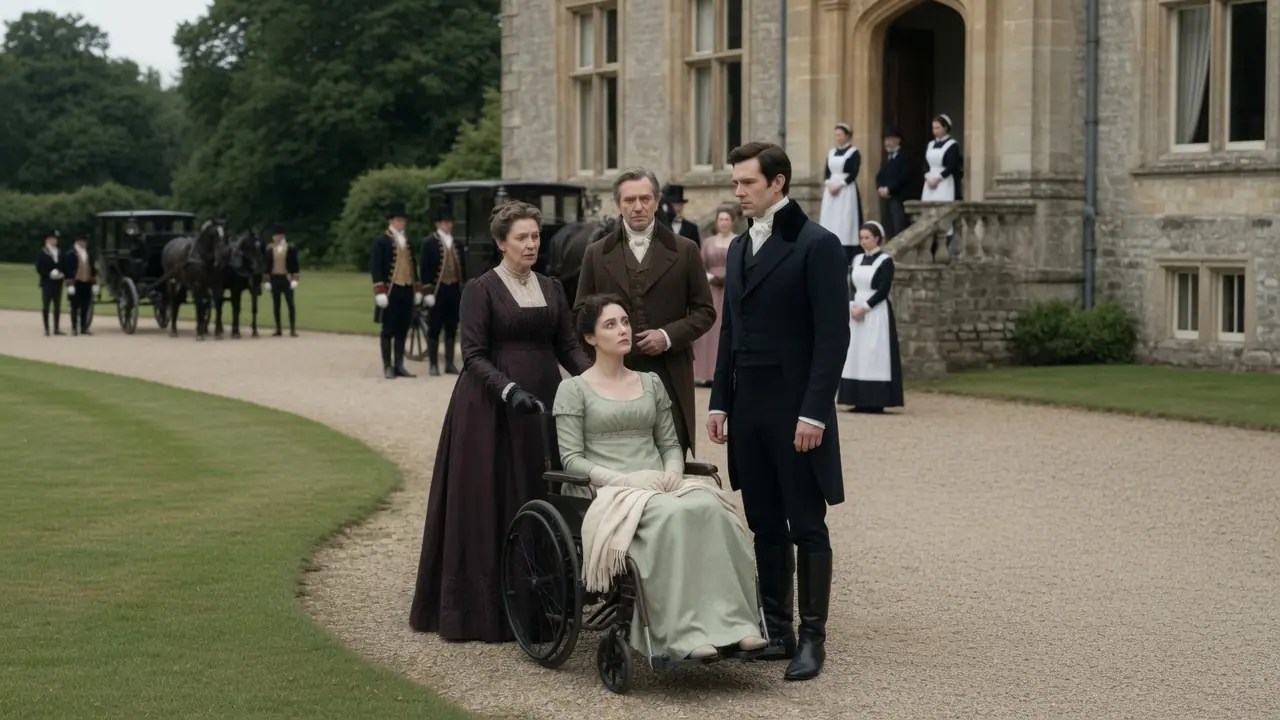
They placed Eleanor Wrenford in the wheelchair before the Duke arrived, though she had walked across her bedroom alone that morning.
Not far. Only twelve steps from the bed to the window and twelve back again, one hand on the carved bedpost, the other pressed against the wall until her palm ached. But she had walked. She had counted every step like a prayer and every breath like a stolen coin.
By noon, her aunt had tightened the straps around Eleanor’s knees until the leather bit through the muslin of her gown.
“You must look convincing,” Lady Maribel said, smoothing the blanket over Eleanor’s lap. “His Grace has agreed to take you as you are, but men are changeable creatures. A single doubt, a single suspicion that we misrepresented your condition, and the arrangement may collapse.”
Eleanor looked down at the blanket. It was blue wool, too heavy for May, chosen not for warmth but to hide the line of her legs.
“I was not aware my condition was being represented honestly.”
Her aunt’s hand stopped.
For a moment, the only sound in the morning room was the rain tapping against the tall windows of Wrenford Park.
Lady Maribel’s smile returned slowly. “Careful, Eleanor. Wit is charming in a ballroom. In a sickroom, it is evidence of agitation.”
That was how it had been for eighteen months.
If Eleanor was quiet, she was resigned. If she objected, she was hysterical. If she wept, she was fragile. If she did not weep, she was cold. Every possible reaction had already been named for her before she could choose it.
And the wheelchair sat in the middle of it all like a verdict.
Her father entered at half past one with a folded paper in one hand and a silver pocket watch in the other. Lord Wrenford had been handsome once, before cards, debt, and vanity hollowed out everything generous in his face. He still dressed beautifully, as if fine tailoring could disguise ruin.
“The Duke is three miles out,” he said. “The groom saw his carriage at the east road.”
Lady Maribel adjusted Eleanor’s shawl. “She is ready.”
Eleanor looked at her father. “Am I?”
His eyes flicked toward her. Not her face. Her chair. Her covered legs. The staged helplessness of her.
“You will be grateful,” he said.
“For what?”
“For salvation.”
Eleanor almost laughed. “Whose?”
His expression hardened.
Before the accident, he would have struck her for that tone. After the accident, he had discovered that pity was more useful than force. A helpless daughter drew sympathy. A helpless heiress drew opportunity. A helpless bride could be sold twice: once for her dowry and once for the mercy of the man who took her.
“The marriage contract is generous,” Lord Wrenford said. “His Grace assumes the eastern mortgages and settles the larger portion of your mother’s trust upon you.”
“Upon me?”
“In legal form, naturally.”
Eleanor knew that voice. She had heard it through closed doors, over candlelit ledgers, beneath the clink of decanters. Legal form meant hidden clauses. Generous settlement meant money moved elsewhere first. Naturally meant fraud.
She had been keeping copies for months.
Not in the desk. Not under the mattress. Not anywhere her aunt would think to search. Eleanor had hidden her pages inside the lining of the old footstool no one used because the embroidery was ugly and one leg was short. Every night, after the house slept, she unpicked three inches of seam, added another folded page, and stitched it back again.
There were seventy-four pages now.
Enough to ruin her father. Enough to expose her aunt. Enough to prove that Eleanor’s mother’s trust had been drained nearly dry while Eleanor had been kept in a chair and called delicate.
A carriage sounded in the drive.
Lady Maribel drew in a breath.
Lord Wrenford turned toward the window.
Eleanor did not move.
The Duke of Blackthorne arrived without fanfare. His carriage was plain black, rain-darkened, the crest so small on the door that a less observant woman would have missed it. Four horses, mud to their knees. No outriders except one groom in a soaked greatcoat. No unnecessary display.
Eleanor noticed that first.
A vain man announced himself before he entered a room. This man did not.
The footman opened the carriage door. A tall man stepped down into the rain.
Adrian Vale, Duke of Blackthorne, was not what Eleanor had expected. Society had made a monster of him long before she had ever seen his face. A cold duke. A widower. A man who had dismissed half his household after his wife’s death and never danced again. A man who smiled so rarely that one lady in Bath had claimed his mouth was incapable of the act.
He was thirty-four, perhaps thirty-five. Broad-shouldered, dark-haired, severe in black. His face was lean and composed, marked by exhaustion rather than age. There was nothing decorative about him. Nothing practiced for admiration.
He looked first at the house.
Then at the rain.
Then at the wheelchair placed too carefully in the center of the morning room window.
Eleanor felt his gaze find her through the glass.
It did not flinch.
That was the second thing she noticed.
Most people looked at the chair first and then arranged their faces around compassion. The Duke looked at her face first. Only after that did his eyes move to the blanket, the straps, the unnatural position in which her aunt had arranged her hands.
Something in his expression changed.
Not visibly enough for her father to notice.
But Eleanor noticed.
She noticed many things. It was one of the reasons her family preferred her still.
The Duke entered the room ten minutes later with rain still on the shoulders of his coat. Lord Wrenford hurried forward with both hands outstretched.
“Your Grace, welcome to Wrenford Park.”
The Duke accepted the greeting with a slight inclination of his head. “Lord Wrenford.”
“My sister, Lady Maribel.”
“Madam.”
“And my daughter, Eleanor.”
The Duke turned.
Lady Maribel moved behind Eleanor’s chair, one hand resting on the handle like ownership.
The Duke crossed the carpet and stopped in front of Eleanor. Not too close. Not far enough to make her feel displayed. He bowed.
“Miss Wrenford.”
“Your Grace.”
His eyes were gray. Not soft. Not warm. But steady.
“Are you cold?” he asked.
The question surprised her enough that she nearly answered honestly.
Lady Maribel answered first. “She is quite comfortable.”
The Duke did not look at Lady Maribel.
Eleanor held his gaze. “Yes. I am cold.”
A pause.
Then the Duke removed his coat.
Her father stiffened. Lady Maribel inhaled sharply. Eleanor sat very still as the Duke stepped behind her chair, lifted the heavy black coat, and laid it over her shoulders with a care that made no performance of itself.
The coat smelled of rain, leather, and cedar.
It was warm from his body.
Eleanor did not close her eyes. She wanted to. She did not.
“There,” he said. “Better?”
“Yes.”
“Good.”
Lord Wrenford laughed lightly. “Very kind, Your Grace. Eleanor has always been rather sensitive to drafts since the accident.”
The Duke looked down at the straps beneath the blanket.
“What accident?”
Lady Maribel’s fingers tightened on the chair.
Eleanor answered before either of them could.
“A fall from the south staircase.”
The Duke looked at her. “A fall?”
“Yes.”
“Were there witnesses?”
Her father’s face went blank.
Lady Maribel smiled. “Surely, Your Grace, that is not relevant to the marriage contract.”
“No,” the Duke said. “It is relevant to the woman.”
Silence.
Eleanor felt something open inside her, not hope exactly. Hope was too unguarded. This was sharper. More alert.
Her father cleared his throat. “The matter was painful. Eleanor remembers little.”
“I remember the stairs,” Eleanor said quietly. “I remember the candle going out. I remember my cousin Lavinia’s perfume.”
Lady Maribel’s hand jerked against the chair.
The Duke’s eyes did not move from Eleanor’s face.
“Do you?”
“Yes.”
Lord Wrenford forced a laugh. “The poor child’s mind often arranges fragments into stories. Dr. Bellamy warned us this would happen.”
“Dr. Bellamy,” the Duke repeated.
“Our family physician.”
“The man who certified that Miss Wrenford cannot walk?”
“Yes.”
The Duke turned slightly. “Where is he?”
“He is not here today.”
“Send for him.”
Lord Wrenford blinked. “I beg your pardon?”
“Send for him.”
Lady Maribel stepped forward. “Your Grace, surely there is no need to delay the agreement. The papers are prepared. The settlements are arranged.”
“I have already signed the London copy,” the Duke said. “The marriage will take place tomorrow morning.”
Eleanor’s heart struck once against her ribs.
Tomorrow.
Her father relaxed too quickly.
“But before I take Miss Wrenford from this house,” the Duke continued, “I want her physician’s notes, the original accident report, and every account relating to her mother’s trust placed in my carriage.”
The room stilled.
Her father’s lips parted.
Lady Maribel’s smile did not quite hold.
“Those matters are private,” she said.
The Duke looked at her then.
“Not anymore.”
For the first time in eighteen months, Eleanor saw her aunt speechless.
The wedding took place the next morning in the family chapel at Wrenford Park.
It rained again.
Of course it rained.
Rain had a talent for attending humiliations.
Eleanor wore ivory silk because Lady Maribel insisted white would be absurd under the circumstances. Her hair was pinned low beneath a veil that had belonged to her mother. The wheelchair was pushed to the front of the chapel and positioned beside the Duke, who stood tall and still in black.
No one asked whether she wished to stand.
The vicar began.
Eleanor listened to her own life being rearranged in words older than anyone in the room. Obey. Honor. Keep. She wondered what any of those words meant when a woman had been wheeled into them by relatives who had stolen her future and called it care.
When the vicar asked whether Adrian Vale would take her as his wife, the Duke answered clearly.
“I will.”
When the vicar turned to Eleanor, the chapel seemed to hold its breath.
“Will you take this man to be your wedded husband?”
She looked at the Duke.
He did not smile. He did not encourage. He did not pity.
He waited.
The choice was small. Perhaps not a choice at all. But it was hers in that moment because he did not take it from her.
“I will,” she said.
After the ceremony, Lord Wrenford attempted to wheel her toward the breakfast room.
The Duke stepped in front of the chair.
“My carriage is waiting.”
Lord Wrenford frowned. “Surely you will remain for the wedding breakfast.”
“No.”
“Your Grace, arrangements have been made.”
“Undo them.”
Lady Maribel’s color rose. “Eleanor cannot travel immediately. Her nerves—”
“My wife,” the Duke said, and the word changed the room, “will travel immediately.”
Eleanor’s breath caught.
My wife.
Not the invalid. Not the girl. Not the burden.
My wife.
The Duke turned to her. “May I lift you?”
Her father made a strangled sound. “There is no need. The chair—”
“I asked my wife.”
Eleanor looked at him.
His face was composed, but his eyes were not cold now. They were attentive. Careful. Almost angry, though not at her.
“Yes,” she said.
He bent before her, one knee touching the chapel floor. Not bending over her. Bending before her.
His hands slid beneath her knees and behind her back with exact care. He did not pull. He did not startle her. He waited until she gave the smallest nod, then lifted.
For a heartbeat, Eleanor forgot to breathe.
No one had carried her since the night of the fall. Then, she had been handled like evidence, passed from footman to physician, from bed to brace, from daughter to liability.
This was different.
The Duke lifted her as if she had weight and the weight mattered.
He carried her down the chapel aisle past her father, past Lady Maribel, past Lavinia standing pale in rose silk near the door, past the servants who pretended not to stare.
Eleanor kept her hands folded in her lap until they reached the carriage.
Only then did she realize she had been gripping his waistcoat.
“I beg your pardon,” she whispered.
“For holding on?”
“Yes.”
“Do not apologize for refusing to fall.”
He set her into the carriage and arranged the blanket over her knees. Her chair was folded and strapped behind. Her trunk followed. Her maid, Alice, climbed onto the rear seat with wide eyes and a trembling mouth.
The Duke stepped in last.
As the carriage pulled away from Wrenford Park, Eleanor looked through the rain-streaked glass and saw her father standing on the chapel steps.
For once, he looked afraid.
Blackthorne Abbey stood on a cliff above the sea.
Eleanor had not seen the sea since childhood. She heard it before she saw it, a deep endless breathing beyond the carriage, beneath the wind. Then the road curved and the abbey appeared through gray afternoon light, ancient and dark, its towers cut sharp against the sky.
It should have frightened her.
Instead, it made her sit straighter.
A house built above cliffs understood survival.
The Duke watched her from the opposite seat. “You are not alarmed.”
“I have lived in a prettier prison.”
His eyes held hers. “This is not a prison.”
“That depends on the jailer.”
“I do not intend to be one.”
“Men rarely announce it when they do.”
A slight movement touched his mouth. Not quite a smile.
“No. I suppose not.”
They arrived at dusk. The household had gathered in the great hall, not in curiosity alone, but in readiness. A housekeeper with silver-streaked hair curtsied. A steward bowed. Two maids stood near the stairs with warming pans and folded linens.
The Duke spoke before anyone else could.
“This is Her Grace, Duchess of Blackthorne. She is mistress here. She is not to be treated as an ornament, an invalid, or a rumor.”
The housekeeper’s eyes flicked once toward Eleanor’s covered legs.
Then back to her face.
“Yes, Your Grace.”
The Duke turned to Eleanor. “This is Mrs. Voss. She knows every useful thing about this house and several dangerous ones.”
Mrs. Voss inclined her head. “Only the dangerous ones necessary to keep the useful ones functioning, Your Grace.”
Eleanor liked her immediately.
The Duke stepped toward the chair waiting by the door, then paused. He looked at Eleanor.
“Would you prefer the chair or my arms?”
The whole hall went very still.
No one at Wrenford had asked such questions. They chose the manner of her movement and called it care.
Eleanor looked at the staircase. It was wide, shallow, lined with dark portraits and candlelight.
“The chair,” she said.
He nodded once. No disappointment. No assumption. “Mrs. Voss, have the west suite prepared on the ground floor until Her Grace decides otherwise.”
“Already done, Your Grace.”
The Duke looked faintly surprised.
Mrs. Voss looked faintly satisfied.
The west suite was warm, quiet, and larger than Eleanor’s entire sickroom at Wrenford. There was a bed with blue hangings, a writing desk by the window, a low fire, and a door that opened onto a small private terrace facing the sea.
Eleanor dismissed Alice gently after supper and waited until the room was silent.
Then she unfastened the straps beneath the blanket.
Her fingers shook. Not from weakness. From anger.
She removed the brace slowly and set it on the floor beside the bed.
Her leg ached. It always did when the straps had been too tight. But the ache was honest. It belonged to her body, not to her aunt’s lie.
She stood.
One hand on the bedpost.
One hand on the desk.
The sea thundered beyond the windows.
She took one step.
Then another.
Then a third.
At the fourth, pain flashed through her hip and she caught the desk edge, breathing hard.
The door opened.
Eleanor froze.
The Duke stood in the doorway.
He had removed his coat. His shirtsleeves were rolled, his hair damp from washing, his face unreadable.
His eyes moved from the brace on the floor to her hand on the desk, then to her feet beneath the hem of her gown.
Eleanor straightened as much as she could.
“If you intend to summon the household, do it quietly.”
He did not move.
“How long?” he asked.
“How long have I been able to stand?”
“Yes.”
“Nearly a year.”
His jaw tightened.
“How long have they known?”
“They do not.”
He looked at her.
“I learned in secret,” she said. “At night. In the old portrait gallery. Twelve steps at first. Then twenty. Then the length of the corridor if I was lucky and no one heard.”
“Why keep it secret?”
“Because helpless daughters are easier to manage.”
The sea struck the cliffs below.
The Duke stepped inside and closed the door behind him.
Eleanor’s pulse leapt.
He did not come closer.
“Do you need assistance?”
“No.”
“Very well.”
He crossed the room, not toward her, but toward a chair near the fire. He turned it to face away from her, sat, and looked into the flames.
Eleanor stared at his back.
“What are you doing?”
“Not watching.”
“I did not ask you to leave.”
“No.”
“You did not ask to stay.”
“No.”
The chair creaked slightly as he settled. “I am here if you fall. I am not here to make you feel observed.”
Something in her chest hurt.
Not the old hurt. Something newer and more difficult.
She gripped the desk and took another step.
Then another.
The Duke did not turn.
She made it to the window and back to the bed in eleven steps. By the last, her breath trembled and sweat gathered at the back of her neck.
She sat.
Only then did he speak.
“How many?”
“Eleven.”
“Tomorrow?”
“Twelve.”
He rose.
At the door, he paused. “The physician from Wrenford sent no notes.”
“I know.”
“There was no accident report.”
“I know.”
“There were no trust accounts.”
“I know that, too.”
He turned to face her.
“Then tomorrow, after your twelve steps, you and I will begin with the ledgers.”
Eleanor looked at him across the firelit room.
For the first time since her mother died, she felt the dangerous warmth of alliance.
“Yes,” she said. “We will.”
The first month at Blackthorne Abbey passed in numbers and steps.
In the mornings, Eleanor walked. At first in the west suite, from bed to window, window to desk, desk to door. The Duke sat in the same chair facing the fire, never watching unless she asked, never offering help unless she reached for it.
By the seventh day, she reached the corridor.
By the twelfth, she reached the blue parlor.
By the eighteenth, she walked from the west suite to the library with one hand on the wall and the other gripping a cane Mrs. Voss had produced from some forgotten cupboard.
The cane was ebony with a silver handle shaped like a fox.
“I hate foxes,” Eleanor said.
Mrs. Voss looked at the cane. “His late mother hated this cane as well.”
“Then why keep it?”
“One never knows when an ugly useful thing may become necessary.”
Eleanor kept the cane.
In the afternoons, she worked.
The Duke gave her every account from Wrenford, every marriage paper, every correspondence packet his solicitor had sent ahead. Her father had been careless in the way vain men were careless. He had assumed no one would examine the details too closely because the story was so emotionally convenient.
A tragic daughter.
A noble duke.
A desperate father saved by an honorable match.
Eleanor found the first forged signature before the end of the second day.
Her mother’s trust had been looted through false medical expenses. Dr. Bellamy had billed for treatments Eleanor had never received, consultations that never occurred, and imported tonics she had never swallowed.
Lady Maribel had purchased jewels through a London account disguised as “mobility apparatus.” Lavinia had received a season in Bath funded under the phrase “therapeutic travel for Miss Wrenford.” Lord Wrenford had paid gambling notes with transfers marked “specialist care.”
Every insult had an invoice.
Every lie had a number.
The Duke stood beside the library window while Eleanor read the fourth ledger aloud.
“Your father charged your mother’s trust for a wheeled invalid bath from Paris.”
“I never saw it.”
“Two hundred pounds.”
“I hope it was very clean.”
His mouth twitched.
She turned another page. “Lavinia’s pearl earrings were charged as surgical hinges.”
“Surgical hinges.”
“Apparently I required six pairs.”
The Duke looked out at the sea.
“Do you laugh often, Your Grace?”
“Not often.”
“You may laugh at that.”
“I am trying not to.”
“Why?”
“Because if I begin, I may not stop.”
Eleanor looked at him.
Then she began to laugh.
It startled her.
The sound came out cracked and unsteady, half humor, half fury. The Duke turned from the window. For one suspended second, she thought he might pity her.
Instead, he laughed too.
Low. Brief. Real.
It transformed his face so completely that Eleanor forgot the ledger in front of her.
Then the laughter passed.
He looked almost embarrassed by it.
She returned to the page. “Surgical hinges,” she repeated.
His shoulders shook once.
That evening, Mrs. Voss brought tea to the library and found the Duke of Blackthorne and his new Duchess sitting across from each other at the long table, surrounded by evidence of theft, laughing quietly over a forged receipt for imported invalid cushions that had in fact been a gambling debt at White’s.
Mrs. Voss set down the tray without comment.
But when she left the room, Eleanor saw her smile.
The summons came in June.
Not from her father.
From Lady Maribel.
The letter was scented with lavender and written in the smooth, elegant hand Eleanor had once admired as a child.
My dearest Eleanor,
Your father is most distressed by reports that have reached us. It is said that you have been seen walking in the gardens at Blackthorne Abbey. Naturally, we rejoice in any improvement in your condition, but we are concerned that undue strain may injure you further.
Dr. Bellamy agrees that such sudden claims of recovery must be examined. We therefore intend to visit you next Thursday with your father, Lavinia, and Dr. Bellamy, so that all uncertainty may be settled.
Your loving aunt,
Maribel
Eleanor read it twice.
Then she passed it to the Duke.
They were in the library, where she had walked without the cane that morning for the first time. Only across the rug. Only six steps. But she had done it. The cane now lay on the desk beside the letter like a witness.
The Duke read silently.
“She means to reclaim the narrative,” he said.
“Yes.”
“Your father?”
“Will come because he has no imagination.”
“Dr. Bellamy?”
“Will say whatever he is paid to say.”
“Lavinia?”
Eleanor folded her hands in her lap. “Lavinia will smile.”
The Duke set the letter down. “Do you want them refused at the gate?”
“No.”
His eyes lifted.
“I want them invited to dinner.”
A pause.
Then, very slowly, he sat opposite her.
“What kind of dinner?”
Eleanor felt the old sharpness settle into place. The part of her that had survived Wrenford Park by observing, copying, waiting, and planning. The part her aunt had called agitation because fear worked better when it wore medical language.
“A proper one,” she said. “With guests. Witnesses. Your solicitor. The magistrate from the village. Mrs. Voss at the door. Dr. Bellamy at the table. My father close enough to hear every word and too far from the door to leave gracefully.”
The Duke’s expression did not change.
But something in his eyes warmed.
“And you?”
“I will enter in the wheelchair.”
His face tightened.
Eleanor held up a hand. “Not because I accept it. Because they expect it. Because they need the chair to be true. Because without it, they have nothing.”
“And then?”
“Then after dinner, when my aunt raises the question of my condition, I will ask Dr. Bellamy to repeat his diagnosis.”
“And he will.”
“Yes.”
“And then?”
Eleanor looked toward the windows, where the sea flashed silver beneath the afternoon light.
“Then I will stand.”
The Duke said nothing.
“I will stand,” she repeated, softer, “in front of them all.”
His gaze dropped briefly to the cane.
“Can you?”
“Yes.”
“Safely?”
“Not comfortably.”
“That is not the same answer.”
“No.”
He leaned back in his chair.
For a moment, he looked older. Not weak, never that, but burdened. As if he had spent a lifetime refusing to show concern because concern, in his experience, could be used against the person who received it.
“Eleanor,” he said.
She looked at him.
“I will not stop you.”
“I know.”
“I will not decide for you.”
“I know.”
“But I will ask you not to turn your body into evidence beyond what it can bear.”
The words found the place in her that still ached from straps.
She looked down at her hands.
“I was evidence before I was ever a woman in that house.”
“Not here.”
“No,” she said. “Not here.”
The Duke reached across the table and laid his hand open on the wood between them.
An offering. Not a demand.
She looked at it for a moment before placing her hand in his.
His fingers closed gently.
“We will rehearse,” he said.
“Yes.”
“We will measure the distance.”
“Yes.”
“We will place a chair where you can reach it if you need it.”
“Yes.”
“And if you decide, even at the last second, not to stand, then you will not stand. And no one in this house will think less of you.”
Eleanor looked at their joined hands.
For months, her family had made her body into a prison.
This man was making her choice into a door.
“I will stand,” she said.
The dinner took place eight days later in the long dining room at Blackthorne Abbey.
The room was designed to intimidate, and for once Eleanor was grateful for it. Stone walls, high windows, dark portraits, a table long enough to make cowardice visible from one end to the other.
Lady Maribel arrived in violet silk. Lord Wrenford arrived in a coat too fine for his circumstances. Lavinia arrived in pale green and kissed the air beside Eleanor’s cheek.
Dr. Bellamy arrived with a medical bag and the soft, damp hands of a man who had profited from weakness.
Eleanor entered last.
In the wheelchair.
She felt every eye follow her.
The Duke walked behind the chair, his hands not touching the handles. A footman pushed it. That had been her choice. She did not want the Duke associated with the chair. Not tonight.
Lady Maribel’s smile deepened when she saw it.
Eleanor smiled back.
The meal was flawless.
Mrs. Voss saw to that.
The soup was served hot. The fish did not fail. The wine was good enough to loosen tongues but not enough to excuse them. The magistrate, Mr. Carden, sat two seats from Dr. Bellamy. The Duke’s solicitor, Mr. Pike, sat across from Lord Wrenford with a small leather case beside his chair.
Conversation moved stiffly through weather, roads, the war, and a scandal involving a baronet’s runaway daughter.
Then Lady Maribel set down her glass.
“My dear Eleanor,” she said, loud enough for the whole table, “we have all been so concerned by these rumors of your health.”
The Duke looked at his plate.
Eleanor recognized the restraint in him.
She folded her hands beneath the table.
“Have you?”
“Of course. We only want what is best for you.”
“That has always been the claim.”
Silence.
Lady Maribel’s smile sharpened. “Dr. Bellamy is prepared to examine you. Surely your husband wishes certainty.”
“My husband,” Eleanor said, “has never required another man to tell him whether I am speaking truthfully.”
The Duke lifted his wine.
Dr. Bellamy cleared his throat. “Your Grace, with respect, ladies recovering from serious spinal shock often experience episodes of mistaken confidence.”
Eleanor turned to him. “Is that what I had?”
“That was my diagnosis.”
“Spinal shock?”
“With associated nervous instability.”
“And paralysis?”
“Functional paralysis.”
“Meaning?”
The doctor shifted. “Meaning the body expresses what the mind cannot process.”
“How elegant.”
Lady Maribel’s eyes narrowed.
Eleanor looked down the table. “Mr. Carden, are you listening?”
The magistrate inclined his head. “Very carefully, Your Grace.”
“Mr. Pike?”
The solicitor opened his case. “Also carefully.”
Eleanor took a breath.
Then she reached down and removed the blanket from her lap.
Lady Maribel’s smile vanished.
The straps were gone.
The brace was gone.
Eleanor placed both hands on the arms of the wheelchair.
The Duke did not move.
That was what nearly broke her.
He did not rush to help. He did not hover. He did not rescue her from the moment she had built with her own hands.
He trusted her to stand.
So she did.
Slowly.
Pain moved through her hip, bright and sharp. Her right leg trembled. The room blurred for one second, then steadied.
Eleanor stood in the long dining room at Blackthorne Abbey in front of her father, her aunt, her cousin, the doctor who had lied for money, the magistrate, the solicitor, the servants, and her husband.
No one breathed.
Lady Maribel whispered, “Impossible.”
Eleanor looked at her.
“No,” she said. “Inconvenient.”
The Duke’s glass touched the table with the softest sound.
Eleanor took one step.
Then another.
The third hurt.
The fourth steadied.
On the fifth, she reached the chair placed halfway between the table and the fireplace. She rested one hand on the back of it, not because she had collapsed, but because she had planned to.
“Dr. Bellamy,” she said, “would you like to revise your diagnosis?”
The doctor had gone white.
Lord Wrenford stood. “This is absurd.”
“No, Father. The absurdity was charging my mother’s trust for twenty-three medical visits that never occurred.”
Mr. Pike opened the first folder.
The room changed.
Not loudly. Not dramatically. It changed the way a storm changes when one realizes the thunder is not passing but coming closer.
Eleanor continued.
“The absurdity was paying for Lavinia’s Bath season under the heading therapeutic travel. The absurdity was Lady Maribel’s pearl necklace listed as a French spinal brace. The absurdity was Dr. Bellamy certifying me unfit to manage my own affairs for eighteen months after he stopped examining me.”
Mr. Carden removed his spectacles, cleaned them, and put them back on.
Lady Maribel rose. “You ungrateful little—”
“Sit down,” the Duke said.
Two words.
The room obeyed them.
Lady Maribel sat.
Lavinia had stopped smiling.
Lord Wrenford looked not angry now, but naked. Without charm. Without vocabulary. Without the polished phrases that had carried him through creditors, widows, solicitors, and daughters.
Eleanor turned to him.
“You sold me because you thought I was broken.”
His mouth moved. No sound came.
“But I was not broken,” she said. “I was hidden. There is a difference.”
She looked at the Duke then.
Only once.
Only long enough to find him watching her with something fierce and quiet in his eyes.
Then she turned back to the table.
“Mr. Pike has copies of every account. Mr. Carden has been informed. Dr. Bellamy, I believe your future will be decided by men with more patience for lies than I possess. Aunt Maribel, you will leave this house tonight and never write to me again. Lavinia, if you ever come near me without invitation, I will tell every mother in London exactly what happened on the south staircase.”
Lavinia’s lips parted.
Eleanor smiled.
“Yes,” she said softly. “I remember.”
That was when Lavinia began to cry.
Eleanor did not sit until she chose to.
The Duke came to her then, not before. He stopped at her side and offered his arm.
She took it.
Together, they walked back to the head of the table. Slowly. Carefully. Publicly.
When she sat, the room remained silent.
The Duke lifted his glass.
“To my wife,” he said.
No one dared refuse the toast.
After that night, Wrenford Park fell quickly.
Dr. Bellamy attempted to blame Lord Wrenford. Lord Wrenford attempted to blame Lady Maribel. Lady Maribel attempted to blame Eleanor’s nerves until Mr. Carden quietly reminded her that the entire county had watched Eleanor stand in a dining room and dismantle them without raising her voice.
Lavinia was sent to relatives in Northumberland.
Lady Maribel left society “for her health.”
Lord Wrenford signed over what remained of Eleanor’s mother’s trust before the end of the month.
Eleanor expected triumph to feel louder.
It did not.
It felt like a window opened in a room that had been airless too long.
She spent the summer learning the abbey.
Not from a chair. Not from a sickbed. Not as a hidden woman moving at night through corridors that belonged to others.
She learned it in daylight.
She walked the west terrace with her cane. She walked the library without it. She walked the gallery on rainy mornings with the Duke beside her at the distance of a husband, which was closer than the distance of a guard and farther than the distance of a cage.
Sometimes she fell.
The first time, she cursed so loudly that Mrs. Voss dropped a spoon in the breakfast room.
The Duke found her sitting on the corridor carpet, furious and breathless.
He stopped ten feet away.
“Do you want help?”
“No.”
“Do you want an audience?”
“No.”
“Do you want me to leave?”
She glared at him.
He waited.
“I want,” she said through her teeth, “the carpet executed.”
“That can be arranged.”
She laughed despite herself.
He sat on the floor ten feet away, leaned back against the wall, and waited until she was ready to stand.
By September, she could walk the length of the cliff path with the cane and only one rest.
By October, she could descend the shallow garden steps with the Duke’s hand beneath her elbow.
By November, she walked into the village church beside him, and every person who had heard rumors about the fragile Duchess of Blackthorne saw her pause at the center aisle, lift her chin, and continue forward on her own feet.
That winter, she turned one of the unused wings of Blackthorne Abbey into a convalescent home for women.
Not fashionable ladies recovering from vapors.
Women injured in childbirth. Servants dismissed after accidents. Widows with no sons willing to keep them. Girls whose families had found it convenient to call them weak.
There were no straps in that wing.
No locked doors.
No doctor could examine a woman there without her consent.
Over the entrance, Eleanor had a line carved in plain stone.
Recovery is not obedience.
The Duke read it the day it was finished and stood silently beneath the words for several minutes.
“You disapprove?” Eleanor asked.
“No.”
“You are very quiet.”
“I am considering whether I have ever seen anything more like you.”
She looked at the stone.
Then at him.
“That is a compliment?”
“The highest one I know how to give.”
Snow came early that year.
It softened the cliffs, silenced the sea path, and turned Blackthorne Abbey into something almost gentle from a distance. Inside, fires burned in every room Eleanor used, and Mrs. Voss complained daily about drafts while secretly adding extra blankets to every chair.
On Christmas Eve, Eleanor walked alone from the west suite to the library without a cane.
Not quickly.
Not painlessly.
But alone.
The Duke was in the library, standing near the fire with a letter in his hand. He turned when the door opened.
Eleanor stood in the threshold.
His eyes moved once to her empty hands.
Then back to her face.
“You walked.”
“I did.”
“From the west suite?”
“Yes.”
“Without the cane.”
“Yes.”
He folded the letter slowly.
She crossed the room.
Halfway there, her leg trembled.
He did not move.
At three paces, she stopped.
He was watching her with that same fierce restraint she had come to understand as one of his deepest forms of love.
“Nathaniel,” she said.
His name had become easier over the months. At first, it had felt like stepping onto thin ice. Now it felt like a key turning in a familiar lock.
“Eleanor.”
“I love you.”
The words entered the room and changed nothing visible.
The fire burned. The snow pressed against the windows. Somewhere in the corridor, Mrs. Voss was scolding a footman.
But the Duke’s face altered completely.
Not dramatically. He was not a dramatic man. But the careful wall he wore before the world seemed, for one breath, to lower.
“I have loved you since the morning room,” he said.
“No, you have not.”
“I have.”
“You were suspicious of me in the morning room.”
“I was furious on your behalf. It confused me.”
She smiled.
He did too, faintly.
“I loved you,” he said, “when you said you were cold.”
“That is a strange beginning.”
“It was the first honest answer anyone had allowed you to give in my presence.”
Eleanor looked at him for a long moment.
Then she took the last three steps.
When she reached him, she did not fall.
She put one hand against his chest and felt his heart beneath the dark waistcoat.
“I am tired,” she said.
“Shall I bring the chair?”
“No.”
“The cane?”
“No.”
“What do you want?”
She looked up at him.
“For you to hold me because I ask it, not because I need rescuing.”
He lowered his head slowly, giving her every second to change her mind.
She did not.
When he kissed her, it was not like being saved.
It was like arriving.
One year later, on a bright May morning, Eleanor stood in the courtyard of Wrenford Park for the first time since her wedding.
She had not come to visit her father.
He no longer lived there.
The estate had passed, by settlement and debt and the kind of legal correction men called unfortunate when it happened to them, into Eleanor’s control. She did not keep it as a family seat. She did not sell it to strangers.
She turned it into a school.
For girls who were told they were fragile. For girls who were too clever, too inconvenient, too poor, too unwanted, or too difficult to arrange neatly into someone else’s plan.
The old morning room became a classroom for accounts. The east wing became dormitories. The south staircase, where Eleanor had fallen, remained exactly as it was, except that she had the lamps doubled and the railing repaired.
“No girl will be afraid of that staircase again,” she told the workmen.
On opening day, thirty students stood in the courtyard with trunks at their feet and uncertainty on their faces.
Eleanor stood before them in a dark blue gown, a cane in one hand and the Duke of Blackthorne beside her.
Not behind her.
Not in front of her.
Beside her.
“You have been sent here,” she said, “because someone believes you need shaping. Perhaps they are correct. But here, you will not be shaped into silence. You will learn numbers. You will learn letters. You will learn law enough to recognize when someone is using it against you. You will learn how to stand, whether on your feet, with a cane, in a chair, or with nothing but your voice.”
The girls listened.
Some wide-eyed. Some skeptical. Some already trying not to cry.
Eleanor understood all of them.
“You are not burdens,” she said. “You are not bargains. You are not evidence of anyone else’s mercy. You are yourselves. That will be enough here.”
When the girls were led inside, Eleanor remained in the courtyard.
The gravel had been raked smooth.
She looked down at it.
Nathaniel followed her gaze.
“Do you want to leave?” he asked.
“No.”
She stepped forward.
One step.
Then another.
The gravel shifted beneath her shoes, uneven and familiar.
For a moment, she was back in the morning room window, watching his carriage arrive. Back in the chair. Back beneath the blanket and straps and the weight of everyone else’s story.
Then Nathaniel’s hand appeared beside hers.
Open.
Waiting.
Not taking.
She placed her hand in his.
Together, they crossed the courtyard.
Slowly. Carefully. In full view of the house, the staff, the students at the windows, the teachers at the door, and the sky above Wrenford Park that had finally, after so much rain, decided to clear.
At the far end, Eleanor stopped.
She looked back at the house where she had once been called broken.
It looked smaller now.
Perhaps it always had been.
Nathaniel stood beside her. “What are you thinking?”
“That they were wrong.”
“About which part?”
“All of it.”
He smiled.
She leaned against him, not because she could not stand, but because she could choose where to rest.
Behind them, a bell rang for the first lesson.
Inside the old morning room, girls opened books. Ink touched paper. Numbers gathered in columns. Doors that had once closed now stood open.
And Eleanor, Duchess of Blackthorne, who had been placed in a wheelchair to make her look powerless, walked back into her own house on her own feet and began again.