They tried to make me pay six figures to upgrade a bridge I built with my own two hands. Said it was a safety issue. Said it was my responsibility. What they really meant was their new luxury resort needed a shortcut, and my land just happened to be in the way. I didn't argue at first. I listened, and then I tore the bridge down.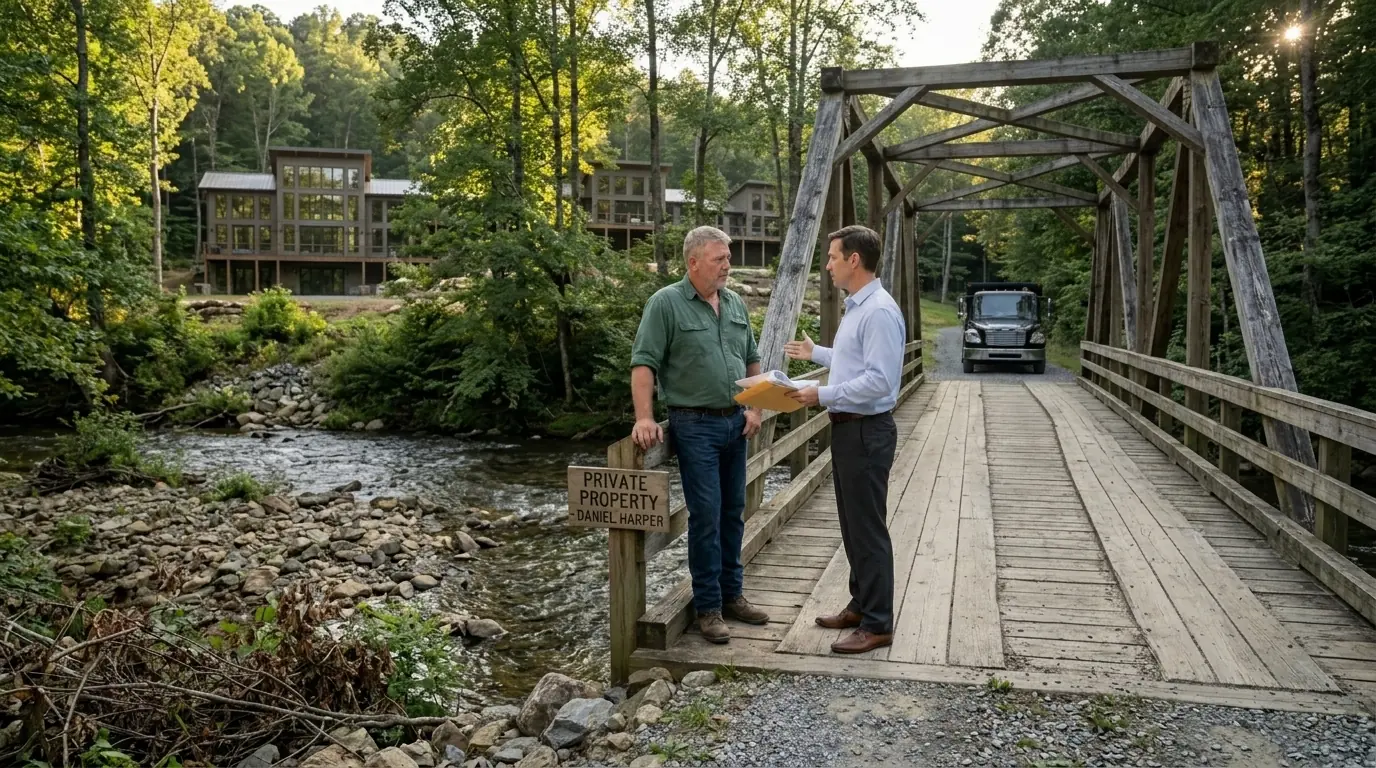
Now, before you decide I'm some bitter old guy shaking a fist at progress, let me back up a little. My name's Daniel Harper. I'm 58, widowed, semi-retired if you want to call it that. I own about 40 acres along a bend in the Coldwater River in Western North Carolina. Not mountain-postcard pretty, not tourist-town flashy, just quiet hardwood forest, a little pasture, and a stretch of river that curves like it's in no hurry to get anywhere.
That's what I loved about it the first time I saw it 20 years ago. It didn't try to impress anyone. When I bought the land, there was no real access across the river, just an old logging trail that washed out every heavy rain. The main county road ran on the opposite bank. If I wanted to reach the back fields or haul equipment across, I had to detour miles upstream to a narrow gravel crossing that wasn't even mine.
So I did what any stubborn man with a welder and more pride than sense would do. I built a bridge. Not a grand thing. No stone arches, no steel trusses. Just a timber span about 40 feet long, pressure-treated beams, reinforced joists, thick oak planks on top.
I hired an engineer to draw it up, filed the permits, and waited through inspections. I anchored both ends well inside my surveyed boundary. I still have the county stamp on the original blueprint rolled up in a tube in my workshop. It was designed for light trucks, tractors, and the occasional delivery van. Nothing commercial, nothing heavy.
It didn't need to be. It served one purpose: giving me access to my own land. For years, that bridge was just part of my routine. I'd cross in the morning with a cup of coffee in the console, check the fence line, maybe fish at dusk on the far bank. Sometimes I'd sit halfway across and listen to the river sliding under the boards.
It creaked in the summer heat, popped in the winter cold, but it was solid. For a long time, it was just mine. Then the land upstream sold. I remember the day I noticed the survey flags, bright orange tape fluttering through the trees like someone had tagged the forest for surgery. I asked around town and found out a development group out of Charlotte had bought nearly 200 acres along the river.
Their name was Blue Fern Hospitality. Fancy logo, lots of talk about eco-luxury and curated experiences. Within months, the quiet upstream turned into a construction site: earthmovers, dump trucks, the whine of saws. They cleared just enough trees to make it look intentional, built cabins with floor-to-ceiling windows, and strung cafe lights along walking paths. Then came the restaurant deck overlooking the water, kayak racks, and fire pits.
Their website called it a secluded riverside escape. I won't lie, part of me was curious. I drove up to the county meeting when they presented the plans. The lead developer, a guy named Evan Callaway, tall, pressed shirt, perfect teeth, stood there talking about boosting the local economy, bringing jobs, putting Coldwater on the map. Folks in town clapped.
I didn't. Not because I hated the idea, but because I've seen what happens when something calls itself secluded while selling $200-a-night cabins. Still, I kept to myself. Their land was upstream. Mine was downstream. The river between us didn't care.
The first time one of their trucks crossed my bridge, I thought it was a mistake. A white pickup with their logo on the side rolled across mid-morning while I was stacking firewood. I stepped out and waved it down. The driver rolled his window halfway.
"Sorry, man. GPS brought me this way."
He nodded, embarrassed. "Didn't know. Won't happen again."
I believed him. Then it happened again and again. At first it was contractors, then delivery vans with restaurant supplies. One afternoon, I watched a flatbed hauling stone for their landscaping creep across, the planks groaning under the weight in a way I'd never heard before. That sound stuck with me.
Wood has a language. You learn it if you work with it long enough. That was the sound of something being asked to do more than it was built for. I replaced the old sign with bigger ones in bright white lettering: PRIVATE PROPERTY. NO THROUGH TRAFFIC. I even added a chain across one end for a while, but I hated the look of it.
It felt like I was barricading myself from a world I didn't invite. Then the guests started showing up. I'd be sitting on my porch and see SUVs full of weekenders roll up, slow down, hesitate at the sign, then drive across anyway. Some waved cheerfully like we were neighbors. One woman actually stopped and asked if this was the scenic entrance to Blue Fern.
"Scenic entrance?" I almost laughed. It wasn't just inconvenience. My bridge was never meant to handle steady commercial traffic, and legally that mattered. So I drove up to the resort one afternoon and asked to speak to someone in charge. That's how I met Evan Callaway in person.
He greeted me on the deck overlooking the river, all charm and handshakes. "Daniel, right? We've heard about you. Beautiful property you've got."
"We need to talk about the bridge," I said.
He tilted his head slightly, like he'd expected this. "We're aware some guests may have used that route. Our marketing team is updating directions."
"Some guests?" I repeated. "Your contractors, too. That structure wasn't designed for commercial use."
He smiled, the kind of smile that tries to stay friendly while measuring you. "Well, interesting thing about that bridge, Daniel. Our survey indicates it connects to what used to be a shared access road decades ago. There may be historical usage rights involved."
I felt something tighten in my chest. "There are no easements on my deed."
"Perhaps," he said smoothly. "But if it functions as access to multiple properties, safety standards come into play."
There it was. Not a request, a setup. I drove home with that conversation looping in my head, the river flashing silver through the trees. That night, I pulled out my deed, my surveys, every document I had. I spread them across the kitchen table like I was preparing for trial.
A week later, the letter arrived. The envelope had their logo in the corner: Blue Fern Hospitality. Thick paper, attorney's name at the bottom. That was the moment it stopped feeling like a misunderstanding and started feeling like a strategy. I stood at my kitchen counter reading it twice before I even sat down.
According to their legal team, my bridge connected to a historically utilized access corridor serving adjacent parcels. Because of that, they claimed it needed to comply with commercial safety standards if it was to remain in use. Their engineer had assessed it, apparently without stepping foot on my property, and recommended widening the span, reinforcing the substructure, increasing load capacity, installing guardrails to code, adding lighting, and posting commercial weight ratings. Estimated cost: $118,000.
The final paragraph was the cleanest cut of all. Given the bridge's functional integration into regional access patterns, I, as the property owner, was responsible for ensuring it met current standards. Failure to do so could expose me to significant liability should an incident occur. They didn't ask me to upgrade it. They told me.
I leaned back in my chair and stared at the ceiling fan spinning slowly above me. I'm not a lawyer. I don't throw around words like "functional integration" in everyday conversation, but I do understand plain English. What they were saying was simple: your bridge is useful to us, therefore you need to make it better for us on your dime.
That night, I barely slept. Not because I was scared of them, but because I was thinking about responsibility. If one of their guests drove across my bridge, overloaded it, and something failed, even if they were trespassing, I'd still be the one standing in court explaining why I didn't do more to prevent it. That's how it works. You can be right and still lose money defending yourself.
The next morning, I called my neighbor, Walt Grayson. Walt's 72, a retired county surveyor, the kind of man who still irons his flannel shirts. He's forgotten more about land boundaries than most attorneys ever learn. I laid everything out on his dining room table. He adjusted his glasses, read through the letter slowly, then pulled one of my old surveys closer.
"There's no recorded easement here," he said, tapping the page. "If there was a shared access route, it would be documented. Dirt tracks don't count."
"They're implying historical use," I said.
Walt snorted. "Historical use is what folks say when they can't find paperwork."
We drove out to the bridge together. He walked the boundary lines with a small handheld GPS unit, nodding to himself. Both abutments were well within my property lines, just like I remembered. The old so-called shared road they referenced was nothing more than a faint depression in the woods, probably from logging equipment back in the '80s. "Legally, it's yours," Walt said. "But that doesn't mean they won't try to make it complicated."
That word stuck with me: complicated. That's how pressure works. You don't break someone in one swing. You bury them in paperwork, inspections, complaints. Two weeks later, the county inspector showed up.
Nice enough guy, apologetic even. He said they'd received an anonymous complaint that my bridge posed a public safety hazard due to increased traffic volume. He walked it, measured a few boards, and checked the guardrails. "It's fine for private use," he said quietly. "But if it's being used commercially..."
"I didn't invite commercial use," I replied.
He gave me a look that said he understood, but understanding and enforcement aren't the same thing. After he left, I drove straight to Blue Fern. This time, Evan didn't greet me on the deck. He met me in his office: glass walls, framed photos of smiling couples by the river.
"You filed a complaint," I said without sitting down.
He leaned back in his chair. "Daniel, we're concerned about guest safety. If navigation apps are routing people over your bridge, that's a shared problem."
"It becomes my problem when you start talking liability."
He folded his hands. "We're willing to collaborate. Shared funding. Perhaps we split the upgrade cost. It benefits both properties."
"I don't need a commercial-grade bridge," I said. "You do."
He didn't deny it. He just smiled that measured smile again. "Your land value increases with improved infrastructure."
There it was. The pitch: progress, growth, community benefit. What he didn't say was that their entire marketing strategy depended on being easily accessible. Their brochures boasted about the short scenic drive from the highway. The most scenic part of that drive was my bridge.
I went home and stood halfway across it at sunset. The river was high from recent rain, sliding under the beams with a steady hush. I ran my hand along the top rail, felt the small splinters where years of weather had roughened the wood. I built this, I thought, for a simple reason: to reach my own land. And now it was being reframed as infrastructure.
The pressure didn't stop. Delivery trucks kept coming. Guests kept following their phones. I started keeping a notebook by the door, writing down license plates, dates, and times. Not because I wanted to be that guy, but because I felt like I needed a record.
If this went to court, I wanted to show I hadn't consented to any of it. One Saturday afternoon, a large catering truck tried to cross. I was outside when I heard the engine rev low and the boards straining. I stepped into the middle of the bridge and held up my hand. The driver rolled down his window.
"We're late for a wedding reception," he said.
"Not across here you're not," I replied.
He looked past me at the river, at the narrow span. "GPS says this is the fastest route."
"GPS doesn't own this bridge," I said.
He reversed slowly, muttering under his breath. That evening, I got a call from Evan. "I hear you blocked one of our vendors."
"I protected my property."
"You're escalating this," he said, voice tighter than before.
"No," I answered. "You escalated it when you tried to hand me a six-figure bill."
There was a pause on the line. I could hear music in the background, laughter, glasses clinking, a wedding in full swing. "Daniel," he said finally, "we can pursue formal recognition of access if necessary. It would be unfortunate."
That was the first time he said it plainly. They were considering legal action to establish some kind of prescriptive easement, arguing that repeated use created a right. I hung up and sat in the dark for a long time. Here's the part people don't see in stories like this: it's not about revenge. It's about erosion.
Little by little, something that was yours alone starts being treated like it belongs to everyone. And if you don't push back, eventually the paperwork catches up to the assumption. I called a property attorney in Asheville the following week and laid everything out.
He listened carefully, then said something simple. "You're on solid ground. But if traffic continues and they argue long-term public use, things get messy. Judges don't like ambiguity."
"What's the cleanest solution?" I asked.
He didn't hesitate. "Remove the structure."
I laughed at first. "You're kidding."
"I'm not. No bridge, no access argument. No access, no upgrade requirement. You eliminate liability entirely."
I drove home thinking about that. The simplest solution wasn't to fight them in court. It wasn't to upgrade. It wasn't to negotiate. It was to make the problem disappear.
For a week, I walked that bridge every evening. I listened to it creak, watched the sunset from its midpoint, remembered hauling lumber across it when I first built the cabin. It felt almost disloyal to consider tearing it down. But it also felt like the only move left that was entirely mine.
I went down to the county office on a Tuesday morning and applied for a demolition permit. The clerk looked surprised. "You're removing it voluntarily?"
"Yes, ma'am."
"Most folks try to expand, not reduce."
I smiled. "I'm simplifying."
Approval came faster than I expected. Maybe because there were no environmental concerns. Maybe because paperwork is easier when you're taking something away instead of adding it. I hired a small local crew, not the big contractors Blue Fern used. Just three guys I'd known for years.
When I told Walt what I planned, he stared at me for a long moment. "You sure?"
"They want a commercial bridge," I said. "They can build one on their own land."
The morning we started, a thin fog hung over the river. I stood at the edge of the span while the crew unloaded tools. Across the water, I could see the rooflines of the resort cabins through the trees. For the first time since this started, I felt calm.
The first board came up with a sound I'll never forget, a long, slow groan followed by the sharp squeal of nails giving way, like the bridge itself was clearing its throat one last time. I stood there with my hands in my jacket pockets while the guys worked, telling myself I was fine, that this was just lumber and bolts and hardware. But it didn't feel that simple. This bridge had carried groceries, lumber, fishing rods, memories.
It had carried my wife back when she was still here, sitting in the passenger seat teasing me about how I overbuilt everything. It had carried quiet mornings and long evenings. And now I was the one taking it apart. By mid-morning, half the planks were stacked neatly on the bank. The beams underneath were exposed, thick treated timbers I'd bolted into concrete footings two decades earlier.
I knelt down and ran my hand along one of them, remembering the day we set it in place. I was younger then, stronger, certain that if I built something solid enough, it would stay that way. Around noon, a black SUV rolled up on the opposite side. Evan stepped out. He didn't wave this time.
He stood there watching for a few minutes before walking across the remaining span toward me. The crew paused instinctively, tools resting against their hips. "What are you doing?" he asked, though the answer was obvious.
"Removing a liability," I said.
"You can't be serious."
"I am."
He looked at the missing planks, the widening gap where river light showed through. "Daniel, this is unnecessary. We were prepared to revisit cost sharing."
"I don't want a commercial bridge," I replied evenly, "and I don't want your guests on my land."
"This affects more than just you," he said, voice sharpening. "Our delivery routes, emergency access, guest experience."
"Those are your logistics," I said, "not mine."
He stepped closer. "You're hurting a local business."
I almost smiled at that. "You tried to hand me a bill for $118,000. That's not community partnership."
For a second, the polished charm slipped. "We're talking about regional growth. Property values rise with infrastructure improvements."
"Then build infrastructure," I said quietly, "on your side."
The crew resumed work. Bolts loosened. Metal clinked against wood. Evan stood there a moment longer, then turned and walked back the way he came, shoes clicking on boards that would be gone by sundown.
By late afternoon, the center span was dismantled in sections. We used a small crane to lift the heavier beams and set them onto a flatbed trailer. When the final crossmember came free, the two halves of the bridge stood separated by 20 feet of open air. The river flowed through uninterrupted, silver and indifferent. Standing there, looking at the empty space, I expected to feel regret.
Instead, I felt something lighter. Not triumph. Not anger. Just relief. The next morning was quiet in a way I hadn't heard in months.
No engines idling at the entrance. No tires crunching across wood. No GPS-confused voices echoing from open windows. The only sound was water and wind through sycamores. I drove into town for feed and passed the turnoff that used to lead across my bridge.
Someone had already updated the navigation systems. Cars headed east now, toward the longer paved county road that Blue Fern had originally ignored because it added nearly four miles. Four miles. That's what this whole battle had been about.
A few days later, Evan called again. "This isn't over," he said.
"It is for me."
"We're reviewing options."
"Do what you need to do," I answered. "So will I."
But the truth was, there wasn't much they could review. Without a structure, there was no functional access to argue over. No ongoing use to claim prescriptive rights. Just a river dividing two properties the way nature intended.
They did request a formal meeting with a mediator a week later. I went, mostly out of curiosity. It was held in a neutral office in town, beige walls, stale coffee. Evan came with his attorney. I came alone.
Their proposal was straightforward. They would fund the majority of a new bridge if I granted a permanent recorded easement allowing commercial traffic across my land. "That ensures long-term stability for both parties," the attorney said smoothly.
"Long-term for who?" I asked.
"For the community," Evan replied.
I leaned back in my chair. "I bought my land because it wasn't part of anyone's long-term development plan. I'm not interested in becoming your access corridor."
The mediator asked if there was any compromise I could consider. I thought about it for a moment. About money. About convenience. About how easy it would be to say yes and let someone else rebuild bigger, stronger, shinier.
Then I pictured weekend traffic streaming past my porch for the next 20 years. "No," I said simply.
The meeting ended there. Over the next month, I restored the riverbank where the bridge had stood. We removed the old concrete footings down to grade, filled the gaps with gravel and soil. I spread native grass seed along the approach road and let it take root.
At the entrance, I installed a steel gate. Not because I needed one anymore, but because I wanted the boundary to be visible. Upstream, Blue Fern kept operating. They adjusted, built better signage directing guests to the proper route, and expanded the eastern entrance. From what I hear, business didn't collapse.
Weddings still happened. Kayaks still lined the shore. Sometimes I sit on my porch in the evening and look upstream, the cabins just visible through the trees. I don't hate them. I don't even hate Evan.
He did what developers do. He saw an opportunity and tried to optimize it. I did what landowners sometimes forget they're allowed to do. I said no. Here's the part that sticks with me.
Progress isn't always someone else's responsibility. Convenience isn't a right just because technology points you somewhere faster. That bridge was mine. Not in a symbolic way. Not in a handshake-agreement kind of way.
Legally. Physically. Morally. They tried to reframe it as shared infrastructure. I reframed it as optional.
People around town still debate whether I overreacted. Some say I should have taken the shared funding and enjoyed a sturdier crossing. Others think I protected something more valuable than wood and nails. But stories like this don't always have clean heroes and villains. They have interests, pressure, pride, and choices.
And sometimes the strongest move isn't building something bigger. It's deciding you don't need it at all.