The forty-first floor of Northstar Cargo Systems looked powerful from the street.
From below, the glass tower caught the morning sun and turned it into something clean, expensive, and untouchable. Inside, the lobby smelled like fresh flowers and polished stone, and the company logo stretched across the wall in brushed steel letters that made visitors lower their voices without knowing why. Everything about the building said success.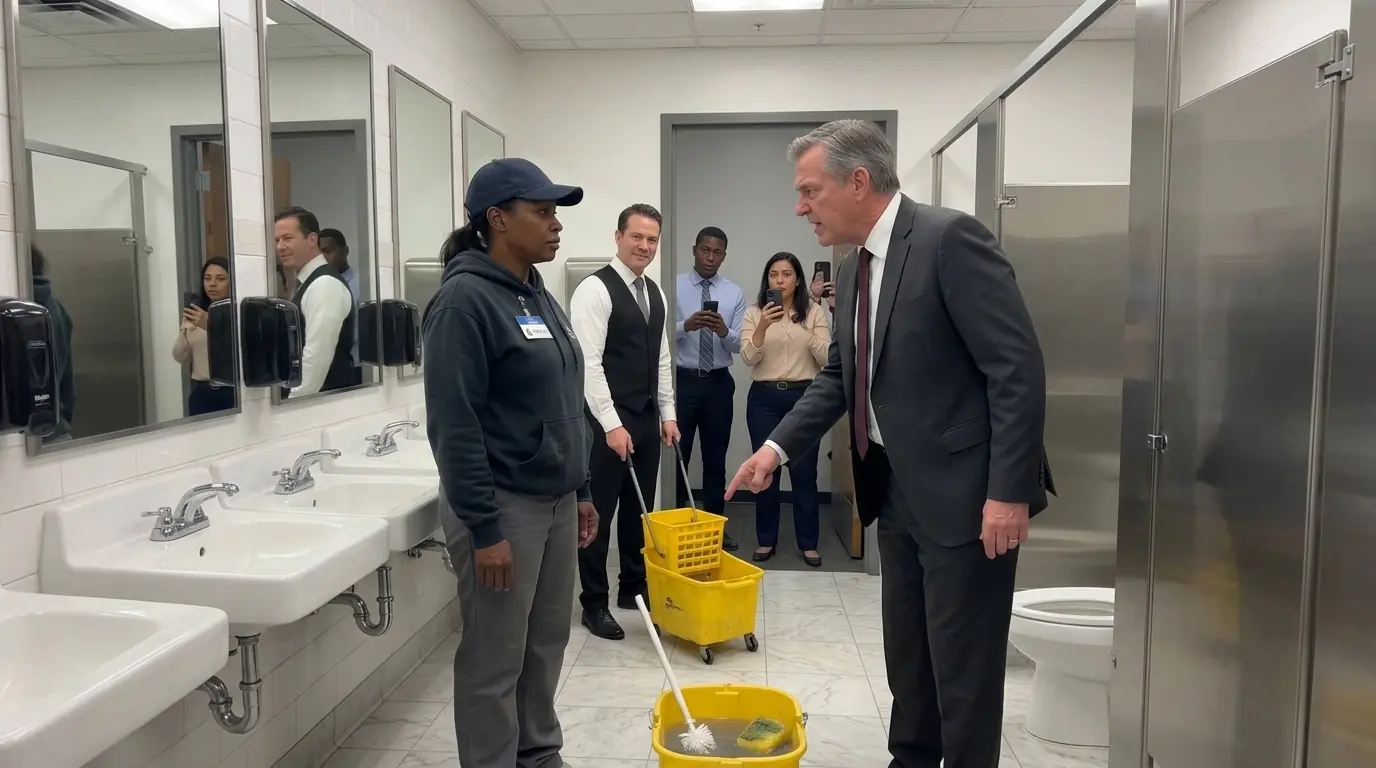
But the forty-first floor told a different story.
People moved through that office like they were trying not to disturb a sleeping animal. Conversations dropped whenever footsteps approached the executive hallway. Coffee cups were carried back to desks quickly, bathroom breaks were timed, and nobody stood near the printer unless they had a document in their hand and a reason prepared in case someone asked.
The sleeping animal was named Victor Langford.
Victor was the senior director of Northstar’s Atlantic Division, and he had turned one of the company’s most profitable floors into a place where adults flinched before emails even arrived. He wore custom suits, expensive shoes, and a silver tie clip shaped like a compass, which he liked to say reminded him that leadership meant always pointing people in the right direction.
The employees had another word for it.
Control.
On paper, Victor’s numbers were beautiful. Shipments moved on time. Payroll stayed lean. Client complaints were low, and productivity had climbed for six straight quarters. In board presentations, his division looked disciplined, efficient, and impressive enough that investors asked why the rest of Northstar could not copy his methods.
But numbers did not show a payroll assistant crying in a stairwell at 7:14 a.m.
Numbers did not show an inventory analyst swallowing panic before walking into Victor’s office. They did not show a junior manager working through lunch because she had been told pregnant women who asked for accommodations “didn’t understand executive expectations.” They did not show the old facilities worker who quietly fixed everything broken and still got called invisible to his face.
Those things reached Amara Whitfield through whispers.
Amara was the founder and CEO of Northstar Cargo Systems. Twenty-four years earlier, she had started with one rented truck, a borrowed office above a mechanic shop, and a client list so small she could write it on the back of a receipt. Now Northstar moved freight across the country, handled international logistics, and employed more than eight thousand people.
Business magazines loved her story.
They liked the version where a Black woman from South Carolina built an empire through grit, vision, and discipline. They liked the photograph of her in a white suit standing in front of shipping containers at dawn. They liked calling her self-made because it sounded cleaner than saying she had worked twice as hard in rooms where people assumed she was there to take notes.
But Amara knew growth had a dangerous side.
A company could become so large that pain got filtered before it reached the top. Supervisors softened complaints, directors cleaned up language, regional reports turned people into percentages, and by the time the truth arrived at headquarters, it had been dressed in professional language until nobody recognized the wound underneath.
Six months earlier, the first anonymous message arrived.
Please don’t use my name.
That sentence sat at the top of the email like a hand over someone’s mouth. The writer described Victor Langford screaming at employees, manipulating time cards, threatening immigration status, mocking accents, and assigning humiliating tasks to anyone who questioned him. Two weeks later, another report came. Then another. Then six more.
All of them ended the same way.
Please don’t use my name.
Amara read every report herself.
Then she called her chief legal officer, her head of ethics, and the one person on her security team who knew how to keep a secret without turning it into gossip. She did not want a staged inspection. She did not want Victor smiling for executives while employees performed relief. She wanted the floor as it truly was, before fear had time to clean itself up.
So on a rainy Tuesday morning, Amara entered Northstar Tower through the loading entrance.
She wore gray work pants, a faded black hoodie, cheap sneakers, and a plain navy cap pulled low enough to hide most of her face from security cameras that had already been told to ignore her. A yellow cleaning cart rolled in front of her. A temporary facilities badge hung from her jacket with a name printed in block letters.
A. Wells.
Nobody at the service desk looked at her twice.
That was the first lesson of the morning.
People in powerful buildings often notice suits, watches, and visitor passes. They notice people who arrive with assistants. They notice executives, clients, and anyone who looks like they might make decisions about budgets. But a Black woman pushing a cleaning cart could pass through a tower of glass like part of the plumbing.
Invisible.
Useful.
Unimportant.
Amara stepped out of the service elevator on the forty-first floor at 7:42 a.m.
The corridor smelled of floor polish, burned coffee, and old stress. Near the executive restroom, water had seeped from under the door and spread across the marble in a thin shine. No warning cone stood nearby. A trash bin overflowed with coffee cups, and the emergency exit sign above the stairwell flickered as if it had given up trying to be noticed.
She wrote all of it down in her head.
A young clerk at the end of the hall kept one hand pressed against his stomach while typing with the other. A woman at the copier blinked too fast, wiping her cheek when she thought no one was looking. An older maintenance worker stood near a supply closet holding a screwdriver, shoulders rounded, eyes lowered, as if he had learned that making himself smaller reduced the chances of being chosen.
Before Amara could speak to him, the office changed.
It was almost physical.
People straightened.
Mugs disappeared.
Chairs slid closer to desks.
The atmosphere tightened so quickly that it felt rehearsed.
Victor Langford turned the corner from the executive hallway.
Beside him walked Bryce Dalton, his operations aide, a thin man in a fitted vest who carried a tablet like a shield and smiled before Victor delivered bad news. Bryce had no real power of his own, but he had become fluent in proximity. He laughed when Victor insulted people. He finished threats Victor did not feel like completing. He had learned that serving a cruel man made him feel taller.
Victor stopped the moment he saw Amara by the restroom door.
His eyes traveled over the cleaning cart, the hoodie, the sneakers, and her face.
Disgust arrived before words.
“You,” he snapped. “Where have you been?”
Amara looked at him calmly. “Good morning.”
“Don’t good-morning me.” Victor pointed toward the restroom. “That bathroom has been leaking for almost an hour. The marble is wet, the floor smells like bleach, and apparently the agency sent someone who thinks wandering around counts as cleaning.”
Amara glanced at the spreading water. “There should be a warning sign placed immediately. Someone could slip.”
Victor stared at her.
Then he laughed.
Not loudly.
Worse.
Privately, as if she had tried to participate in a conversation above her station.
“I didn’t ask for your safety analysis,” he said. “I asked why you are late.”
“I’m not with the agency.”
Victor looked her up and down again. “Of course you are.”
“I’m telling you I’m not.”
His smile sharpened. “And I’m telling you I can see what you are.”
The office went still.
Amara saw the woman by the copier lower her head. The young clerk stopped typing. The old maintenance worker tightened his grip around the screwdriver until his knuckles paled.
Victor stepped closer.
“Listen carefully,” he said. “On this floor, people who push cleaning carts clean. They do not give opinions. They do not correct directors. They do not stand around pretending the building needs their input.”
Amara’s voice stayed level. “You should be careful with assumptions.”
That was his warning.
He missed it completely.
Bryce picked up a plastic bucket from the cart and shoved it toward her with his foot. Gray water sloshed over the rim and splattered near her shoes.
“Director Langford doesn’t like repeating himself,” Bryce said.
Amara looked at the bucket.
Then at Bryce.
Then back at Victor.
“You allow your staff to speak to people this way?”
Victor’s face darkened. “My staff speaks to people according to their value.”
A small sound came from the copier.
The woman standing there covered her mouth.
Victor ignored it.
“You don’t walk onto my floor in thrift-store shoes and lecture me about safety,” he said. “You don’t tell me what you are not. You do what the badge on your jacket says you were hired to do.”
Amara touched the edge of the temporary badge. “And what do you believe I was hired to do?”
Victor pointed toward the executive restroom. “To clean up what better people don’t have time to touch.”
The silence after that was not empty.
It was full of history.
Amara had heard prettier versions of that sentence in boardrooms, hotels, airports, investor dinners, and legal meetings where men tried to guess whether she was the assistant before they learned she owned the room. She had built a fortune, signed payroll for thousands, negotiated with heads of state, and still, one man with a title and no character could look at a hoodie and decide her place was beneath him.
She did not move.
Victor did.
He grabbed her sleeve.
The movement was quick, irritated, almost casual in its entitlement. His fingers twisted the fabric of her hoodie and jerked her toward the restroom hard enough that the cleaning cart banged into the wall. Someone gasped. Bryce stepped sideways, not to stop him, but to block part of the view from the main office.
He was too late.
The young clerk had already lifted his phone below desk level.
The woman at the copier had done the same.
Victor dragged Amara through the restroom door.
White tile reflected harsh lights. Water ran from the broken sink and slid across the floor in shining veins. Paper towels lay damp near the trash can, and the air smelled of disinfectant trying to hide neglect.
Victor released her arm with a shove.
“Since you want to talk like management,” he said, “let’s see how you manage a toilet.”
Bryce followed with the bucket and dropped it near her feet. The handle clattered against the tile. A yellow sponge floated in the dirty water, bumping softly against a white scrub brush.
Victor pointed to the last stall.
“That one.”
Amara looked at him. “You want me to clean that stall.”
“No,” Victor said. “I want you on your knees cleaning that stall.”
Bryce chuckled.
From the doorway, several employees had gathered, pretending not to gather. The young clerk held his phone low. The copier woman’s phone shook in her hand, but she did not lower it. The maintenance worker stood behind them, face pale, eyes burning.
Victor saw the phones.
“Put those away,” he snapped. “Unless all of you want to join her.”
Nobody moved.
It was the first time that morning the floor did not obey immediately.
Amara bent down and picked up the sponge.
For a second, the office held its breath.
Victor smiled, believing he had won.
Then Amara looked at the sponge, squeezed dirty water from it slowly, and dropped it back into the bucket.
“You have five minutes left,” she said.
Victor blinked. “What?”
“Five minutes of believing this floor belongs to you.”
Bryce’s laugh came out nervous this time.
Victor stepped closer, his face red now. “You think this is a game?”
“No.”
“I can have you removed from every agency list in this city.”
“No.”
“I can make sure nobody hires you again.”
“No.”
Each answer was calm.
Each one irritated him more.
Victor snatched the scrub brush from the bucket and slapped it against the stall door. The crack echoed through the restroom.
“You will scrub that toilet,” he said, “or I will drag you out of this building by your collar.”
Amara slowly removed the cap from her head.
Pinned inside the brim was a tiny camera, no larger than a shirt button.
Victor stared at it.
Confusion crossed his face first.
Then unease.
Amara looked directly into the lens and spoke clearly.
“Activate integrity review. Floor forty-one. Executive misconduct in progress.”
For two seconds, nothing happened.
Then every monitor in the office went black.
Spreadsheets vanished.
Client dashboards disappeared.
Email windows shut down.
Across the forty-first floor, screens flickered and came back alive with video from the restroom doorway. Victor’s face filled every monitor, angry and close. His voice came through the office speakers, crystal clear.
I want you on your knees cleaning that stall.
Marcy Vale from payroll dropped the papers in her hand.
The young clerk, whose name was Adam Reyes, stopped recording because he no longer needed to. Every workstation, conference room screen, hallway monitor, and executive display now showed the last several minutes of footage, replaying with a timestamp and an incident banner across the top.
Executive Conduct Review Activated.
Workplace Assault Flagged.
Corporate Security Notified.
Victor stumbled backward.
“No,” he whispered.
Bryce ran to the nearest desk and began jabbing at the keyboard. “I can shut it down.”
He could not.
The footage kept playing.
Victor grabbing Amara’s sleeve.
Victor dragging her forward.
Victor ordering her onto her knees.
Victor telling her people pushing cleaning carts did not give opinions.
The office watched the truth fill every screen.
The elevator chimed.
Once.
Then again.
Then a third time.
The doors opened to reveal six corporate security officers, the chief legal officer, the head of human resources, and two members of the board’s ethics committee. Behind them came Amara Whitfield.
Not in the hoodie.
Not with the cleaning cart.
Not under the temporary badge.
She walked out in a tailored ivory suit, her hair pulled back, diamond studs at her ears, her executive ID clipped clearly to her lapel. The same calm face. The same eyes. The same woman Victor had dragged toward a toilet because he thought no one important could possibly be wearing cheap sneakers.
The floor stopped breathing.
Victor turned toward her, then toward the restroom, then back again.
His mind could not build a bridge fast enough.
Amara stopped beneath the largest monitor, where his own recorded face glared over her shoulder.
“Victor Langford,” she said.
His lips moved soundlessly.
“Ms. Whitfield,” Bryce whispered.
The employees stared.
A few had covered their mouths. Others looked stunned, frightened, relieved, and furious all at once. The old maintenance worker slowly straightened to his full height, as if years had come off his back in one breath.
Victor forced a laugh that fooled nobody. “This is some kind of corporate exercise.”
“Yes,” Amara said. “It is called evidence.”
The chief legal officer, Denise Armand, stepped forward with a folder in her hand. “For the record, this review began after multiple anonymous complaints regarding abusive leadership, retaliation, payroll manipulation, and discriminatory conduct in the Atlantic Division.”
Victor’s face hardened in panic. “Anonymous complaints from weak employees who can’t handle pressure.”
Adam Reyes stepped forward from his desk.
His voice shook, but he spoke.
“He called me weak when I asked to leave early for my mother’s chemo appointment.”
Marcy from payroll stepped out beside him. “He made me change time cards.”
Victor snapped toward her. “Careful.”
Marcy flinched.
Then she looked at the monitor, at the video still looping behind Amara, and something in her steadied.
“No,” she said. “I’m done being careful for you.”
The room changed.
Not dramatically.
Not like applause.
More like a lock opening.
One employee after another began speaking.
“He told me maternity leave made me a liability.”
“He made us work through lunch and told us to mark the break anyway.”
“He called our department dead weight in front of clients.”
“He said anyone who reported him would never get promoted anywhere in Northstar.”
“He told facilities not to fix the restroom leak because he wanted to see how long it took before someone complained.”
Amara turned slowly toward Victor.
“That leak could have injured someone.”
Victor’s voice came out sharp and desperate. “This is being exaggerated. I run the highest-performing division in the company.”
“You ran the most frightened division in the company.”
His face flushed.
Denise Armand opened the folder. “Victor Langford, effective immediately, your employment is terminated for cause. Your access has been revoked, your severance is denied, and evidence of physical assault and labor violations will be referred to the appropriate authorities.”
Victor looked as if she had struck him.
“You cannot terminate me in front of my staff.”
Amara’s voice was cold. “You humiliated them in front of each other for years.”
Bryce stepped backward.
Security stepped with him.
Denise turned toward him. “Bryce Dalton, your employment is also terminated for participation in harassment, intimidation, obstruction of complaints, and attempted interference with an active integrity review.”
Bryce’s face collapsed. “I was following Victor’s orders.”
Amara looked at him. “That is not innocence. That is cowardice with a supervisor.”
Victor lunged toward the executive corridor.
The badge reader flashed red.
Denied.
He swiped his card again.
Denied.
Again.
Denied.
Every failed beep sounded louder than the last.
For years, that badge had opened doors and closed mouths. Now it was a dead piece of plastic in his hand.
He turned toward Amara. “I built this division.”
“You damaged it,” she said.
Security moved in.
Victor resisted just enough to make the scene worse. Two guards took his arms and turned him around. His face reddened as he shouted about lawsuits, investors, board members, and how none of them understood what it took to win in business.
No one lowered their eyes.
That frightened him more than security.
Bryce tried to slip behind a conference room door, but the old maintenance worker stepped into his path. He did not touch him. He simply stood there, tall and still, forcing Bryce to see a man he had ignored for years.
Security collected Bryce quietly.
The two men were escorted across the same marble floor where they had made employees feel small. They passed the restroom where the bucket still sat with the yellow sponge floating in dirty water. They passed the desks where people had cried silently, worked unpaid minutes, swallowed insults, and carried fear home to families who did not know why dinner was so quiet.
At the elevator, Victor twisted back.
“You ruined me,” he spat.
Amara looked at him for a long moment.
“No,” she said. “I let you speak freely.”
The elevator doors closed.
For several seconds, the floor did not move.
Then Marcy began to cry.
Adam set his phone down and rubbed both hands over his face. A woman from client services sat slowly in her chair, like her knees could not hold her and her relief at the same time. The maintenance worker looked toward the restroom, then toward Amara, then down at his own hands.
Amara stepped into the center of the office.
“The Atlantic Division is closed for the rest of the day,” she said. “Everyone will be paid. HR and outside counsel will be available for private statements. No retaliation will be tolerated. Not from supervisors. Not from coworkers. Not from anyone trying to protect what happened here.”
Nobody spoke.
So she continued.
“If you stayed silent because you were afraid, you are not the one on trial today.”
That sentence moved through the room like air after a door opened.
Adam’s eyes filled.
Marcy covered her mouth again, but this time she was not hiding from Victor.
The maintenance worker raised one hand.
Amara turned to him. “Your name?”
“Samuel Boone,” he said.
“How long have you worked here, Mr. Boone?”
“Seventeen years.”
She nodded. “You tried to report the safety issues, didn’t you?”
His mouth tightened.
“Four times,” he said. “They told me to stop making facilities look incompetent.”
Amara looked toward the broken restroom.
“That ends today.”
By noon, the video had reached Northstar’s board, legal archive, HR department, and ethics division across all regions.
By three, someone leaked a screenshot of the incident banner.
By five, reporters were calling.
At six, Northstar issued a statement that did not hide behind soft language. It confirmed that a senior director had physically and verbally abused a person he believed to be a temporary cleaner, that the person was in fact CEO Amara Whitfield conducting an internal ethics review, and that the company had terminated the director and his aide for cause.
The statement also said every complaint linked to the Atlantic Division would be reopened.
Victor tried to defend himself within hours.
He called business reporters, former colleagues, and two board members who suddenly stopped answering. He claimed entrapment. He claimed emotional pressure. He claimed he thought Amara was trespassing. He claimed she had provoked him by refusing instructions.
Then Adam gave a statement.
Then Marcy.
Then Samuel.
Then twenty-six more employees.
Payroll manipulation surfaced first. Then retaliation emails. Then deleted complaint logs recovered by IT. Then a message from Bryce to Victor that read: Keep them scared enough to stay productive.
That line went public two days later.
It became the headline.
Keep Them Scared Enough.
By the end of the week, Victor Langford was no longer arguing about reputation.
He was facing assault charges, labor complaints, civil claims, and the collapse of a career built on making people too afraid to tell the truth.
Three months later, the forty-first floor looked almost the same.
The city still shone through glass walls. The desks still lined up in clean rows. The company plaques still reflected expensive light. From a distance, power looked unchanged.
But inside, people breathed differently.
The executive restroom leak was fixed. The fire door was cleared. The printer area had a real chair and not the broken one everyone had complained about for months. Time sheets were audited weekly, and every correction required review by someone outside the chain of command.
Adam became assistant compliance coordinator.
Marcy led payroll integrity review.
Samuel Boone was promoted to facilities safety manager and given authority to shut down unsafe areas without waiting for executive approval.
The new regional director, Lillian Graves, started her first day by removing the private coffee station from the executive hallway and moving it into the shared breakroom. Victor would have considered that weak. Lillian considered it honest.
“Coffee tastes worse when power hides it,” she said.
People laughed when she said it.
Not nervously.
Actually laughed.
That mattered.
On the wall beside the executive restroom, someone placed the yellow sponge in a small glass frame. Amara saw it during her first follow-up visit. Beneath it was a brass plate that read:
The day the floor got its voice back.
She stood in front of it for a long time.
Lillian approached quietly. “I can have it removed.”
“No,” Amara said. “Leave it.”
“It’s a little dramatic.”
“So was ordering a stranger onto her knees.”
Lillian smiled faintly. “Fair.”
Later that afternoon, Amara held an all-floor meeting.
No stage.
No spotlight.
No camera crew.
She stood among the desks, not above them, and looked at the people whose complaints had almost vanished inside the machinery of corporate comfort.
“I built Northstar to move freight,” she said. “But freight does not move itself. People move it. People answer the calls, fix the leaks, process the invoices, check the weight, calm the clients, track the hours, and make leadership look competent.”
The room was silent, but not afraid.
She could feel the difference now.
“Somewhere on this floor, we allowed performance to become a mask for abuse. We praised output and ignored what it cost. That failure belongs to leadership, including me.”
Samuel nodded once.
Amara continued. “From this day forward, no manager in this company will be judged only by what the team produces. They will be judged by whether people can produce without being threatened, humiliated, or made invisible.”
Marcy wiped a tear from her cheek.
Adam looked down at his notes and smiled.
Amara glanced toward the framed sponge by the restroom. “Victor Langford believed power meant forcing someone beneath him. He was wrong. Power is not what you can make people do when they are afraid. Power is what you choose not to do when nobody can stop you.”
Someone clapped.
Then another.
Then the floor filled with applause.
It was not a victory parade.
Too much damage had happened for that.
It was acknowledgment.
A floor that had once gone silent when Victor walked in was now making noise for the truth that removed him.
When Amara left that evening, she did not take the executive elevator.
She walked back through the service corridor where she had entered months earlier, past the supply closet, past the repaired emergency sign, past the hallway that had first told her something was rotten. Outside, the city had softened into sunset, the glass buildings glowing gold as if the world had been polished clean.
She knew better.
Nothing cleans itself.
Companies do not become humane because they print values on walls. Power does not become ethical because people clap after one speech. Culture has to be inspected, challenged, repaired, and sometimes torn open in front of everyone before the mold underneath can be treated.
Still, as Amara stepped onto the sidewalk, she allowed herself one breath of satisfaction.
Not because Victor lost his job.
Not because the video had gone viral.
Because somewhere on the forty-first floor, a new temporary cleaner had asked Samuel Boone where to find extra paper towels that afternoon, and Samuel had walked her there himself.
No sarcasm.
No threat.
No performance.
Just help.
That was where change began.
Not in the statement.
Not in the firing.
Not even in the dramatic moment when every monitor exposed Victor Langford for who he was.
Change began when the next person believed they could ask a question without being punished for it.
Years later, people inside Northstar would still tell the story of the yellow sponge.
Some told it like a legend.
Some told it like a warning.
Some told it to new managers on their first week, just to see whether they laughed for the wrong reason.
Amara never corrected the details.
Stories are allowed to grow as long as the lesson stays intact.
Never mistake a uniform for worth.
Never mistake silence for consent.
Never mistake fear for respect.
And never order a woman to her knees unless you are prepared for the whole company to stand up.