They gave her the abandoned kitchen. It was meant as an insult, a gilded cage of cold stone and creeping ivy, a place to put the inconvenient poor relation where she would not be seen. Mrs. Arabella Crane, with a smile as thin and sharp as a shard of glass, had called it a kindness.
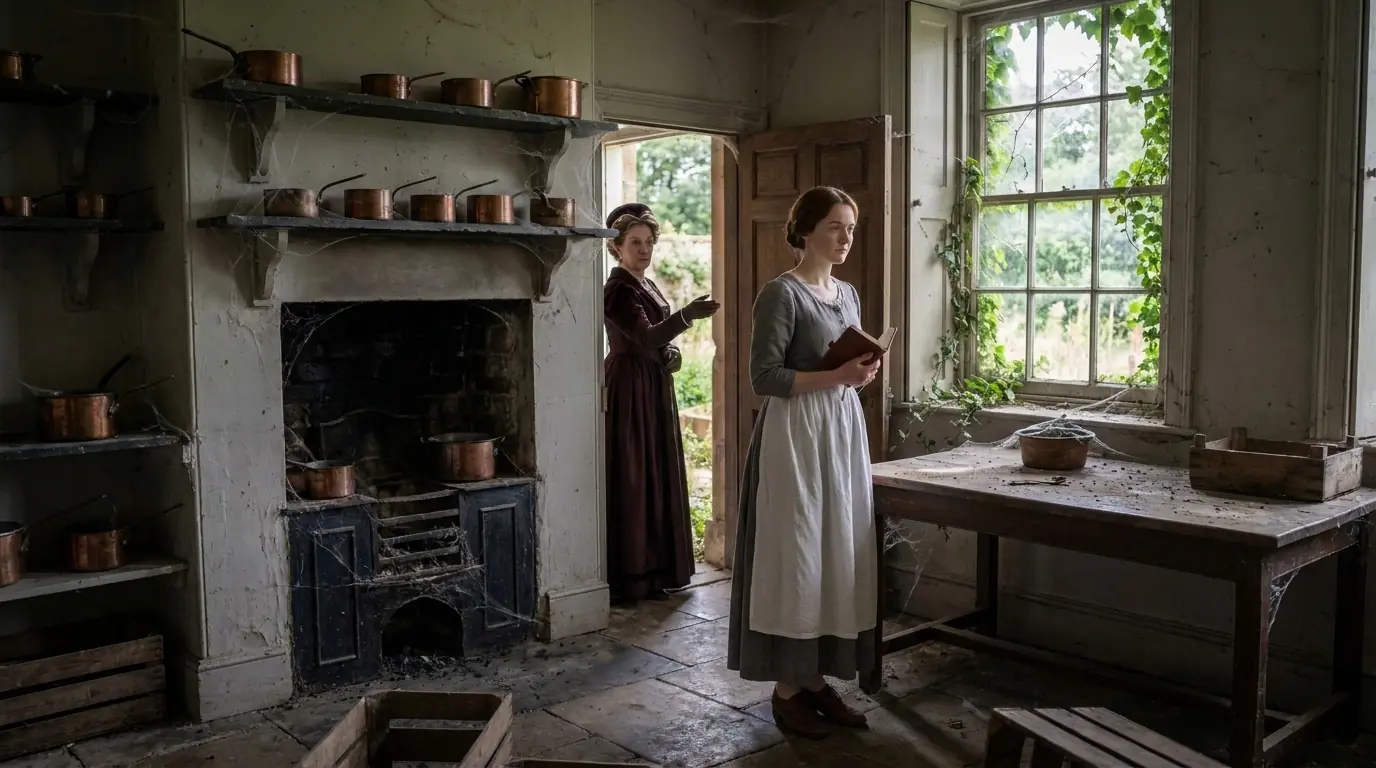
"A little domain of your own, Prudence," she had said, her voice dripping with a condescension that was its own form of cruelty. "So you might feel you are contributing." Prudence Lockhart had accepted with a quiet nod. She did not point out that she had been contributing for five years, ever since her parents' deaths had left her penniless and at the mercy of her distant cousin, the late Mrs. Severn of Withercombe. For five years, her contributions had been invisible, mending linens no one else would touch, balancing household accounts the steward found too tedious, sitting with the sickly child of a tenant while the doctor was summoned.
She was a ghost in the architecture of the great house, a necessary cog that was never acknowledged. Now, she had been banished to the north wing, to the old still room and preserve kitchen that had not been used in a generation. It was a place of ghosts, too. The air was thick with the dust of forgotten years and the faint spectral scent of rosemary and dried lavender.
Stone flagstones, slick with a fine green damp, drank the warmth from her thin-soled shoes. But as Prudence stood in the center of the cavernous room, her gaze traveled over the slate shelves, the cavernous hearth black with ancient soot, the copper pots dulled to a murky brown. They did not know it was an armory. They had given her a kingdom.
Her first days were a campaign of reclamation. She wore a plain apron over her plain gray dress, and she worked. She swept away decades of cobwebs, her broom whispering against the stone. She scrubbed the slate shelves until they were dark and clean, their surfaces cool and ready.
She hauled buckets of water from the courtyard pump, her arms aching, and washed the flagstones until the damp chill began to recede. The housekeeper, Mrs. Ingram, a woman whose face seemed permanently set in a state of disapproval, watched her from the doorway once or twice, saying nothing before turning away with a sniff. Prudence paid her no mind. She was not working for approval.
She was working for the work itself. In a locked cabinet, she found the old household recipe books. Their leather covers cracked, and their pages foxed with age. The ink was faded, the script a delicate spidery hand from a woman long dead.
Here were instructions for spiced plum preserves, for pickled walnuts, for rosewater cordial and candied angelica. Here were remedies for coughs and instructions for soap making. It was a library of survival, a testament to a time when a great house had to be a fortress against winter, not merely a stage for social theater. Prudence read them not as recipes, but as maps.
The kitchen garden, connected to her new domain by a heavy oak door, was a ruin. Nettles choked what had once been neat beds of herbs. A hardy, ancient rose bush, its flowers a deep, defiant crimson, had thrown its thorny arms across a collapsed cold frame. But beneath the chaos, there was life.
A patch of stubborn mint, the feathery tops of feral carrots, a gnarled apple tree, its fruit small and bitter, but sound. Prudence tied her hair back, found a rusted trowel, and began to clear the earth. She worked until her back ached and her hands were raw, but a small, neat square of dark soil emerged from the wilderness. It was a start.
It was hers. Mr. Gideon Severn, the master of Withercombe, was as neglected as the north wing. A year had passed since his wife, the daughter of Mrs. Crane, had died, and grief had hollowed him out, leaving a man of cold silences and abrupt movements. He walked the halls of his own home like a trespasser, his face a mask of stern control.
He ate what was put before him without tasting it, signed the papers the steward presented without reading them, and endured Mrs. Crane's suffocating management of his household because he lacked the energy to resist. The house was dying around him, a slow, quiet decay of morale and purpose, and he was dying with it. One evening, fleeing the drawing room where Mrs. Crane was entertaining neighbors with a maudlin retelling of her daughter's virtues, Gideon found himself wandering the unfamiliar corridors of the north wing. He was drawn not by a thought, but by a scent, faint and surprising.
Not the cloying perfume his mother-in-law favored, nor the stale dust of disuse. It was the scent of cinnamon, cloves, and simmering fruit. A smell so warm and honest, it felt like a memory of a life he had never lived. The corridor ended at the door to the old kitchen.
A sliver of warm candlelight shone from beneath it. He pushed it open. The room was transformed. The hearth held a gentle glowing fire, and on it a copper pot bubbled slowly, releasing the fragrant steam that had drawn him there.
The slate shelves were no longer empty, but were beginning to fill with rows of gleaming glass jars, each catching the firelight like a jewel. And at a heavy wooden table in the center of the room, stood Prudence Lockhart. She did not notice him at first. Her head was bent, her focus absolute, as she used a small pair of tongs to place a star anise into a jar of deep purple plums.
Her brow was furrowed in concentration. Her hands, he noted, were not the pale, idle hands of a gentlewoman. They were stained with fruit juice, a small cut on one knuckle, but they moved with a steady, practiced grace. A ledger lay open beside her, and with a pen she made a neat entry, her lips moving silently as she counted.
She was not beautiful, not in the way his late wife had been. There was no artifice to her, no delicate fragility. Her face was pale and serious. Her brown hair pulled back severely from her forehead.
But in the quiet competence of her actions, in the focused order she was creating from forgotten things, there was a strength that felt more real than any drawing room charm. He must have made a sound, a shifting of his weight on the stone floor, for she looked up, and her eyes, a clear, intelligent gray, widened in surprise. She did not blush or stammer. She simply straightened and met his gaze, a question in her expression.
"Mr. Severn," she said, her voice low and calm. He felt an unfamiliar awkwardness. He was the master of the house. He needed no reason to be here.
Yet, he felt like an intruder in her quiet world. His eyes fell to the row of sealed jars on the table. They were labeled in her neat, precise script. Spiced plum preserve.