Nobody on Flight 419 knew who he was.
That was what made the morning honest.
Before anyone knew his name, before they knew what he had built, before they knew why hospital directors answered his calls and medical schools named lecture halls after his mother, they looked at him and decided a story. They did not need facts for it. People rarely do when an assumption feels familiar enough to pass for truth.
The first thing most passengers noticed was the color.
Orange.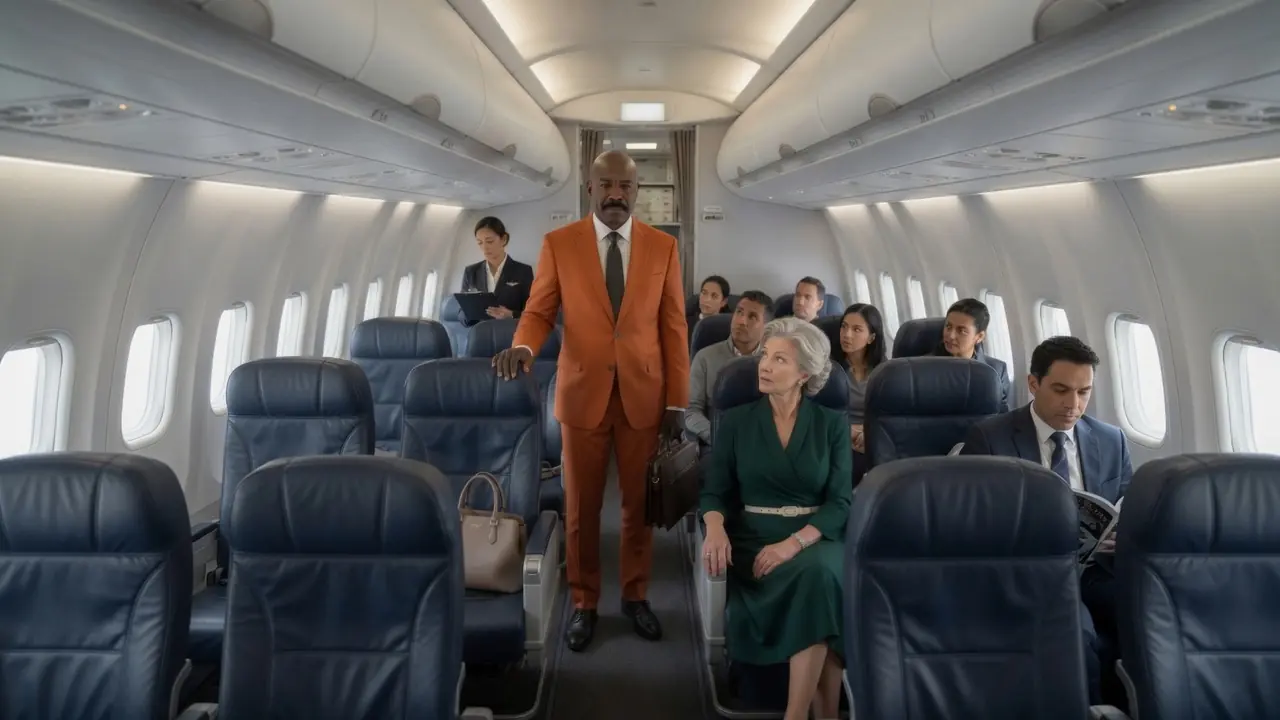
Not rust. Not burnt copper. Not a safe little pocket square hiding in a dark jacket. A bright, fearless orange suit moving through a first-class cabin full of navy coats, charcoal blazers, beige sweaters, polished shoes, and quiet money.
It looked almost rebellious inside the soft, controlled atmosphere of a morning flight from Atlanta to New York.
Then they noticed the man wearing it.
He was tall, broad-shouldered, and Black, somewhere in his late fifties, with a shaved head, a close gray beard, and the calm expression of someone who had spent a lifetime entering rooms where people expected him to explain his presence. He carried a small brown leather briefcase in one hand. No designer carry-on. No assistant rushing behind him. No expensive headphones around his neck.
Just the briefcase.
And the orange suit.
His name was Donovan Hale.
But nobody knew that yet.
To most of the passengers, he was just the unusual man moving slowly down the aisle, stopping once to let a woman settle her garment bag into the overhead bin, then thanking a flight attendant for stepping aside.
People watched him the way people watch something they have already decided does not fit.
A woman in 3A leaned toward her husband.
“Is he in the right cabin?”
Her husband kept his eyes on his newspaper. “Margaret.”
“I’m just asking.”
“No, you’re not.”
She pressed her lips together and looked out the window, offended by being recognized too quickly.
Across the aisle, a man in a dark suit paused mid-email and let his eyes follow Donovan from the shoes to the jacket to the briefcase. A young couple whispered near the bulkhead. A college student in noise-canceling headphones lifted one ear cup, looked once, then looked again.
The flight attendant at the front checked the passenger list.
Then checked it again.
Donovan noticed.
Of course he did.
He had spent decades noticing things other people hoped would pass silently. The pause before a greeting. The way a security guard’s eyes lingered one second too long. The little surprise when he spoke with precision. The sudden friendliness that arrived only after someone learned his title.
The world had trained him to read those moments.
But age had taught him something else.
Not every insult deserved his energy.
Sometimes the most powerful thing a man could do was keep walking.
So Donovan smiled politely, adjusted his jacket, and continued toward his seat.
2D.
First class.
A place where everyone was assumed to belong until someone like him entered wearing a color nobody could ignore.
The woman in 2C looked up when he reached the row.
Her name was Margaret Ellery, a wealthy private-equity consultant in her sixties, traveling to Manhattan for a board meeting. Her silver hair was styled perfectly. Her diamond bracelet caught the cabin light each time she moved her hand. Her handbag sat on the seat beside her with the casual confidence of something that had never been told to move.
Donovan stopped beside the row.
“Good morning,” he said.
Margaret glanced at the seat number above him, then at his face.
“You’re sitting here?”
“Yes, ma’am.”
“Oh.”
Small.
Polite enough to deny.
Heavy enough to reveal everything.
Donovan had heard that word all his life. Not always with sound. Sometimes in raised eyebrows. Sometimes in tight smiles. Sometimes in the way a receptionist asked, “Can I help you?” when what she meant was, “Who let you in?”
He placed his briefcase under the seat.
“Something wrong?”
Margaret looked away quickly. “No. Nothing.”
But there was something.
The cabin felt it.
The flight attendant returned. Her name tag read Jenna Morales.
“Mr. Hale,” she said, professional smile in place, “can I get you anything before takeoff?”
“Coffee would be wonderful.”
“Cream or sugar?”
“Black, please.”
“Of course.”
“Thank you, Jenna.”
She paused.
Not because he said anything extraordinary.
Because he used her name like she was a person, not part of the furniture.
A few minutes later, the plane doors closed.
The engines began their low, steady growl.
Donovan fastened his seat belt, took a small notebook from his briefcase, and opened it to a page filled with handwritten notes. Margaret tried not to look, then looked anyway. The handwriting was neat. The headings were precise. The words meant nothing to her from that angle, but the discipline of the page surprised her.
That bothered her more than she wanted to admit.
The aircraft climbed into the bright morning sky.
For the first twenty minutes, everything was ordinary.
Coffee cups. Seat belts. Emails. The soft rustle of newspapers. A baby fussing somewhere in economy. The thin mechanical sound of a plane settling into altitude.
Then something shifted.
A man in 1A received a message on his phone after the Wi-Fi connected. He read it, frowned, then looked toward Donovan. The man beside him noticed.
“What?”
The first man lowered his voice.
“That’s Donovan Hale.”
His seatmate looked confused. “Who?”
“The medical technology guy.”
The whisper spread slowly, like smoke under a door.
Donovan Hale.
Some passengers typed the name into their phones.
Some froze before pretending they had not.
The search results changed the cabin.
Donovan Hale was not a random man in a loud suit.
He was the founder of Hale Meridian Health Systems, a company whose emergency-response software was used in hospitals, trauma centers, ambulances, and disaster-relief networks across the country. He had built his first prototype in a rented office above a laundromat. He had turned it into a billion-dollar enterprise. He had donated millions to pediatric cancer centers, rural clinics, and medical scholarships for students whose families had never imagined such doors opening.
His face had been on magazine covers.
His speeches were quoted in business schools.
His company had helped reduce emergency-room response times in dozens of major cities.
Margaret Ellery looked at her phone.
Then at Donovan.
Her face changed.
Not with admiration first.
With discomfort.
Because the problem had never been the orange suit.
The problem was the story she created before she knew the truth.
Donovan felt the change around him.
The sudden softer glances.
The different posture.
The way suspicion became curiosity the moment success entered the room.
He had seen that transformation too many times to enjoy it.
People were often quicker to respect achievement than humanity.
He looked out the window.
Clouds spread beneath the plane like a white ocean, smooth and endless and far removed from every small cruelty on the ground. For a moment, Donovan was no longer in first class. He was back in a two-bedroom apartment on the south side of Atlanta, watching his mother tie an orange scarf around her hair before leaving for her night shift.
Her name was Celia Hale.
She worked days at a pharmacy counter and nights cleaning office buildings downtown. She came home tired enough to fall asleep standing, but somehow she still asked Donovan about school, checked his homework, and made him feel like the smallest victories in his life deserved witnesses.
Near their front door hung that orange scarf.
Bright.
Old.
Faded at the edges.
When Donovan was little, he asked her why she kept wearing something so loud.
Celia smiled and said, “Baby, the world will try to make you disappear. Give it something to look at.”
He never forgot that.
Years later, when he wore orange to board meetings, charity galas, hospital openings, and uncomfortable rooms full of people who had underestimated him, reporters called it a signature style. Investors called it branding. Magazines called it bold.
They were all wrong.
It was his mother.
At cruising altitude, Margaret finally turned toward him.
“Mr. Hale?”
Donovan closed his notebook. “Yes?”
She hesitated. “I hope I’m not bothering you.”
“Not at all.”
“I just realized who you are.”
“I assumed that might happen eventually.”
A faint blush rose into her cheeks.
“That sounded terrible of me.”
“It sounded honest.”
She looked down at her hands. “I owe you an apology.”
He waited.
“When you walked in, I judged you.”
Donovan said nothing.
Margaret continued, each word becoming harder as she dragged it into the open. “I saw the suit. I saw you. I thought you looked out of place.”
He nodded slowly.
“Most people do at first.”
“I’m sorry.”
Donovan turned slightly toward her.
“Don’t apologize just because I turned out to be wealthy.”
Margaret looked up, startled.
He spoke gently, which somehow made the words heavier.
“That is the easier apology. The harder one is asking why I needed to be Donovan Hale before I deserved the benefit of the doubt.”
She looked away.
This time, not in dismissal.
In shame.
Before she could answer, the cabin changed.
Jenna Morales rushed from the rear of the plane with a look that was not quite panic but close enough to make people straighten in their seats. Another flight attendant met her near the galley. They spoke in quick whispers. Jenna glanced toward the back, then toward the cockpit.
Passengers noticed immediately.
People always notice fear before they understand it.
A child stopped playing with a tablet.
A man removed his headphones.
Someone asked, “Is everything okay?”
Jenna stepped into the aisle.
“Ladies and gentlemen, please remain seated and keep the aisle clear.”
That sentence did not make anyone calm.
It did the opposite.
Another flight attendant came over the speaker.
“If there is a medical professional onboard, please ring your call button or identify yourself to a crew member.”
A murmur moved through the plane.
A medical emergency.
Somewhere behind first class, a woman had collapsed near row eighteen.
Her name, they would later learn, was Hannah Price. She was thirty-four, traveling alone to visit her sister in Brooklyn, and had been feeling light-headed since takeoff. When she tried to stand, her knees gave out, and she went down hard in the aisle.
A nurse in row twenty-three stood quickly.
“I’m a registered nurse.”
Jenna hurried her forward.
Donovan unbuckled his seat belt.
Margaret looked at him. “Are you a doctor?”
“No.”
He stepped into the aisle.
The businessman in 1A frowned. “Then why is he getting involved?”
Donovan ignored him.
He had spent his life ignoring people who questioned him too early.
He moved toward row eighteen with the calm of a man who understood that panic was contagious, and so was steadiness. The aisle felt too narrow. Faces turned toward him. Somewhere, a baby began to cry.
Hannah lay on her side, pale and sweating, one hand trembling against the carpet.
The nurse knelt beside her and checked her pulse.
“Fast,” she said. “She’s breathing, but shallow.”
Jenna looked at Donovan. “Mr. Hale?”
“I can help coordinate,” he said. “I’m not a physician, but I spent twelve years in trauma-response systems before my company. I’ve trained emergency teams and field medics.”
The nurse looked at him.
Not impressed.
Evaluating.
Then she nodded once.
“Good. We need space.”
Donovan turned to the passengers crowding the aisle with their eyes and fear.
“Everyone in this section, sit back and clear the aisle. If you are not helping, give her air.”
His voice was not loud.
It did not have to be.
People listened.
Maybe because he sounded like authority. Maybe because the cabin had already learned who he was. Maybe because emergencies strip away performance and reveal who can still think.
Jenna brought the medical kit.
Another crew member brought oxygen.
Donovan glanced at Hannah’s face.
“Hannah, can you hear me?”
Her eyes fluttered open.
“I can’t breathe.”
“I know,” he said. “But you’re breathing. Stay with us.”
The nurse attached the oxygen mask.
Donovan asked Jenna for the automated external defibrillator to be brought nearby, not because he wanted to use it, but because preparedness mattered. He asked whether the crew had contacted the ground medical team. They had. He asked whether the captain knew the situation might require diversion. Jenna nodded.
Then he turned back to Hannah.
“What medical conditions do you have?”
She tried to speak.
Could not.
Her hand moved weakly toward her bag under the seat.
Donovan looked at the passenger beside her. “May I check her bag for medication?”
The woman nodded quickly.
Inside, he found an inhaler, a pill bottle, and a folded discharge summary from a hospital visit two weeks earlier. He handed everything to the nurse.
The nurse read the label and exhaled.
“Severe asthma history. Possible reaction. We need to keep her upright.”
Donovan and another passenger helped shift Hannah carefully, supporting her back without crowding her chest.
“Good,” he said softly. “Hannah, look at me.”
Her frightened eyes found his.
“You are not alone. Breathe with the mask. Slow as you can. We are right here.”
The words changed the atmosphere.
Not dramatically.
Not like a movie.
But enough.
Her shoulders lowered slightly.
Her breathing, still strained, found rhythm.
The nurse continued monitoring her while the crew relayed information to the ground medical team. The captain announced that they were diverting to Philadelphia as a precaution. A few passengers groaned under their breath, then stopped when Donovan looked up.
He did not scold them.
He did not need to.
For forty minutes, he stayed near Hannah.
He held the space calm.
He kept Jenna focused.
He helped the nurse repeat vital signs to the crew.
He spoke to Hannah whenever fear widened her eyes again.
By the time the plane began descending, her breathing had improved. She was still weak, still frightened, but no longer slipping toward the edge of something worse. When the aircraft landed, paramedics boarded and took over with practiced speed.
As they lifted Hannah onto the aisle chair, she reached for Donovan’s hand.
“Thank you,” she whispered through the oxygen mask.
He squeezed her fingers gently.
“Go get better.”
The paramedics moved her off the plane.
The cabin remained quiet after she left.
People did not immediately return to their screens or coffee or complaints about the delay. Something had happened inside the metal tube above the clouds, and everyone felt the shape of it.
The man in the orange suit had walked in under suspicion.
Then, when fear arrived, he had become the center of calm.
Not because of money.
Not because of headlines.
Because character had a way of revealing itself when there was no time to pretend.
When they finally resumed the flight, Margaret sat beside Donovan in silence for a long time.
Then she said, “You were very kind to her.”
Donovan looked down at his hands. “My mother used to say kindness is only real if it costs you attention.”
“What does that mean?”
“It means anyone can be kind when the room is watching the reward. The test is whether you can serve when the room is watching the crisis.”
Margaret absorbed that.
Across the aisle, the businessman in 1A leaned forward.
“Mr. Hale?”
Donovan turned.
“I owe you an apology too.”
“For what?”
The man looked embarrassed. “I questioned why you were getting involved.”
Donovan smiled faintly. “You were not alone.”
The man lowered his eyes.
“I thought I knew something about you.”
“No,” Donovan said. “You imagined something about me. There is a difference.”
The businessman nodded slowly.
No one in first class spoke for a while after that.
The plane landed in New York later than scheduled, but no one complained where Donovan could hear. As they taxied toward the gate, the captain made an announcement.
“Ladies and gentlemen, thank you for your patience today. Earlier in the flight, a passenger experienced a serious medical emergency. We are grateful to the medical professionals onboard and to Mr. Donovan Hale for his calm and immediate assistance.”
Donovan looked down immediately.
He hated applause.
But it came anyway.
Not thunderous.
Not theatrical.
Sincere.
That made it harder to dismiss.
Jenna stood near the galley with tears in her eyes, clapping softly. Margaret clapped beside him, not out of social politeness but because she understood more than she had when the flight began. The businessman in 1A clapped with his head slightly bowed.
Donovan gave one small nod.
When the doors opened, passengers stood slowly. This time, when Donovan stepped into the aisle, people moved differently. Not away from him. Not around him. They made room.
A little boy near the exit looked up at his suit.
“That color is awesome.”
Donovan smiled.
“Thank you.”
“Why orange?”
Donovan looked down at the jacket.
For a second, he saw his mother’s scarf hanging beside a cracked apartment door.
“Because my mother told me never to be afraid of being seen.”
The boy nodded like that answer made perfect sense.
Maybe children understood some truths faster because the world had not yet taught them to complicate kindness.
Donovan walked into the airport carrying the same briefcase and wearing the same orange suit.
But everyone from Flight 419 carried him differently now.
They carried the lesson.
Appearance can introduce a person.
Only action reveals them.
Most people who met Donovan Hale after that flight knew the finished version.
The billionaire.
The innovator.
The philanthropist.
The man whose company helped hospitals respond faster when minutes meant life or death.
But success has a strange way of hiding the years that built it. People admire the building and forget someone once carried bricks in the rain. They praise the harvest and never ask who bled over the soil.
Donovan was born in East Atlanta, in an apartment where the kitchen window rattled during storms and the heater worked only when winter was nearly over.
His mother, Celia, worked two jobs and still found time to make breakfast feel like a ceremony. Oatmeal with cinnamon when she had it. Toast with butter when she did not. She owned two church dresses, one good pair of shoes, and that orange scarf she tied around her hair whenever she needed courage.
“Color keeps the soul awake,” she used to say.
Donovan did not understand then.
He did later.
At nineteen, he wanted to become an engineer. He loved taking broken things apart, not because destruction pleased him, but because he believed everything broken was trying to explain itself. Radios. Fans. Bicycle chains. Old hospital monitors discarded behind a clinic where his mother sometimes cleaned at night.
He fixed what he could.
He learned from what he could not.
After college, he applied for more jobs than he could count. He wore his only suit to interviews, carried a folder of projects, and answered every question twice as well as the nervous young men who were offered positions before leaving the building. Sometimes rejection came by email. Sometimes it came through silence.
Once, a hiring manager looked at his address and said, “East Ridge, huh? Tough place to grow up.”
Donovan smiled politely. “It taught me to work.”
The manager nodded in a way that felt final.
“We’ll be in touch.”
They were not.
That evening, Donovan sat on a bus bench in the rain and wondered whether ambition was just another word for hurting yourself slowly.
When he got home, Celia was waiting at the kitchen table.
She took one look at his face.
“Somebody made your world small today.”
Donovan tried to laugh. “It’s fine.”
“No, it isn’t.”
He sat down across from her.
She reached for his hand.
“You cannot control what people decide when they look at you,” she said. “But you can control what you build after they look away.”
The next morning, he started again.
Not because hope had returned easily.
Because his mother had taught him that survival was sometimes just discipline wearing hope’s clothes.
Years later, Donovan built his first medical-response platform in a rented office above a laundromat with two employees, a broken coffee maker, and a folding table that leaned to one side. Investors told him hospitals were too slow to change. Hospital administrators told him his company was too small to trust. Competitors told him the space was already crowded.
He listened.
Then he fixed what they were too comfortable to see.
The first doctor who believed in him was Dr. Miriam Vale, who ran a small emergency clinic outside Birmingham. She let Donovan test his system after hours, when the waiting room emptied and the floors smelled of bleach.
“You’re trying to solve a problem hospitals pretend is only paperwork,” she told him.
“It’s not paperwork,” Donovan said. “It’s time.”
Miriam nodded. “Then save some.”
He never forgot that.
His company grew from that sentence.
Hale Meridian Health Systems became known for reducing delays between emergency calls, triage, hospital readiness, and specialist response. Rural clinics used it. City trauma centers used it. Disaster teams used it when storms tore through entire regions.
Donovan made money, yes.
But money had never been the point that kept him awake.
He remembered waiting in hospital chairs as a child while doctors moved too slowly for people without influence. He remembered his mother pressing both hands together while machines beeped behind a curtain. He remembered the helplessness of not knowing whether anyone was paying attention.
That was why, on Flight 419, when Hannah Price collapsed in the aisle, he did not think about status, schedule, or whether strangers believed he belonged.
He acted.
Because helping was not something success taught him.
It was something hardship had never managed to take away.
The video went viral before Donovan reached his hotel.
A passenger had recorded part of the emergency. Another had recorded the captain’s announcement. Someone stitched it together with earlier footage of Donovan walking through the cabin, passengers staring, the woman in 3A whispering to her husband, the businessman watching him too carefully.
The title spread fast.
Everyone Judged The Man In Orange Until They Needed Him.
By midnight, millions had seen it.
Commentators praised Donovan.
Others condemned the passengers.
Some argued about race.
Some argued about class.
Some argued about whether the orange suit was brilliant or ridiculous.
Donovan said nothing publicly.
He did not post.
He did not give interviews.
He flew to New York, attended the hospital board meeting he had been traveling for, and spent the next morning visiting a pediatric cancer unit funded by his foundation. The children liked the suit. One girl with a purple headscarf told him he looked like a superhero pretending to be a traffic cone.
He laughed harder than he had in weeks.
When reporters finally caught him outside the hospital, one called out, “Mr. Hale, what do you say to the people who judged you on that flight?”
Donovan stopped.
Cameras lifted.
He could have scolded.
He could have shamed.
He could have turned the moment into a speech about his own dignity.
Instead, he said, “I hope they remember how easy it is to create a story about someone before learning the truth.”
A reporter asked, “Do you forgive them?”
Donovan looked toward the hospital doors.
“I’m less interested in forgiveness than recognition.”
“What does that mean?”
“It means people cannot change what they refuse to recognize.”
Then he walked inside.
Months later, he received a handwritten letter.
The envelope came from Margaret Ellery.
She wrote that she had spent her life believing she was fair. She gave money to good causes. She hired people from different backgrounds. She considered herself open-minded. But on Flight 419, she saw how quickly politeness could hide prejudice when it did not have to answer for itself.
“I did not say what I thought,” she wrote. “But I thought it. That was enough to shame me.”
Donovan read the letter twice.
Then he placed it in a drawer where he kept things more important than awards.
Letters from patients.
Photos from clinics.
A note from Dr. Miriam Vale.
His mother’s last birthday card.
A faded piece of orange fabric cut from Celia Hale’s scarf after she passed.
People assumed Donovan wore orange so the world would look at him.
The truth was different.
He wore orange so he would never forget who saw him first.
Years later, when Donovan returned to his old neighborhood in Atlanta, the apartment building looked smaller than he remembered. The paint had changed. The old grocery store was gone. The laundromat had become a tax office. But the window of his mother’s former apartment was still there, catching late afternoon light.
He stood outside for a long time.
A young man on the sidewalk recognized him.
“Mr. Hale?”
Donovan turned.
The young man pointed at his suit and smiled. “I saw that airplane video.”
Donovan sighed softly. “A lot of people did.”
“My mom cried watching it.”
“Why?”
“She said people looked at you the way they look at my brother sometimes.”
Donovan’s expression softened.
The young man looked embarrassed by his own honesty. “She said maybe he should wear something bright too.”
Donovan smiled.
“Tell your brother he does not need permission to be seen.”
The young man nodded.
Donovan looked back at the apartment window.
For a moment, he could almost hear Celia’s voice.
Never let someone else’s opinion become the size of your world.
He had carried that sentence farther than she ever lived to see.
Onto airplanes.
Into boardrooms.
Through hospitals.
Past people who whispered, doubted, apologized, applauded, and sometimes learned.
The man in the orange suit was never just a man wearing bright clothes.
He was a reminder.
That every person walking past you carries a history you cannot see.
A mother’s lesson.
A wound.
A battle.
A reason they stand the way they stand.
And before you decide someone does not belong, before you turn a stranger into a story that flatters your own comfort, maybe pause.
Maybe listen.
Maybe leave room for the truth.
Because the person you judge before knowing their name might be carrying something you need.
Wisdom.
Mercy.
Courage.
Or, thirty thousand feet above the ground, the calm that helps someone breathe again.