Everybody in Mercy Flats had laughed at Clara Wren for keeping twelve horses.
They laughed at her in the feed store. They laughed at her outside the church. They laughed when she drove her teams through town instead of buying into the new steam rigs that were supposed to make every old way of working the land disappear.
But by the middle of August, when the sun had burned the grass silver and every machine in the county sat dead from heat, rust, and broken parts, nobody was laughing anymore.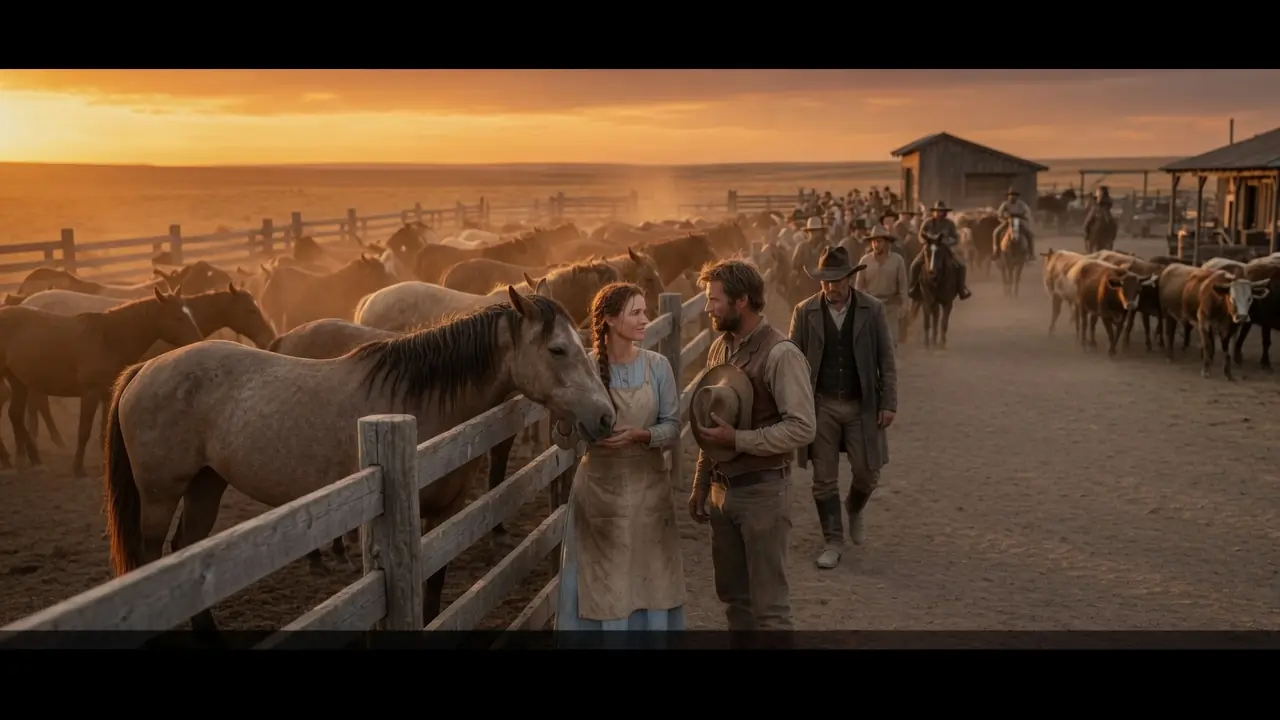
Clara pressed her blistered hand against the neck of an old bay gelding and whispered, “One more row, Moses. Just one more.”
The horse flicked an ear back toward her.
That small movement nearly broke her.
It had been weeks since anything in Mercy Flats seemed to listen to her. Men talked over her. Bankers dismissed her. Neighbors shook their heads like grief had made her foolish. But Moses listened, because horses did that when a person had earned them.
The field in front of her shimmered under the Kansas heat.
Behind her, the cultivator creaked through dry soil that had not seen decent rain in months. Her boots sank into soft dust, and sweat soaked through the collar of the faded blue work shirt she wore. The shirt had belonged to her husband, Nathan, before fever took him two winters earlier.
She had buried Nathan in February.
She had buried her father, Gideon Wren, ten months after that.
Between the two graves, Mercy Flats had decided Clara was done before Clara herself had been given any chance to decide it. A widow with debt, twelve horses, and a farm everyone said belonged to the past did not inspire confidence in a town drunk on machines.
Her father had left her land.
He had left her harness, journals, bloodlines, debts, and twelve heavy horses bred from twenty-five years of patience.
The town saw useless animals eating expensive grain.
Clara saw the last living piece of her father’s hands.
Out beyond the fence, a man laughed.
She knew the laugh before she turned her head.
Barton Cray had the kind of laugh that came from money and never from humor. It rolled out of him like he expected the world to move aside and make room for it. He sat on a polished chestnut horse beside her fence, wearing a cream-colored coat no working man could have kept clean for ten minutes.
Three hired men sat behind him.
They laughed because Barton laughed.
“Well, boys,” Barton called, “come take a look. Mrs. Wren is out here pretending the year is 1875.”
Clara did not stop walking.
The team leaned into the collar, steady and slow.
“You hear me, Clara?” Barton called again. “I’m trying to help you. This whole county has moved on, and you’re out here wearing yourself down behind dead tradition.”
“They’re horses,” Clara said.
She did not raise her voice.
“Not tradition.”
One of Barton’s men snorted.
Barton’s smile thinned.
“You know what I mean.”
“No,” Clara said, guiding the team to the end of the row. “I don’t think you do.”
She turned Moses and the off horse, a big roan named Jasper, with a touch on the line and a soft word. The horses came around clean, their shoulders shining dark with sweat. Clara gave them a moment before asking them forward again, because her father had taught her a tired horse would give you its heart if you never took it for granted.
Barton watched the pause.
Then he laughed again.
“You rest them more than you rest yourself.”
“They earn it more than I do.”
“Sentimental nonsense,” Barton said. “That’s why your father died owing money.”
Clara’s hand tightened on the lines.
For one second, the whole field seemed to stop.
The horses felt it, and she forced her fingers soft again.
A horse could read anger through leather better than most men could read a Bible.
“My father died tired,” she said.
Barton leaned in the saddle.
“There’s another word for that.”
Clara looked at him then.
Her face was sunburned, hard from grief, and younger than it looked. People used to call her pretty. That was before two funerals in one year and a town full of men treating her sorrow like an opening bid.
“What word is that, Mr. Cray?”
“Defeated,” he said. “He died defeated. Same as this farm will be if you keep pretending twelve horses can stand against the future.”
The hired men went quiet.
Even they knew he had stepped somewhere ugly.
Clara turned back to her team.
“You rode a mile out of your way to say that.”
Barton’s eyes narrowed.
“You worry me, Clara.”
“No,” she said. “I offend you.”
That landed harder than she expected.
His smile vanished.
Barton Cray owned the biggest cattle yard in Mercy Flats. He owned three steam pumps, two threshing rigs, half the freight contract to the rail spur, and enough influence at the bank to ruin a man without leaving fingerprints. He liked to believe his power made him generous when he offered to buy something for less than it was worth.
He had been trying to buy Clara’s land since spring.
Every offer had come lower than the last.
Every refusal had made him meaner.
“You’ve got a note coming due,” he said. “You’ve got feed bills. You’ve got a barn roof that leaks and a line of horses nobody wants. I’m offering mercy.”
Clara clicked her tongue to the team.
They moved forward.
“Mercy doesn’t usually come with paperwork.”
Barton’s jaw worked.
Just then, from the shade of a fence post near the road, a man pushed himself upright.
Clara had noticed him earlier but paid him little mind.
He had come with Barton’s men, though he had not laughed with them. He was lean, broad across the shoulders, and quiet in the way of men who had learned that words were sometimes poor tools. His name was Elias Boone, and every person in three counties knew him as the best horseman between Abilene and the river.
He broke horses for a living.
Though people who knew horses said Elias did not break them so much as convince them the world was not all teeth and rope.
“That’s enough, Barton,” Elias said.
Barton turned slowly.
“Beg your pardon?”
“I said that’s enough.”
Barton stared at him.
“Since when do you take orders from a widow with dirt on her face?”
“I don’t,” Elias said. “But I know when a man’s talking just to hear himself feel bigger.”
The air changed.
Clara did not turn around, but her shoulders loosened by half an inch.
She hated that he noticed.
She hated more that it helped.
Barton looked from Elias to Clara and back again. He wanted to strike, but he was too practiced for that. Men like Barton did not swing fists when debt papers could do cleaner damage.
So he went for the grave again.
“Your father was stubborn too, Clara. All that pride and all those horses. Look where it got him.”
Clara stopped.
This time the horses stopped with her.
The only sounds were flies, leather creaking, and a dry wind moving over corn leaves that curled like old paper.
Elias took one step away from the post.
Just one.
But it was enough to tell every man at that fence that if Barton kept digging, someone would answer for it.
“My father,” Clara said, “died believing work mattered even when people mocked it.”
Her voice stayed steady.
“I wish he’d lived long enough to see which of us was wrong.”
Before Barton could answer, hoofbeats came from the road.
Fast.
Too fast.
A boy rounded the bend on a sweat-dark pony, hat gone, face red with panic. It was Tommy Hale, a messenger who carried notes for the store, the bank, and anybody willing to pay him five cents. He hauled the pony up so hard it slid in the dust.
“Mr. Cray!” he shouted.
Barton turned.
“What is it?”
“The south cattle pens,” Tommy gasped. “The big pump quit. The new one. The spare pump broke yesterday, and now the main one won’t fire, and the well by the freight road’s dry.”
Barton’s face changed.
The color drained out of it slowly.
Tommy swallowed and kept talking because a child does not yet know how to soften disaster.
“Mr. Dawson said there’s already cattle down. Four or five. Maybe more now. They don’t have water, sir. They don’t have any way to move water.”
Barton sat very still.
His hired men stopped grinning.
Clara knew the numbers as well as any rancher did. Four hundred head in killing heat. No pump. Dry well. No working freight horses left because most men had sold their teams once Barton convinced them steam was cheaper.
Cattle did not wait politely for men to solve mechanical problems.
They went down.
Then more went down.
Then a man’s herd became bones, debt, and silence.
“Get every barrel in town,” Barton said.
Tommy looked at him helplessly.
“Sir, there ain’t water to put in them. And no teams to haul them if there was.”
The boy’s eyes drifted past Barton.
Across the fence.
To Clara’s field.
Six horses stood in harness, tired but solid, breathing deep and steady. Six more waited in the barn behind the cottonwoods, eating feed everyone said Clara could not afford. Twelve living engines in a county where every iron engine had failed.
The boy’s mouth opened.
No one laughed now.
Barton followed his eyes.
So did the hired men.
So did Elias Boone.
Clara felt every one of them looking.
For months, her horses had been called useless, backward, expensive, sentimental. Now they were the only strong things left between Barton Cray and the collapse of everything he had built.
“Mrs. Wren,” Barton said.
His voice had gone soft.
Too soft.
Clara turned halfway.
“Yes?”
“I need your teams.”
“I expect you do.”
“I’ll pay,” he said quickly. “Whatever is fair for the day. Just until the pumps are running. Just enough to haul water.”
Clara looked at him.
“You came to my fence this morning to call my father defeated.”
Barton’s mouth tightened.
“This isn’t about that.”
“You came to tell me I was a fool.”
“Cattle are dying.”
“You called my horses dead tradition.”
His control slipped.
“Damn it, woman, would you let four hundred head die just to make a point?”
There it was.
The one place he knew to press.
Because Clara could bear insult.
She could bear hunger.
She could bear gossip, debt, and loneliness so sharp it sometimes felt like another person in the house.
But she could not bear a living thing dying of thirst while she had the means to stop it.
Barton knew that.
Cruel men often know exactly where kindness lives in other people.
Clara looked toward town.
Toward the unseen pens.
Toward animals who had never laughed at her, never mocked her father, never offered half price for her land.
“No,” she said.
Barton exhaled.
“Then we’re agreed.”
“I didn’t say you could take my horses.”
His breath stopped.
“You just said—”
“I said I wouldn’t let them die.”
She turned fully now.
“My horses don’t go anywhere under your men’s hands. I’ve seen how they handle stock. They jerk, whip, curse, and rush because that is the only language you’ve taught them.”
One hired man looked away.
Clara went on.
“I’ll bring the teams myself. I’ll drive them myself. I’ll rest them when they need rest and water them before they founder. No man touches a rein unless I say so.”
Barton stared at her.
“You’re setting terms?”
“I am.”
“To save my herd?”
“To save the cattle,” she said. “Not you.”
The difference struck him.
For a long moment he said nothing.
Clara looked down the empty road.
“You can agree, or you can find another twelve horses still standing.”
There were no other twelve.
They all knew it.
Barton gave one hard nod.
“Your terms, Mrs. Wren.”
“Say it plain.”
His face burned.
“Your terms.”
Clara nodded once.
Then she turned her back on him and began unhitching the team from the cultivator.
Elias Boone climbed over the fence instead of walking to the gate.
Clara heard him cross the turned earth and stop beside her.
When she looked up, his hat was in his hand.
Not tipped.
Removed.
“Ma’am,” he said, “I rode here with the wrong company this morning.”
“That so?”
“Yes, ma’am.”
She unbuckled a trace.
“Most people in Mercy Flats have kept poor company where I’m concerned.”
“I saw you water Jasper before you took a drink.”
Clara’s fingers stilled.
Elias looked at the horses, not at her face, and that made it easier to hear him.
“A person can fake pride. Can’t fake that. You learned it young.”
“My father taught me.”
“I figured.”
He held his hat against his chest.
“I’d like to ride with you. I know panicked cattle, and I know horses. I won’t touch your teams except how you tell me.”
Clara studied his hands.
Scarred.
Careful.
Horse hands.
“You take orders from women often, Mr. Boone?”
“Not often enough to know if I’m good at it.”
The corner of her mouth almost moved.
Almost.
“Can you keep your hands soft when men around you start yelling?”
“Yes, ma’am.”
“Can you keep Barton’s men away from my horses?”
“I can.”
“Then get the gray team from the barn.”
He put his hat back on.
“Yes, ma’am.”
The barn was cooler than the yard, but not by much.
Six horses lifted their heads when Clara came in. A black mare named Sunday. A gray gelding named Atlas. Two chestnuts called Ruth and Rowan. A big buckskin named Preacher. A spotted bay her father had named Mercy because, he said, every farm needed some.
Clara went down the line, touching each neck.
“Easy,” she whispered. “We’ve got work.”
Elias stopped inside the door.
She heard the silence in him.
It was not ignorance.
It was recognition.
He knew what he was looking at.
“These are Wren horses,” he said quietly.
“They are.”
“I heard stories.”
“Most of them unkind.”
“Most people don’t know what they’re seeing until it’s gone.”
Clara pulled harness from the peg.
“The gray hates a hand coming behind his left ear. The mare will test you once, maybe twice. Don’t pull on her. Ask.”
Elias took the collar carefully.
“Yes, ma’am.”
She watched him from the corner of her eye.
There were men who handled horses like tools.
There were men who handled them like enemies.
Elias Boone handled a horse like a conversation, leaving room for the animal to answer.
By the time Atlas was collared, the gray had lowered his head into Elias’s hand.
Clara looked away before Elias could see what that did to her.
She had thought her father’s kind of gentleness had died with him.
Seeing it in another man hurt in a way she had not expected.
They took the road south with all twelve horses moving in pairs.
Word outran them.
By the time they passed the Bell place, people had started gathering along fences, porches, and dry ditches. Some came to watch her fail. Some came because disaster always drew eyes. Some stood with shame already creeping over them, though they did not yet know what to do with it.
Mrs. Ruth Bell came running into the road, apron flapping.
“Clara Wren,” she cried, “tell me they lied. Tell me you’re not taking your father’s horses to help Barton Cray.”
Clara slowed but did not stop.
“I’m taking them to help cattle.”
“After what he’s done to you?”
“The cattle didn’t do it.”
Ruth’s eyes filled.
“You are too good for this town.”
“No,” Clara said. “I’m just too stubborn to let something die when I can stop it.”
She rode on.
Elias rode beside her in silence for a while.
Then he said, “You help her, don’t you?”
“Ruth?”
“Yes.”
“She’s got no sons. I put in her corn twice a year.”
“She pays?”
“Eggs when she has them.”
“And when she doesn’t?”
Clara looked ahead.
“Then she pays next season.”
Elias was quiet.
Then he said, “Barton doesn’t hate you because you’re backward.”
Clara glanced at him.
“He hates you because every time you help someone for nothing, you make his prices look like theft.”
That thought settled coldly under her ribs.
She had believed Barton mocked her because he wanted her land.
Now she understood that he wanted something else too.
He wanted the town to believe there was no way to survive except his way.
And all summer, without meaning to, Clara had been proving him wrong.
The south pens came into view just before noon.
It was worse than Tommy had said.
It always was.
The cattle stood packed under a sun that seemed to press them into the dirt. Their heads hung low. Their tongues lolled. A few bawled weakly, but most had gone quiet, and Clara hated that most of all.
A frightened animal made noise.
A dying one saved breath.
Five were down along the far fence.
Two were already gone.
Men rushed around with buckets and curses, doing the useless work of people who had waited for machines to solve everything and had never learned what to do when the machines did not.
Barton rode up as Clara entered.
“What took you so long?”
Clara did not even look at him.
“Your herd’s still alive, so I came fast enough.”
His face tightened.
She swung down and took in the yard.
“The chute tank?”
“Quarter full,” one man said.
“Any pipe working?”
“No.”
“Then we haul by barrel.”
She pointed to Elias.
“Atlas and Sunday on the stone sled. Moses and Jasper after that. Rotate every twenty minutes. No team pulls past its breath.”
She turned to Barton’s men.
“You, clear the south rail. You, get every empty barrel by the chute. You, stop waving your arms near those cattle before you send them through the fence.”
The men stared at her.
Barton snapped, “Do what she says.”
That was the first time Mercy Flats heard Barton Cray take second place.
A few people along the fence exchanged looks.
Clara heard them.
She ignored them.
For the next six hours, the south pens became labor, dust, and water.
There was no miracle.
Only muscle.
Only barrels filled from the tank, loaded onto sleds, hauled through heat, and tipped into troughs while desperate cattle pushed, shoved, and trembled. Clara moved like a person built for the moment, giving orders before others saw the need, reading horses and cattle with the same steady eye.
She watered her teams one swallow at a time.
No more.
No less.
She rested them before their legs shook.
When Barton’s foreman tried to slap a horse forward with a rope end, Elias Boone caught his wrist so fast the man cried out.
“She said no one touches them,” Elias said.
The foreman looked toward Barton.
Barton looked away.
The crowd grew.
By midafternoon, half of Mercy Flats stood along the fence watching the widow they had mocked do the one thing no machine could do. The laughter left their faces first. Then the pity. Then something older and heavier took its place.
Respect rarely arrives loudly.
It comes like weather turning.
Slow at first.
Then everywhere.
When the third steer went down near the trough, Clara knelt beside it and put her hand on its neck. She stayed until she knew it was gone. Then she stood, wiped her hand on Nathan’s old shirt, and said, “That’s three. We are not losing four.”
No one argued.
Not even Barton.
Near dusk, Marshal Jonah Reed rode into the yard.
He was a square-built man with tired eyes and a reputation for being slow because he disliked mistakes. He sat his horse and studied the scene—the working teams, the saved cattle, Barton Cray holding a shovel, and Clara Wren black with dust from collar to boot.
“Mrs. Wren,” he said, removing his hat. “I hear you brought your horses down.”
“You heard right.”
The marshal looked at Barton.
“She saved your herd?”
Barton’s face twitched.
“She helped.”
A murmur moved through the fence line.
Clara looked at him.
“I did not help your herd, Mr. Cray. I saved the cattle.”
Barton’s pride, beaten down all day, found one last place to stand.
“And you’ll be paid for it.”
“I expect fair pay.”
“Fair is what I decide for use of teams on my property.”
Clara’s eyes lifted.
Every sound in the yard seemed to fall away.
“Your property?”
Barton realized too late that he had chosen the wrong words.
Still, he kept going because men like him often mistake momentum for strength.
“You’re behind on your note, Clara. Three months. Don’t forget that while you’re standing here acting like the queen of Kansas. Come fall, I can own that farm, that barn, and every horse in it if I choose.”
The marshal went still.
The crowd went silent.
Clara stood with sweat drying in white streaks on her face.
“There it is,” she said softly. “That’s the man I’ve been waiting for Mercy Flats to see.”
Barton’s mouth closed.
Marshal Reed stepped down from his horse.
“You hold her note?”
Barton looked at him.
“It was for sale.”
“How many others?”
“What?”
The marshal’s eyes narrowed.
“How many notes, Barton?”
Barton said nothing.
Reed looked toward the crowd.
“I’ve watched eleven families lose land in six years. The Harpers. The Lowes. The Kinney place. The old Mill Creek farms. Every one of them rented your machines before they went under.”
Barton’s face hardened.
“That’s business.”
“And every note ended up in your hands after the bank called it.”
The silence deepened.
It became the kind of silence a town makes when it finally hears its own guilt spoken aloud.
Marshal Reed turned back to Barton.
“You haven’t broken the law.”
Barton smiled faintly.
“Then we’re finished.”
“No,” Reed said. “We’re beginning.”
The smile vanished.
“I may not be able to arrest a man for finding every crack in the law and filling it with greed. But I can look through every paper you own. I can ride to the county seat tomorrow. I can make sure every person in this county knows exactly how you got rich.”
He glanced toward Clara.
“And I can tell them who saved your herd while you threatened to steal her father’s land.”
Barton stood in the dust with a shovel in his hand and the whole county staring at him.
For the first time anyone could remember, he had no answer.
Clara did not feel victory.
She was too tired for victory.
She only felt the strange sensation of a burden shifting.
Not leaving.
Just no longer carried alone.
Elias came to stand beside her.
Not touching.
Close enough that everybody saw the meaning.
“You all right?” he asked quietly.
“No.”
She looked toward her horses.
“But I will be.”
They got all twelve horses home by moonrise.
Every one of them walked in on its own four feet.
The next morning, men who had mocked Clara took off their hats when she passed through town. She did not know what to do with that. Hatless respect felt heavier than laughter somehow.
For eleven days, Mercy Flats changed.
Not perfectly.
Not permanently yet.
But enough.
People brought grain. Someone patched the barn roof without asking. Ruth Bell baked bread and carried it over wrapped in a towel. The Harper boys repaired a broken gate and left before Clara could refuse them.
Elias came every morning at first light.
He never said he was helping.
He simply found work and did it.
On the seventh day, Clara found him mending the irrigation ditch her father had started before he died.
“Mr. Boone,” she said, hands on her hips, “I did not hire you.”
He looked up from the ditch.
“No, ma’am.”
“Then why are you here?”
“Ditch was unfinished.”
“That is not an answer.”
“It is the truest one I’ve got.”
She should have sent him away.
She had spent two years becoming a woman who needed no one because needing people had cost too much. But there was a difference between a man trying to rescue her and a man willing to stand beside her while she rescued herself.
Elias knew the difference.
That was why she let him stay.
On the twelfth night, the dust came.
Clara woke before the storm fully arrived because people raised on the plains know the sound of dry wind. It moaned low across the ground, gathering itself, dragging the skin of the earth behind it. She sat up in darkness with one thought already formed.
The horses.
She was in the barn before the first wall of dust reached the yard.
One by one, she brought them in, bolted doors, checked water, covered gaps with feed sacks. She was tying down the last shutter when hoofbeats tore through the wind outside.
For one terrifying second, she thought it was Elias.
It was Tommy Hale.
He half fell from his pony at her gate.
“Mrs. Wren!” he shouted over the wind. “Mr. Cray sent me!”
Clara opened the barn door just enough to hear him.
“What happened?”
“The Mill Creek bottom. He moved cattle there for what grass was left. Storm pushed in fast, and now they’re trapped against the dry creek bank. A hundred head, maybe more. They’re going to stampede into the freight cut.”
Clara’s stomach tightened.
The freight cut was narrow, steep, and already choked with dust.
A herd could pile into it blind and smother.
“Where’s Elias?”
Tommy swallowed.
“He rode that way from town when word came.”
The wind seemed to go silent inside her.
Elias was already out there.
Alone.
That decided what conscience had not yet finished deciding.
Clara turned into the barn and began pulling harness from the wall.
She chose six horses.
The strongest.
Moses, Jasper, Atlas, Sunday, Mercy, and her father’s favorite old black mare, Juniper.
“You will ride to Ruth Bell’s and stay there,” Clara told Tommy. “You hear me? You do not go back to that bottom.”
“But Mr. Cray said—”
“I don’t care what Mr. Cray said. You’re a child, and children don’t die for cattle.”
She tied a lantern to her saddle and slipped her father’s worn field journal inside her coat.
Then she led the six horses into the storm.
The ride to Mill Creek was the worst of her life.
Dust turned the world into a brown wall. The wind ripped at her breath and filled her eyes with grit. She rode by memory, by fence line, by the feel of the road under the horse’s feet, trusting land she had known since childhood.
The herd sounded like thunder before she saw it.
A terrible, panicked thunder.
Then a rider appeared through the dust.
“Clara!”
Elias came alongside her, bandana over his face, eyes red from grit.
“You came.”
“You sound surprised.”
“I prayed you wouldn’t. Then I prayed you would.”
“Where are they?”
“Packed against the creek bank. If they break, they’ll go for the freight cut.”
“We turn them upstream.”
“There’s no opening.”
“There is,” Clara said. “The old ford.”
Elias stared at her through the dust.
“Can they climb it?”
“If we get the leaders pointed right, yes.”
“And if we don’t?”
“Then they die in the cut.”
The answer hung between them.
Clara leaned closer.
“I need you at Atlas’s head. I can drive the team, but I can’t hold the leaders and the lines both.”
Elias looked toward the unseen herd.
“That’s a bad place to put a horse.”
“I know.”
“That’s a bad place to put us.”
“I know that too.”
She looked at him.
“I’m asking. Not ordering.”
Elias’s eyes changed.
Even in the storm, she saw it.
“Mrs. Wren,” he said, “I would ride into worse beside you.”
They went in.
No one later could tell the story properly.
Not the men who were there, not Barton’s hands, not Barton himself. Storm work is not something memory holds in clean lines. It holds flashes.
The gray shoulder of a horse in dust.
A lantern swinging, then going dark.
Clara’s voice cutting through wind.
Elias at the head of Atlas, calm in a place where calm had no business surviving.
Cattle surged toward the cut twice.
Twice Clara threw the team across them, not striking, not forcing, but making a living wall where there had been only panic. Horses trusted hands they knew. That trust held when iron and shouting would not.
Slowly, painfully, the front of the herd turned.
One step.
Then another.
The leaders found the old ford.
The herd began to pour upstream, away from the killing cut, toward high ground.
For one breath, Clara believed they had done it.
Then Juniper went down.
The old black mare dropped in the traces with a sound Clara would hear in dreams for years. Not a scream. Worse. A heavy, exhausted collapse of a living thing that had given everything it had.
Clara was out of the saddle before thinking.
“Whoa!” she shouted. “Hold them!”
Elias turned.
“Clara, the herd!”
“Hold them!”
Barton stumbled out of the dust, hat gone, coat torn, face wild.
“What are you doing?” he shouted. “Get up! The herd’s still moving!”
Clara knelt beside Juniper, hands on the mare’s neck.
The old horse’s sides heaved.
Her eyes rolled white.
“Get up!” Barton screamed. “That’s one horse. I’ve got a hundred head out there!”
Clara looked up at him.
Dust streaked her face.
Her voice was quiet, but the storm did not swallow it.
“Then lose them.”
Barton stared.
“If it comes to your profit or this horse’s life, you lose every time. That is the difference between you and me.”
He grabbed her arm.
Elias hit him like a storm breaking.
He did not strike him, but he tore Barton backward so hard the man nearly fell.
“That horse,” Elias said, voice low and dangerous, “has done more honest work for this county than you have in your entire life.”
Barton froze.
Elias stepped between him and Clara.
“She hauled water to your cattle in the heat. She came into this storm because you begged for help from a woman you tried to ruin. And now you stand over her talking about profit?”
Barton said nothing.
“Get back to your herd,” Elias said. “Or I will put you in the dirt and let the cattle decide whether you’re worth saving.”
Barton backed away.
For the first time in his life, he looked not angry, but ashamed.
The herd made it to high ground.
Juniper made it too.
It took an hour to get her back on her feet. Clara talked to her the whole time, low and steady, one hand on the mare’s neck, one hand against her chest where her father’s journal rested beneath her coat.
“Come on, old girl,” she whispered. “Come back to me.”
When Juniper finally stood, swaying but alive, Clara put both arms around the mare’s neck and broke.
She had not cried at Nathan’s funeral.
She had not cried when her father died.
She had not cried when Barton mocked her, threatened her, or made the whole town laugh at the last thing her father left behind.
But in the thinning dust, with Juniper alive under her hands, Clara Wren wept like grief had finally found the door.
Elias stood close and said nothing.
That was the kindest thing he could have done.
At dawn, the road home was lined with people.
No one cheered.
No one knew how.
As Clara rode past with six exhausted horses and Juniper walking slow but sound, every man along that road removed his hat. Women stood on porches with hands pressed to their mouths. Children watched without being told to quiet down, because even children understand when something sacred is passing.
Clara looked down at her hands.
“Steady,” Elias said beside her.
“I never wanted this.”
“I know.”
“I only wanted them to leave me alone.”
“That’s why it means something.”
By noon, she slept.
While she slept, Mercy Flats came to her farm.
Men patched the barn.
Boys cleared the ditch.
Women brought bread, eggs, butter, coffee, bacon, and grain. Someone mended the corral gate. Someone stacked wood by the kitchen door. Someone left a new coil of rope on the porch with no note.
Clara woke to hammering and nearly panicked.
Then she stepped outside and saw the town doing what shame had finally taught it to do.
Work.
An old farmer named Samuel Pike climbed down from her barn roof when he saw her.
He held his hat in both hands.
“Roof won’t leak now,” he said.
Clara stared at him.
Samuel cleared his throat.
“Your father fixed my well one winter when I had pneumonia. Never charged me. I forgot that until I was up there with a hammer in my hand.”
His voice cracked.
“I laughed at you in June. I’m sorry for that.”
Then he walked away before she could answer.
One by one, the town left pieces of apology in work.
Not words.
Work.
Clara did not know how to receive it.
Elias stood beside her.
“You can let them,” he said.
“I didn’t ask.”
“That’s why they came.”
The debt still remained.
Respect did not clear a bank note.
Eggs did not erase interest.
A repaired roof did not stop Barton Cray from holding a legal claim over her land.
Three days later, Marshal Reed rode into her yard with a folded paper in his coat.
Clara saw his face and felt the old fear return.
“Mrs. Wren,” he said, “I need you to hear this sitting down.”
“I’ll stand.”
Elias came from the barn and stopped beside her.
The marshal looked from one to the other.
“Barton Cray filed papers yesterday.”
Clara’s stomach turned.
“On my note?”
“Yes.”
She nodded once.
Of course.
Of course a man like Barton did not change in a storm. Of course shame could not last past sunrise. Of course hope had been a foolish thing to let near her.
“He filed to release it,” the marshal said.
The words did not make sense.
Clara blinked.
“What?”
“Your note is forgiven. Cleared in full. Recorded at the county seat. Your land is yours, free and clear.”
He held out the paper.
Clara took it but could not read it.
Her eyes would not focus.
“That isn’t all,” the marshal continued. “He released the others too. The Lowes. The Harpers. The Kinney land. Every note he held from families he broke through those machines.”
The yard went silent.
“He’s giving the land back where he can. Where families moved on, the county will hold it until kin are found.”
Clara looked toward the road.
“Why?”
Marshal Reed took off his hat.
“I asked him.”
A long pause.
“He said he stood in a dust storm and watched you choose one old mare over a fortune in cattle. Said you told him he could lose every head before you’d trade a living thing’s life for profit.”
The marshal’s voice grew rough.
“He said he realized he had spent his whole life doing exactly that. Trading living things for profit.”
Clara pressed the paper against her chest.
“He said he never earned trust from anything alive,” Reed continued. “Not a horse. Not a neighbor. Not a child. Not even a dog. He said all he ever owned was machinery, paper, and fear.”
Elias looked down.
The marshal folded his hat between his hands.
“He’s selling the machines. Selling most of the cattle. Keeping one small ranch he says he came by honestly. Says he means to learn how to work before he dies.”
No one spoke for a long time.
Then Elias said quietly, “Your father did this.”
Clara looked at him.
“No.”
“Yes,” Elias said. “Through you.”
That broke something in her.
For two years, she had carried her father’s last words like a stone under her ribs. He had apologized for leaving her horses instead of money. He had called them a burden. He had died believing the world had moved past him.
Now the county that laughed at his horses was learning from them.
The man who tried to ruin his daughter had been changed by them.
The land was safe because of them.
Clara covered her face with her hands and cried in her own yard, in front of Elias, the marshal, Ruth Bell, and half the people who had gathered when word spread.
No one looked away.
That was respect too.
Barton Cray came at sunset.
He rode a plain brown horse, not the polished chestnut. He wore work clothes. His face looked older than it had a week before.
He stopped at Clara’s gate and did not enter.
She walked down to meet him.
“I heard you know,” he said.
“I know.”
“It doesn’t fix what I did.”
“No.”
“I don’t expect forgiveness.”
“Good.”
He flinched, but he accepted it.
“I wanted you to hear one thing from me,” he said. “Your father was right.”
Clara’s throat tightened.
Barton looked past her toward the barn.
“A machine stops when the world gets hard. Those horses kept going because they trusted you. I never understood that. I thought trust was something weak people talked about when they didn’t have money.”
He removed his hat.
“I was wrong.”
Clara studied him.
“You gave the land back.”
“I did.”
“Why?”
“Because for the first time in my life, I saw what I had bought.”
His voice cracked slightly.
“And it was uglier than being poor.”
Clara did not comfort him.
That would have been false.
But she gave him truth.
“You can’t buy back trust, Mr. Cray.”
“I know.”
“You earn it slowly.”
“I know that now.”
She looked toward the barn.
“My father said a good horse remembers every hand that ever hurt it. But it also remembers every hand that showed patience.”
Barton swallowed.
“That mean there’s hope for me?”
“It means you can start.”
He nodded.
Then he bowed his head to her, mounted his horse, and rode away poorer than he had come, though perhaps for the first time not empty.
The next spring came green.
Mercy Flats did not become perfect because towns do not heal in one season. Some families forgave Barton Cray. Some never did. Both were allowed. Clara made sure of that.
But the old way returned.
Not as nostalgia.
As survival.
Families came to the Wren farm to learn horse handling. Boys who had grown up around engines learned how to collar a team without making the horse flinch. Widows borrowed teams and paid with labor when they had no money. Men who once rented machines from Barton now traded hours, seed, wood, skill, and work.
Clara called it the Wren Exchange.
Elias called it common sense.
Ruth Bell called it grace with dirt under its fingernails.
Juniper lived through winter.
In March, the old black mare dropped a filly with a white star on her forehead. Clara sat in the straw, watching the newborn struggle up on trembling legs, and laughed through tears when the filly stood.
“What will you name her?” Elias asked.
Clara touched the tiny star.
“Legacy.”
Elias smiled.
“Your father would like that.”
“He left one,” Clara said.
“Yes, ma’am. He did.”
By summer, Elias Boone no longer pretended he came by only because work needed doing.
The town had married them in gossip months earlier, but Elias never rushed her. He knew Clara had built herself back from grief one board, one harness, one morning at a time. A man did not walk into that and start moving furniture.
One evening, as the sun lowered behind the barn, he stood beside her at the fence.
“Clara,” he said.
It was the first time he had used her name without accident or emergency.
She looked at him.
“I love you,” he said simply. “I have for a while. I’m not asking you to need me. You don’t. I’m asking whether you might want me beside you.”
Clara stared out at the pasture.
The twelve horses grazed in the gold light.
Legacy stumbled near Juniper and then found her legs again.
“I spent two years proving I didn’t need anybody,” Clara said.
“I know.”
“It was lonely.”
“I figured.”
She looked at him then.
“I don’t need you, Elias Boone.”
His face stayed still, but his eyes softened.
“I know that too.”
“I want you.”
That was all.
For a careful man and a stubborn woman, it was enough.
They married in October under the cottonwoods at the edge of the Wren farm. Ruth Bell cried through the whole ceremony. Marshal Reed stood witness. The families who had gotten their land back filled the yard with food, music, children, and horses tied along the fence.
Barton Cray came late.
He stood at the far edge of the property, hat in hand, not sure whether he had earned the right to come closer.
Clara saw him.
After the vows, she walked across the yard in her wedding dress and stopped at the fence.
“You plan to stand out here all day?”
Barton looked down.
“I didn’t want to presume.”
“Then don’t presume,” she said. “Come eat because I invited you.”
His eyes lifted.
“Why?”
“Because you started.”
He looked toward the gathered families.
“Not everyone wants me here.”
“They don’t have to forgive you to watch you try.”
Barton nodded slowly.
Then he entered through the gate.
Not as a rich man.
Not as the man who owned Mercy Flats.
Just as a man with a plate in his hand, sitting at the far end of a table, learning the long work of being worthy of trust.
That night, after the last wagon left, Clara and Elias walked to the barn together.
The twelve horses stood quiet in fresh straw. Juniper dozed with Legacy pressed against her side. The irrigation ditch her father had drawn in his journal ran softly beyond the barn, carrying water across land that was finally, completely hers.
Clara stood in the doorway.
For the first time in years, thinking of her father did not hurt like an open wound.
It hurt like love.
“You didn’t fail,” she whispered into the warm dark of the barn. “You hear me, Daddy? They laughed at your horses, but the horses outlasted every machine in the county.”
Elias put an arm around her shoulders.
She leaned into him, not because she had to.
Because she chose to.
Behind them, the horses shifted softly in the straw.
Outside, Mercy Flats slept under a sky washed clean after a brutal year.
The machines had failed when the world got hard. The steam pumps had cracked, the iron wheels had rusted, and the men who believed money could replace trust had learned what drought could do to pride.
But the horses kept going.
They kept going through heat.
Through dust.
Through darkness.
Through every mile where love, patience, and earned trust mattered more than noise and steel.
Gideon Wren had died believing the county would never learn that lesson.
His daughter taught it to them anyway.
And Mercy Flats never forgot.