The laughter carried farther across the field than the sound of the old grain drill.
Margaret Hold heard both.
The laughter came sharp and irregular from four men leaning against the wire fence at the western edge of her property. The drill answered with an uneven metallic clatter, a rhythm of chains, sprockets, seed cups, worn shafts, and rusted iron that sounded as if the entire machine were objecting to being awakened after years of abandonment.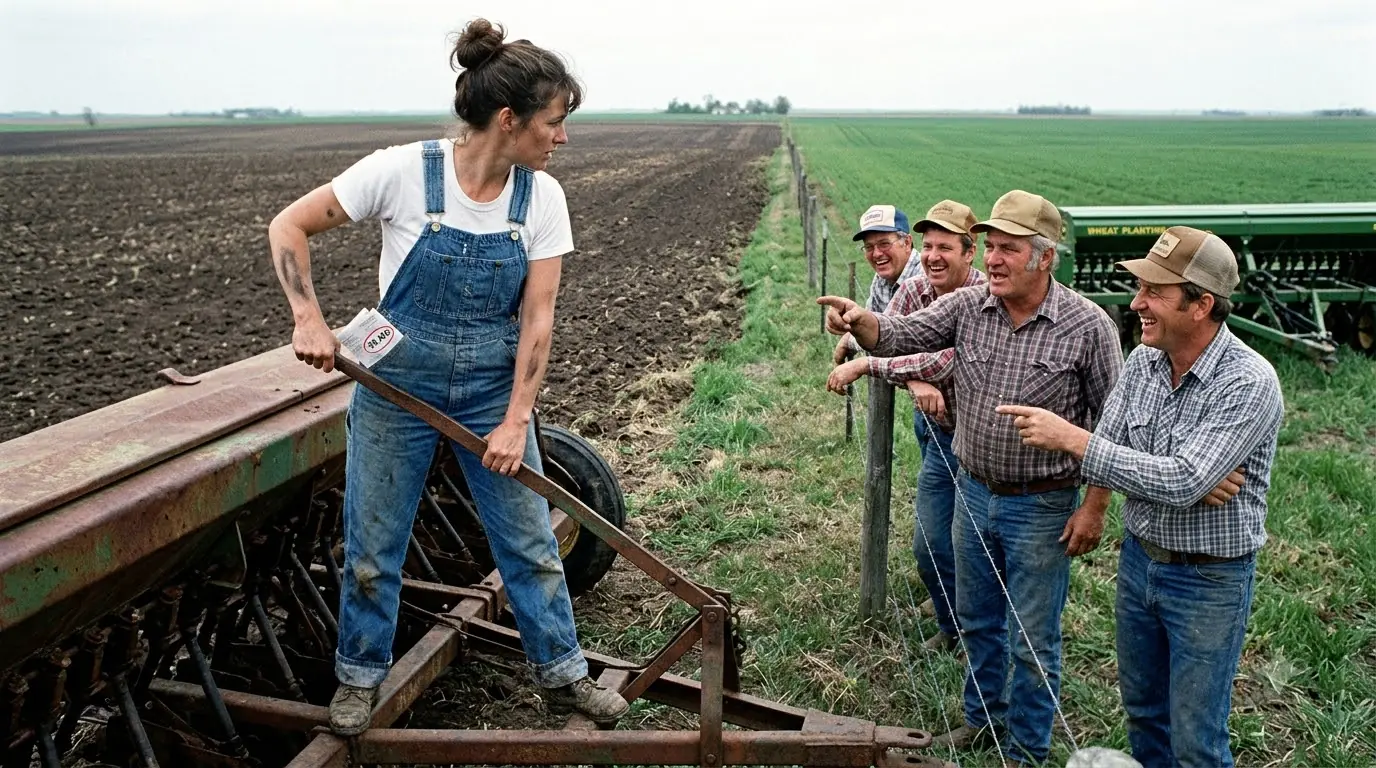
Margaret trusted the machine more.
She stood high on its narrow frame with one boot braced against a crossmember and both hands wrapped around a long adjustment lever. Grease streaked her forearms. Dust clung to her white T-shirt beneath faded blue denim overalls, and dark strands of hair had escaped the knot behind her head and stuck to her damp face.
It was only April.
Kansas was already hot enough to make metal burn through gloves.
“Careful, Margaret!” a voice shouted from the fence. “That antique might remember the Civil War and fall apart from the excitement.”
The other men laughed.
Margaret looked over.
Roy Demer stood closest to the gate.
At fifty-one, Roy farmed more than two thousand acres of wheat across Dickinson and Saline counties and carried himself with the confidence of a man whose methods had worked long enough that he no longer considered them methods. To Roy, wheat was not simply a crop.
It was farming.
Everything else was experimentation.
He wore a tan cap, plaid shirt, faded jeans, and the satisfied expression of someone who believed the scene unfolding before him would eventually become a story told at Margaret’s expense.
Beside him stood Harvey Quinn, Leon Barker, and Paul Sutter, all neighboring farmers, all older than Margaret, and all watching her wrestle with the old John Deere drill as though she were attempting surgery with a hammer.
Roy pointed toward the machine.
“You know the salvage yard pays by weight.”
Margaret tightened the final bolt.
“Then I’ll keep that in mind when I’m finished with it.”
“You planning to finish this year?”
She wiped one wrist across her forehead.
“That depends.”
“On what?”
“How long you stand there talking.”
Harvey laughed.
Roy did not.
He stepped closer to the fence.
“You bought six hundred and forty acres you could barely afford, and now you’re going to plant it with that?”
Margaret looked toward the drill.
“Part of it.”
Roy frowned.
“Part?”
“Two hundred acres grain sorghum.”
The men exchanged glances.
“Hundred sixty oats.”
Paul made a face.
“Oats?”
Margaret continued.
“Hundred forty sunflowers.”
Then:
“Rest wheat.”
Roy stared.
The laughter returned harder than before.
Margaret climbed down.
Roy spread both arms.
“You bought the Kellerman place to turn it into a seed catalog?”
“It’s my land.”
“For now.”
That stopped the laughter.
Margaret looked directly at him.
Roy nodded toward her breast pocket.
“Everybody knows what that place cost.”
Not everybody knew.
But farmers knew enough.
The Kellerman acreage had come onto the market the previous fall after Walter Kellerman’s sons decided they wanted cash rather than soil. Margaret already owned 560 acres beside it, most inherited from her father and expanded slowly through purchases that had taken nearly fifteen years.
The Kellerman tract was different.
Large.
Expensive.
Too important to ignore because once someone else bought it, Margaret’s farm would remain boxed between larger operations forever.
She bought it.
That required debt.
More debt than Margaret liked.
Her next payment was $9,400.
She carried the statement folded inside her pocket as though paper could become heavier through awareness.
Roy knew about the loan.
So did half the county.
He pointed toward the green fields beyond Margaret’s boundary.
“My wheat’s already up.”
“So is Harvey’s.”
“Leon’s.”
“Everybody planted early.”
Margaret nodded.
“I noticed.”
“And you’re still changing plates on Grandpa’s museum piece.”
Margaret removed the folded statement.
Looked at the circled payment.
Then back at Roy.
He smiled.
“Wheat always comes back.”
Margaret folded the paper again.
“Maybe.”
“Not maybe.”
Roy pointed across the county.
“Wheat built this place.”
Margaret slipped the statement into her overalls.
“Wheat also ruined plenty of people who thought yesterday’s price was a promise.”
Roy laughed.
“That what some university pamphlet told you?”
“No.”
“My father.”
Roy’s smile disappeared slightly.
Margaret reached for the drill.
“Better four markets than twelve hundred acres begging one buyer for mercy.”
Roy shook his head.
“You’ll lose money switching equipment.”
“Lose days harvesting.”
“Pay more storage.”
“Buy four kinds of seed.”
“Fight four kinds of weeds.”
“And when wheat jumps back up, you’ll be stuck watching everybody else make money.”
Margaret grabbed the lever.
“Then keep planting what worked yesterday, Roy.”
The men quieted.
She locked the mechanism into place.
“I’m betting my farm on what survives tomorrow.”
Then she climbed back onto the old drill.
Roy watched for another minute.
Finally he turned away.
“Come on.”
Harvey followed.
Leon too.
Paul lingered.
He looked at Margaret.
Then at the drill.
“You really think wheat’s going down?”
Margaret answered honestly.
“I don’t know.”
Paul frowned.
“Then why do this?”
“Because I don’t know.”
That answer bothered him more than certainty would have.
He walked away.
Margaret restarted the tractor.
The drill began moving.
And behind it, shallow rows opened across the Kansas soil.
Margaret’s father, Henry Hold, had believed farming punished certainty.
He had never attended college.
Never owned more than seven hundred acres.
Never used phrases like risk distribution or commodity exposure.
But he had understood their meaning long before Margaret learned the terminology.
When she was nine, Henry stood beside a hail-damaged wheat field and said:
“Never ask a crop to save your whole life.”
Margaret remembered the sentence because the field looked impossible.
Every stalk bent.
Green heads scattered through mud.
Their neighbor had lost the same storm.
He had planted nothing but wheat.
The Hold farm had cattle, alfalfa, corn, wheat, and a small orchard Margaret’s mother considered mostly useless.
That year the cattle carried them.
Two years later cattle prices collapsed and wheat did the work.
Henry never described diversification as strategy.
He called it:
“Making sure one bad thing doesn’t get to become every bad thing.”
Margaret grew up hearing it.
Then ignored it briefly after he died.
At twenty-seven, she inherited most of the farm.
She simplified.
Wheat prices were strong.
Machinery was already available.
Local elevators understood it.
Everyone nearby planted it.
One crop made operations easier.
For three years, Margaret loved simplicity.
Then came 1981.
Prices softened.
Inputs did not.
Interest rates hurt anyone carrying debt.
A fuel bill that once irritated her began frightening her.
Margaret survived because the farm still had almost no mortgage.
That protection made her think differently.
She began writing numbers down.
Not only yields.
Prices.
Storage.
Transportation.
Seed cost.
Fertilizer.
Fuel.
Interest.
Crop insurance.
Rainfall.
She kept notebooks stacked in an old kitchen cabinet.
At first there was no grand plan.
Only questions.
What happened to sorghum prices when wheat fell?
How much moisture did sunflowers require?
Could oats use fields too marginal for higher-input wheat?
Which crops shared equipment?
Which did not?
Which buyers operated within trucking distance?
How did harvesting schedules overlap?
Margaret drove to extension meetings where she was often the only woman who was not someone’s wife.
She asked questions.
Some men answered helpfully.
Others answered slowly, as though explaining farming to somebody who had wandered in from the library.
Margaret listened either way.
Information had no pride.
That made it useful.
By 1984, she had become convinced of one thing.
She could not predict the next collapse.
But she could decide whether the collapse would own every acre.
Then the Kellerman land came up for sale.
And all Margaret’s theoretical planning became expensive.
The 640 acres bordered her southern line.
Excellent access.
Mixed soil quality.
A small grain shed.
Two wells.
An equipment lean-to.
The property would make Margaret’s operation large enough to support more efficient custom arrangements and better negotiate freight.
It would also place her in debt until 1994 if everything went according to plan.
Margaret hated that sentence.
If everything went according to plan.
Nothing in agriculture ever did.
Her banker, Charles Benton, sat across from her in December 1984.
“You can service this note with wheat.”
Margaret looked at his projection.
“Using what price?”
He pointed.
“Current regional average.”
“That’s not what I asked.”
Charles looked up.
Margaret repeated.
“What happens if wheat drops fifteen percent?”
He leaned back.
“Then the margin tightens.”
“Twenty-five?”
“Margaret.”
“Thirty?”
“You’re modeling disaster.”
“Yes.”
“Why?”
“Because disaster is when the loan matters most.”
Charles sighed.
“You’ve got strong equity.”
“I can structure the note.”
“Harvest payment.”
“Good collateral.”
Margaret pointed toward the projection.
“Run it.”
He did.
Thirty-percent price reduction.
The numbers turned ugly.
Not immediate foreclosure.
But working capital disappeared.
Equipment maintenance became delayed.
Input purchases required short-term borrowing.
One bad season became vulnerability.
Margaret tapped the paper.
“This is what I’m buying.”
Charles frowned.
“You’re buying land.”
“No.”
“I’m buying this risk.”
He looked at her.
“What do you want?”
“A structure that lets me diversify.”
He smiled slightly.
“You’re going into sorghum?”
“And sunflowers.”
“Oats.”
“Some wheat.”
Charles stared.
“You’re serious.”
“Yes.”
“Why buy premium wheat ground and plant oats?”
“Because land doesn’t know what the neighbors think it should grow.”
Charles laughed.
Margaret did not.
Eventually he reworked the loan.
Still difficult.
Still risky.
But manageable if Margaret’s mix performed within a broad range rather than requiring wheat alone to remain strong.
She signed.
Then went home and became terrified.
That was normal.
Signing land documents and feeling fearless would have been a sign she had not understood them.
The old drill entered the plan because newer equipment cost too much.
Margaret could have financed a modern multi-crop system.
Charles offered.
She refused.
More debt to reduce the risk created by debt seemed counterproductive.
Her father’s 1963 John Deere mechanical drill sat beneath a lean-to behind the original barn.
It had not worked properly since 1978.
Rust everywhere.
Several seed tubes cracked.
Chains frozen.
Bearings dry.
One wheel seized.
Her hired hand, Calvin Ross, stared at it when Margaret announced she planned to rebuild it.
“You’re kidding.”
“No.”
“That thing’s older than me.”
“Only by two years.”
“Not helping.”
They spent most of January repairing it.
Calvin cursed.