By the time Mara Collins led Ruby down the steel ramp at the Red River Hereford sale, she already knew what people were going to notice first.
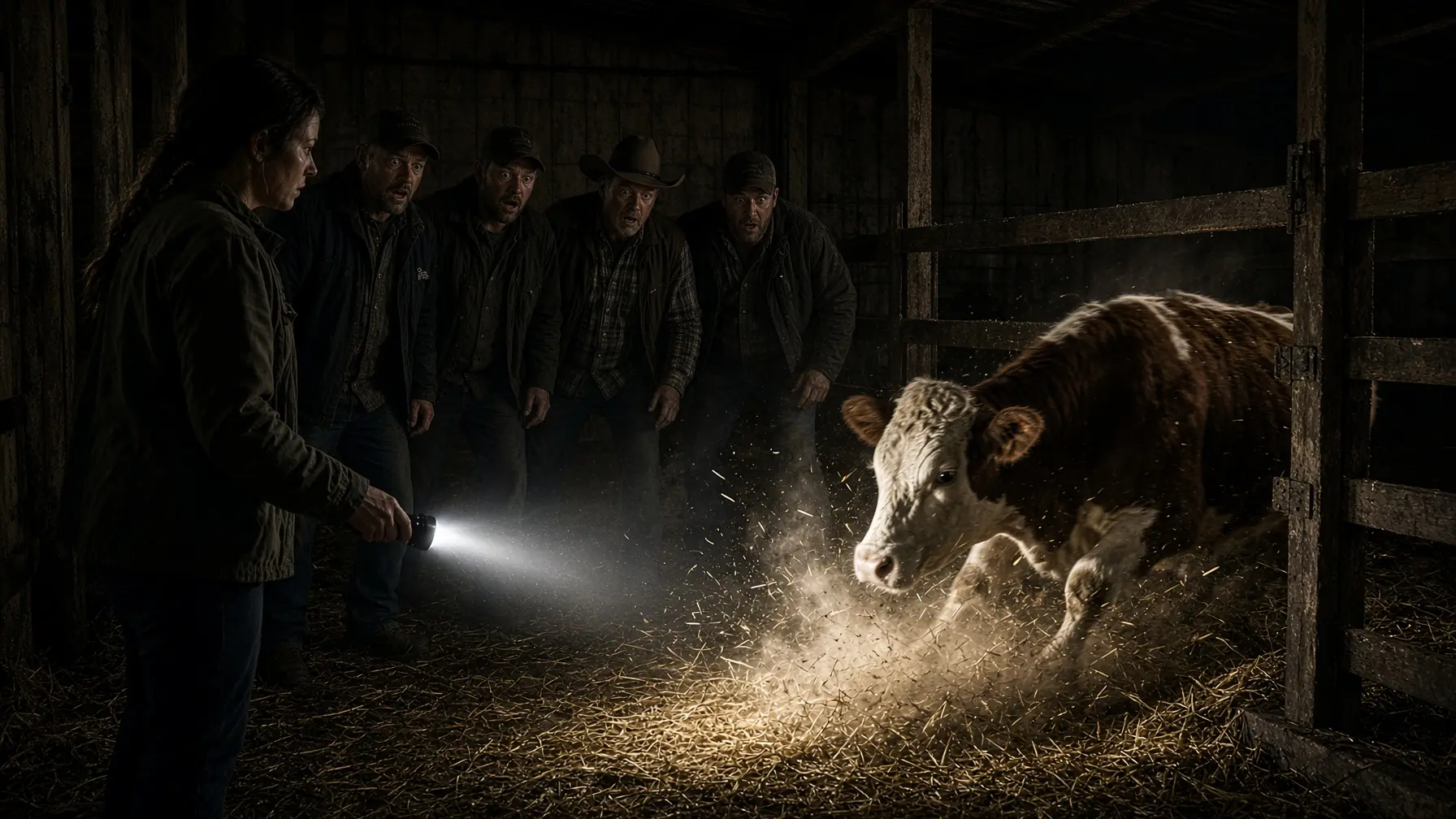
It would not be Ruby’s shoulders.
Not her feet.
Not the deep rib or calm disposition.
Not the fact that she had gained nearly three pounds a day through the best part of summer on grass and hay.
And certainly not the fact that, in twenty-eight months, she had never needed anything beyond routine vaccinations and ordinary veterinary care.
They would look at her face.
A Hereford was supposed to have a white face.
Everybody in that sale barn knew it.
Ruby technically had one.
The problem was that only half of it was white.
A remarkably clean boundary ran from the center of her forehead down beside her left eye, crossed the bridge of her nose, and continued almost straight toward the edge of her mouth.
One side of her face looked like the Herefords printed on breeder calendars across America.
The other side was dark red.
As Ruby stepped onto the concrete, somebody behind Mara said:
“Looks like she forgot to finish getting dressed.”
A few men laughed.
Mara kept walking.
Ruby followed calmly at the end of the halter as though she had heard the joke a thousand times.
In a way, she had.
Half-face.
Paint job.
Split-screen.
Before-and-after cow.
Cattle people could be inventive when something looked different.
Most of the jokes came wrapped in smiles, which made them difficult to challenge without being accused of taking things too seriously.
Then Clayton Mercer walked over.
The laughter changed immediately.
Clayton owned Mercer Herefords.
That meant he owned more cattle than Mara could count without opening a spreadsheet, more pasture than she could drive across before lunch, and enough influence in the county that people tended to laugh a little harder when he was telling the joke.
Mercer Herefords had been breeding registered cattle since Clayton’s grandfather bought their first cows in 1958.
They sold bulls across six states.
Their annual production sale had catered food, professional videos, glossy catalogs, and enough genomic information beside each animal to make Mara’s handwritten herd book look prehistoric.
Clayton was fifty-four.
Broad through the shoulders.
Always clean.
Always shaved.
And somehow capable of spending an entire morning around cattle without manure ever touching his boots.
He looked Ruby over slowly.
Then said, loud enough for everyone nearby to hear:
“A Hereford that can’t even get the white face right isn’t breeding stock.”
A few people smiled.
Someone chuckled.
Mara did not.
Clayton glanced at her.
“You seriously planning to breed her?”
“That depends on what I learn.”
“Learn what?”
“Whether there’s anything behind the color.”
Clayton smiled.
“There’s color behind the color.”
More laughter.
Then, because Clayton preferred his insults to sound educational, he began explaining breed consistency.
Commercial producers wanted predictability.
Registered breeders had a responsibility to protect type.
A breeder could forgive minor variation, he said, but a serious program did not build around question marks.
Then he looked at Ruby again.
“That’s exactly the kind of animal sentiment keeps around longer than economics should.”
Mara felt the words harder than she wanted to admit.
Because economics was exactly why she had brought Ruby.
She needed money.
Badly.
She had been awake since 4:36 that morning.
The exact time mattered because when somebody owed a bank enough money, strange numbers had a way of becoming permanent.
Her operating-note payment was due November 18.
There was $13,740 in the farm account.
She needed a little more than twenty-one thousand.
The hay supplier wanted cash.
The north well pump had started making a grinding sound that everyone kept telling her was “probably nothing.”
In farm language, that meant:
Start setting money aside.
And Red Gate Farm had twenty-three registered Herefords on forty-six acres that had spent the summer getting browner every week.
Mara’s father used to say a cow could turn grass into money.
That year Red Gate Farm had mostly turned money into hay.
Ruby was supposed to help.
On paper, she should have been one of the easiest animals on the place to sell.
Twenty-eight months old.
Deep-bodied.
Good feet.
Quiet.
Structurally sound.
From a cow family Mara had spent thirteen years improving.
But in person, Ruby looked as though somebody had started making two different Herefords and stopped halfway through deciding between them.
Clayton took out his phone.
Tapped the calculator.
Then showed Mara a number.
It was $540 below what a normal young Hereford female of Ruby’s weight should have been worth that morning.
“I’ll take her right now,” he said.
Mara stared at the screen.
“Cash transfer. No commission. No hauling her home.”
He slipped the phone back into his pocket.
“You’re out from under the feed bill.”
For three seconds, Mara considered it.
Three long seconds.
Her father had taught her not to get sentimental about livestock.
Every animal on a working farm had to justify its place eventually.
Ruby did not understand bank notes.
She did not care what hay cost.
She was standing beside the rail chewing at a loose strand somebody had dropped.
Mara looked at her.
Then at Clayton.
“No.”
Clayton tilted his head.
“Your choice.”
He waited for an explanation.
Mara gave him none.
That bothered him.
People like Clayton were comfortable when someone argued because argument meant they were still setting the terms.
Silence was harder.
Finally he said:
“Don’t let being embarrassed today cost you money tomorrow.”
Then he walked away.
Mara loaded Ruby back into the trailer.
But before she left, somebody else had already noticed the cow.
Dr. Ellis Grant.
Ellis had been the large-animal veterinarian in that part of Oklahoma longer than Mara had been alive.
He was sixty-eight, moved slowly because one knee had been replaced and the other probably needed the same treatment, and could look at a cow from thirty feet away and tell which foot was bothering her.
Unlike everyone else, Ellis approached Ruby without smiling.
He stared at her face.
Then stepped closer.
“Has she always looked like this?”
“Since birth.”
“No change?”
“None.”
He put on his glasses.
That was when Mara started paying attention.
Ellis did not put his glasses on for ordinary things.
He ran two fingers gently along the boundary where Ruby’s white hair met the red near her cheek.
Then he walked around her.
There was another unusual marking near her shoulder.
A narrow red line cutting into white.
On one rear leg, white hair stopped and red began along a remarkably sharp boundary.
Ellis frowned.
“Any health problems?”
“Never.”
“Cycles normally?”
“As far as I can tell.”
“Registered?”
Mara nodded.
“Still have Maple’s breeding record?”
“Somewhere.”
Ellis looked at Ruby again.
“Would you let me pull some hair?”
Mara frowned.
“For what?”
“I know a woman at a livestock genetics laboratory who likes unusual pigment cases.”
He paused.
“This is unusual.”
The way he said it changed something.
Not funny.
Not ugly.
Not worthless.
Unusual.
Mara nodded.
Ellis collected a small bundle of hair with follicles from Ruby’s white side.
Then another from the red.
After that he drew blood.
He labeled everything carefully.
WHITE FACE
RED FACE
BLOOD
Same animal.
Same date.
Mara signed a sample-release form on the hood of his truck.
She barely looked at it.
Twenty minutes later, she was listening to Clayton Mercer explain why Ruby was not breeding stock.
Five days later, Mara was standing in her kitchen with a phone against her ear when a geneticist asked her a question she would remember for the rest of her life.
“Ms. Collins, are you absolutely certain every sample labeled Ruby came from the same cow?”
Mara laughed.
Not because it was funny.
Because the question made no sense.
“Ellis pulled them while I was standing there.”
The woman did not laugh.
Her name was Dr. Hannah Price.
Plains Agricultural Genomics.
She confirmed Mara’s address.
Confirmed Ruby’s registration number.
Then asked:
“Can you describe exactly how those samples were collected?”
Mara did.
White side.
Red side.
Blood.
“Were other animals in the chute?”
“No.”
“Did Dr. Grant change gloves?”
“I don’t remember.”
“Were the sample envelopes open simultaneously?”
“I don’t remember that either.”
Mara leaned against the kitchen counter.
“What’s wrong?”
There was a pause.
“The markers aren't lining up the way they should.”
“What does that mean?”