The first person to laugh when Walter Boone arrived was Brent Lawson.
The second was a man standing beneath a black umbrella beside him.
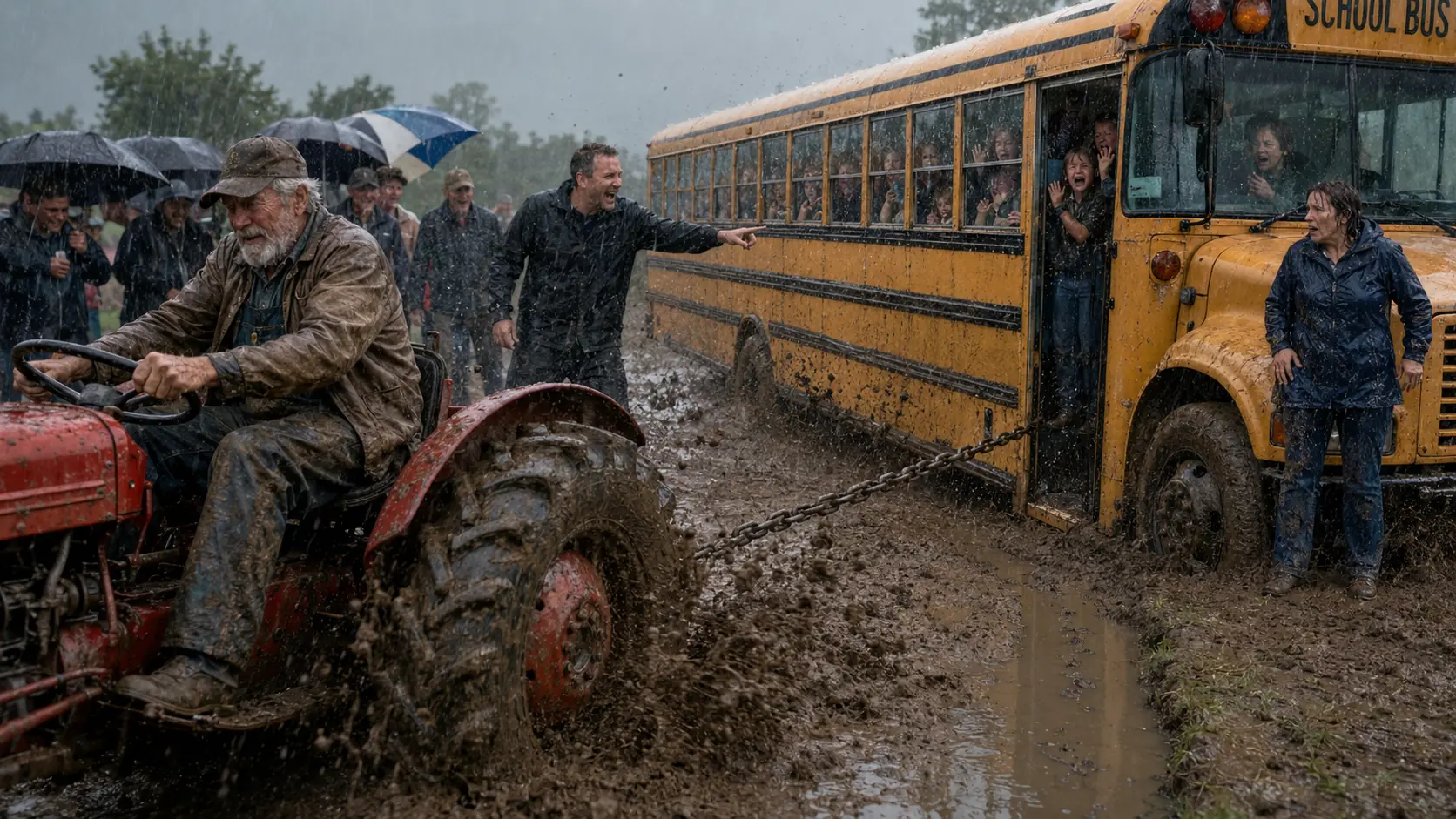
By the time Walter shut down his old red tractor at the edge of County Road 6, four or five people had joined in.
Walter heard every one of them.
He simply did not care.
There were thirty-one children inside the yellow school bus sitting crooked in the mud, and that made everybody else’s opinion fairly low on his list of concerns.
Rain hammered the road so hard that water ran across it in silver sheets.
The bus had left the pavement thirty minutes earlier when its right-side tires dropped onto a shoulder softened by three days of rain. The driver had tried correcting, but the ground beneath the rear duals collapsed almost immediately.
Now the bus leaned several degrees toward a drainage ditch swollen with brown runoff.
Not enough to roll.
Not yet.
But enough that every child inside knew something was wrong.
Faces crowded the wet windows.
Some children were crying.
One little girl had both palms pressed against the glass.
Another boy kept asking the driver when they were going home.
The driver, Laura Bennett, had been answering with the same words for almost twenty minutes.
“We’re okay.”
“Stay in your seats.”
“Help is coming.”
The first two statements were mostly true.
The third was definitely true.
The problem was how long help would take.
A wreck on Highway 14 had tied up the nearest heavy recovery truck.
The volunteer fire department was coming from Oak Ridge.
A sheriff’s deputy had already arrived and blocked the road.
And Brent Lawson had contributed the most immediate form of assistance available to him.
Opinions.
Lots of them.
Brent owned Lawson Excavation.
He was forty-five, strong, loud, and permanently confident in the usefulness of whatever machine happened to have his company name printed on the side.
His three-quarter-ton diesel pickup sat on the pavement with oversized tires and a winch mounted behind the front bumper.
He had already tried helping.
That attempt lasted less than two minutes.
He attached a recovery strap to the bus, eased forward, then added throttle when the bus did not move.
His pickup spun.
Mud sprayed.
The rear of the bus sank another inch.
Deputy Mark Ellis stopped the attempt immediately.
“No more pulling.”
Brent climbed out, irritated.
“I almost had it.”
“You were digging it deeper.”
“I needed another run.”
“You're not getting another run.”
Then Walter arrived.
Sixty-eight years old.
Gray stubble.
Faded brown jacket soaked nearly black across the shoulders.
Mud-stained overalls.
Worn cap.
And behind him came a machine that looked embarrassingly small beside a full-size school bus.
An old red Farmall.
The paint had faded decades ago.
One fender carried a welded repair.
The headlights did not match.
The seat had black tape across one corner.
The tractor had probably spent more days pulling wagons, mowing fields, and dragging feed through winter mud than Brent had spent alive.
Brent looked at it.
Then at Walter.
“You’ve got to be kidding me.”
Walter shut the engine off.
Brent pointed toward the bus.
“That little tractor can’t pull a loaded school bus.”
A man under the umbrella laughed.
“He’s just putting on a show.”
Another said:
“Old man’s about to bury himself too.”
Walter climbed down.
Rain ran from the brim of his cap.
He did not look at Brent.
He walked toward the bus.
That annoyed Brent.
“Hey, Boone.”
Walter kept walking.
“You hear me?”
Walter stopped beside the front wheel.
Then crouched.
He pressed two fingers into the mud.
Looked toward the ditch.
Then toward the crown of the road.
Brent laughed again.
“What are you doing, checking the weather?”
Walter stood.
“No.”
“What then?”
“Checking what the road is sitting on.”
Brent shook his head.
“Road is sitting on mud.”
Walter finally looked at him.
“No.”
Then he walked toward the rear of the bus.
That ended the conversation.
For the moment.
Walter Boone knew County Road 6 better than anyone standing there.
Not because he had studied maps.
Because forty-two years earlier, he had farmed the ground beside it.
Before the subdivision north of town.
Before the widened drainage ditch.
Before the county resurfaced the road three different times.
Walter’s father had rented the bottom ground along the creek.
Walter had spent thousands of hours crossing it with tractors, wagons, combines, and trucks.
He knew where the clay began.
Knew where the old gravel base ran wider beneath the road.
Knew that the shoulder beside the eastern ditch looked solid until enough water got underneath it.
Then it behaved like pudding.
The bus had found exactly that spot.
Laura opened the folding door when Walter approached.
“You Walter Boone?”
“Yes, ma’am.”
“Deputy said you live nearby.”
“Half mile.”
She looked toward the little red tractor.
Then back at him.
“You think that can pull us out?”
Walter looked inside the bus.
Children watched him.
A little boy in the second row was crying quietly into his jacket sleeve.
Walter took his cap off.
“First thing I think is we should stop worrying about pulling.”
Laura stared.
“What?”
“This bus moved any since you stopped?”
“A little.”
“How much?”
“I don't know.”
Deputy Ellis approached.
“Maybe two inches. Right rear keeps settling.”
Walter looked toward the ditch.
Water was moving faster now.
Not yet touching the bus.
But rain was feeding the drainage channel from several fields.
Walter pointed.
“That bank is washing underneath.”
Ellis looked.
So did Brent.
Walter continued.
“You get enough water under that shoulder, we’re not worried about getting the bus unstuck anymore.”
Laura’s face lost color.
“You mean it could tip?”
“I mean I don't want to find out.”
That was the moment the situation changed.
Until then, everyone had treated the bus like a stuck vehicle.
A recovery problem.
Walter saw something else.
A stability problem.
The distinction mattered.
He walked around the front of the bus.
Then back toward his tractor.
Brent followed.
“So what, you’re going to save it with fifty horsepower?”
Walter stopped.
“Probably closer to sixty when it was young.”
Brent laughed.
“Even better.”
Walter looked at him.
“Horsepower isn't what I'm short of right now.”
“What are you short of?”
“People staying quiet long enough to think.”
The man beneath the umbrella tried not to smile.
Brent noticed.
He did not enjoy it.
The volunteer fire department arrived eight minutes later.
Chief Raymond Hale was fifty-six and had known Walter most of his life.
He stepped from the engine, saw the tractor, and said:
“Please tell me that isn't your whole rescue plan.”
Walter shrugged.
“Haven't got one yet.”
“Good.”
Chief Hale walked the scene.
Bus leaning.
Children inside.
Ditch rising.
Shoulder unstable.
Nearest heavy wrecker estimated forty-five minutes.
Possibly longer.
Hale made the decision Walter hoped he would make.
“We unload the kids.”
Laura immediately nodded.
Then Walter said:
“Not yet.”
Everyone looked at him.
Chief Hale raised an eyebrow.
“You've got about ten seconds before I stop liking that sentence.”
Walter pointed toward the right side of the bus.
“If everybody shifts toward that front door at once, weight moves to the low side.”
Hale looked again.
The bus door was on the side nearest the softened shoulder.
Walter continued.
“You're also putting thirty kids on ground that may not hold.”