By the time Everett Cole pushed the thirty-seventh willow cutting into the mud, his fingers were so cold he could barely feel them.
Harmon Creek had risen overnight.
Not enough to flood.
Not yet.
But enough to turn the bank behind the Cole pasture into a strip of black Missouri mud that swallowed his boots almost to the ankles.
Everett was thirteen years old.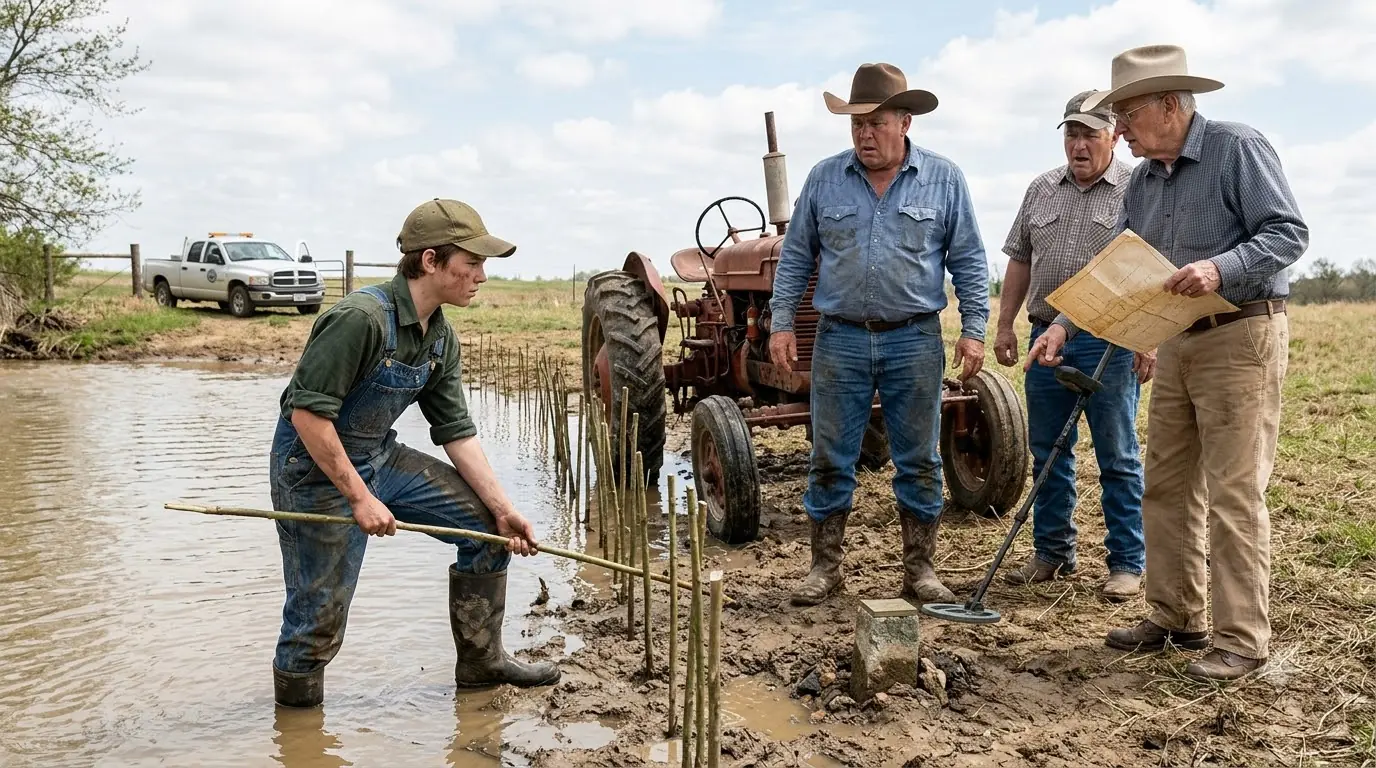
Thin.
Brown-haired.
Quiet.
He wore a faded olive work cap that had belonged to his grandfather, a dark-green farm shirt with the sleeves rolled above his elbows, blue denim overalls patched twice at the knees, and rubber boots several sizes larger than they should have been because his mother insisted he would “grow into them.”
The willow cutting in his hands looked unimpressive.
No leaves.
No roots.
Barely thicker than his thumb.
He drove it into the wet bank beside thirty-six others.
Then measured the distance to the next position using a frayed length of twine.
Eight feet.
He marked the mud with his heel.
Picked up another cutting.
Behind him, three grown men laughed.
Everett did not turn around.
He knew the laugh.
He had been hearing versions of it since he started this project three weeks earlier.
Harold Briggs laughed the loudest.
At sixty-one, Harold owned one of the largest cattle operations in that portion of Harmon Valley.
Three hundred head.
Two modern tractors.
A relatively new hay baler.
A renovated barn.
And enough land that people tended to believe his opinion about farming simply because he had more acres on which to express it.
He stood beside Everett’s battered rust-red tractor wearing a brown cowboy hat, faded blue work shirt, old jeans, and heavy boots coated in mud.
Beside him stood Earl Baines and Tommy Keller.
Both cattle farmers.
Both roughly Harold’s age.
Both enjoying themselves.
Harold folded his arms.
“You planning on growing a forest in my creek?”
Everett pressed the next willow deeper.
“No.”
Harold looked at Earl.
“He speaks.”
Earl laughed.
Tommy nodded toward the bundle of cuttings.
“What are those supposed to do?”
Everett did not answer.
Harold moved closer.
“Boy.”
Everett continued working.
“I asked you a question.”
“They’re willow.”
“I can see that.”
Everett stood.
Mud covered both hands.
He wiped them on the thighs of his overalls.
Harold pointed toward the creekbank.
“What are they supposed to do?”
“Grow.”
The older men laughed again.
Everett waited.
Harold shook his head.
“You know, your grandfather used to have some strange ideas.”
Everett’s expression changed slightly.
Harold noticed.
“He did.”
Everett said nothing.
“But even Walter Cole wouldn’t waste pasture sticking dead branches in mud.”
“They aren’t dead.”
Harold stepped toward the closest cutting.
“Looks dead.”
“It isn’t.”
“You a botanist now?”
“No.”
“Engineer?”
“No.”
“Surveyor?”
Everett looked at him.
That word mattered.
Harold did not notice.
Everett said:
“No.”
Harold smiled.
“Then maybe listen to somebody who’s spent forty years raising cattle beside this creek.”
He pointed toward the bank.
“This water moves every spring.”
Everett nodded.
“I know.”
“Cuts a little here.”
Another gesture.
“Deposits a little there.”
“Yes.”
“You can’t stop it.”
“I’m not trying to.”
Harold frowned.
“What are you trying to do?”
Everett looked at the willow line.
“Mark something.”
Harold followed his eyes.
“Mark what?”
Everett said nothing.
That irritated Harold.
Adults often claimed children should ask questions.
What they actually meant was that children should answer them.
Harold stepped down toward the mud.
“Those sticks are on Briggs pasture.”
Everett finally turned fully.
“No, they aren’t.”
The laughter stopped.
Harold stared.
“What?”
“They’re not on your pasture.”
Earl gave a low whistle.
Tommy stepped back slightly.
This was becoming more interesting than watching a boy make a fool of himself.
Harold approached Everett.
The difference in size was ridiculous.
Everett came barely to Harold’s shoulder.
Harold’s arms were thicker than the boy’s legs.
“You want to say that again?”
Everett looked directly into his eyes.
“This isn’t your pasture.”
Harold laughed.
Not amused now.
“You see that fence?”
Everett looked toward a weathered barbed-wire fence running fifty yards behind them.
“Yes.”
“Who built it?”
“You.”
“Whose cattle are behind it?”
“Yours.”
“Who pays taxes on this pasture?”
Everett paused.
“That depends which pasture.”
Harold’s face hardened.
Earl stopped smiling.
Tommy looked toward the creek.
Harold pointed at Everett.
“Your mother know you’re down here telling people they stole land?”
“I didn’t say you stole anything.”
“You just said this isn’t mine.”
“Yes.”
“What do you call that?”
“A mistake.”
Harold took another step.
Everett did not move.
“You're getting smart.”
“I’m answering.”
Harold looked toward the willow cuttings again.
Then noticed something he had not paid attention to before.
They were not following the present creek.
Not exactly.
The water curved.
Everett’s line did not.
The willows ran almost perfectly straight across the bank, then continued toward a low section of pasture where the creek had clearly shifted years earlier.
Harold frowned.
“Why are these planted straight?”
Everett looked toward him.
“Because that’s where they go.”
“According to who?”
“My grandfather.”
That brought back the laughter.
Harold threw his head back.
“Walter?”
Earl laughed too.
Tommy said:
“Walter’s been dead six years.”
Everett looked at him.
“I know.”
Harold wiped rain from the brim of his hat.
“You’re following something a dead man told you?”
Everett reached into the bib pocket of his overalls.
He removed a folded sheet of paper.
Not the original.
A copy.
He unfolded it carefully.
Lines.
Numbers.
Distances.
Small handwriting.
Harold tried to see.
Everett folded it again.
“What’s that?”
“Notes.”
“From Walter?”
“Yes.”
Harold laughed.
“Boy, your grandfather spent half his life arguing with county maps.”
“He was usually right.”
“He was stubborn.”
“So are you.”
Earl coughed to hide a laugh.
Harold turned.
Earl immediately looked toward the tractor.
Harold returned his attention to Everett.
“Pull the sticks out.”
“No.”
The answer came instantly.
Harold stared.
“I’m not asking.”
Everett looked toward the willow line.
“They stay.”
Harold stepped toward one.
Everett moved between him and it.
That changed the atmosphere.
Harold stopped.
“You going to stop me?”
Everett did not answer.
Harold smiled.
“Move.”
“No.”
“Everett.”
“No.”
Harold pointed toward the creek.
“This bank belongs to me.”
Everett’s jaw tightened.
“You keep saying that.”
“Because it does.”
“Then why did the creek move?”
Harold frowned.
“What?”
“The creek.”
“What about it?”
“You said it cuts one place and deposits another.”
“It does.”
“So if water moves, does the property line move too?”
Harold laughed.
“Of course it does.”
Everett stared.
“Always?”
Harold hesitated.
There.
Everett saw it.
He had expected certainty.
Instead Harold had to think.
Everett continued.
“My grandfather didn’t think so.”
“Your grandfather was wrong.”
“Maybe.”
Harold seemed surprised by the answer.
Everett looked toward the farm gate.
“We’ll know today.”
Harold followed his gaze.
A white county pickup truck was entering the lane.
Amber beacon.
Mud-covered tires.
Black lettering on the door.
HARMON COUNTY SURVEY OFFICE
Harold stopped smiling.
The truck rolled toward them.
Earl looked at Harold.
“You call them?”
“No.”
Tommy looked toward Everett.
The boy picked up another willow cutting.
Harold stared.
“You called the county?”
Everett pushed the cutting into the mud.
“My mother did.”
“You had no right.”
Everett looked up.
“To call a surveyor?”
Harold said nothing.
The truck stopped near the gate.
An elderly man climbed out.
Seventy perhaps.
Lean.
Gray beard.
Brown canvas coat.
Work pants.
Heavy boots.
He took an old metal detector from the truck bed.
Then removed a document tube.
Everett smiled for the first time all morning.
“Mr. Bell.”
The man nodded.
“Everett.”
Harold stepped forward.
“Samuel Bell?”
The surveyor looked at him.
“Harold.”
“You know him?” Earl asked.
Harold ignored the question.
Samuel Bell had surveyed property throughout Harmon County for almost fifty years.
He had retired officially three times.
The county kept calling him back whenever old deed descriptions involved trees that no longer existed, stone markers nobody could find, or measurements written when survey equipment consisted of chains and stubborn men.
Samuel approached the creek.
He studied Everett’s willow line.
Then looked at the boy.
“You moved any?”
“No, sir.”
“Straight from the measurements?”
“Yes.”
“All of them?”