The first thing Dale Voss noticed about Emily Carter was the cowboy hat.
The second was the cash in her hand.
Neither made sense to him.
It was September 1988, and the Harmon Valley Pencil Mill had been throwing cedar scraps behind the cutting shed for longer than anyone still working there could remember.
Thin strips.
Broken pencil blanks.
Crooked offcuts.
Shavings.
Splintered blocks.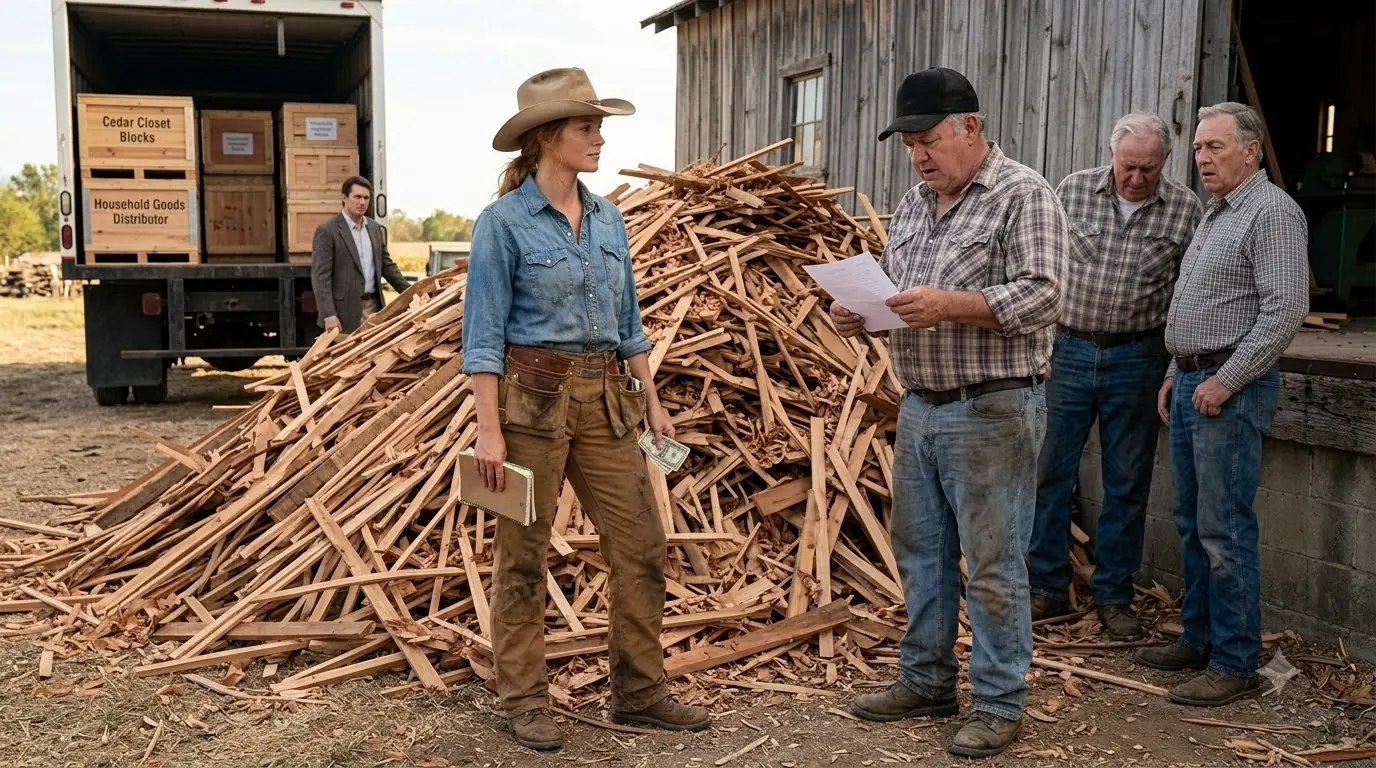
Pieces too short, too narrow, too twisted, or too damaged to feed through the next stage of production.
Every day another cartload joined the pile.
Every month the pile grew.
Sometimes the mill burned portions of it.
Sometimes a farmer hauled away a pickup load for kindling.
Sometimes rain soaked the lowest layers until they became a soft, fragrant mulch under newer wood.
Nobody cared.
It was waste.
That was the word used on production sheets.
CEDAR WASTE.
Dale had worked at the mill for thirty-eight years.
He started at nineteen sweeping floors.
Moved to cutting.
Then maintenance.
Then line supervision.
At sixty-three, he was foreman of the entire yard and possessed the absolute certainty of a man who had spent nearly four decades watching the same materials move through the same machines.
He knew cedar.
He knew what made a good blank.
He knew what warped.
What split.
What chipped.
What could be salvaged.
And what belonged outside in the scrap pile.
Emily Carter apparently believed she knew better.
She stood beside the waste pile wearing a battered tan cowboy hat, faded denim shirt, brown canvas trousers stained at the knees, leather tool belt, and work boots coated in sawdust and mud.
Her auburn hair escaped beneath the hat in loose strands.
A small notebook rested in one hand.
Three folded twenty-dollar bills in the other.
Dale stared at the money.
“You serious?”
“Yes.”
He looked at the pile.
Then at her.
“You want to buy that?”
“Yes.”
“All of it?”
Emily glanced toward the mountain of wood.
“Not today.”
Dale laughed.
Behind him, Earl Jenkins and Roy Beasley laughed too.
Both were older mill hands.
Earl removed his cap and scratched his head.
“Maybe she’s building the world’s ugliest barn.”
Roy said:
“With pencil sticks?”
Dale pointed toward Emily’s money.
“What exactly are you planning to do with it?”
Emily looked at him.
“Take it home.”
“That part I understood.”
“Then why ask?”
Earl laughed harder.
Dale’s smile weakened.
Emily had that effect.
She was twenty-seven years old and had inherited a small farm five miles outside Harmon Valley after her father died.
Forty-three acres.
Old barn.
Two sheds.
Three cows.
A garden.
One truck that started when it felt charitable.
Not much else.
People expected her to sell.
She did not.
Instead she repaired fencing, leased twelve acres to a neighbor, grew vegetables for two local restaurants, and took whatever temporary work she could find.
Painting barns.
Mending gates.
Helping at livestock auctions.
Bookkeeping for a feed store.
She was not wealthy.
Everybody knew it.
That made her willingness to pay for waste even funnier.
Dale crossed his arms.
“I’ll tell you what.”
Emily waited.
“Twenty dollars.”
“For?”
“All you can fit in your truck.”
Emily looked toward her old Ford pickup.
Then the scrap pile.
“Twenty?”
“Yes.”
Dale grinned.
“You want garbage, I’ll sell you garbage.”
Emily opened the notebook.
“What about next week?”
“What about it?”
“Another load.”
Dale shrugged.
“Another twenty.”
“And next month?”
Dale laughed.
“As long as you keep paying me twenty dollars to clean my yard, you can come every Tuesday.”
Emily wrote.
Dale watched.
“What are you doing?”
“Writing that down.”
“For what?”
“Agreement.”
He laughed again.
“You need paperwork to buy trash?”
“Yes.”
“Why?”
Emily looked up.
“Because people remember things differently when money changes.”
Dale’s smile faded slightly.
That sounded like something an old banker would say.
Not a farm woman standing in sawdust.
He pointed toward the mill office.
“You want a receipt?”
“I want something saying I have first right to discarded cedar.”
Dale stared.
“For twenty dollars a truckload?”
“Yes.”
“How long?”
Emily shrugged.
“Three years.”
Earl nearly choked laughing.
Dale turned toward him.
“You hear that?”
Earl nodded.
“She wants guaranteed garbage.”
Roy wiped his eyes.
Dale looked back at Emily.
“Five years.”
Emily blinked.
He smiled.
“Why not?”
The men laughed again.
Emily studied him.
“You’re offering five?”
“For cedar scrap.”
“All discard-grade cedar generated by the mill?”
Dale waved one hand.
“Everything outside production.”
“Broken blanks?”
“Yes.”
“Trim strips?”
“Yes.”
“Shavings?”
“If you want them.”
“Rejected blocks?”
“Take them.”
“Anything classified as disposal material?”
Dale laughed.
“Lady, if it goes in that pile, it’s yours.”
Emily nodded slowly.
“Five years.”
“Five.”
“Twenty dollars per pickup load?”
“Yes.”
She looked toward the mill office.
“Write it.”
Dale smiled.
“You really are serious.”
“Yes.”
He should have stopped then.
Should have asked why.
Should have wondered why a woman who counted every dollar was eager to sign a five-year agreement for waste.
But certainty is dangerous when experience makes a person feel immune to surprise.
Dale believed he knew what cedar scrap was worth.
Nothing.
Less than nothing.
The mill sometimes paid to dispose of excess.
If Emily wanted to remove it herself and hand him twenty dollars each trip, she was doing him a favor.
So Dale walked into the office.
The mill’s assistant bookkeeper, Helen Price, typed a simple agreement.
HARMON VALLEY PENCIL MILL grants Emily Carter first right and exclusive removal access to discarded aromatic cedar waste generated from pencil production for a period of five years, provided material has been classified by mill management as scrap or disposal-grade before removal. Price: $20 per standard pickup load. Removal at purchaser’s labor and expense.
Dale signed.
Emily signed.
Helen made two copies.
Dale handed one to Emily.
“Congratulations.”
She folded it.
“Thanks.”
“You now own the most valuable mountain of garbage in Missouri.”
Emily smiled.
“Maybe.”
Dale laughed.
That word should have bothered him.
It did not.
Emily loaded her first pickup by hand.
Cedar strips.
Broken blanks.
Thin slabs.
Several sacks of dry shavings.
The men watched from the loading door.
Earl shouted:
“Don’t forget the sawdust!”
Emily kept working.
Roy called:
“You can sprinkle it on your cereal!”
More laughter.
Emily ignored them.
By sunset, she had stacked the bed above the rails and tied everything down with rope.
Dale walked over.
“You know you can’t burn all this.”
“I know.”
“Cedar smoke isn’t something you want too much of.”
“I know.”
“Then what are you doing?”
Emily pulled the rope tight.
“Experimenting.”
“With?”
“Cedar.”
Dale looked toward the pile.
Then at her.
“I’ve worked with that wood longer than you’ve been alive.”
“I know.”
“And I’m telling you the pieces in your truck are useless.”
Emily climbed into the cab.
“Then you won’t miss them.”
She drove away.
Dale watched the truck disappear.
For the next month, Emily returned every Tuesday.
Then Thursday too.
Twenty dollars each time.
She kept every receipt.
Her barn began filling.
At first even her mother thought she had lost her mind.
Sarah Carter visited one Saturday and stopped inside the barn.
Cedar occupied half the floor.
Stacks sorted by length.
Thin strips.
Short blocks.
Shavings in sacks.
Longer offcuts tied in bundles.
Sarah stared.
“Emily.”
“Yes?”
“What have you done?”
“Bought wood.”
“This is not wood.”
Emily looked around.
“What is it?”