The first thing Dale Pruitt noticed about Eldon Carver was the safety pin.
It held together the broken zipper of Eldon’s winter coat just below his chest, a cheap silver pin bright enough to catch the fluorescent lights inside the John Deere showroom. Eldon had been standing at the service counter for less than three minutes, quietly studying a financing brochure, when Dale walked out of his office and looked him over from boots to cap as though deciding whether mud had somehow learned to speak.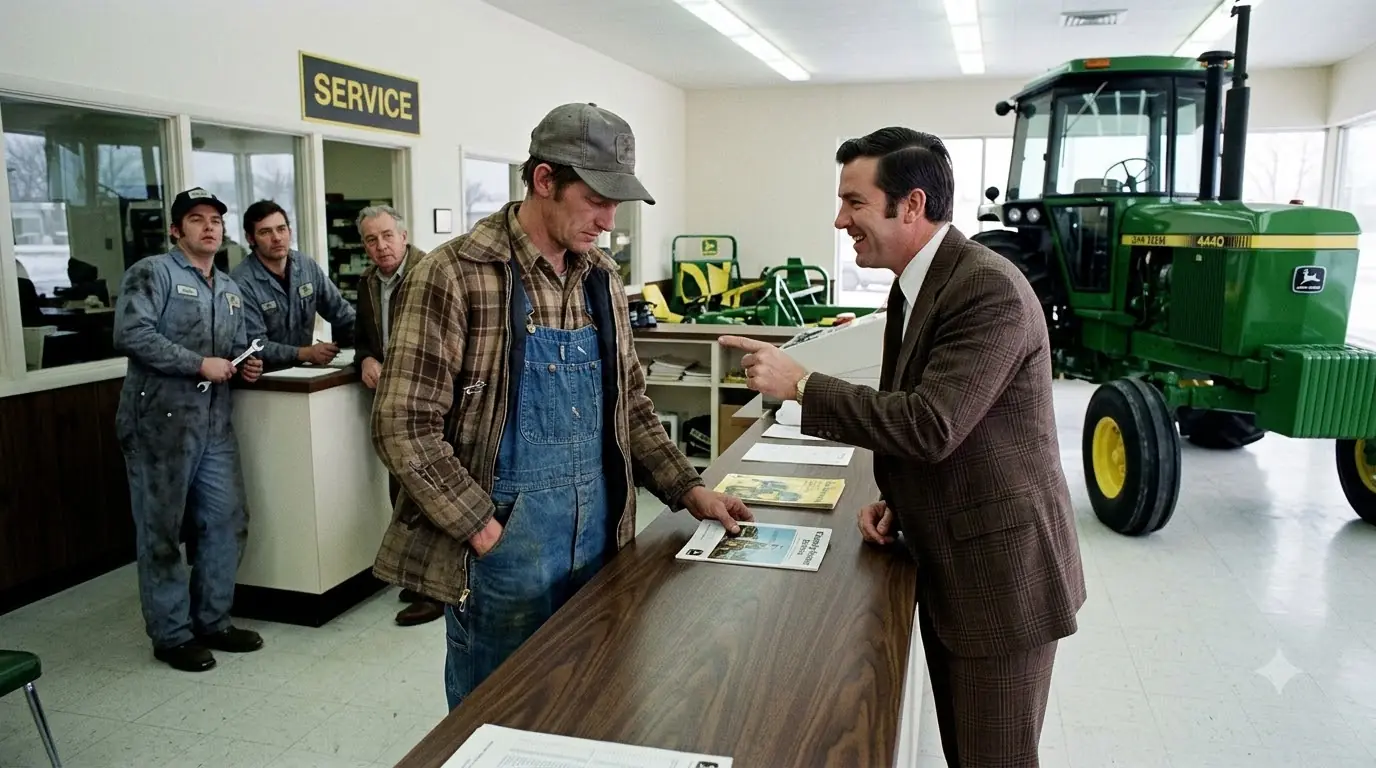
Outside, January wind pushed hard across Cass County, Nebraska, rattling showroom windows and blowing dry snow across the highway. Inside, the polished floor reflected a brand-new John Deere 4440 tractor so clean that Eldon could see fluorescent ceiling panels in the green hood.
He had never stood that close to one before.
The tractor represented everything his family farm needed and almost everything Eldon could not afford.
Their old 4020 had developed a crack near the engine block two weeks earlier. Eldon repaired it temporarily, but the fix would not survive another full planting season, and the Carver farm’s 280 acres depended on a tractor capable of pulling their planter, cultivator, and grain wagon without forcing Eldon to spend every evening wondering what would break next.
That was why he had driven twenty-two miles through freezing wind to Pruitt’s.
Not to buy anything that morning.
To ask questions.
Financing term.
Trade allowance.
Down payment.
Monthly obligation.
Nothing more.
The salesman at the counter, a younger man named Frank Ellis, had been polite enough. He opened a brochure, showed Eldon preliminary figures, and asked whether the old 4020 was available for inspection.
Then Dale arrived.
Dale Pruitt was thirty-nine and had inherited the dealership from his father three years earlier. He wore a brown plaid suit, dark tie, white shirt, polished shoes, and the easy smile of somebody who had spent his entire adult life walking through a building where employees moved when he appeared.
He looked at Eldon.
Then at the brochure.
Then back at Eldon.
“You buying a 4440?”
Eldon answered, “Looking at terms.”
Dale smiled.
“How much you got to put down?”
“Depends on trade value.”
“That wasn’t the question.”
Eldon folded the brochure slightly.
“What difference does it make before you look at the tractor?”
Dale laughed.
Two mechanics behind the open service counter looked over.
One of them, Ray Simmons, wiped grease from his hands with a rag. The other, Tommy Dean, leaned against the counter.
Dale pointed toward Eldon’s coat.
“Son, poor men don’t buy John Deere.”
The room changed.
Not dramatically.
Nobody gasped.
Nobody protested.
Just a brief stillness before Tommy smiled.
Then Ray chuckled.
Eldon looked down at the safety pin.
He had forgotten it was visible.
Dale continued.
“Go find a machine that matches your pockets.”
Eldon raised his eyes.
“I asked what the terms were, Dale. Not what you thought I was worth.”
That made Ray stop smiling.
Dale’s grin widened.
He stepped closer.
“How much is actually in those pockets?”
Eldon should have walked away.
Instead, perhaps because he had spent the previous week sleeping four hours a night while trying to keep a cracked tractor alive, he answered honestly.
“Seventeen dollars.”
Tommy laughed aloud.
Dale slapped the counter.
“Seventeen dollars?”
He turned toward the mechanics.
“Man’s staring at a forty-thousand-dollar tractor with seventeen dollars.”
Eldon felt heat rise beneath his collar.
He did not move.
Dale looked toward the 4440.
“You couldn’t afford the tires.”
More laughter.
Eldon slowly placed the financing brochure on the counter.
Frank Ellis looked embarrassed.
Dale seemed delighted.
Eldon picked up his cap, which he had removed when entering, and pulled it over his short brown hair.
“Maybe not today.”
Dale spread his hands.
“That’s the first sensible thing you’ve said.”
Eldon looked toward the tractor once more.
Then toward Dale.
“Just remember my face when somebody else owns this floor.”
The mechanics went quiet.
Dale stared at him.
Then laughed harder than before.
“Sure, kid.”
Eldon opened the showroom door.
Cold air rushed inside.
He stepped into the January wind with exactly seventeen dollars and thirty-eight cents in his wallet.
He did not look back.
Eldon’s truck barely started in the dealership parking lot.
That seemed appropriate.
The 1967 Ford F-100 had one reliable door, one unreliable heater, and a starter motor Eldon had rebuilt twice. He turned the key, listened to the engine struggle, pumped the accelerator once, then tried again.
The motor caught.
He sat behind the wheel while snow moved across the windshield.
His hands shook.
Not from cold.
Anger.
He imagined walking back inside.
He imagined throwing the brochure onto Dale’s desk.
He imagined telling every mechanic in that building exactly how many dealership repairs Eldon had already corrected for neighbors after official service departments failed to diagnose them.
None of it would matter.
Dale owned the building.
Eldon owned a broken tractor.
Facts had hierarchy when money was involved.
He reached inside his coat and pulled out his wallet.
Seventeen dollars.
One ten.
One five.
Two ones.
Thirty-eight cents.
Dale had been cruel.
But cruelty did not make the number less real.
Eldon stared at the money.
Then put it away.
“Fine.”
He said the word to nobody.
“Seventeen.”
The heater began blowing slightly warmer air.
Eldon pulled onto the highway.
By the time he reached home, anger had become calculation.
The Carver farm belonged equally to Eldon and his widowed mother, Helen Carver.
Eldon’s father, Robert, had died four years earlier after suffering a heart attack while repairing a grain auger. Robert had been fifty-two, strong enough that nobody imagined his body contained anything capable of suddenly ending.
One moment he had been tightening a belt.
Twenty minutes later, Eldon was kneeling beside him waiting for an ambulance.
The farm changed overnight.
Robert had carried most of its knowledge inside his head.
Loan dates.
Seed suppliers.
Equipment weaknesses.
Which low field stayed wet after April rain.
Which neighbor could be trusted to return borrowed tools.
Eldon knew mechanics better than bookkeeping, but grief did not provide a transition period.
He learned.
So did Helen.
Together they kept the farm.
Barely.
By January 1979, the land itself was mostly paid for, but machinery was old and cash reserves thin. The farm produced enough to survive unless something expensive broke.
Then something expensive broke.
The 4020.
Helen was sitting at the kitchen table when Eldon returned from Pruitt’s.
She looked at him.
“Well?”
Eldon removed his coat.
The safety pin caught briefly on the fabric.
He freed it.
“No tractor.”
“Terms bad?”
“I didn’t get that far.”
Helen understood from his expression that something else had happened.
“What did he say?”
“Doesn’t matter.”
“Eldon.”
He opened the refrigerator.
Nothing appealed.
Helen waited.
Finally he said, “Apparently poor men don’t buy John Deere.”
His mother became still.
“Who said that?”
“Dale Pruitt.”
Helen looked toward the window.
Then back.
“You say anything?”
“Enough.”
“What’s enough?”
“Told him to remember my face when somebody else owns his floor.”
Helen stared.
Then slowly smiled.
“Oh, Lord.”
“What?”
“You said that?”
“Yes.”
“With seventeen dollars?”
Eldon looked at her.
“You gonna laugh too?”
Helen covered her mouth.
That answered the question.
Eldon tried to remain angry.
He failed.
Within seconds both of them were laughing.
Not because Dale had been right.
Because the gap between Eldon’s promise and his wallet was absurd.
When the laughter faded, Helen reached across the table.
“What are we actually going to do?”
That was the useful question.
Eldon sat.
“Repair the 4020.”
“Can you?”
“For spring.”
“For summer?”
He shook his head.
Helen nodded.
“Then we buy used.”
“With what?”
“We figure that out.”
Eldon leaned back.
“What if I start taking more repair work?”
“You already repair half the county.”
“Not officially.”
Helen looked toward the barn.
“Maybe officially is the part we’re missing.”
Eldon frowned.
She continued.
“Your father always said you could hear an engine better than most people could hear a conversation.”
“That wasn’t always a compliment.”
“No.”
“But it’s still true.”
Eldon looked down at his hands.
Grease remained beneath his fingernails despite washing twice.
Repair work had always been supplemental.
Neighbors came by.
Eldon fixed something.
They paid cash or exchanged labor.
No invoices.
No schedule.
No business.
What if it became one?
The idea was small.
That made it believable.
The first official customer arrived nine days later.
Walter Jensen had a 1965 International tractor that lost oil pressure after warming.
The dealership had already replaced the oil pump.
Problem remained.
Walter heard Eldon was taking work.
He drove the tractor onto the Carver property and asked:
“What do you charge?”
Eldon had not decided.
“Ten dollars an hour.”
Walter nodded.
“Cheaper than town.”
“That might be because I don’t know what I’m doing.”
Walter laughed.
“You’ll figure it out.”
Eldon did.
The oil pump was not the problem.
Excessive bearing clearance was bleeding pressure once the engine heated.
Eldon pulled the pan.
Measured.
Confirmed.
Replaced bearings.
Walter picked up the tractor two days later.
“How much?”
“Forty-eight dollars parts.”
“Twenty labor.”
Walter stared.
“That’s it?”
“That’s what it cost.”
He handed Eldon eighty.
Eldon counted.
“You gave me twelve extra.”
“Keep it.”
“No.”
Walter pushed his hand away.
“Dealership charged me three hundred and didn’t fix it.”
Eldon gave him six dollars back.
“That’s still too much.”
Walter laughed.
“Stubborn.”
Eldon kept seventy-four dollars.
That evening he put fifty into an empty coffee can above the workbench.
On masking tape, he wrote:
SHOP.
The remaining twenty-four went toward groceries and diesel.
Seventeen dollars had become ninety-one over two weeks.
Not a revolution.
A beginning.
Word moved through rural counties more effectively than advertising ever could.
Walter told his brother.
His brother sent Dennis Hale with a combine starter problem.
Dennis sent Paul Granger with a hydraulic leak.
Paul told somebody at church.
By March, Eldon had six machines waiting beside the barn.
He worked the farm during daylight.
Repairs at night.
Helen handled invoices using a receipt book from the hardware store.
“Carver Farm Repair” appeared at the top because she wrote it there.
Eldon objected.
“Sounds fake.”
“All businesses sound fake before they’re businesses.”
He stopped arguing.
The coffee can became a savings account.
Then an actual business account.
By planting season, Eldon had enough money to buy a wrecked John Deere 4020 from an insurance auction for $1,100.
The transmission was destroyed.
Engine good.
His own 4020 had a cracked block but a usable transmission.
Two broken tractors.
One working machine.
Eldon and Helen hauled the wreck home.
Calvin Brooks, a neighbor, stared at the parts scattered across the barn.
“You sure this works?”
“No.”
“Comforting.”
Three weeks later, it ran.
Not beautifully.
Enough.
Eldon painted nothing.
The hood remained a slightly different shade of green than the fenders.
Helen called it “the quilt tractor.”
Eldon hated the name.
It stayed.
The 1979 season became better than expected.
Corn prices improved.
Soybeans were decent.
Repair work continued.
Eldon paid every bill.
Then put $3,400 into the shop account.
That winter he bought a used engine hoist, better welding equipment, and a service manual collection from a retiring mechanic.
No new truck.
No new clothes.