By the time Hank Mercer rolled through the west gate of the Mason County Fairgrounds, the younger men were already laughing.
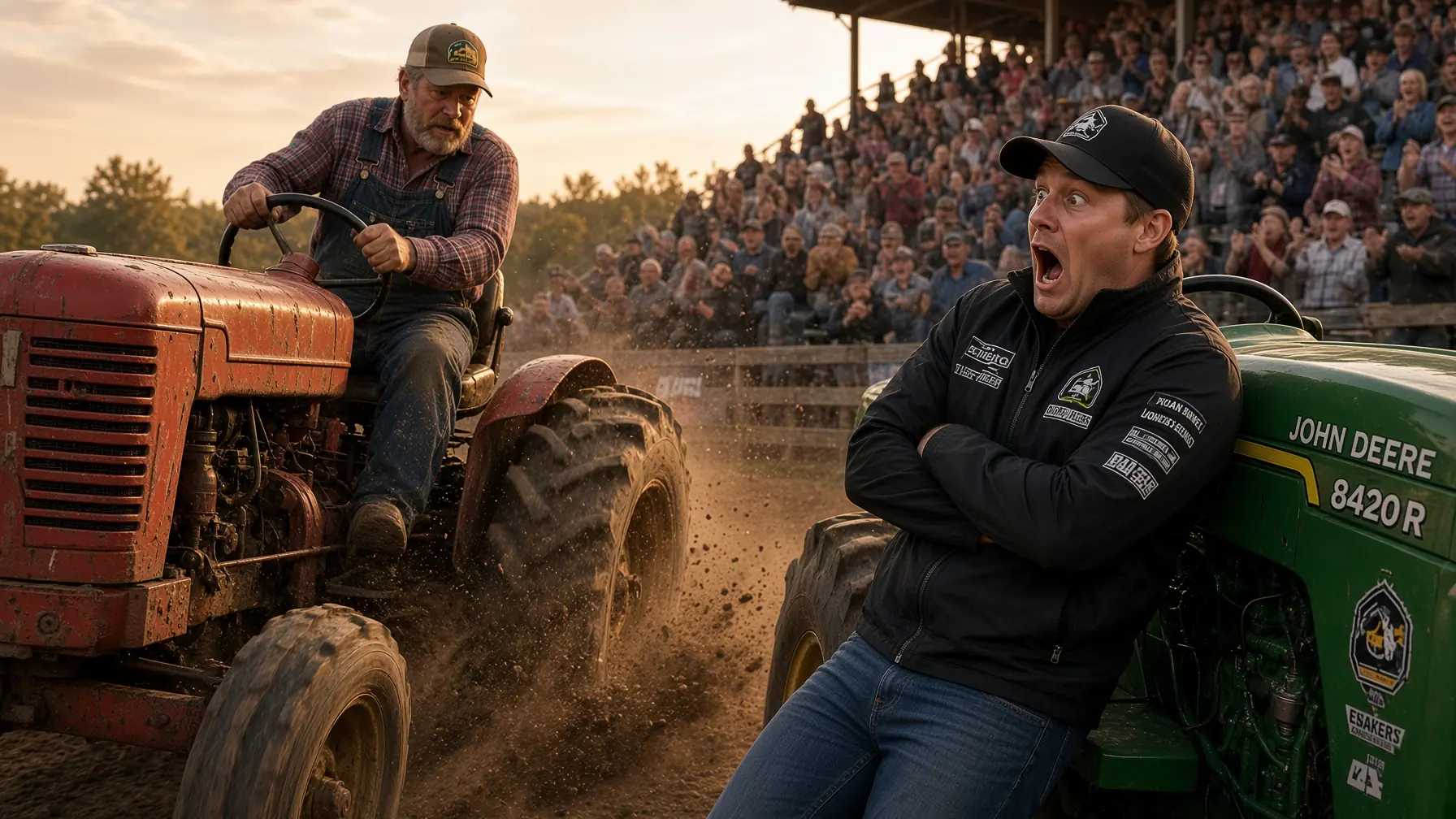
They did not try very hard to hide it.
Maybe that was the first thing people noticed about farm-country arrogance. It rarely arrived with malice sharp enough to look evil. It usually came wearing a grin, carrying a paper cup of coffee, and speaking in the easy, careless tone of somebody who had never recently been proved wrong. That kind of arrogance was all over the tractor-race track that Saturday evening.
The sun was dropping low over the fairgrounds, throwing long gold light across the churned dirt. Bleachers creaked under the weight of families in denim and ball caps. Kids leaned against fences with lemonades in their hands. Sponsor banners snapped lightly in the wind. Somewhere behind the livestock barns, a generator hummed. The smell of funnel cakes drifted across the infield, mixing with diesel smoke, dry hay, and the rich raw scent of turned earth.
It should have been an ordinary county-fair evening.
And maybe it would have been, if Hank Mercer had arrived in something polished.
But Hank had arrived in an old red tractor that looked like it had spent most of its life doing exactly what tractors were built to do.
The machine was no showpiece. Its paint had long ago faded from bright farm-red to a weathered, sun-burned shade that carried years in it. One fender had been patched. The steel around the hood showed scars from tools, chains, and real use. The front grille had a slight bend in it. There was no glossy restoration, no fresh decals, no polished chrome designed to catch attention under fair lights. Its tires were thick and ugly and practical, caked at the edges with dried mud that even a pressure washer had not fully removed.
It looked, in short, like a tractor.
And beside it, in the next lane, stood something very different.
Colt Avery’s machine gleamed green in the sunset like a trophy somebody had built an engine around. Its body shone beneath layers of fresh wax. Sponsor decals ran along the side panels. The rear tires looked enormous and expensive. Every visible part seemed clean enough to eat off. Colt himself was leaning against it with the relaxed confidence of a man who had already accepted congratulations he had not yet earned.
He was twenty-nine, broad-shouldered, clean-cut, and careful about how he presented himself. His black cap sat perfectly. His racing jacket looked freshly unzipped for effect rather than comfort. Even his boots had the polished look of something made to resemble work more than do it. He laughed easily and loudly, especially when enough people were around to hear him.
That evening, there were plenty.
Hank shut off his pickup, climbed down slowly, and unlatched the trailer as if he had not heard a single word being said around him.
But he heard them.
Of course he did.
“Look at that thing.”
“Did he haul it here or drag it out of a hedgerow?”
“That tractor ought to be in a museum.”
“No,” one man said, to a fresh burst of laughter, “a museum would’ve cleaned it first.”
Hank did not react. He just lowered the trailer ramp, checked one chain twice, and guided the red tractor backward with the patience of someone who had spent a lifetime around machinery and knew that nothing good came from hurrying heavy equipment.
His grandson Eli, who had ridden with him to the fairgrounds, stood near the truck with his jaw already tight. Eli was seventeen, all elbows and stubbornness, with his grandmother’s eyes and his grandfather’s silence—at least when he remembered to use it.
“They’re acting like idiots,” Eli muttered.
Hank glanced at him once. “That bothering you any?”
“Yes.”
“Then don’t hand it back to ’em. Let it bother them instead.”
Eli looked toward the crowd again. “I still don’t like it.”
“You don’t have to like it,” Hank said. “Just don’t let other folks rent space in your temper.”
That sounded like the sort of line old men collected after sixty years on the same land. Eli had heard variations of it his whole life. Usually he rolled his eyes. Tonight he only nodded.
Because tonight mattered.
This was not just some silly fair exhibition to Hank Mercer.
Nobody else around that track knew it yet, but the entry fee for the Mason County open tractor pull had come out of money Hank should have spent somewhere safer. His north soybean field had underperformed after a punishing spring. Diesel costs had climbed. One of the irrigation pumps needed bearings before next season. And the county bank had become less patient in recent months, especially since word had gotten around that the Mercer farm was not as steady as it had once been.
Hank still farmed just over four hundred acres—corn, soybeans, a little hay—and he worked them mostly with older equipment because older equipment was what he could afford to own outright. That mattered to him. He had watched younger farmers bury themselves under enormous loans for shiny machinery and then act as if debt were the same thing as success. Hank had never believed that.
But he also knew this much: pride did not pay notes.
The winner’s purse for the county fair race was not life-changing money. It would not rescue a failing operation or transform a bad year into a good one. But it would cover the parts he needed for the irrigation pump and leave enough to breathe a little easier heading into fall. More important than that, there was another purse tied to a regional invitational if the winner posted a strong enough time. Hank had read the rules carefully. A good result tonight could turn into a better one later.
He was not at the fair for nostalgia.
He was there because he still knew how to make old iron work.
At registration, the volunteer in the booth looked up from the form and smiled politely.
“Name?”
“Hank Mercer.”
“Machine?”