There are things that get tested only once. The first time is the only time that counts. Because after the first time, it’s no longer a question of whether. It becomes a question of how well.
Catherine Aldridge had been around Scout for almost a year. She had watched the horse, fed him, talked to him the way certain people talk to animals when they think nobody is listening. And Scout had watched her back with the dark, intelligent eyes of an animal that was conducting its own assessment, and had not yet announced the result. The result was announced on a Tuesday morning in October of 1888, in front of half the county, with a strip of Thomas Aldridge’s land on the line.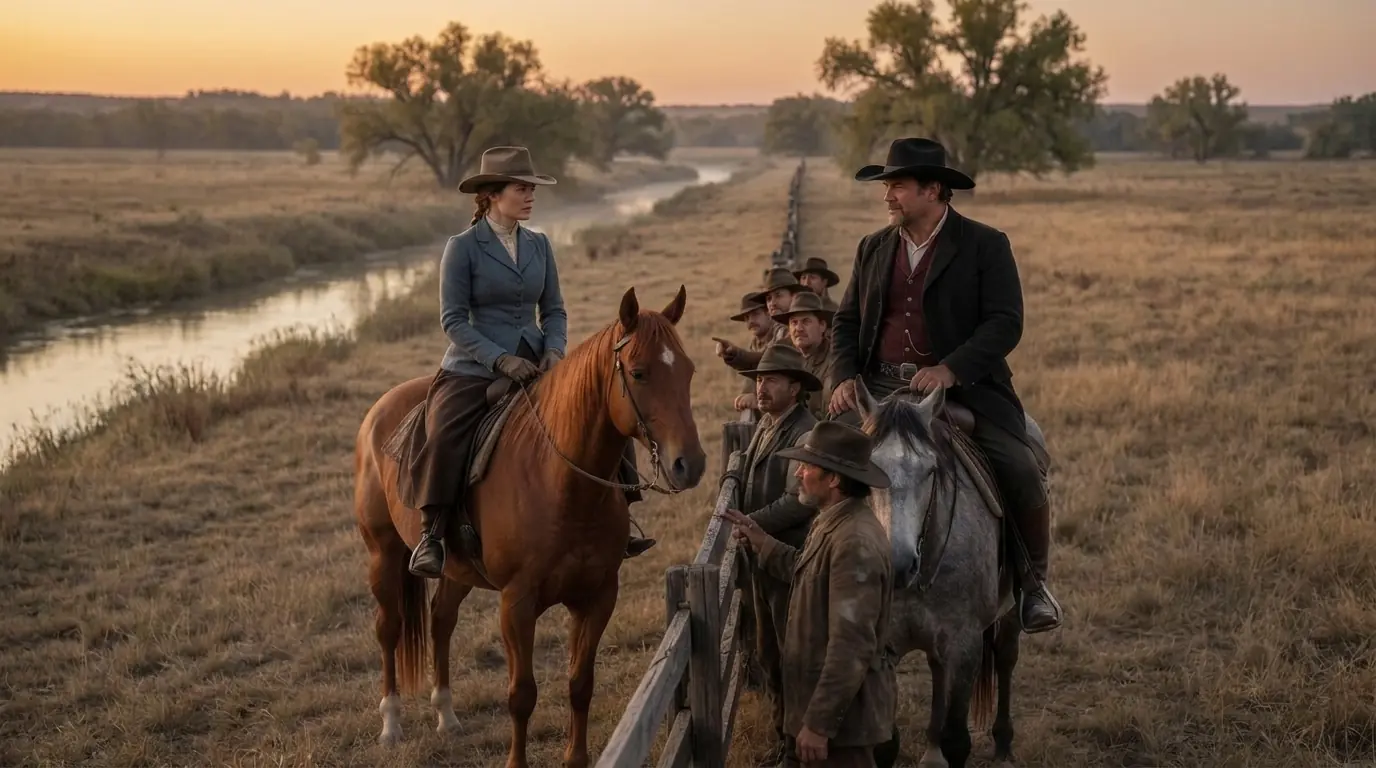
Caldwell Ranch, Texas, October 1888. The man’s name was Harlan Burke, 40, wide, the build of someone who had been the largest person in every room in Comanche County for 20 years and had developed over those 20 years the confidence of someone who has never been seriously challenged in any room. He rode onto the Aldridge Ranch on a Monday morning with two men behind him, and a proposal that he delivered from the saddle without dismounting. The discourtesy of a man who does not consider the people he is talking to worth the effort of getting off the horse.
I want to race, he said. Thomas looked at him, at the two men behind him, at the horse Burke was riding, a big gray quarter horse, deep chest, thick legs, the kind of animal bred specifically for one thing, and bred well. Race what? Thomas said. Your son-in-law’s horse, Burke said. The roan.
I’ve heard about that for two years. I want to see what it can do. He looked at the ranch. Half-mile, straight course.
Your east fence line to the creek. If my horse wins, I get the creek strip. Thomas looked at the creek strip. 20 acres of the best watered land on the Aldridge ranch.
The land that made everything else possible. And if your horse loses? Thomas said. It won’t. If it does, Burke smiled. If it does, I sign over the deed to the North 40.
Land I’ve been holding adjacent to yours for three years. He looked at Thomas. Been meaning to sell it anyway. Consider it a sporting gesture.
Thomas looked at the house, at the stranger on the porch, who had been sitting there with his coffee for the last 10 minutes with the complete stillness of someone who had heard every word and was making no visible decision about any of it. I’ll ask him, Thomas said. The stranger looked at Burke from the porch, at the gray quarter horse, at the two men, at the creek strip. Then he looked at Scout in the corral, ears forward, watching Burke’s horse with the alert attention of an animal that has identified another animal and is conducting an assessment.
When? he said. Tomorrow morning, Burke said. First light. In front of whoever wants to watch. I’ll bring witnesses, you bring yours.
The creek strip, Thomas said. The tone of a man who has had his land threatened enough times in the past to have developed very precise feelings about it. I know. Burke’s horse is fast. I’ve seen it run.
He didn’t propose this race because he thought he’d lose. I know that, too. Thomas looked at Scout in the corral. At the roan coat.
At the ears still tracking Burke’s gray horse as it disappeared down the south road. You’re not worried, Thomas said. I’m aware. That’s different from worried. Let me stop here for a second.
Because I want to tell you something about horse racing in Texas in 1888. Because it wasn’t a sport. Not in the way we think of sports. Quarter horse racing in the Texas of the 1880s was land negotiation by another name.
Disputes that couldn’t be resolved in courtrooms, or that the parties preferred not to resolve in courtrooms, were resolved on a half-mile track in front of witnesses. The outcome was legally binding by social contract in a way that courthouse filings sometimes weren’t. Harlan Burke knew this. He had used this mechanism twice before.
Once for a water rights dispute in 1884. Once for a grazing boundary in 1886. He had won both times. The gray quarter horse was not a pet.
It was an instrument. The quarter horse as a breed had been developed in Texas and the southern states specifically for this distance. The quarter mile. The fastest horse over a short straight course that existed in the Americas.
By 1888, a well-bred gray quarter horse in Comanche County was not just an animal. It was a capital investment. Burke’s horse had cost more than most ranches in the county. That was the point.
Catherine found him at the corral at dusk. He was standing at the fence rail looking at Scout. Not examining the horse. Simply present with him the way he was present with things that mattered and that didn’t require commentary.
Scout was looking back. Burke’s horse, Catherine said. Have you seen it run? Not yet. I have. She leaned on the fence rail beside him.
Two years ago at the Comanche Fair, it ran the quarter mile in under 22 seconds. She looked at Scout. That’s fast. Scout is faster. You know that?
I know Scout. She looked at the horse, at the roan coat in the fading light, at the dark, intelligent eyes that were now watching Catherine with the same focused attention they had been giving the stranger. He’s been watching me differently lately, she said. Since I started spending more time with him when you’re working with Pa. I know.
What does that mean? The stranger looked at Scout. It means he’s decided something. Scout doesn’t watch people without reason.
Catherine looked at the horse. Scout looked back at her. The dusk settling over the Aldridge ranch, the stars beginning. He was saddling Scout at 5:00 in the morning when it happened.
Not dramatically, the way most things that change everything happen: without drama, without announcement, in the quiet of an early morning when the light is just beginning and the day has not yet decided what kind of day it is going to be. He reached for the cinch, his left side, the side that had taken the knife in October of last year. The wound that had healed responded. The wound had healed.
He had told himself that for 12 months, and it had, mostly. The scar tissue that replaced it had its own opinions about certain movements, the specific memory that bodies keep of serious injuries regardless of what the mind decides about them. Not catastrophically. Precisely. The reminder of a body that has been carrying things for a long time and occasionally presents the bill without warning. He stood still for a moment.
Scout turned his head, looked at him, at the left side with the dark, intelligent eyes of an animal that had been watching this man’s body for years and understood its vocabulary. He tried the cinch again. The left side responded again. He stood with his hand on the saddle and looked at the corral fence and understood with the cold clarity of someone who has been practical about these things his entire life that riding a quarter mile at full speed in two hours was not what the left side was going to allow this morning. Huh.
He stood there for a long moment. Then he heard the barn door. Catherine. Up before dawn, because ranch people are up before dawn, the habit of years, came into the corral with the focused efficiency of someone who had something to do and was doing it. She looked at him, at the hand on the saddle, at the left side.
She’d been looking at him for almost a year. She knew the vocabulary, too. No, he said. I didn’t say anything.
You were about to. She looked at Scout, at the saddle, at the east fence line visible in the early light, the half-mile course to the creek, at the creek strip. How bad? she said. Bad enough. Scale of one to the canyon in New Mexico. Four. That’s rideable.
At a trot. Not at a full run for half a mile. She was quiet. Scout was looking at her.
Not at the stranger. At Catherine. The ears forward. The dark eyes conducting the assessment that Scout conducted when he had decided something and was waiting for the humans to catch up. I’ve watched you ride him for a year.
I know how he moves. I know his signals. She looked at the stranger. I know what he needs from a rider.
You’ve never ridden him. I know. He’s never been ridden by anyone else. I know that, too. She looked at Scout.
Scout looked at her. The exchange of two creatures who have been watching each other for a year. And had arrived simultaneously at the same conclusion. Let me try, she said.
He looked at his left side. At the east fence line. At the creek strip. At Scout. Who was still looking at Catherine with the forward ears and the dark eyes.
And the quality of an animal that has made a decision. He stepped back from the saddle. She approached Scout the way she had watched the stranger approach Scout. Not directly. At an angle. Not fast. Measured. Speaking quietly.
The low words that weren’t the content, but the tone. The frequency that horses respond to before they respond to anything else. Scout stood completely still. She put her hand on his neck.
Scout pressed into it: the gesture, the confirmation of contact, the physical statement. She looked at the stranger. He nodded once. She mounted. I want to stop here.
Because I’ve been telling you about Scout for 20 episodes. About the surgery door. About the meadow in Oregon. About 1,200 pounds on one specific foot in a Dodge City stable, about the corral facing south, about the moment Scout went to the north gate when the poncho came off the nail.
And I’ve been telling you about Catherine, about the rifle in the barn loft, about 31 days of watching. About the shot placed six feet in front of a moving man at 100 yards. And in all of that, in 20 episodes, these two had never been alone together, not really, not without the stranger as the center of gravity between them. The moment Catherine mounted Scout was the moment I understood something I should have understood earlier.
They had been preparing for this for a year, both of them, without being asked, without being told. The way certain partnerships develop, not by design, but by proximity and attention, and the slow accumulation of mornings. Scout stood perfectly still when she mounted, not still the way a trained horse stands still, still the way Scout stands still, the deliberate, chosen stillness of an animal that has decided. That’s when I knew the race was already decided.
The question was just the half-mile. Burke arrived at 7:00 with six witnesses, not two, six. The escalation of a man who had expected a straightforward transaction and had heard somewhere between Monday and Tuesday morning that something had changed. He looked at the corral, at Catherine on Scout, at the stranger standing at the fence rail with his coffee and his left side, and the complete stillness of a man watching something he trusts completely.
Where’s the rider? Burke said. You’re looking at her, Thomas said. Burke looked at Catherine on Scout, at the roan coat, at Catherine’s hands on the reins, steady, practiced, the hands of someone who had been watching how those reins were held for a year. The deal was the horse, Burke said.
Not a substitute rider. The deal was the roan. She’s riding the roan. Burke looked at him, at the left side, at the coffee.
The calculation of a man who has just understood that the situation has changed in a way he hadn’t prepared for, and who is deciding whether the change favors him or doesn’t. He decided it favored him. A woman who had never raced Scout against a horse bred for this distance, with land on the line. Fine, Burke said.
He didn’t smile. That should have told him something. Half a mile. The east fence line to the creek.
Thomas walked the course that morning, the 26th year of walking this land, knowing every rock and dip and the place where the ground went soft near the third fence post. He told Catherine. She listened the way she listened to everything, completely, without interrupting, filing it in the way that people file information they intend to use. The witnesses lined up at the start.
Burke on the gray quarter horse, the horse shifting its weight, the nervous energy of an animal that knows what is about to happen and is built for it. Catherine on Scout, the horse completely still, ears forward. The focused attention of an animal that has read the course and is ready. The stranger at the fence rail, Thomas beside him, both watching.
Riders, I’ve had some of you ask me whether I ever get nervous telling these stories, whether I already know how they end before I start telling them. Mostly, yes. This one, I’ll be honest, I wasn’t sure. Not because I didn’t trust Scout, not because I didn’t trust Catherine, because a half-mile is a half-mile, and the gray horse was fast, and Burke hadn’t been wrong about very many things in Comanche County for 20 years. My wife asked me that morning why I looked distracted.
I told her I was thinking about a horse race in Texas in 1888. She looked at me the way she always looks at me when I say things like that, and went back to her coffee. I love her for that. Thomas raised his hand and dropped it.
The gray horse exploded off the line, the launch of an animal bred for exactly this. The first 20 yards, the fastest it would run, the quarter horse’s particular genius for the opening of a race. Scout launched a half second later, not because Scout was slow, because Catherine had felt him gather, and had waited for the gather to complete before asking for the run. The half second of patience that turned into something else entirely by the third fence post.
The gray horse was ahead at the first fence post, by three lengths at the second. The witnesses watching, Burke watching, Thomas watching with the expression of a man who has been holding his breath since Monday morning. The stranger at the fence rail, not watching the gray horse, watching Scout. At the third fence post, the soft ground Thomas had mentioned, the gray horse’s stride adjusted. Not dramatically.
The microsecond of recalibration that a horse makes when the ground changes under it. Catherine felt Scout feel it. And Scout, who had been reading ground for years across territories that changed with every season, did not recalibrate. Scout accelerated. At the creek, the half-mile mark, the willows visible, the water catching the October morning light, Scout was ahead.
By two lengths, then three, then the creek. Catherine pulled Scout to a stop at the creek bank. The horse breathing, the hard, clean breathing of an animal that has run at full capacity and is processing the effort. Catherine breathing. The witnesses arriving behind her.
Burke on the gray horse pulled up 20 yards back, the horse’s sides heaving, Burke’s face doing the calculation that a man does when something he was certain of has produced a result he wasn’t prepared for. Thomas arrived at the creek on foot, moving faster than a 63-year-old man with an October wound should move, which is to say, fast. He looked at Catherine, at Scout, at the creek strip, his creek strip, still his, 20 acres of the best watered land on the Aldridge ranch. That’ll do, he said.
The same two words, a different weight every time. Scout was still breathing. Catherine had her hand on his neck. The horse pressed into it.
The North 40 transferred to Thomas Aldridge three days later. Reeves had stayed in Comanche County for a week after the Hargrove case, tying up filings, he said. The stranger suspected he had other reasons. Either way, he was available.
He handled the paperwork the same way he handled everything, efficiently, without ceremony, with the focused attention of a man who understood that the documents mattered more than the drama around them. The land added a water access point on the northeast corner that Thomas had been wanting for six years. He didn’t say much about it. He went out and walked the new boundary line the morning after the transfer. Alone.
The way a man walks land that is his. And that he wants to understand with his feet before he understands it with anything else. I think about that walk. About 2six years of the original land, and then one Tuesday morning in October.
And then the North 40. About what it means to add to something you’ve been holding for that long. It doesn’t happen often. When it does, it’s worth the walk.
He found them at the corral that evening: Catherine and Scout. Not training. Simply present with each other. Catherine at the fence rail, Scout beside her. Both looking south at the pasture the way they had been looking at things together all year without either of them acknowledging that was what they were doing.
He stood at the corral gate for a moment. Watching. Scout’s ears moved toward him, then back to Catherine. The horse not leaving. Choosing to stay where it was.
He walked to the fence rail, stood beside Catherine. The three of them looking south. He ran differently for you, he said. I know. I felt it.
How? She thought about it. Freer, she said. Like he wasn’t?
She paused, finding it. Like he wasn’t managing me. Like he trusted that I knew what I was doing and he could just run. I’ve been trying to find the right word for what happened between the third fence post and the creek.
20 episodes and I still hadn’t found it. And then Catherine said, Freer. One word. And I think that might be it. Not speed, not trust. Freer.
That’s what happens when two things that have been preparing for the same moment find it at the same time. I’ll take it. He looked at Scout. Scout looked at him.
The dark, intelligent eyes. The ears relaxed. He does that when he decides. When he’s decided about someone.
When did he decide about you? He looked at the south pasture, at the grass, at the last light going amber on the Texas hills. Dusk Creek, he said. A long time ago.
Catherine looked at Scout. How long did it take? One afternoon? She looked at the horse.
It took him a year with me. You were worth the wait, he said. Scout pressed his head against Catherine’s shoulder. The corral. The south pasture.
The Texas evening. The three of them. Thomas cooked again. He always cooked when something had been settled.
The language of a man who expressed completion through feeding people, the same way he expressed everything that was difficult to say with words. They ate on the porch this time. The October evening around them cooler than the summer, the Texas autumn that arrived without drama and made everything smell like the earth had finally exhaled. Scout in the corral facing south.
The North 40 visible in the last light. The new boundary, the water access. The six years of wanting now resolved. Thomas Aldridge looked at Catherine, at the stranger, at his glass.
My daughter, he said, ran a horse race for my land. He looked at the glass. Against a man who hasn’t lost in 20 years. Scout ran the race, Catherine said.
Scout and my daughter, Thomas said. He raised his glass. To the North 40, he said. To Scout, Catherine said.
To the North 40 and Scout, the stranger said. Thomas almost smiled. That’ll do, he said. For every time he had said it and meant something slightly different.