It started with a bucket.
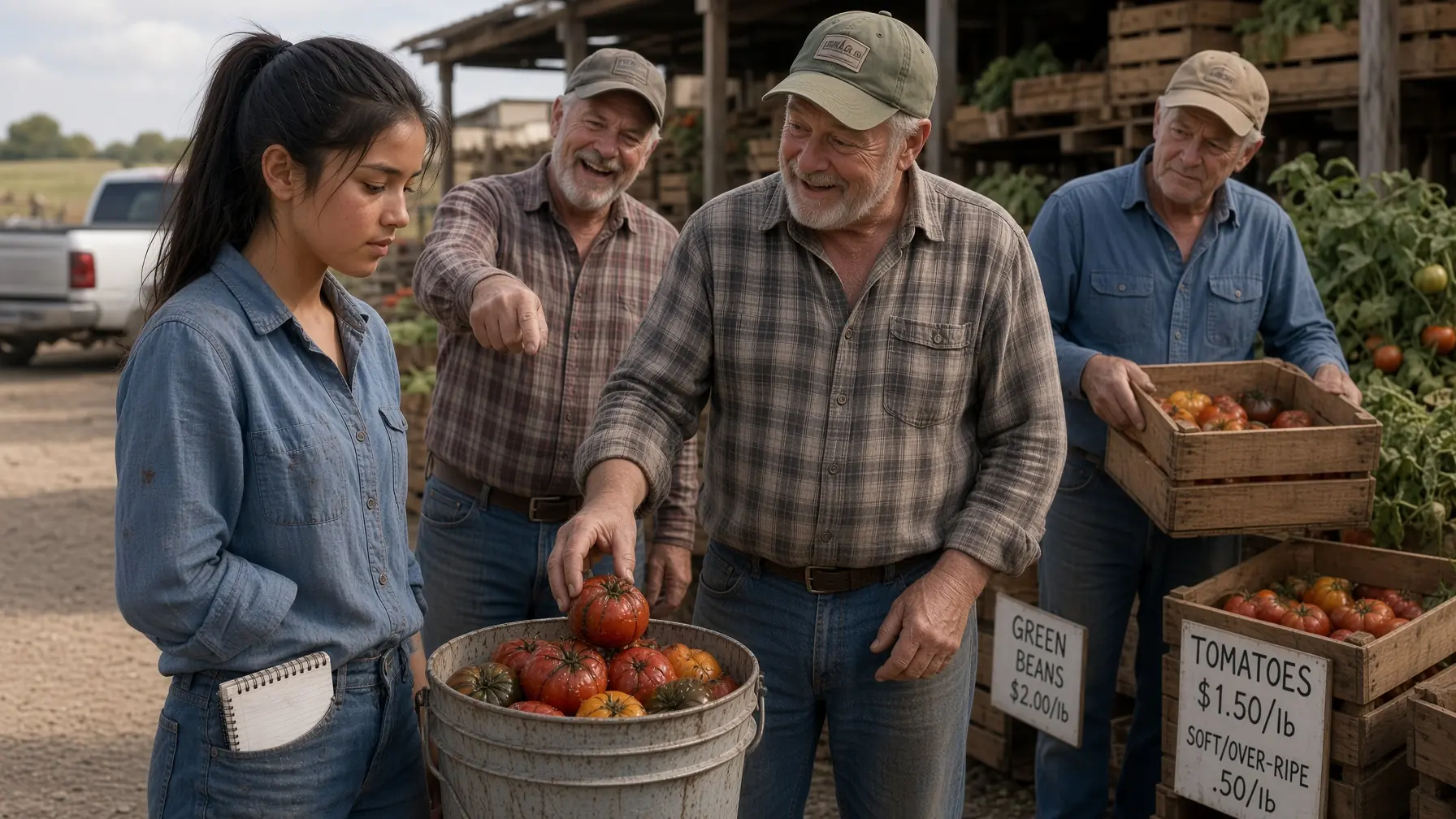
Not a clean bucket, either. The galvanized handle was bent, one side carried a rust-colored streak, and somebody had painted the word FEED across it years before Maren Castell was born. On Saturday afternoons, when the town produce market began shutting down and vendors started sorting what could survive another day from what could not, sixteen-year-old Maren dragged that bucket behind the stalls and asked the same question.
“You throwing those out?”
At first, vendors barely looked at her.
A split tomato was a split tomato. If the skin had burst badly enough that juice leaked into the crate, customers usually left it alone. If it had gone too soft for transport, it could not be stacked. If a shoulder bruise had spread during a hot market day, it would not survive another morning on display. Some went home with farmers. Some became livestock feed. Some entered compost piles. A surprising number ended up in waste bins simply because everyone was tired and the value of rescuing one more damaged tomato was lower than the labor required to do it.
Maren did not take everything.
That was what people began noticing.
She rejected fruit with fuzzy mold.
Rejected anything with obvious bacterial lesions.
Rejected tomatoes smelling fermented in the wrong way, fruit collapsing into liquid, or anything she could not identify with confidence.
But an overripe tomato with intact seed cavities?
Into the bucket.
A fruit split after heavy irrigation but still free of obvious disease?
Bucket.
A cosmetically ugly heirloom too misshapen for a customer who wanted perfect sandwich slices?
Bucket.
She would hold each one under the afternoon light, turn it once or twice in her fingers, and make a decision.
Within three weeks, one bucket became two.
Then Maren started bringing a wheelbarrow.
That was when people began laughing.
Not viciously.
Most of them liked Maren.
Her family had sold vegetables at that market for years. People had watched her grow from the child sleeping beneath the folding table into the teenager who could calculate change faster than some vendors’ card readers.
But carrying discarded tomatoes home in a wheelbarrow created questions.
Corinne Bell, who operated three produce stalls near the east entrance, finally asked.
“What are you doing with all that?”
Maren lifted another cracked Cherokee Purple from Corinne’s reject crate.
“Trying something.”
“What?”
“I don’t know if it works yet.”
Corinne stared.
“That sounds reassuring.”
Maren smiled and dropped the tomato into her bucket.
Behind Corinne, another vendor called, “Maybe she's making perfume.”
Someone else answered, “If she is, sell it downwind.”
People laughed.
Maren did too.
Then she kept sorting.
The Castells farmed eleven acres outside the small agricultural town of Bellweather, North Carolina, on land Maren’s grandfather had purchased when eleven acres could still support a family willing to work every daylight hour available. Her father, Daniel, grew collards, kale, squash, cucumbers, peppers, and tomatoes. Some years were respectable. Others were calculations about which repair could wait.
Maren knew the numbers because Daniel made no effort to hide them from his children.
Diesel.
Transplants.
Seed.
Fertilizer.
Drip tape.
Plastic mulch.
Pesticides.
Boxes.
Market fees.
Cooler electricity.
Truck repairs.
Labor when the family could afford it.
The farm could produce twenty thousand dollars’ worth of vegetables in a good stretch and then consume much of the apparent profit through costs that never appeared in photographs of beautiful harvest baskets.
Daniel was not bitter about farming.
He simply had no romance left for waste.
“You plant enough tomatoes,” he once told Maren, “and some become food, some become compost, and some become lessons.”
Maren had been fourteen when she heard him say it.
They were sorting a late-July harvest behind the barn.
A rainstorm after a dry stretch had caused splitting across several varieties. Fruit that had looked marketable two days earlier now opened around the shoulders. Some was still usable for sauces at home. Some Daniel gave away. Some was too damaged to justify cleaning and processing.
He dumped a crate near the compost pile.
Maren watched red fruit tumble onto old vines and straw.
“How much do we throw away?”
Daniel shrugged.
“Depends on the year.”
“No. Like how much?”
“Enough.”
“Why?”
“Because not everything grows into something somebody will buy.”
“What about the seeds?”
Daniel looked at her.
“What about them?”
“Are they still good?”
He considered.
“Some.”
“Then why throw those away?”
Daniel smiled tiredly.
“Because I am forty-seven years old and have 300 feet of drip line leaking in field three.”
That ended the conversation.
It did not end the question.
Maren had always been the child most likely to ask why after everybody else accepted because.
She kept a spiral notebook in her back pocket. Not a diary. She filled it with rainfall totals, sketches of roots, planting dates, insect drawings, germination counts, market prices, and questions that came to her while working.
Why did one compost-amended bed dry more slowly?
Why did squash nearest the windbreak develop less mechanical damage?
Why did some tomato plants remain healthy two rows beyond others after the same disease pressure?
Why did the family buy some seed every year while saving others?
Her older brother Matthew found the notebook unbearable.
“You know farming still works if you don't write everything down.”
“Does it?”
“Yes.”
“Then why did Dad plant the same bad squash variety twice?”
Matthew stared at her.
“Never say that near him.”
Maren wrote down his answer.
The idea behind the market tomatoes began during an agriculture class at Bellweather High.
A county extension specialist named Dr. Leah Ramirez visited to speak about seed biology and crop diversity. Most students expected a presentation about careers in agriculture. Instead, Ramirez brought jars containing beans, corn kernels, pepper seeds, tomato seeds, and a handful of strange-looking dried pods.
She explained the difference between open-pollinated varieties, hybrids, and genetically uniform commercial seed lines.
That caught Maren’s attention.
Ramirez held up a packet of hybrid tomato seed.
“If you save seed from an F1 hybrid,” she explained, “the next generation may not resemble the plant you harvested from. The genetics segregate. That doesn't mean the seeds are dead. It means they won't necessarily breed true.”
Maren wrote rapidly.
Then Ramirez showed an open-pollinated tomato.
“With a reasonably isolated, stable open-pollinated variety, seed saving is much more predictable. Tomatoes are largely self-pollinating, though crossing can still occur, especially depending on pollinator activity and flower structure. If varietal purity matters, you manage for that.”
A student near the window yawned.
Maren raised her hand.
“What if the tomato is overripe?”
“Seeds may still be perfectly viable.”
“What if the fruit split?”
“Depends why it split and whether the seed itself is healthy.”
“What if the tomato has rot?”
Ramirez looked at her more carefully.
“That's where you stop treating ‘rotten’ as one category.”
Maren’s pencil stopped.
Ramirez continued.
“Fruit rejected cosmetically or because it became overripe may still contain excellent seed. Fruit affected by certain diseases can carry seed-borne pathogens or indicate plants you do not want propagating. Saving seed responsibly means selecting from known, healthy parent plants whenever possible. A dumpster is not a seed catalog.”
Several students laughed.
Maren wrote the sentence anyway.
A dumpster is not a seed catalog.
That night she asked Daniel what tomato varieties he grew.
He listed them.
Two hybrids for the main commercial crop.
One determinate paste variety.
Three heirlooms in smaller quantities because market customers liked them.
“Which are open-pollinated?”
Daniel looked at her.
“Why?”
“Question.”
“You're becoming expensive.”
She waited.
He sighed.
“The heirlooms. Probably the paste one too, but I'd check the variety.”
Maren checked.
The paste tomato was open-pollinated.
The idea became more specific.
She was not going to rescue “rotten tomatoes.”
She wanted to know whether cosmetically rejected, overripe, or split but otherwise healthy fruit from known open-pollinated varieties could become a useful local seed source.
That was narrower.
Also harder.
Because once she began asking vendors what varieties were in their reject boxes, many did not know.
“Red tomatoes,” one man answered.
“What cultivar?”
“The kind customers buy.”
“That doesn't help.”
“It helps me.”
Some crates mixed varieties.
Some farmers purchased transplants from nurseries without tracking the exact cultivar after planting.
Some tomatoes were hybrids.
Some were open-pollinated but had been grown next to different varieties closely enough that Maren could not guarantee purity.
She began labeling everything she could verify.
Castell Farm — Rutgers — OP
Corinne Bell — Cherokee Purple — OP
Massey Produce — unknown red slicer — do not save
Her wheelbarrow grew smaller again.
Selection eliminated more fruit than she expected.
Then disease eliminated more.
By June, she had learned enough to understand that the easiest part of seed saving was producing a seed.
Producing seed worth giving somebody else was different.
Her mother discovered the experiment through smell.
Rosa Castell opened the tool shed one afternoon, stopped, and immediately stepped backward.
“Maren.”
Maren was inside wearing kitchen gloves, surrounded by jars.
“Yes?”
“What died?”
“Nothing.”
Rosa looked toward six jars containing tomato pulp.
“That is not a convincing answer.”
“I'm fermenting seed.”
“You're fermenting my patience.”
Tomato seed is surrounded by gelatinous material that inhibits germination inside the fruit. Traditional wet processing often uses brief fermentation to separate seed from pulp and break down that coating. Maren had read about it from university and extension publications. She had not, however, learned the difference between reading instructions and understanding what mattered inside them.
Her first batch fermented too long in midsummer heat.
She left the jars for four days because one guide said fermentation might take several days depending on temperature.
The shed reached nearly ninety degrees.
By the time Maren rinsed, dried, and tested fifty seeds, only seven germinated.
Three seedlings were weak.
One developed damping-off and collapsed.