On a cold Thursday morning in late March of 1987, Emmett Hassell stood inside the equipment shed behind his Hardin County farmhouse and held seventeen years of careful work in both hands. Nothing had exploded. No barn had burned, no tractor had rolled, and no storm had torn the roof from the machine shed. The disaster in front of him was quieter than that, spread across the concrete floor in fourteen pieces of twisted high-carbon steel.
They were cultivator shanks.
All fourteen were bent.
Some had curved gently to one side while others looked as though someone had hooked them around a fence post and pulled until the steel surrendered. A week earlier, Emmett had crossed a field before the ground was ready, struck a buried tile line, and felt the old International Harvester cultivator jump hard enough behind the tractor that he immediately knew something had gone wrong. He had stopped, climbed down, and discovered that what thirty years of Iowa clay had failed to destroy, one frozen obstruction had done in seconds.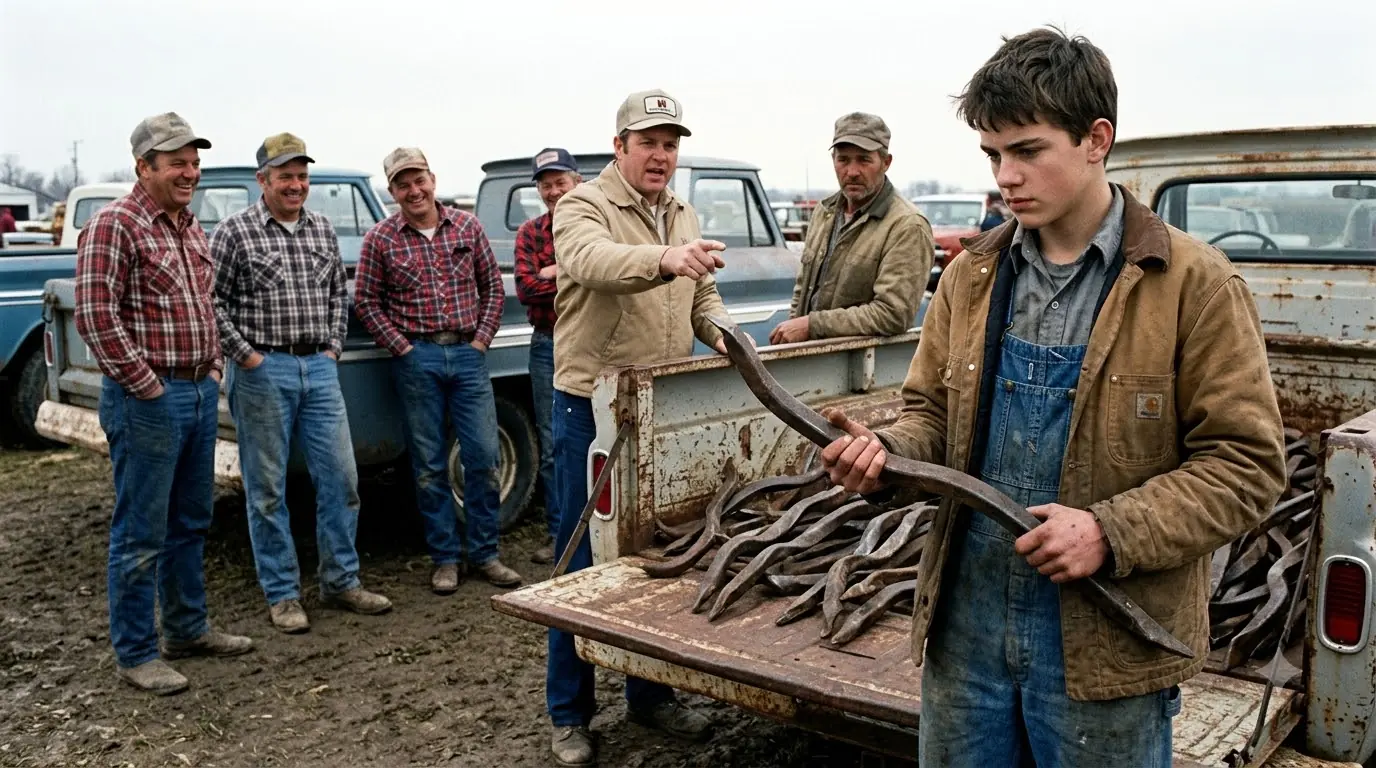
His hired man, Lyle Jensen, stood in the doorway with his hands in the pockets of a faded work coat.
“How many?”
“Fourteen.”
Lyle whistled.
“That’s not good.”
“No.”
Emmett set one of the shanks against the wall.
“Dealer?”
“Calling this morning.”
Lyle nodded slowly.
They both knew the problem was bigger than a parts order.
The cultivator had been built in 1954.
International Harvester had stopped cataloging those particular shanks more than fifteen years earlier.
Emmett’s father, Rupert Hassell, had bought the cultivator used in 1961 for four hundred twenty dollars, and except for one soybean experiment in 1968, the machine had worked every Hassell cornfield since. Rupert believed that properly built equipment was meant to be maintained rather than discarded, and Emmett had inherited that philosophy along with the land, the mortgages, the tools, and nearly every machine inside the shed.
The difference was that Rupert had farmed in a world where repair shops still understood machines built before the men repairing them were born.
By 1987, that world was disappearing.
Emmett called the International Harvester dealer in Eldora first.
The parts manager checked old catalogs.
Then microfiche.
Then a handwritten inventory list.
“Nothing.”
“Could you order them?”
“Not these.”
“Used?”
“I can make calls.”
“How long?”
The man hesitated.
“That depends on whether there are any left.”
Emmett thanked him and hung up.
He called three other implement dealers before lunch. A salvage yard outside Ames had two shanks that might fit and another buried somewhere behind several rows of dismantled equipment. A man in Story City thought he had one. Another dealer suggested replacing the entire cultivator.
By the end of the week, Emmett had located four usable shanks.
He needed fourteen.
Corn cultivation would begin in six weeks.
Emmett was forty-one years old and had farmed the same six hundred forty acres since he was twenty-four. He had inherited the operation after Rupert died from a heart attack between the barn and farmhouse on a November morning, leaving his son land that was valuable, debt that was real, and machinery that was already old.
Emmett had survived because he understood something his father had practiced rather than explained.
A machine did not need to be fashionable.
It needed to work.
The 1954 cultivator worked.
At least it had before the tile line.
Replacing it with something newer would cost money Emmett preferred not to borrow during a decade when too many Midwestern farms were already drowning in debt. He had watched neighbors finance newer tractors, larger planters, bigger combines, and equipment designed around acreage they hoped someday to farm. Some prospered.
Others disappeared.
Emmett distrusted debt that arrived wearing fresh paint.
That made the fourteen bent shanks more than broken steel.
They were a challenge to the way he had chosen to run his farm.
The problem, Emmett soon discovered, was not that bent cultivator shanks could not theoretically be repaired.
The problem was that nobody seemed to repair them anymore.
Older farmers remembered seeing blacksmiths heat damaged shanks, straighten them, normalize the steel, harden the working surfaces again, and return them to service. Younger farmers remembered dealerships.
By the late 1980s, replacement had become normal.
Repair had become old-fashioned.
Emmett called men his father would have known.
Most were dead.
Some had retired.
One shop had become a craft brewery.
Another had been converted into storage.
A former blacksmith in Grundy County answered the telephone himself but explained that arthritis had ended his working days ten years earlier.
“Steel doesn’t care if your hands hurt,” the old man said. “That’s the trouble.”
Emmett thanked him.
Then sat in the kitchen afterward staring at a yellow legal pad covered in names, numbers, and crossed-out possibilities.
His wife had died years earlier, and the silence in the house had long ago become ordinary. Emmett poured coffee and studied the page. He could buy another cultivator.
The simplest solution.
Also the one he hated most.
Not because he was sentimental.
Because the machine was otherwise sound.
Throwing away a working implement because fourteen pieces of steel were bent seemed less like progress and more like surrender.
The following Saturday, Emmett loaded all fourteen damaged shanks into the back of his old pickup and drove to the annual Hardin County spring equipment swap.
The event took place in the fairgrounds parking lot outside Eldora. Farmers came from several counties carrying old tractor parts, manuals, tires, tools, seed plates, gears, mower sections, carburetors, and every other object that had become too obsolete for dealerships but too useful to throw away.
Emmett backed into a gravel spot.
Lowered the tailgate.
Arranged the bent shanks where people could see them.
Then waited.
Farmers stopped.
Picked them up.
Turned them.
Shook their heads.
One man suggested welding reinforcement plates over the bends.
Emmett rejected that immediately.
Another said he might know a machinist.
A third advised him to sell the entire cultivator for scrap.
Then came Rick Crowley.
Rick was thirty-eight and operated the largest implement dealership in Hardin County. He sold John Deere and Case IH equipment, understood modern machinery well, and had the relaxed confidence of a businessman who spent his days solving problems with financing packages and inventory.
Rick picked up one of the shanks.
Turned it.
Set it down.
“You’re still chasing these?”
“Yes.”
“How many parts you find?”
“Four.”
Rick shook his head.
“I told you, Emmett. You’re fighting the calendar.”
“I know.”
“I’ve got a lead on a newer cultivator over in Webster County.”
“How much?”
Rick named a figure.
Emmett’s expression answered before his mouth did.
Rick smiled.
“You can’t cultivate six hundred acres with nostalgia.”
“It’s not nostalgia if the machine works.”
“It doesn’t work.”
“Fourteen pieces don’t work.”
Rick looked toward the pile.
“Same result.”
Several farmers nearby laughed quietly.
Emmett ignored them.
Twenty feet away, a sixteen-year-old boy stopped examining a box of old hand tools.
His name was Silas Novak.
And he had been listening.
Silas did not look like someone about to solve a problem experienced farmers had already given up on.
He was sixteen, lean, fair-skinned, handsome in the unfinished way boys sometimes are just before adulthood settles fully into their faces. Short dark-brown hair fell untidily across his forehead beneath a feed-store cap, and he wore faded denim overalls, a dirty gray shirt, his father’s brown canvas work jacket, and boots marked with oil, ash, and mud.
Most people saw a farm kid.
He was not exactly one.
His father, Denny Novak, owned a small-engine repair shop in Eldora and farmed thirty acres on the side. Silas had grown up around carburetors, mower engines, generators, chainsaws, bearings, stripped bolts, and men who brought broken things into his father’s shop expecting answers.
At twelve, Silas found something in his grandfather’s attic that changed the direction of his life.
A 1943 farm-shop manual.
The binding was failing.
Pages smelled like dust and old oil.
Nearly eighty pages were devoted to forging, straightening, heat treating, and repairing agricultural steel.
Silas read them until the book began falling apart.
Then stitched the binding himself with waxed thread.
He built a crude forge from an old brake drum, pipe, and salvaged blower motor. At first he ruined steel. Then he ruined less steel.
By fourteen, he could make hooks and hinges.
By fifteen, men occasionally paid him for simple repairs.
More important than what Silas knew was what he understood he did not know.
So he went looking for people who did.
For three years he attended swap meets, antique tractor gatherings, farm auctions, county fairs, blacksmith demonstrations, and machine-shop open houses. He asked questions.
He wrote answers in small notebooks.
He never pretended to be an expert.
Older craftsmen tolerated him because Silas listened.
Eventually, they began teaching.
That Saturday morning, he waited until another farmer walked away from Emmett’s pickup.
Then approached the tailgate.
Silas picked up one shank.
No introduction.
No sales pitch.
He studied the bend.
Ran his thumb across the oxidized surface.
Turned it toward the light.
Emmett watched silently.
Silas picked up another.
Then a third.
Rick Crowley noticed.
“What are you doing, son?”
Silas did not answer immediately.
He placed the third shank down.
“These bent cold.”
Emmett nodded.
“Frozen ground.”
Silas picked up the first again.
“They didn’t crack.”
“Not that I can see.”
“That’s good.”
Rick laughed.
Several farmers turned.
Silas ignored him.
He held the shank with both hands.
“High carbon?”
“Should be.”
“International?”
“1954.”
Silas nodded.
“Steel that bends cold without cracking can usually come back.”