Three days before Terrence Walker walked into the headquarters of Nexus Systems, half the company’s customers had stopped trusting their own login screens.
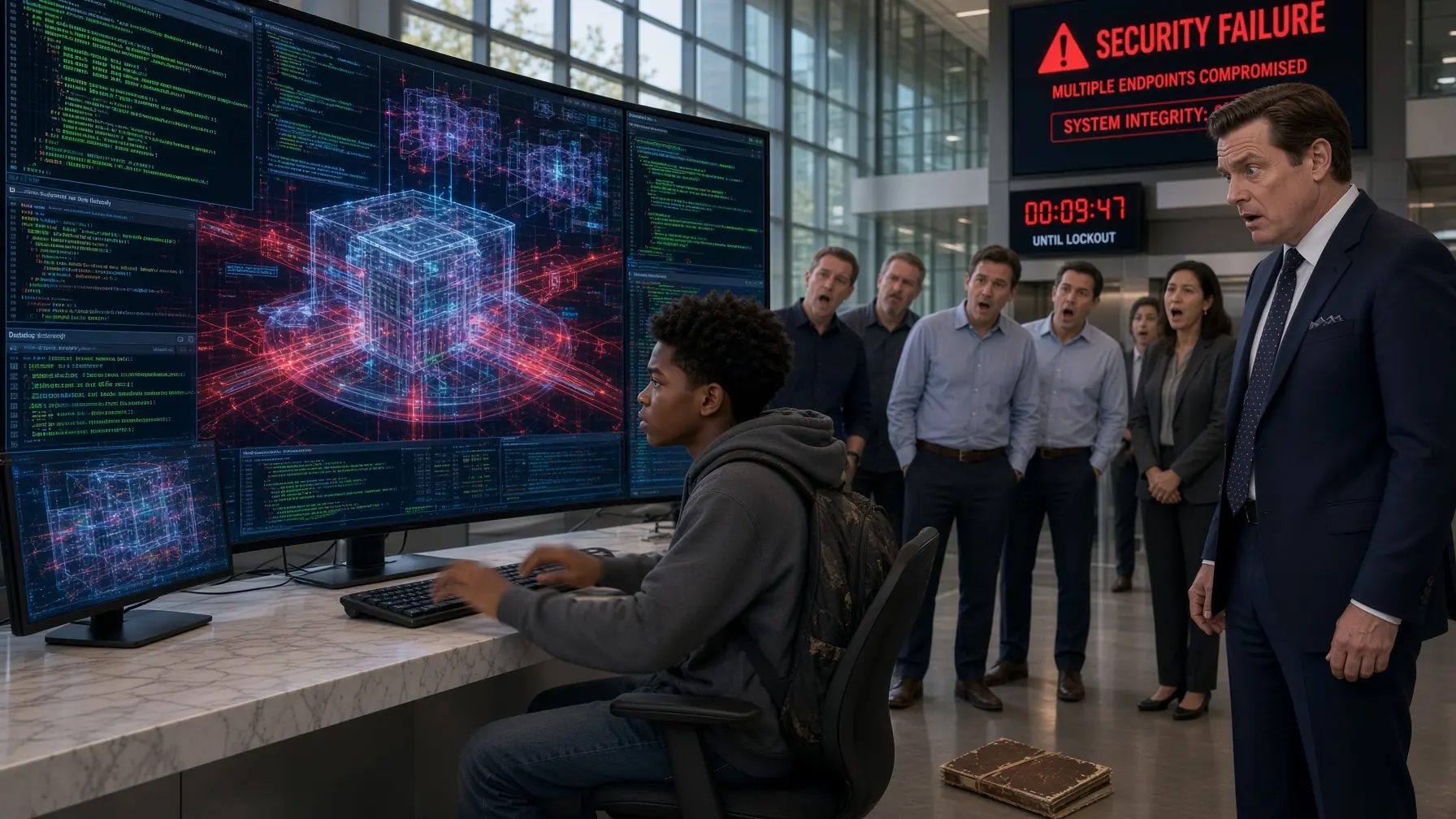
The first alarms appeared at 2:14 on a Tuesday morning, not as one spectacular collapse but as thousands of authentication requests arriving in patterns Nexus’s monitoring systems had never seen before. Banks found employees repeatedly locked out of internal tools. Airline ground crews lost access to scheduling systems and fell back to contingency procedures. Several hospital networks temporarily switched portions of their electronic record systems to downtime protocols because clinicians could not reliably authenticate. Warehouses delayed shipments, call centers slowed, and corporate VPNs failed across multiple continents. Nexus did not control thirty percent of the internet, as television anchors would later claim, but its identity and access platform sat invisibly underneath enough large enterprise systems that a failure there traveled frighteningly far.
By dawn, Nexus engineers understood the broad problem. Something in the company’s session-validation architecture was allowing a deliberately crafted flood of simultaneous authentication events to force different parts of the platform into contradictory states. One service believed a session had been validated while another believed it needed to be checked again. Recovery routines amplified the confusion. Systems designed to protect accounts began rejecting legitimate users faster than the network could restore them. Engineers contained the worst external traffic within hours, but every attempted permanent fix created some new failure in the mirrored test environment. The vulnerability was no longer actively spreading through the production network, yet nobody could guarantee that the next patch would not trigger another outage.
By Tuesday afternoon, Nexus had become the lead story on financial television. Early estimates of business interruption across its customers climbed into the billions, although nobody could calculate a reliable number yet. There were photographs of airport employees using printed passenger lists and nurses writing temporary notes on paper forms, which made for dramatic broadcasts even when the backup procedures were working exactly as designed. Federal cybersecurity agencies joined information-sharing calls because several affected customers operated critical infrastructure. Nexus’s board demanded updates every two hours. Its cyber insurer sent outside incident-response specialists. Major clients wanted to know two things: what had failed, and why Nexus had not found it earlier.
Grant Hollister had no comfortable answer to either question.
Grant was forty-nine, executive vice president of engineering, and had spent eleven years at Nexus. He was not incompetent. That was part of what made the later story harder to reduce to a cartoon. He had built teams that scaled products from millions of daily transactions to billions. He could read architecture diagrams faster than most senior engineers could explain them. He knew how to hold a technical review, how to challenge weak assumptions, and how to present terrible news to a board without letting panic infect the room. But Grant had one flaw that success had spent years rewarding instead of correcting: once he decided he was the smartest person in a disagreement, contrary evidence began feeling like disloyalty.
At 4:00 Tuesday afternoon, he stood before cameras in the Nexus auditorium and announced an emergency research challenge. The company already operated a conventional bug-bounty program, but this would be different. Nexus had created a sanitized reproduction of the failing authentication environment, stripped of customer information and isolated from production. Any independent researcher at least eighteen years old could register, analyze the published diagnostic package, and submit a reproducible explanation and corrective design. The first submission that independently passed the company’s full verification process would earn one million dollars.
“Open to anyone,” Grant said.
The sentence would become important later.
Researchers responded immediately. Most worked remotely. Others arrived at the Palo Alto campus because Nexus had opened a secured lab with mirrored systems for people who wanted supervised access to additional telemetry. Universities sent teams. Cybersecurity consultancies assigned senior engineers. Former government researchers joined. Specialists who normally charged thousands of dollars a day temporarily ignored other clients because a million-dollar bounty and one of the year’s most interesting failures had appeared at the same time.
By Thursday night, Nexus had received hundreds of submissions.
Most were wrong.
Some identified symptoms already known to the company.
A few found real weaknesses that needed correction but did not explain the outage.
Several proposals appeared promising until stress testing showed that they merely moved the failure elsewhere.
Nobody had a complete root-cause explanation and a patch the independent verification team trusted enough to recommend for production.
Six hundred miles away in Oakland, Terrence Walker had spent nearly the entire time at a folding table in the back room of a phone-repair shop.
He was eighteen.
He did not have a computer-science degree.
He did not claim to be an engineer when a regulated license or degree was required. If someone asked what he did, he usually said, “I fix things and write code.”
He had been doing both since childhood.
Terrence’s mother died when he was four. His father drifted in and out of his life before eventually disappearing into a cycle of addiction, incarceration, and temporary jobs that never became stability. Evelyn Walker, Terrence’s grandmother, took him in and raised him in a two-bedroom apartment in East Oakland. She cleaned offices at night, worked food service during the day when her knees allowed it, and never once told Terrence the family was poor in the dramatic way people say it in stories. She simply taught him to notice prices before putting anything in a shopping cart.
The Oakland Public Library gave Terrence his first computer that did not belong to somebody else.
He began with websites because webpages produced immediate results. Change a line and the screen changed. Then Python interested him because it let him automate boring things. C came later because he wanted to understand why some programs behaved differently when resources became scarce. Eventually he became fascinated by operating systems, state machines, distributed services, compilers, and the places where software stopped behaving like a neat sequence of instructions and began behaving like a crowd.
By sixteen, he had responsibly reported three security flaws in open-source projects.
None made him famous.
One earned him a T-shirt.
Another earned a thank-you message from a maintainer in Finland.
The third resulted in a seventy-five-dollar bounty that Evelyn insisted he save.
Terrence framed the email rather than the money.
His real work lived in notebooks.
Not because paper was somehow superior to computers.
Because a notebook could remain open beside a broken phone while both of his hands were inside the device.
He drew systems as boxes and arrows, wrote questions beside them, crossed out assumptions, and returned months later when some unrelated failure reminded him of an old idea. His latest notebook was black, cheap, and held together by an elastic strap that had stretched almost uselessly loose. Forty-seven pages into it was a diagram of a general problem he had been thinking about for months: distributed identity systems that allowed two recovery paths to make incompatible assumptions about the same session at nearly the same time.
It was not Nexus’s proprietary architecture.
Terrence had never seen Nexus source code.
It was a class of design problem.
When Nexus published its sanitized failure traces for the bounty, something in them looked familiar.
Terrence began Wednesday morning thinking he would spend an hour on it.
He was still awake at 3:00 Thursday.
He did not “solve a billion-dollar vulnerability in five minutes.”
That was the legend people invented later.
Terrence spent almost two days working.
He built a small local model from the public challenge specification. He reproduced the failure. He compared timestamps. He noticed that everyone online seemed to be concentrating on the service that failed last because that was where the visible symptoms accumulated. Terrence worked backward instead. He asked which earlier component could make two later components each behave correctly according to their own local information while producing a wrong result together.
At 4:12 Thursday morning, he circled one box.
Then he wrote:
Not corrupt state. Competing valid states. Authority duplicated during recovery.
That was the beginning.
By sunrise he had a candidate design change.
He did not know whether Nexus would accept it.
He did know that it behaved correctly in every version of the public test harness he could construct.
Terrence needed the bounty for a reason more urgent than ambition.
Evelyn had liver cancer.
The diagnosis was hepatocellular carcinoma, locally advanced but potentially operable according to the specialists who had reviewed her imaging. Her case was complicated enough that her doctors wanted treatment through a hepatobiliary center across the bay. Medicare covered much of her care, but an authorization dispute involving part of the specialist plan had become tangled between hospital billing, a supplemental insurer, and an outside review. Nobody had told Terrence, “Bring us $380,000 or we let your grandmother die.” Hospitals did not work that simply, and Evelyn had a social worker fighting the denial. But the family was already drowning in transportation costs, medications, unpaid time, deductibles, and the possibility that portions of her treatment might remain uncovered.
Terrence saw the million dollars and thought something very simple.
No more waiting for letters.
No more choosing which bill to delay.
No more watching Evelyn pretend she was not frightened because she knew he was.
When he told her about the bounty Thursday evening, she stared at him from her recliner for several seconds.
“You think you found it?”
“I think I found something.”
“That wasn't my question.”
Terrence smiled.
“I think I found it.”
Evelyn studied him.
“You going down there?”
“The site says they have on-site verification.”
“You registered?”
“Yes.”
“They say you can come?”
“My registration says pending. Deadline is tomorrow afternoon.”
“Then call.”
“I did.”
“And?”
“Hold music.”
Evelyn laughed softly.
“That sounds like a technology company.”
Terrence looked at the bus schedule.
A flight was impossible.
Even if he had money for one, the next affordable option did not help much.
The overnight bus did.
Evelyn reached into a drawer and handed him sixty dollars.
Terrence shook his head.
“No.”
“Don't start.”
“Grandma.”
“It's my money.”
“You need prescriptions.”
“I need you to stop acting like twenty-dollar bills are family heirlooms.”
He looked at her.
She pushed the money into his hand.
“You come back.”
“I will.”
“No.”
Her voice changed.
“That's the condition.”
Terrence understood what she meant.
The bounty mattered.
She mattered more.
“I'll come back.”
He packed one change of clothes, his old laptop, chargers, the notebook, a toothbrush, and two peanut-butter sandwiches Evelyn made even though standing in the kitchen exhausted her.
The bus left Oakland shortly before midnight.
Terrence slept perhaps forty minutes.
The rest of the trip he reviewed his model.
At 6:11 Friday morning, he stepped off near Palo Alto wearing black jeans, an old charcoal hoodie, and sneakers with gray tape reinforcing a tear near the toe. He had washed in a bus-station restroom. He had not slept enough to look rested. He carried everything he had brought in a backpack whose right strap had been stitched twice by Evelyn.
Nexus headquarters looked exactly like the sort of place designed by people who wanted architecture to imply inevitability.
Glass.
Steel.
Concrete.
A lobby ceiling so high the people beneath it seemed temporary.
Terrence walked to reception.
“My name is Terrence Walker. I registered for the recovery challenge.”
The receptionist typed.
“Status says pending verification.”
“I know. I submitted last night.”
“On-site participants need confirmation.”
“The deadline is this afternoon.”
She looked apologetic rather than hostile.
“I can call the challenge team.”
“Please.”
That should have been the entire interaction.
Then Grant Hollister entered the lobby.
He was already angry.
He had spent the previous night being told that another internal patch had failed under load. He had slept three hours. The board wanted a permanent remediation plan before noon. Two major customers were considering contractual remedies. His engineering floor looked like a disaster shelter made of laptops and caffeine.
The receptionist called him because the challenge manager was unavailable and Grant happened to be crossing the lobby.
“Mr. Hollister, this researcher says he registered but his access is still pending.”
Grant looked at Terrence.
Then at the backpack.
Then at the shoes.
“What researcher?”
“Terrence Walker.”
Grant looked again.
“You?”
“Yes.”
“How old are you?”
“Eighteen.”
Grant almost laughed.
“Of course.”
Terrence waited.
“The program is for security researchers.”
“The website says independent researchers.”
“You have a company?”
“No.”
“University?”
“No.”
“Employer?”
“I work at a phone-repair shop.”
Grant stared.
Then he gave the receptionist a look of exhausted disbelief.
“We have former NSA people upstairs who haven't slept in three days.”
Terrence said, “Okay.”
“And you came from a phone shop.”
“Yes.”
“Why?”
“Because I think the team is patching the wrong layer.”
That changed Grant’s attention.
Only slightly.
“What layer?”
Terrence did not answer immediately.
Grant smiled.
“Exactly.”
“I'll explain it in the challenge environment.”
“You don't even know our architecture.”
“I know the architecture you published.”
“That is a simplified reproduction.”
“It still shows the failure.”
Grant crossed his arms.
Several employees waiting for elevators had begun listening.
“What exactly are you proposing?”
Terrence glanced toward the reception desk.
“Is the lobby where you want me to discuss the bounty submission?”
That annoyed Grant.
“You think you're protecting some secret?”
“I think the rules say submissions should go through the verification team.”
Someone near the elevators smiled.
Grant saw it.
His embarrassment converted instantly into contempt.
“Listen to me, kid. We have people upstairs with doctorates from MIT, Carnegie Mellon, Stanford, Georgia Tech. People who have built systems you couldn't begin to understand.”
Terrence said nothing.
Grant continued.
“Do you even know how to use a terminal beyond repairing cracked phone screens?”
The receptionist looked down.
A young security engineer named Briana Wells was standing near the elevators holding coffee.
She stopped walking.
Terrence looked directly at Grant.
“Give me five minutes in the sandbox.”
Grant laughed.
Not because it was funny.
Because people were watching.
“Five minutes?”
“Yes.”
“To solve what hundreds of submissions haven't solved?”
“To show you what I already found.”
That distinction should have mattered.
Grant ignored it.
“Fine.”