“Please, Your Grace. May I try the slipper?”
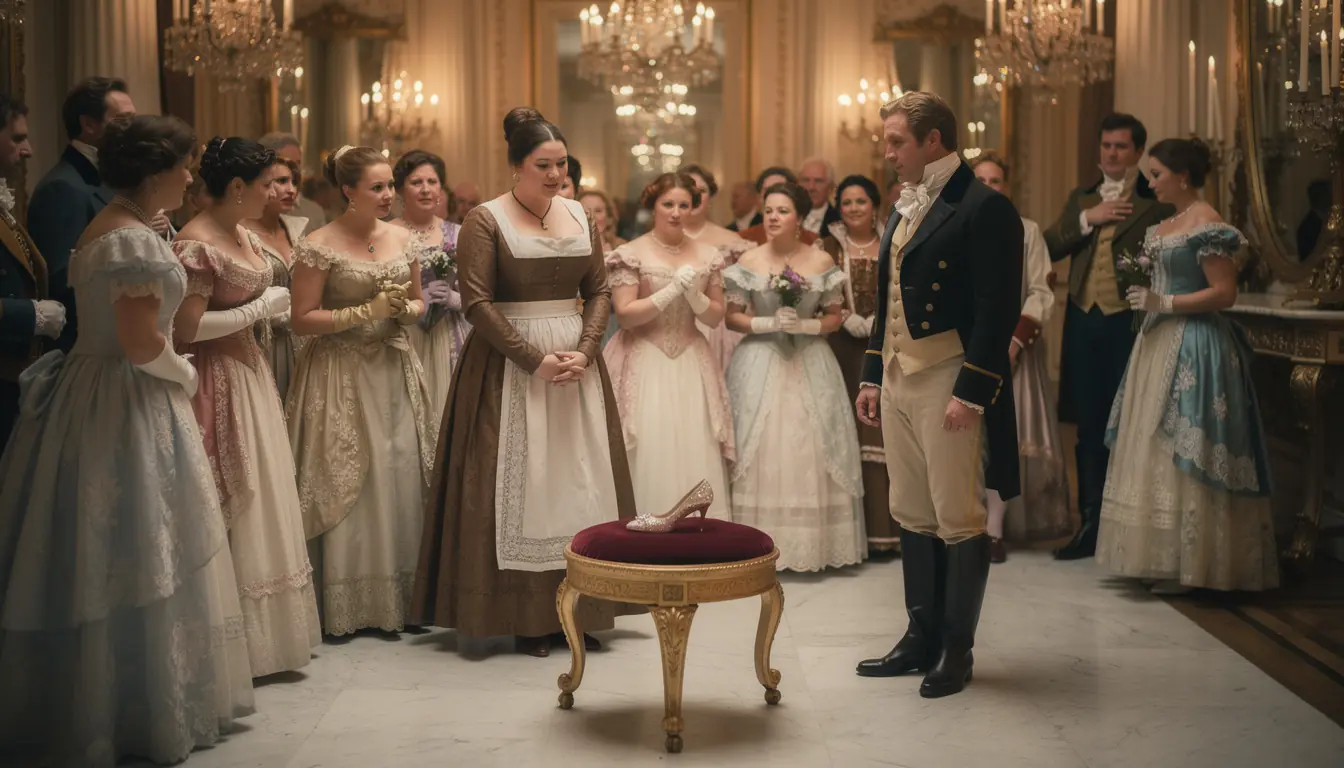
Eliza Rowan’s voice was barely louder than the crackle of the fire, but it reached every corner of the blue drawing room.
Forty guests turned toward the young maid standing beside the door. She wore a plain gray dress, a white apron with a faint flour mark on the hem, and shoes so worn that she had stitched one sole twice. Her dark chestnut hair was pinned in a simple knot, and her hands were roughened by cold water and soap.
On a cushion of midnight-blue velvet, beneath the winter sunlight, rested a single crystal slipper.
The first laugh came from Miss Lavinia Dacre.
“Oh, this is too wonderful,” she said, pressing a lace handkerchief to her lips. “The kitchen maid thinks she is the mysterious lady from the Duke’s ball.”
Others joined in. A gentleman near the window raised his eyebrows as though Eliza had made a delightful joke, and Lady Dacre, mistress of Thornbury Hall, looked ready to dismiss her before the entertainment could spread.
“Back to the kitchen, Rowan,” she ordered. “You have already forgotten your place once today.”
Eliza stood very still. For a moment she thought she might obey, as she had obeyed nearly every command in that house for four years.
Then she looked at the slipper.
It was made of clear crystal fitted over an intricate framework of silver, with a delicate satin lining and a tiny design of a robin worked into the heel. She knew that design. She had sewn the robin herself.
“Please,” she said again. “I know it seems unlikely. But I must ask.”
Lavinia laughed more loudly. “She will break it with those great work-worn feet.”
A faint flush rose along Eliza’s neck. She was neither particularly tall nor especially thin, and every dress she owned had been altered twice to fit the figure Lady Dacre considered too substantial for fashionable society.
Beside the fireplace, Adrian Ellsworth, Duke of Wycliffe, rose from his chair.
“That is quite enough,” he said.
His voice was not raised, but it carried the authority of a man who had never needed to shout to be heard.
Lady Dacre turned toward him. “Your Grace, I do apologize. She is merely a servant who has grown confused by the excitement.”
“Then let her try.”
The room went silent.
Lavinia stared. “Surely you cannot be serious.”
The Duke’s gray eyes remained fixed on Eliza.
“I came to discover who wore this slipper,” he said. “I did not come to ask who is permitted to hope.”
He held out his hand.
Eliza approached the velvet cushion. Her heart beat so rapidly that she could feel it in her throat. Slowly, she removed her worn shoe, placed one foot on the stool, and drew the crystal slipper toward her.
It slipped over her toes.
The silver arch settled beneath her instep.
The heel closed around her foot as though it had been made for her and no one else.