The auctioneer did not waste much enthusiasm on the old fuel pump.
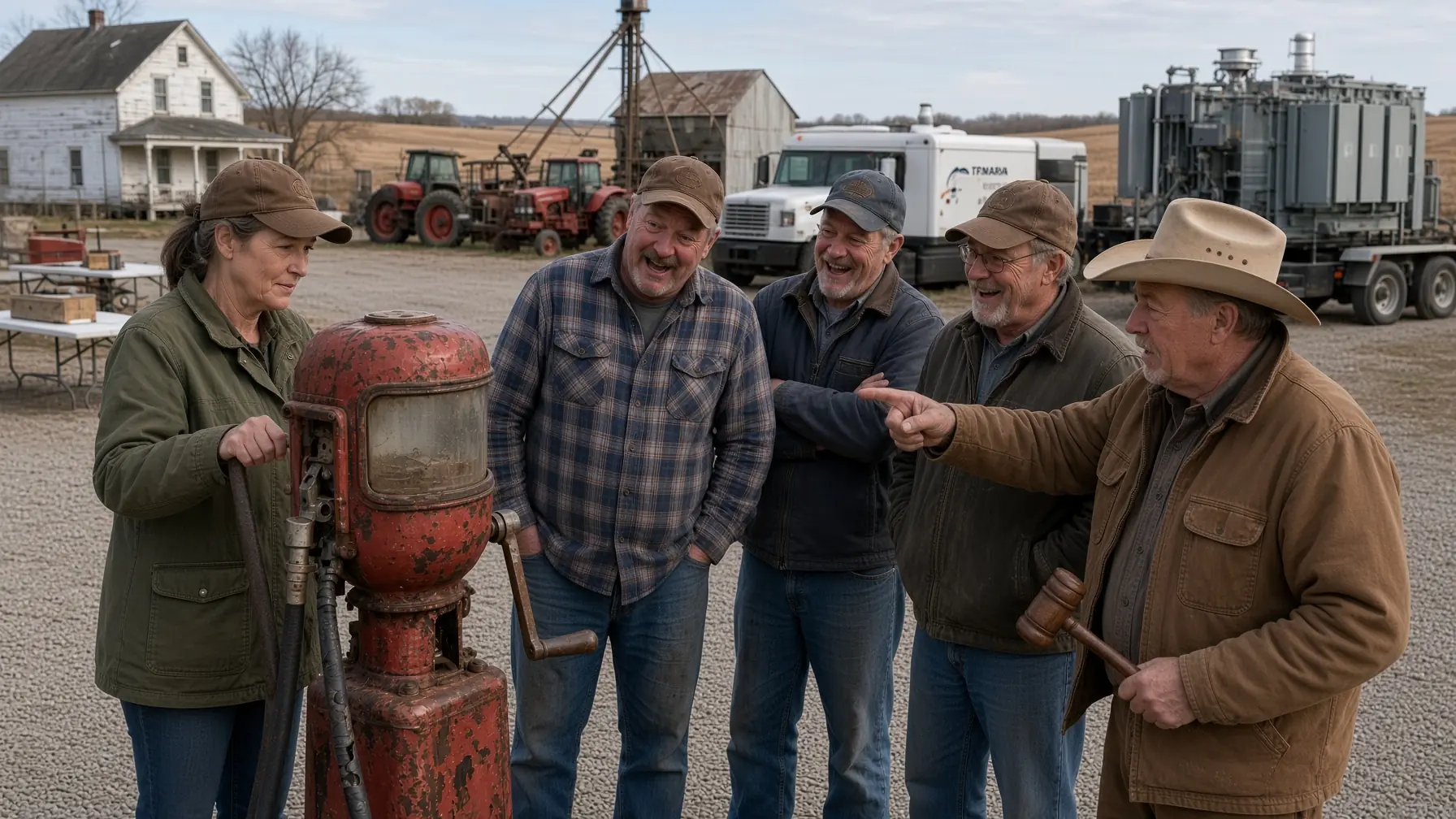
After twenty-two years conducting farm retirement sales across eastern Nebraska, Earl Madsen had learned to read a crowd almost as well as he read bid cards. People leaned toward machinery they wanted. They walked circles around tractors, squatted beside tires, opened toolboxes, checked hydraulic hoses, and whispered numbers to their wives or sons. Things nobody wanted created their own empty space.
That Saturday morning, the empty space was at the back corner of Bill Harland’s farmyard.
An old steel fuel tank sat beside a leaning fence post, half hidden against a field of brown October corn. Rust ran down its lower seam. The tank probably belonged in a scrap pile, but bolted to its side was something Clara Whitaker had noticed the moment she arrived: a heavy cast-iron rotary transfer pump with a hand crank, glass filter bowl, steel nozzle, and faded red paint bleached nearly pink by decades of Nebraska weather.
The hose was cracked. The bowl was cloudy. Dark staining beneath one gasket suggested it had leaked sometime in its previous life.
Nobody else cared.
Earl tapped the pump body with two fingers. “Old manual fuel-transfer pump, sells with the tank. What do I have, folks?”
Silence.
A farmer near the grain auger kept talking to his brother.
Another man studied a set of socket wrenches.
Someone at the edge of the crowd said, “Put it in a museum.”
Several people chuckled.
Earl tried once more. “Twenty dollars?”
Nothing.
“Ten?”
A hand rose near the back.
“Forty.”
The auctioneer blinked.
Clara Whitaker stood apart from the main crowd with both hands tucked into the pockets of a brown canvas coat. At fifty-five, she had gray appearing along her temples and the quiet expression of someone accustomed to thinking before speaking. A stainless-steel thermos rested beneath one arm.
Earl looked toward her.
“Forty dollars from Clara. Anybody fifty?”
Nobody moved.
He waited three practiced seconds.
“Sold. Forty dollars.”
The gavel fell.
Ray Collins turned around.
He farmed four hundred acres east of town and had known Clara’s late husband for twenty years. Ray glanced at the pump, then at Clara, then exchanged a smile with the man beside him. Neither said anything directly to her.
They did not need to.
Clara knew the look.
Her nephew Mason stood six feet away.
He was twenty-five, broad-shouldered and still young enough to believe efficiency should be obvious when he saw it. He had worked on Clara’s farm for two years after finishing an agricultural equipment program at community college. He liked clean wiring, modern hydraulics, electronic moisture sensors, fast pumps, and machines that started when a key turned.
He looked at the pump.
Then at his aunt.
“What are we doing with that?”
“Taking it home.”
“I gathered that.”
Clara sipped coffee.
Mason waited.
Nothing.
He sighed. “Is it for something?”
“Yes.”
“What?”
“You’ll see.”
That was all she gave him.
They stayed another two hours.
Clara bought a set of cultivator sweeps she did not particularly need because the price was too good to ignore. Mason bid unsuccessfully on a newer impact wrench. Ray Collins bought the late-model grain auger for considerably more than he had intended and spent the rest of the afternoon convincing himself he had gotten a bargain.
When the sale thinned out, Bill Harland used his loader to lift the old fuel tank into Clara’s pickup.
The pump looked even worse up close.
Mason touched one cracked section of hose.
“This needs everything.”
“Not everything.”
“The bowl’s stained.”
“Cleanable.”
“Seal leaked.”
“Replaceable.”
“The crank’s half seized.”
“Lubrication.”
He looked at her.
“Do you already have every answer?”
“No.”
“That’s comforting.”
Clara climbed into the passenger seat.
Mason drove.
For several miles, only the sound of tires over county pavement filled the cab. Harvested soybean fields stretched flat beneath a pale October sky. Shelterbelts cut dark lines across the horizon. Grain bins appeared beside farmhouses every few miles, silver against dry grass.
Mason glanced toward the rearview mirror.
The pump bounced slightly in the truck bed.
“It’s going to take forever to fill anything with that.”
“Probably.”
“We already have a transfer pump.”
“Yes.”
“A good one.”
“Yes.”
“Then I’m missing something.”
Clara looked out the window.
“That happens.”
Mason laughed despite himself.
He knew better than to push.
Clara rarely purchased anything without a reason.
She had spent eleven years behind the parts counter at Halverson Farm Supply before she and her husband, Tom, began farming full-time. During those years she had learned carburetors, bearings, filters, hydraulic fittings, belts, grease specifications, pump curves, and the peculiar art of listening to a farmer describe a broken machine without using the name of any actual component.
She could identify more equipment by sound than Mason could identify by model number.
Tom used to joke that Clara had sold enough machinery parts to know which pieces manufacturers regretted designing.
Then he died.
Eight years earlier, pancreatic cancer took him in less than seven months.
For the first year afterward, several neighbors quietly assumed Clara would rent out all three hundred forty acres and stop farming.
Instead she sold forty older beef cows, reduced debt, kept the cropland, hired custom help for the heaviest work, and continued.
Mason joined her six years later.
He had grown up spending summers on the farm and knew the basics, but Clara taught him the operational part: planning not for the machine that worked, but for what happened when it stopped.
Tom had believed the same thing.
Their shop contained spare belts for equipment they no longer owned, two backup hydraulic hoses with common fittings, a battery-powered radio, an old PTO generator that was temperamental enough Clara considered it “emergency only,” and a handwritten list taped inside the machine-shed office showing where every fuel shutoff was located.
Mason called it paranoia.
Clara called it harvest.
The old hand pump went behind the machine shed the following afternoon.
She did not keep Bill Harland’s rusted tank.
The steel around the lower seam had deteriorated enough that Clara did not trust it for fuel storage, so she removed the pump and sent the tank for scrap. Behind her shed already stood a two-hundred-fifty-gallon reserve diesel tank mounted low on a steel cradle. It was separate from the larger main tank and usually kept only partially filled.
The main tank used a 120-volt electric transfer pump.
Fast.
Filtered.
Metered.
Convenient.
The reserve tank had no permanent pump.
Clara had always considered that a weakness.
After Tom died, she nearly installed a second electric unit, then rejected the idea. Two pumps depending on the same power source were not two independent systems.
She wanted something else.
The old cast-iron pump gave her that for forty dollars.
It took three evenings to make it trustworthy.
Clara started with the glass bowl.
Mason held a trouble light while she loosened the retaining ring carefully.
“If that cracks, good luck finding another.”
“I found replacements online.”
Clara looked at him.
“You already searched?”
“Maybe.”
She smiled.
The bowl came free.
Years of residue coated the inside.
Underneath the grime, they found a faint line near the base.
Mason frowned. “Crack?”
Clara cleaned it again.
They inspected the line under brighter light.
“Scratch,” she decided. “Not through the glass.”
“You sure?”
“No.”
Mason smiled.
“There’s the answer I trust.”
They filled the bowl with solvent and watched for seepage.
None appeared.
The old gasket beneath it was useless, compressed flat and hard enough to snap when Clara bent it.
That went into the trash.
The next morning, she drove into town and returned with two replacement gaskets rather than one.
Mason noticed.
“Why two?”
“Because if one matters enough to drive twenty miles for, it matters enough to keep a spare.”
The filter screen inside the pump body was almost plugged.
They soaked it.
Brushed it.
Blew it clean.
The shaft received fresh lubricant. The check-valve assembly came apart for inspection. A worn sealing surface was cleaned and dressed carefully. They replaced the cracked discharge hose with modern fuel-rated hose and kept the original metal nozzle after confirming the valve still closed properly.
Mason turned the crank.
At first it dragged.
Clara adjusted the packing.
He tried again.
Better.
“How many gallons per minute?”
“Maybe five.”
“That’s terrible.”
“Compared with what?”
“Our electric pump.”
“Yes.”
“That does twelve.”
“Closer to fifteen when the filter is clean.”
“So why are we doing this?”
Clara wiped her hands.
Mason waited.
She pointed toward the crank.
“What makes that turn?”
“My hand.”
“What else?”
“Nothing.”
“What makes the big pump turn?”
“Electric motor.”
“And that gets power from?”
“The grid.”
Clara nodded.
Mason looked at the pump again.
“We have the PTO generator.”
“When it starts.”
“It starts.”
“Usually.”
He laughed.
“You really bought this for a power outage?”
“I bought it because forty dollars was cheaper than discovering during an outage that we had fuel we couldn’t move.”
Mason considered that.
“It’s still slow.”
Clara picked up her wrench.
“Slow beats empty.”
That sentence stayed with him.
The first real test came Friday afternoon.
They had mounted the pump to a welded steel bracket attached beside the reserve tank. A rigid suction tube reached near the tank bottom, stopping high enough to remain above any settled contaminants. Clara installed a coarse strainer at the inlet and kept a clean replacement nearby.
She filled the tank with thirty gallons of diesel.
Then she handed Mason an empty five-gallon can.
“Moment of truth.”
He held the can beneath the nozzle.
Clara opened the valve and began cranking.
Nothing happened.
Ten seconds.
Fifteen.
Mason looked through the cloudy glass bowl.
“No fuel.”
“Keep watching.”
“You want me to tell you when nothing changes?”
“Yes.”
Twenty seconds.
The crank resisted rhythmically.
Then a dark line appeared at the bottom of the bowl.
“Got something.”
Clara continued.
Fuel rose slowly.
Air bubbles moved through the glass.
The nozzle coughed once.
Then again.
A thin stream appeared.
Within seconds it became steady.
Mason adjusted the can.