The laughter started before the auctioneer finished describing the machine.
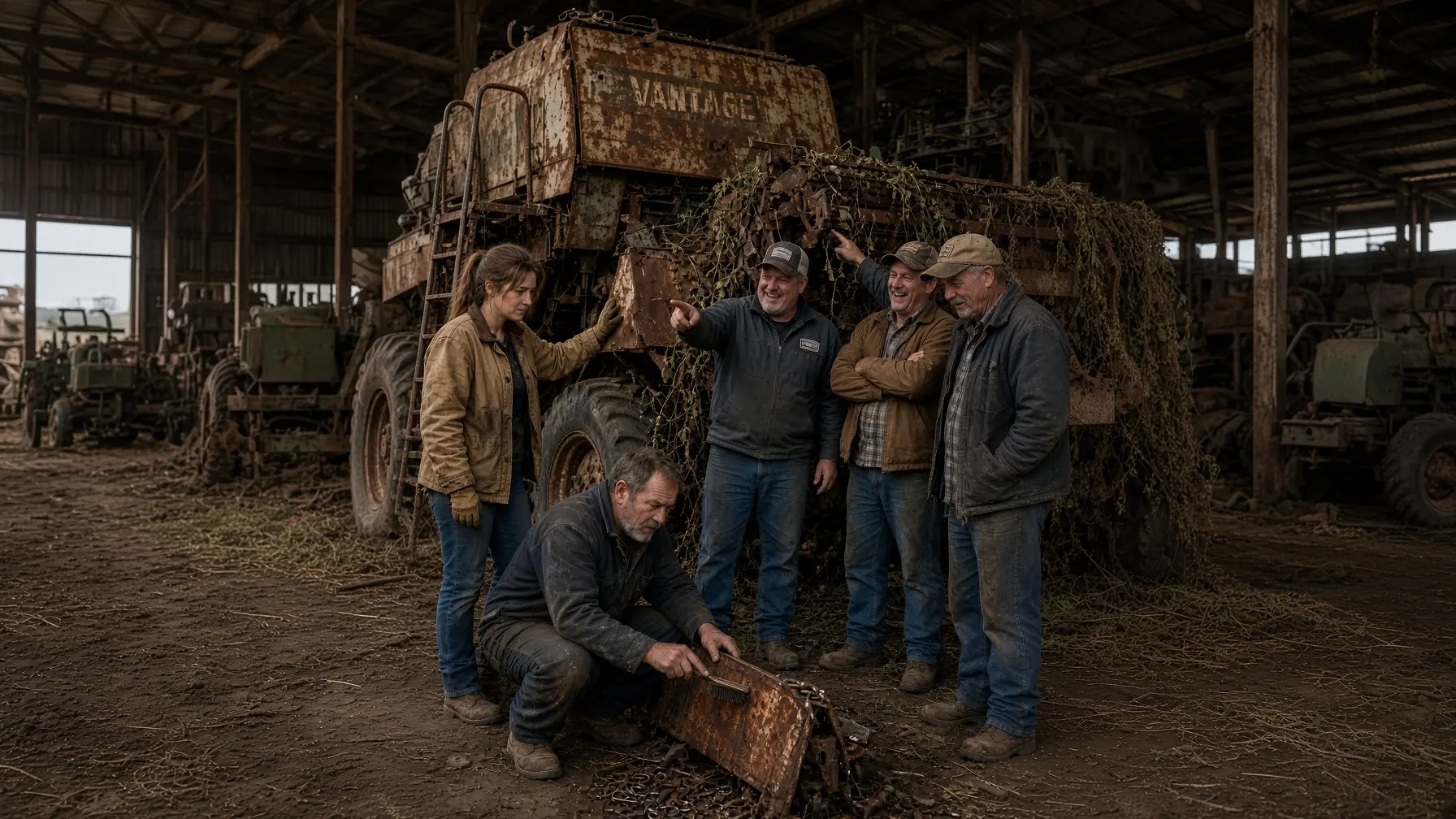
“Vantage combine. Non-running. Sold where-is, as-is. No warranty on engine, transmission, hydraulics, or anything else you’re brave enough to believe still works.”
Kurt Baylor lowered the clipboard and looked across the machine shed.
Nobody moved.
The old combine sat beneath a lean-to at the rear of Otto Renner’s property outside Millbrook, Kansas, surrounded by equipment people actually wanted. A late-model grain auger already had three farmers circling it. Two service trucks were parked beside a row of cultivators. Toolboxes, cattle panels, a seed tender, and a nearly new portable welder had drawn most of the crowd.
The combine had drawn wasps.
A nest the size of a dinner plate hung above the right rear wheel.
Both front tires were flat. Grass grew through one end of the header reel. Thirty years of dust covered the cab glass so heavily that the seat inside was only a shadow. Rust streaked the sheet metal beneath every seam, and somebody from the auction crew had spray-painted LOT 114 directly onto the side because an adhesive tag would not stay attached.
Kurt lifted one hand.
“Who’ll give me two hundred dollars?”
Someone laughed.
It was Wade Holloway, owner of Holloway Farm Equipment two miles east on Route 9.
“Two hundred?” Wade called. “Recycler might charge you that to take it.”
Several men smiled.
Kurt waited.
“Hundred?”
Nothing.
Then a woman standing near the back raised her hand.
“Four hundred.”
Heads turned.
Claire Whitfield kept her hand up.
She was thirty-four, wore faded jeans, work boots, and a canvas farm coat much too heavy for the mild April afternoon. Her dark hair was tied at the back of her neck. She had not come to the sale planning to buy a combine. She had come for two grain augers and possibly a used fuel tank if the price stayed low.
Her father-in-law, Ray Whitfield, stood beside her.
He looked at the machine.
Then at Claire.
Then back at the machine.
“Four hundred,” Kurt repeated. “I’ve got four. Anybody five?”
A man near the doorway raised two fingers.
“Five.”
Claire answered immediately.
“Six.”
The man shrugged and stepped away.
Kurt found another bidder at eight hundred.
Claire went to nine.
At twelve hundred, Wade Holloway stopped smiling.
Not because he wanted the machine.
Because he knew Claire.
Everyone did.
The Whitfield farm was seven hundred sixty acres of hard red winter wheat and a small rotation of grain sorghum spread across rolling ground south of Millbrook. It had been in Daniel Whitfield’s family since 1961. Daniel had died four years earlier, and since then Claire had been holding the operation together with Ray, one hired man, seasonal help, and more borrowed time than she liked admitting.
Wade glanced toward the combine.
Then toward Claire.
“Don’t chase it,” he said quietly.
She heard him.
Kurt called, “Fifteen hundred.”
Claire raised her hand.
“Sixteen.”
Someone bid eighteen.
Claire went two thousand.
Ray leaned closer.
“You know something I don’t?”
“No.”
“That’s not comforting.”
“Two thousand two hundred,” Claire called.
Silence.
Kurt scanned the shed.
“Twenty-two hundred once.”
Nobody moved.
“Twice.”
Wade shook his head.
“Sold.”
The gavel struck the folding table.
Somebody behind Claire muttered, “Most expensive scrap pile in Larkspur County.”
A few people laughed again.
Claire did not.
She looked toward the combine.
It was ugly.
Possibly useless.
And now hers.
The reason she had raised her hand had nothing to do with antique machinery, sentiment, or some secret knowledge that everyone else lacked.
She needed a combine.
And two days earlier, Roland Voss at First Prairie Bank had told her how little time remained before needing one became the least of her problems.
The Whitfield farm had not collapsed all at once.
Most farms did not.
They weakened in pieces.
Daniel’s death had been the first.
It happened on a Tuesday afternoon in February 2020.
He was thirty-six.
Claire was thirty.
Their daughter, Nora, was seven.
Daniel had been clearing a problem near a grain-cart auger when his jacket caught rotating equipment before the machine was completely isolated.
The accident lasted seconds.
The consequences did not.
Afterward came casseroles.
Funeral arrangements.
Life-insurance forms.
Probate.
Farm accounts.
Equipment notes.
Neighbors arriving before sunrise because cattle still needed water and wheat did not care that somebody had died.
Much of the kindness was genuine.
So were the assumptions.
At the co-op, men discussed whether Claire would sell.
At church, women asked whether she planned to move closer to family in Wichita.
Nobody meant much harm.
But the question always seemed to contain its own answer.
Surely you aren’t staying.
Claire stayed.
Not because Daniel had made her promise.
He had not.
Not because the Whitfield name had to remain on the land.
Claire did not believe dead people should control the living through guilt.
She stayed because when she looked at the ledgers with Ray after the funeral, the farm still made sense if they could manage debt carefully and if harvests remained normal.
“With your help,” she told Ray across the kitchen table, “I want to keep going as long as the numbers say we can.”
Ray was sixty-seven then and had retired only in theory.
He looked at her for a long moment.
“My knee’s bad.”
“I know.”
“I’m slower than Daniel.”
“I know.”
“And you’ve never run harvest alone.”
“No.”
Ray folded his hands over the ledger.
“But you know this farm.”
“Yes.”
He nodded.
“Then we try.”
For three seasons, they did more than try.
They made it work.
Claire handled field planning, input purchases, records, most spraying, and an increasing share of machinery operation. Ray hauled grain and repaired what his knee allowed. Curtis Doyle, Daniel’s childhood friend, continued working the farm as he had for eleven years.
Curtis was fifty-eight by 2024, divorced, lived in a trailer outside town, and possessed the kind of mechanical intelligence that made formal explanations seem unnecessary. He could hear a hydraulic pump cavitating before anyone else noticed. He once identified a failing idler bearing from across a field.
Daniel had trusted him.
Claire did too.
The problem was the combine.
Daniel had purchased a used but relatively modern machine in 2019 through financing arranged by Holloway Farm Equipment. At the time, the payment made sense.
Then Daniel died.
The estate settlement did not.
A title issue involving another piece of equipment delayed insurance disbursement. Medical expenses arrived. Wheat prices moved. An input loan grew larger during two difficult seasons.
Claire stayed current until late 2023.
Then she missed a payment on the combine.
Then another.
Wade Holloway extended what flexibility he could.
Eventually his lender stopped allowing flexibility.
In early April 2024, a recovery contractor arrived with a flatbed.
Nora, now eleven, stood on the farmhouse porch while men winched the combine onto the trailer.
Claire hated that her daughter saw it.
Wade called before the truck left.
“I’m sorry.”
Claire stood beside the empty machine shed.
“I know.”
“I mean it.”
“I know that too.”
He exhaled.
“I can’t carry the note any farther. My floor-plan agreement doesn’t let me.”
“I understand.”
“Claire—”
“It’s all right.”
“No, it isn’t.”
That was the most honest thing he said.
Then she told him, “That machine is my harvest.”
A long silence followed.
“I know.”
Wade did not offer another combine on credit.
He could not.
Claire’s recent payment history would not pass his lender’s requirements, and he had nearly lost his dealership during a credit squeeze thirteen years earlier after extending too much personal mercy to customers whose debts became his.
He had learned something harsh from it.
You could sympathize with a farmer and still be unable to finance one.
Claire did not hate him.
That almost made the situation worse.
The next morning, she met Roland Voss at First Prairie Bank.
Roland had known Daniel since county-fair days.
He was not waiting behind the desk with foreclosure papers.
He was waiting with three pages of calculations.
The farm’s operating note stood at roughly eighty-four thousand dollars, secured partly by crop proceeds and partly by farm assets.
“You have wheat in the ground,” Roland said.
“Yes.”
“Looks decent.”
“So far.”
“You need harvest revenue.”
“I’m aware.”
Roland removed his glasses.
“I can keep the regional credit office from pushing this into special assets through August fifteenth if I have something defensible.”
“What’s defensible?”
“A working harvest plan.”
“I can custom hire.”
“You called?”
“Everybody.”
He nodded.
Custom crews were already booked.
The late-June wheat window did not allow every farmer to wait politely for the same machine.
“What about rental?”
“Cash up front.”
“How much?”
“More than I have.”
Roland looked toward the papers.
“You can sell ground.”
Claire’s jaw tightened.
“How much?”
“Eighty acres would probably resolve the immediate issue.”
“That eighty cuts access to the south quarter unless I negotiate another road.”
“I know.”
“So I solve one problem by making the farm worse forever.”
“I’m not recommending it. I’m telling you options.”
“What happens if I do nothing?”
Roland met her eyes.
“Then by late summer people above me start making decisions neither of us will like.”
Claire left the bank with perhaps ten weeks to create a harvest plan.
That was why a non-running combine at an estate auction did not look the same to her as it looked to Wade Holloway.
He saw an obsolete machine with unknown repair costs.
She saw something that might become a combine for less cash than anything else available.
Not likely.
Not sensible.
Possible.
And when every sensible option had already told her no, possible deserved inspection.
She did not bid because she somehow knew it was special.
She bid because while everyone else laughed, she had walked around the machine.
The sheet metal was rough.
The cab was tired.
But the structural frame beneath it seemed unusually heavy.
The grain tank had dents but little perforation.
The main rotor housing looked overbuilt relative to combines she remembered from that era.
Something about the proportions seemed strange.
Not valuable.
Strange.
At twenty-two hundred dollars, she decided strange was enough.
Wade caught her at the cashier’s table.
“You serious about putting that in wheat?”
“That’s the idea.”
“Claire, I’m not trying to embarrass you.”
“I know.”
“You could put ten thousand into it and still own scrap.”
“Yes.”
“Engine might be locked.”
“Probably.”
“Transmission?”
“Unknown.”
“Hydraulics?”
“Unknown.”
“Header’s cracked.”
“I saw.”
Wade looked at her.
“What exactly did you buy?”
Claire handed the cashier her check.
“Ten weeks.”
Wade had no answer to that.
The combine arrived at the Whitfield farm the following Saturday.
Curtis Doyle was waiting.
He walked around it once.
Then again.
He opened the engine compartment.
Dust rolled out.
A mouse nest fell near his boot.
He stepped back.
“Well.”
Claire folded her arms.
“That bad?”
“I didn’t say anything.”
“You made a sound.”
“Sound isn’t diagnosis.”
Curtis crawled beneath the frame.
For several minutes all Claire saw were his boots.
Then he slid out.
“What?”
He ran one hand across the lower frame rail.
“Steel’s heavy.”
“I thought so.”
“Too heavy.”
“For what?”
“This generation.”
Claire crouched beside him.
Curtis tapped the frame.
“Most manufacturers were taking weight out by then. This looks like somebody built it expecting trouble.”
“That good?”
“Means it’s heavy.”
“You are incredibly helpful.”
He smiled.
Then he began the real inspection.
The engine was stuck.
Not necessarily ruined.
The transmission contained water contamination and deteriorated oil.
Hydraulic hoses needed replacement.