Every Friday morning, sometime after seven, the first sawmill truck climbed the gravel road toward Emma Brooks’s farm carrying another load nobody else particularly wanted.
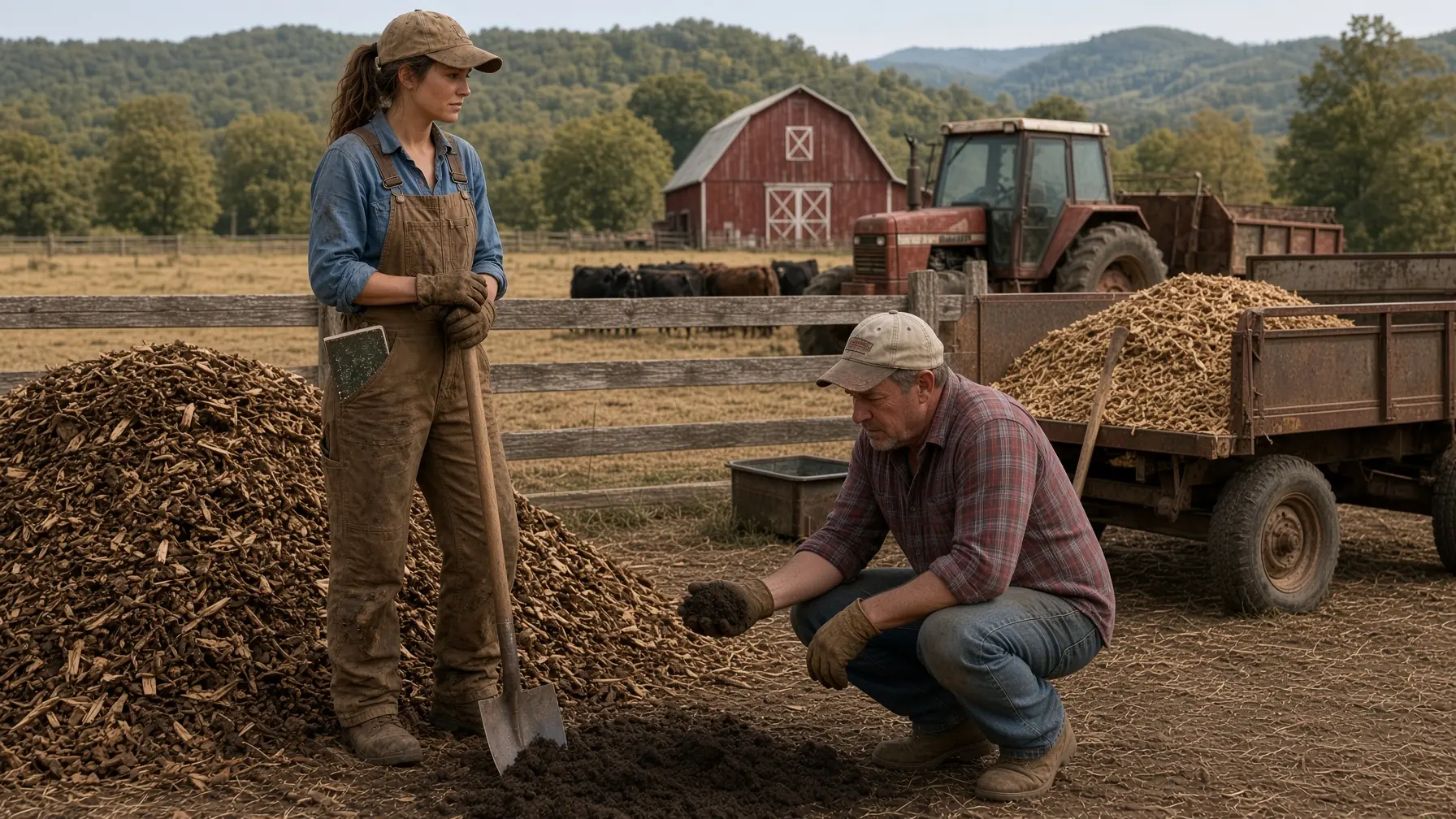
Oak. Maple. Hickory. Cherry. Poplar mixed in some weeks, depending on what had come through Jenkins Family Sawmill. The chips were fresh enough to steam when the cool mountain air hit them, pale wood mixed with strips of bark and occasional curls of sawdust. By lunchtime, another mound sat in the lower pasture, some of them high enough that Emma’s pickup disappeared behind them when she drove along the fence. The smell of fresh-cut hardwood drifted across the hollow, clean and sweet at first, then darker and earthier as the piles aged.
People noticed.
It was difficult not to.
For most of Emma’s childhood, that pasture had been open enough that you could stand on County Road 18 and see all the way to her grandfather’s red barn. Now the view was interrupted by piles of wood chips that looked, from a distance, like small tan hills dropped onto forty-eight acres of tired western North Carolina ground.
The school bus drivers started pointing them out.
Children gave the place a name.
Wood Chip Mountain.
Her neighbor Ben Carter was less charitable.
One evening he stopped his truck along the fence and leaned through the open window while Emma stood halfway up one of the piles with a long compost thermometer.
“You building the county’s largest hamster cage?”
Emma looked down.
“Not intentionally.”
“Good. Because you’d need a remarkable hamster.”
She smiled.
Ben looked at the piles again.
“How many loads now?”
“Twenty-three.”
His eyebrows rose.
“You counting?”
“I count everything.”
“That ought to worry me more.”
She pushed the thermometer deeper.
Ben waited.
“What’s it say?”
“One-thirty-one.”
“Degrees?”
“Yes.”
He stared at the steaming mound.
“And that doesn’t worry you?”
“It interests me.”
“Those are not the same thing.”
“No.”
Ben laughed, shook his head, and drove away.
Emma wrote in a dark green field notebook.
Pile 3. Interior 131°F at roughly 36 inches. Exterior 74°F. Moist but not saturated. Steam visible at dawn. Odor woody, not sour.
Then she climbed down.
She was twenty-seven years old and had inherited more questions than money.
Her grandfather, Charles Brooks, had worked the farm for most of his adult life. It was never a large operation. Forty-eight acres tucked into the lower foothills of the Blue Ridge, with roughly half suitable for pasture or field use, another section climbing into mixed hardwood forest, and a creek bending along the southern boundary.
Charles had kept cattle when Emma was young.
Not many.
Enough.
He planted corn in one lower field some years, hay in another, and maintained a large vegetable garden beside the barn. When fertilizer prices rose, he reduced applications. When cattle prices fell, he kept cows too long on small paddocks because selling them felt like surrender. During several wet springs he worked ground before it was ready because weather did not ask whether the soil structure approved of his schedule.
None of those decisions destroyed the farm in one dramatic season.
They simply accumulated.
Compaction in the old cattle lanes.
Bare soil on slopes.
Thin organic matter in fields cultivated too often.
Erosion below the barn.
One lower patch that crusted so hard after summer rain that Emma could almost hear her grandfather curse it from memory.
Charles knew the land was getting tired.
His notebooks proved that.
He wrote things like:
South field drying too fast again.
Need manure. Can’t afford hauling.
Creek bank worse below crossing.
Should rest upper pasture next year.
Then next year arrived with another bill.
By the final years of his life, he stopped trying to force crops from the poorest field and let it grow weeds and rough grass.
When he died at seventy-eight, Emma inherited the farm because her mother had died years earlier and Charles’s will divided cash assets among family but left the land to the granddaughter who had spent every childhood summer following him through fields asking questions.
There was not much cash.
The farmhouse needed roof work.
The barn leaned slightly east.
The tractor was twenty-six years old.
Property taxes continued to arrive with impressive punctuality.
Emma had a degree in environmental science and four years working for a landscaping company outside Asheville, which meant she knew more about soil than most people assumed when they first saw her and less about farming than she understood after moving back.
She could identify erosion.
She could read a soil test.
She understood carbon cycles, basic soil biology, plant nutrient relationships, and watershed processes.
That did not mean she knew how to turn forty-eight worn acres into a living.
The distinction became clear within six months.
Her first vegetable planting looked respectable in April.
By July, half the beds looked exhausted.
Some sections puddled after hard rain.
Others dried rapidly.
Roots hit compacted layers.
A soil test showed several different problems depending on location rather than one neat diagnosis. Organic matter was low in the most heavily used ground. Some areas needed lime. Phosphorus and potassium varied. The old garden had more fertility than the pasture. One field carried evidence of years of manure deposition near former feeding areas while another was starved.
Emma realized the farm did not have “bad soil.”
It had different soils with different histories.
That was more difficult.
It was also more useful.
She began mapping.
Field 1.
Field 2.
Old garden.
Lower pasture.
North slope.
Creek strip.
She collected samples separately instead of mixing the whole farm into one misleading average.
She dug small pits.
Measured infiltration after rain.
Pressed soil between her fingers.
Counted earthworms because she had read enough to know the count alone proved very little but repeated counts under the same conditions might reveal change.
The dark green notebook became her second memory.
Then Harold Jenkins came up the driveway.
He was sixty-one, square-bodied, with gray hair flattened beneath a Jenkins Sawmill cap. His family’s mill sat two miles down the valley and processed local hardwood into flooring blanks, furniture lumber, beams, and rough-sawn boards.
Wood chips were not new to him.
Disposal was.
For years local livestock owners took some for bedding. Landscapers bought occasional loads. People mulched trails. The mill used some sawdust internally and sold certain clean material when markets existed.
But production exceeded demand.
Hauling the surplus cost money.
So did disposal.
Harold had heard Emma possessed an underused pasture.
He arrived expecting negotiation.
“I need somewhere temporary.”
Emma leaned against the porch railing.
“For what?”
“Chips. Mostly clean hardwood. Bark mixed in. No treated lumber.”
“How much?”
Harold looked toward his truck as though quantities were embarrassing.
“Couple loads a week.”
“For how long?”
“Month, maybe two.”
Emma said nothing.
Harold turned his cap in both hands.
“I’d keep it down in the lower pasture. Won’t put anything near your creek. I can pay something.”
“What happens after two months?”
“I figure something else.”
“What?”
He smiled.
“That is the part I have not figured out.”
Emma looked toward the pasture.
“How much do you pay now to get rid of it?”
Harold told her.
She asked several more questions.
What species?
How much sawdust?
Any walnut?
Any treated lumber?
Painted wood?
Pallets?
Glue?
Engineered wood products?
Harold became more attentive.
“Clean mill waste only. Logs in, boards out. I can keep questionable material separate.”
“Can you guarantee that?”
“Yes.”
Emma looked toward the soil beyond the barn.
“Bring me one load.”
Harold blinked.
“That’s it?”
“One first.”
He delivered it Friday.
Emma spent three days examining something everybody else considered waste.
She spread part thinly as surface mulch around young fruit trees.
Put another portion into a controlled pile.
Left some untouched.
Took moisture readings.
Watched what happened after rain.
On Monday she called Harold.
“Bring more.”
“Another load?”
“As much clean hardwood chip as you need to move.”
Harold paused.
“You sure?”
“No.”
“That doesn’t sound reassuring.”
“I’m sure enough to try it.”
Word reached Ben Carter before the third truck.
Ben operated one hundred fifty acres next door, mostly beef cattle and hay. At sixty-three, he considered himself too old to be impressed by anything with the word regenerative attached to it and too practical to ignore an idea if it actually worked.
He watched the trucks.
One.
Four.
Ten.
Twenty.
By the second month, Emma’s lower pasture looked less like a farm than a municipal landscaping yard.
Ben finally asked, “You charging Harold rent?”
“No.”
“He paying you?”
“No.”
“You paying him?”
“No.”
“So two people are conducting business and neither is making money.”
“Apparently.”
“That sounds modern.”
Emma laughed.
She did not tell him her full idea because she did not yet have one.
That was the part people later edited from the story.
Emma did not look at the first pile of chips and instantly envision a successful compost business.
She was investigating.
She knew wood was carbon rich.
She knew forest soils accumulated organic matter through litter decomposition, root turnover, fungal activity, animal processing, and centuries of interaction between climate, organisms, minerals, and vegetation.
She also knew dumping wood chips onto farmland did not magically reproduce a forest.
Raw wood buried directly into soil could temporarily immobilize plant-available nitrogen as microbes decomposed carbon-rich material.
Thick wet piles could go anaerobic.