The laughter began before the auctioneer finished saying the number.
“One thousand dollars. Anyone?”
Thirty horses stood inside the far holding pen at Clear Run Equine Center beneath a hard North Carolina winter sky.
Most buyers had already dismissed them.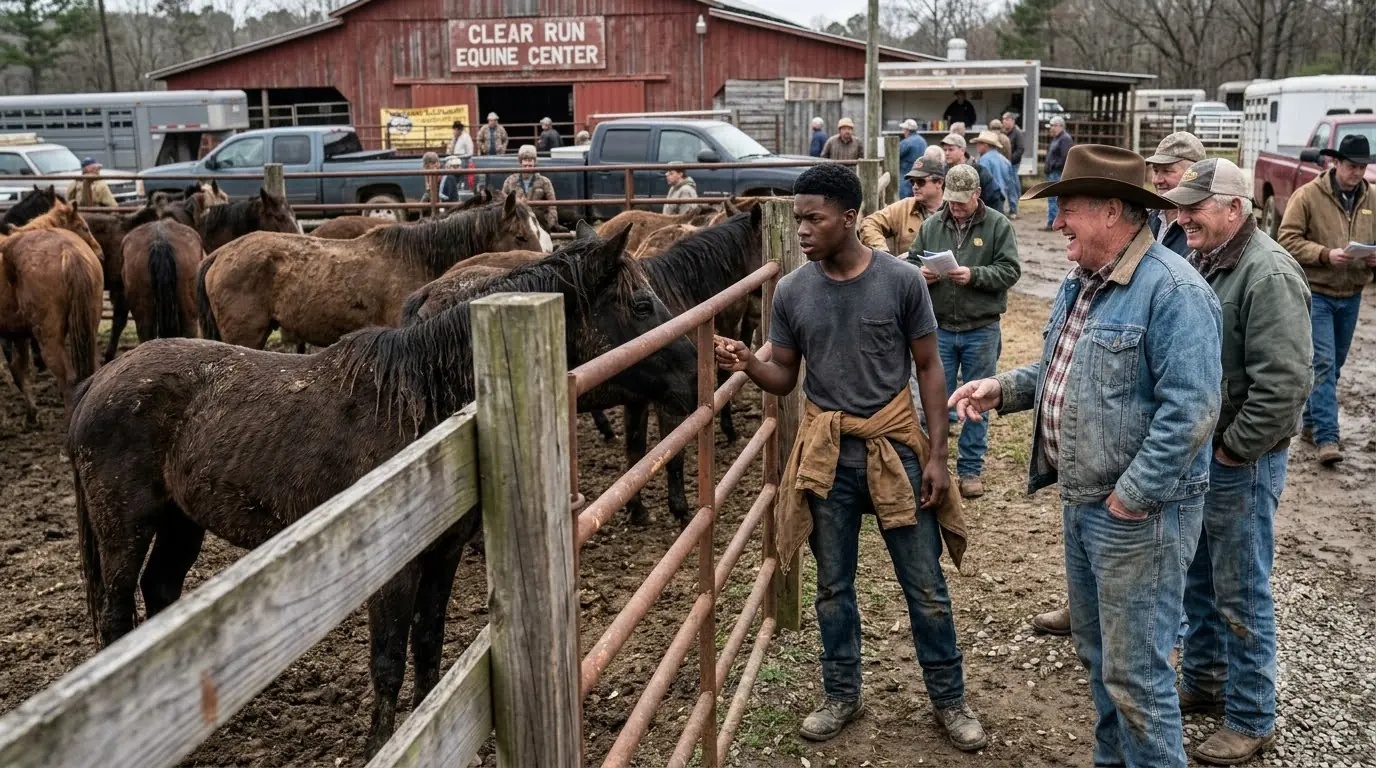
The horses were too thin.
Their coats were long and dull.
Mud clung to their legs.
Several had overgrown hooves.
One bay mare stood with her head low enough that an older rancher beside the fence shook his head and said she probably would not make it through the month.
Nobody saw breeding stock.
Nobody saw opportunity.
They saw thirty mouths.
Thirty veterinary bills.
Thirty transportation problems.
Thirty chances to lose money.
Roland Talbot stood near the front of the auction crowd with a coffee cup in one hand and his catalog folded beneath the other arm.
At fifty-eight, Roland had spent more than thirty years buying horses across the Southeast.
He owned Talbot Equine Group, several hundred acres, two training barns, and enough breeding stock that younger ranchers often waited for him to bid before deciding whether an animal was worth noticing.
He stared toward the neglected herd.
Then laughed.
“Whoever takes that lot deserves what's coming.”
Several men around him joined in.
The auctioneer raised his microphone.
“One thousand. Opening bid. All thirty. Buyer responsible for removal within twenty-four hours.”
Silence.
Then a hand rose near the back.
Roland stopped smiling.
Everyone turned.
Kendrick Mercer stood beside a rusted railing holding bidding card number sixty-one.
Eighteen years old.
Lean.
Deep-brown skin.
Short black hair.
Faded charcoal shirt.
Worn jeans.
Dusty work boots.
A brown work jacket tied around his waist.
He looked more like someone hired to clean the auction grounds than someone preparing to buy thirty horses.
The auctioneer pointed.
“One thousand from the young man.”
Roland laughed again.
This time louder.
“Son, you can't even afford the feed to move them.”
Kendrick said nothing.
He kept the card raised.
The auctioneer looked across the crowd.
“One thousand once.”
Nobody moved.
“Twice.”
Still nothing.
Roland shook his head.
“Let the boy learn.”
The gavel came down.
“Sold.”
For one second Kendrick felt something close to victory.
Then the arithmetic arrived.
Thirty horses.
Twenty-four hours.
One thousand dollars spent.
Balance in his checking account afterward:
Almost nothing.
No large trailer.
No significant hay reserve.
No working barn prepared for thirty animals.
The laughter followed him from the auction ring to the holding fence.
Roland walked over.
“You know what you just bought?”
Kendrick kept studying the horses.
“Yes.”
“Really?”
“Yes.”
Roland pointed through the rails.
“Thirty vet bills and not one horse worth feeding.”
Kendrick stepped closer to the nearest mare.
Her coat hung heavily over her shoulders.
Beneath the hair, barely visible, was something pale.
A freeze brand.
Small flame.
Half circle.
Kendrick brushed the coat aside.
Roland watched.
“What are you doing?”
Kendrick pointed.
“What's that?”
Roland glanced.
“Old ownership mark.”
“Which ranch?”
“Doesn't matter.”
Kendrick looked at another mare.
Same faint shape.
Then another.
Same.
Roland's smile tightened.
Kendrick said:
“You sure?”
Roland laughed.
“A mark doesn't make bones valuable.”
Several ranchers behind him laughed again.
Kendrick looked at the herd.
Not ribs.
Structure.
Shoulder angle.
Leg alignment.
The way several mares responded when a handler shifted pressure near the gate.
Too disciplined.
Too consistent.
These horses had not always been neglected.
Once, somebody had trained them.
Selected them.
Managed them as a group.
Kendrick looked back at Roland.
“You're looking at what happened to them.”
Roland frowned.
“What?”
“I’m looking at what they were before it happened.”
Roland opened his arms toward the laughing crowd.
“Keep talking like that and you'll feel better when you're broke.”
Kendrick stared directly at him.
“Then keep laughing.”
His voice stayed low.
“Because when I find out what that brand belongs to, you might be the one asking me to sell.”
Roland's laughter returned.
But something in his eyes had changed.
Only slightly.
Kendrick noticed.
He remembered it.
Kendrick Mercer had not driven to Clear Run intending to buy one horse.
He had come for fencing.
Maybe a feeder.
If prices stayed low, possibly an old mower.
Lantern Field Farm had belonged to his family for generations, though “farm” had become an increasingly generous description.
His father, Samuel Mercer, had died two years earlier after a sudden illness.
Samuel had done nearly everything himself.
Cut hay.
Fixed equipment.
Trained horses for neighboring ranches.
Mended fence.
Rebuilt engines.
After his death, the work did not disappear.
Only the man doing it.
Kendrick's grandmother, Bernice, still lived in the farmhouse.
She was seventy-one and stubborn enough to believe age was an administrative inconvenience.
But she could not operate the farm alone.
So Kendrick dropped plans for college.
At least temporarily.
He cleaned stalls at neighboring ranches.
Repaired tack.
Strung wire.
Loaded feed.
Worked whatever jobs appeared.
Every dollar he saved had been building toward one purchase.
A used mower.
If he could cut his own hay again, Lantern Field might begin producing enough to survive.
The one thousand dollars in his account represented months of work.
Now it belonged to Clear Run.
And thirty horses had to leave by tomorrow afternoon.
Kendrick stood beside his old pickup staring at the auction receipt.
Then heard:
“You've finally lost your mind.”
He looked up.
Owen Pike stood nearby.
Sixty-four.
White beard.
Baseball cap.
Owner of Pike Livestock Hauling.
Owen had known Kendrick's father for twenty-five years.
Kendrick held up the receipt.
“You hauling tomorrow?”
Owen laughed.
“You have hauling money?”
“No.”
“Then no.”
Kendrick waited.
Owen waited too.
They both knew where the conversation was going.
Kendrick said:
“I’ll rebuild the west fence on your lower pasture.”
Owen scratched his beard.
“All of it?”
“Yes.”
“Posts too?”
“Yes.”
“Thirty horses is multiple trips.”
“I know.”
“Fuel isn't free.”
“I know.”
“You really believe they're worth saving?”
Kendrick looked toward the holding pens.
“Yes.”
Owen sighed.
“Your father used to make that face.”
“What face?”
“The expensive one.”
He held out his hand.
“Fine.”
Kendrick shook it.
“Tomorrow before daylight.”
The first trailer reached Lantern Field at 5:48 the next morning.
The last arrived shortly before sunset.
Bernice stood outside the barn with both hands planted on her hips.
She watched horse after horse step into paddocks that had not carried a herd this large in years.
When Kendrick finally walked toward her, exhausted, she did not ask what the horses cost.
She already knew.
News traveled quickly.
She asked:
“How much money do you have left?”
Kendrick smiled weakly.
“Depends whether you count coins.”
Bernice closed her eyes.
“Kendrick.”
“I saw something.”
“You always see something.”
“I mean it.”
She looked toward the horses.
Thin animals.
Poor coats.
One limping slightly.
Another coughing.
Then she looked at her grandson.
“What do you need?”
“A veterinarian.”
“And after that?”
“Hay.”
“And after that?”
“Probably a miracle.”
Bernice nodded.
“Call Malcolm.”
Dr. Malcolm Vance arrived an hour later.
He was fifty-three, patient, brutally practical, and had treated Mercer family horses since Kendrick was a child.
He walked the herd in silence.
Checked gums.
Eyes.
Hooves.
Heart rates.
Body condition.
Temperature.
Movement.
After nearly two hours, he closed his notebook.
Kendrick waited.
Malcolm said:
“First thing you're going to want to do is feed them.”
“Yes.”
“Don't.”
Kendrick frowned.
“They're starving.”
“Exactly.”
Malcolm explained refeeding syndrome.
Animals deprived for long periods could become seriously ill if rich feed returned too quickly.
Recovery had to be controlled.
Small portions.
Specific hay.
Minerals.
Water.
Monitoring.
No shortcuts.