The badge had spent thirty years beneath eight inches of Missouri clay.
Elias Mercer did not know that when his shovel struck the rusted metal box.
He only knew the sound was wrong.
The old barn behind his farmhouse had been leaning east for nearly five years, and the storm that crossed Harmon County on Tuesday finally decided the matter for him. Half the roof collapsed. One corner post split. Rainwater ran through the hayloft and pooled beneath the workbench his father had built in 1958.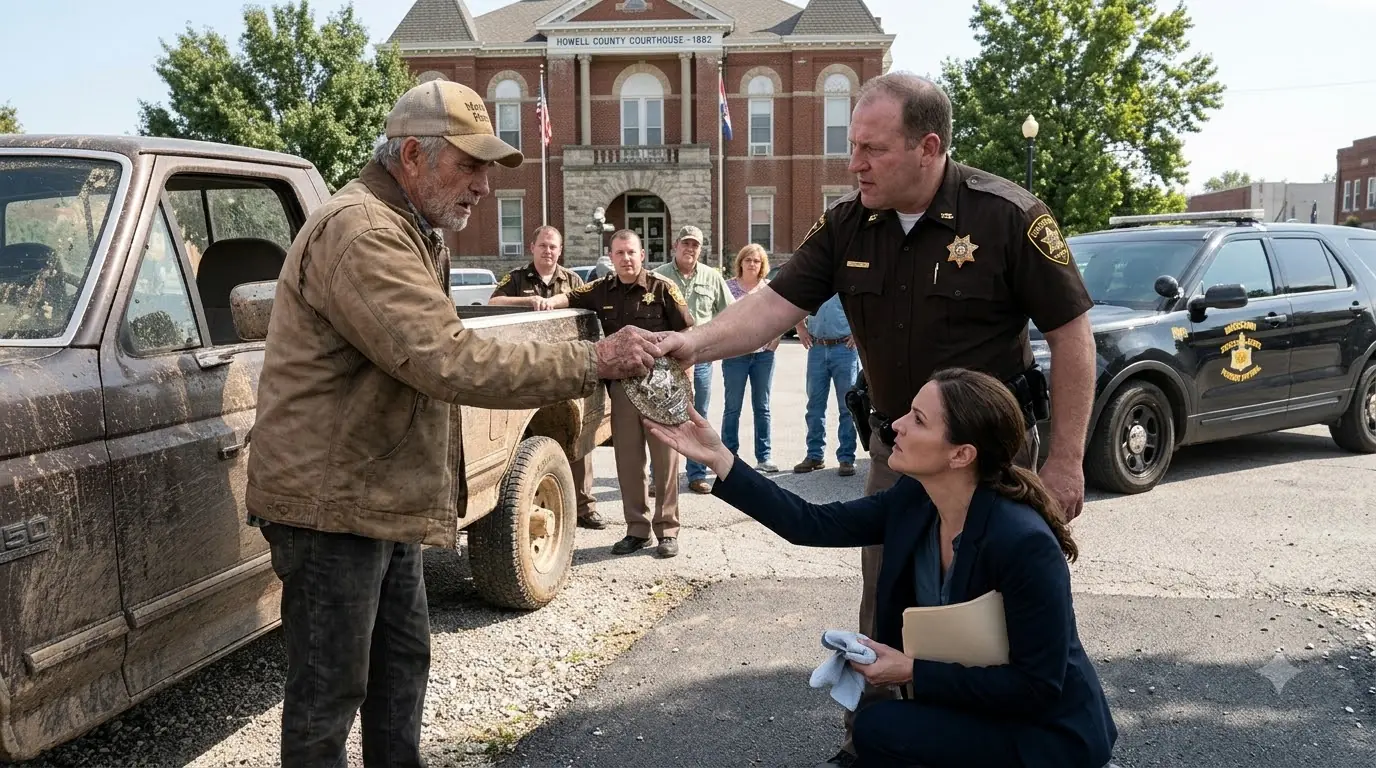
By Thursday morning, Elias had accepted that the barn needed to come down.
At seventy-two, he no longer enjoyed demolition work.
His knees objected to ladders.
His back objected to everything.
But paying someone else to remove a building his family had constructed with their own hands felt like surrender.
So Elias worked slowly.
Board by board.
Nail by nail.
He stacked usable lumber near the machine shed and tossed rotten pieces into a burn pile.
Around noon, while clearing the foundation beneath the old east wall, his shovel struck metal.
Clang.
Elias stopped.
He scraped mud aside.
Another strike.
Clang.
Not pipe.
Not farm equipment.
Something flat.
He knelt carefully.
The ground was softer than the packed clay around it.
Someone had dug there once.
Elias used a hand trowel.
Five minutes later, the corner of a steel box appeared.
It was roughly fourteen inches long.
Ten wide.
The hinges had rusted nearly solid.
A padlock remained attached.
Elias stared.
He had lived on the property most of his life.
Never seen the box.
Never heard his father mention it.
He carried it to the workbench.
Used penetrating oil.
Waited.
Then struck the lock with a hammer.
The metal finally broke.
The lid resisted.
He pried it upward.
Inside were three things.
A plastic-wrapped notebook.
A small cassette tape.
And a badge.
Elias stopped breathing.
The badge was blackened with moisture and corrosion.
Mud had entered through one corner of the box.
But the shape remained unmistakable.
Six-point star.
County seal.
Faded lettering.
He picked it up.
Turned it toward the window.
The engraved name became visible only after he rubbed the surface with his thumb.
SAMUEL MERCER
Elias sat down.
For thirty years, his brother’s name had existed mostly in photographs.
Samuel had disappeared in October 1959.
Not died.
Not officially.
Disappeared.
No body.
No confirmed accident.
No grave.
No explanation that ever satisfied the family.
Samuel had been thirty-four.
Deputy sheriff.
Married.
Father of one son.
Elias had been forty-two at the time and still working the farm with their father.
The official story had changed three times.
First, Samuel had failed to report for duty.
Then someone claimed he had taken money from the evidence room.
Then investigators suggested he might have left the county voluntarily.
By winter, the whispers hardened into certainty.
Samuel Mercer had stolen money and run.
Elias never believed it.
Their father certainly never did.
Thomas Mercer spent the final twelve years of his life insisting Samuel had uncovered something.
Nobody listened.
When Thomas died in 1973, Elias found boxes of newspaper clippings in his bedroom.
Every article about Samuel.
Every court notice.
Every sheriff’s election.
Every unexplained resignation.
But no badge.
No notebook.
No tape.
Until now.
Elias turned the badge over.
A serial number was engraved on the back.
HC-2147
His hands began to tremble.
The notebook remained sealed inside cloudy plastic.
He did not open it.
Not yet.
The tape label had only one word written in faded pencil.
IF
Elias stared.
If what?
If I disappear?
If something happens?
If they come?
He looked back toward the badge.
Then toward the road.
For the first time in years, the farm felt too quiet.
Elias carried everything inside.
Placed the box on his kitchen table.
Made coffee.
Did not drink it.
He called the county sheriff’s office.
A dispatcher answered.
“Harmon County Sheriff.”
“My name is Elias Mercer.”
Pause.
“Yes, Mr. Mercer?”
“I found something belonging to my brother.”
Another pause.
“Your brother?”
“Deputy Samuel Mercer.”
Silence.
Most younger county employees knew the name only because the disappearance had become local folklore.
The dispatcher lowered her voice.
“What did you find?”
“His badge.”
She did not answer immediately.
“And some other things.”
“What other things?”
“A notebook and a tape.”
The dispatcher said:
“Do not handle them more than necessary.”
Elias looked at the badge already sitting in his hand.
“Little late.”
“Where did you find them?”
“Buried beneath my barn.”
Another pause.
“Mr. Mercer, stay there. We can send someone.”
Elias looked toward the window.
“No.”
“Sir?”
“I’m bringing it in myself.”
“That may not be advisable.”
“I’ve waited thirty years.”
He hung up.
The courthouse sat twelve miles away in Harland, the county seat.
Elias drove his mud-splattered Ford pickup.
The metal box sat on the passenger floor inside a clean feed sack.
He had wrapped the notebook and cassette separately without opening them.
The badge remained inside a small plastic sandwich bag.
He did not know evidence procedure.
He did know enough not to clean anything.
By the time he reached the courthouse, word had already traveled.
Small counties did not need social media to move information quickly.
They had dispatchers.
Clerks.
Radio scanners.
Cousins.
Elias parked beside the courthouse steps.
Two deputies stood near the entrance.
One recognized him.
“Mr. Mercer?”
“Yes.”
“Sheriff’s expecting you.”
Elias frowned.
“Dale?”
“Yes.”
Sheriff Dale Whitmore came out before Elias reached the door.
Forty-eight.
Heavyset.
Thinning brown hair.
Dark-brown uniform.
Gold badge.
A man who had spent most of his career making sure he looked comfortable inside authority.
His father, Curtis Whitmore, had also worked for the sheriff’s office.
That name mattered to Elias.
Curtis had been a young deputy in 1959.
One of the last people officially documented as seeing Samuel alive.
Dale descended the courthouse steps.
“What exactly did you find?”
No hello.
No concern.
No surprise.
Elias noticed.
He held up the bag containing the badge.
“This.”
Dale stopped.
His eyes fixed on it.
For less than a second, something crossed his face.
Recognition?
Fear?
Elias could not be sure.
Then the sheriff laughed.
“You dug that out of your barn?”
“Yes.”
Dale took it before Elias could object.
He turned the plastic bag over.
“Could be anything.”
“It has Samuel’s name.”
“Old badges get copied.”
“It has a serial number.”
Dale’s thumb froze near the back.
Elias saw it.
The sheriff recovered quickly.
“Where are the other items?”
“In my truck.”
“What other items?”
“Notebook. Cassette.”
Dale’s face changed again.
This time Elias was certain.
“Give them to me.”
“No.”
“What?”
“I said no.”