The laughter began when Walt Greer raised his hand.
It was not vicious at first. Just the loose, easy laughter of farmers and equipment buyers who believed they had witnessed a harmless act of foolishness at somebody else’s expense. Under the open-sided auction barn in Augusta County, Virginia, men leaned against rusted livestock rails while an October wind pushed dried leaves against the fencing and a tired old bay horse stood alone in the center of the sale ring.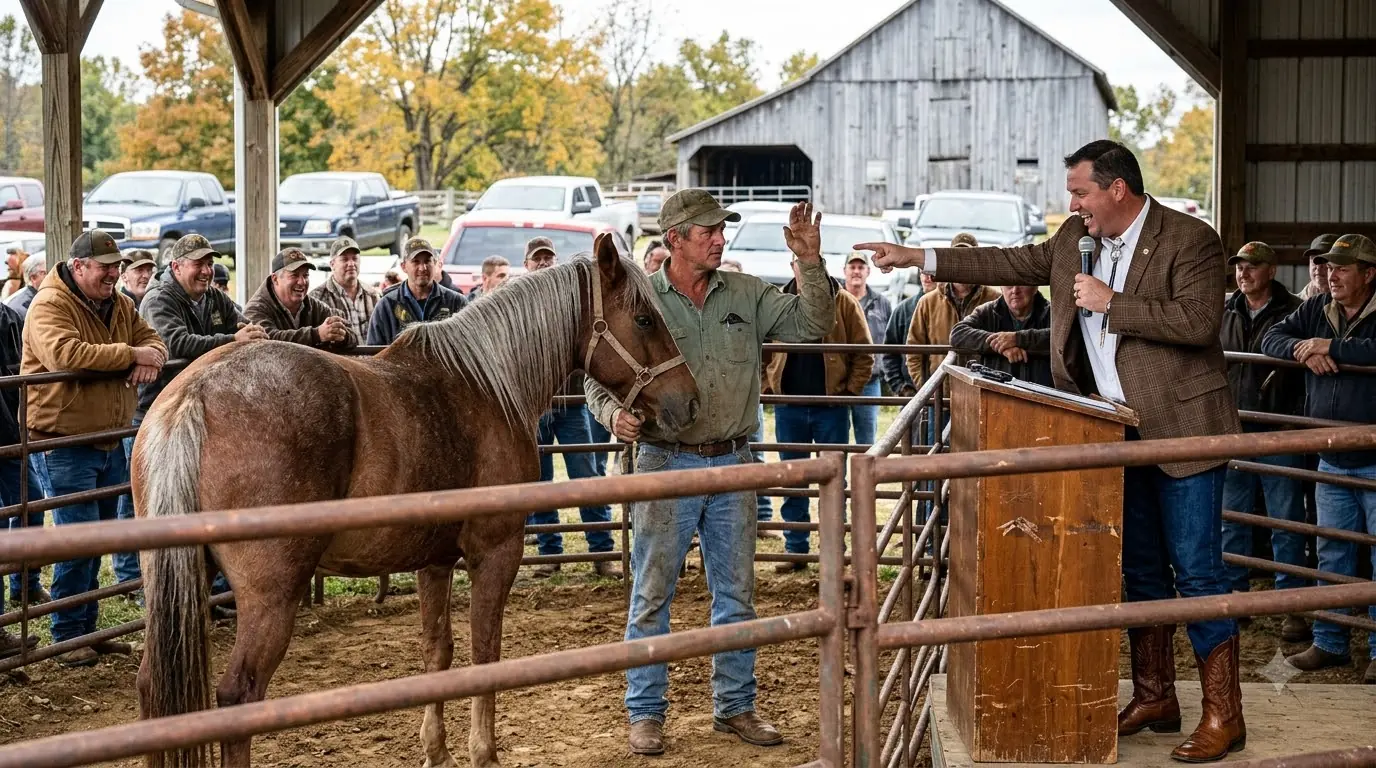
Auctioneer Dale Mercer looked from Walt to the horse and grinned into his microphone.
“Eighty dollars?”
He pointed toward Walt.
“Walt, you buying a horse or paying to bury one?”
Several men laughed harder.
Walt remained where he stood near the back rail, wearing faded blue overalls over a dusty olive work shirt. At fifty-eight, he had the narrow, sun-lined face of a man who had spent most of his life outside and had never considered that something requiring work might also require complaining. His old cap sat low over short gray-brown hair, and one weathered hand remained raised as though Dale’s joke had never happened.
“Call the bid,” Walt said.
The laughter thinned.
Dale leaned forward.
“You heard the description, didn’t you?”
“I did.”
“Twenty-four years old. Stiff in the left hind after work. No papers anyone cares about. He’s past useful.”
Walt looked toward the horse.
The animal had a deep reddish-brown coat faded by age, four cream-colored stockings, and a back that dipped slightly where years had slowly reshaped him. But what Walt noticed most was the mane. It had gone completely silver, not dull gray, but bright enough to catch the pale autumn light whenever the horse moved his head.
The horse was looking directly at him.
Not toward the crowd.
Not toward Dale.
At Walt.
Dale slapped one hand against the podium.
“You just bought yourself somebody else’s problem.”
Walt finally looked at him.
“Then remember saying that when we find out why he already knows my farm.”
Someone behind Walt stopped laughing.
Dale stared.
Then, with the shrug of a man already thinking about the next lot, he dropped the hammer.
“Sold. Eighty dollars.”
That should have been the end of it.
Instead, it was the beginning.
Walt had not come to the Whitfield farm liquidation looking for a horse.
He had driven forty minutes that Tuesday morning because Ben Caldwell from the agricultural co-op mentioned that unopened fencing materials were being sold. A section along the east side of Walt’s apple orchard had been leaning since July, and every time he passed it, he promised himself he would repair it before winter.
The Whitfield property looked like a place that had run out of money slowly and then all at once. The barn’s paint had peeled back to gray wood, mismatched roof patches revealed years of delayed repairs, and a hand-painted sign beside the driveway read LIQUIDATION SALE — EVERYTHING GOES.
Walt parked on the grass.
He inspected the fencing first.
Worth buying.
Then a tractor with a bad alternator.
Not worth buying.
He drank coffee that became cold before he remembered it existed and watched other men circle machinery, open hoods, kick tires, and pretend they had not already decided what they wanted.
The horses waited in a side paddock.
Three of them.
Two were young and clean enough that buyers began discussing them before bidding started.
The third stood alone.
Walt noticed because it did not move when the other horses moved.
The younger animals shifted, grazed, swatted flies, and watched people coming through the gate. The old bay simply stood beside the fence, head level, ears forward.
And watched Walt.
He had been forty feet away.
Maybe more.
Yet the horse’s attention never seemed accidental.
Walt looked behind himself once, wondering if there was something more interesting there.
Nothing.
He turned back.
The horse was still watching him.
Walt walked away.
There were certain feelings a sensible man learned not to encourage.
The two young horses sold quickly.
When the old bay entered the ring, Dale Mercer read the sale description with less enthusiasm than he had used for a rusted manure spreader fifteen minutes earlier.
“Twenty-four-year-old quarter-horse cross. Sound on level ground. Stiffness in left hind following prolonged exercise. Current owner has held him two years, previously acquired from a Rockingham County farm.”
Dale looked at the crowd.
“Sixty dollars.”
Nobody moved.
“Fifty.”
Nothing.
Dale sighed.
“Forty dollars. Gentlemen, that is less than some of you spent on lunch last week.”
A man in a John Deere cap shook his head.
An older couple turned away.
Somebody muttered something about feed costs.
The horse stood still.
Then his head moved.
Slowly.
Toward Walt.
Their eyes met again.
Walt had spent his life around livestock. He did not believe every animal glance contained destiny. Horses looked at people because people carried buckets, ropes, feed, fear, impatience, and sometimes carrots.
But this felt different.
Not supernatural.
Just specific.
Like an unfinished question.
Walt lowered his cold coffee.
Then raised his hand.
Dale blinked.
“Eighty?”
Walt nodded.
That was when the laughter started.
After the sale, Walt signed a transfer form at a folding table beside the barn office.
The young man who had been holding the horse’s rope passed it over with little interest.
“Good luck.”
Walt looked at him.
“With what?”
The boy shrugged.
“The horse.”
Walt turned toward the old bay.
The horse had stepped close enough that his shoulder almost touched Walt’s arm.
“He seems polite.”
The boy laughed once.
“Polite don’t make him younger.”
“No.”
“It doesn’t.”
Nearby, veterinarian Nora Finch was finishing health paperwork beside a white pickup with a veterinary decal on the door. Walt recognized her from the feed store and from a vaccination visit she had made to one of his neighbors.
Nora was practical in a way Walt respected.
No unnecessary conversation.
No sentimental opinions unless she had evidence.
She watched Walt and the horse.
Then looked again.
“You bought the old one.”
“Appears that way.”
“He’s twenty-four.”
“So I’ve been informed by half the county.”
Nora clicked her pen.
“What are you going to do with him?”
Walt looked toward the horse.
The silver mane lifted in the wind.
“Don’t know yet.”
Nora’s eyes moved from Walt to the horse once more.
She seemed about to say something.
Instead she put the clipboard inside her truck.
“Have his teeth checked before you increase feed too quickly.”
“I will.”
“And don’t treat that hind leg like he’s twelve.”
“I wasn’t planning to.”
“Good.”
She drove away.
Walt looked down at the horse.
“Apparently you came with instructions.”
The horse exhaled.
Walt could almost have mistaken it for judgment.
The old bay loaded more easily than expected.
No resistance.
No nervous backing.
He placed each hoof onto the trailer ramp carefully, almost as if age had taught him not to waste movement.
Walt drove home through the Shenandoah Valley with the trailer shifting gently behind his truck.
He told himself the purchase had been pity.
Eighty dollars.
A quiet old horse.
Enough pasture.
Enough hay.
No great mystery.
Nothing complicated.
That explanation lasted until the horse reached the Greer farm.
Walt’s property ran along Route 11 beneath the soft rise of the Blue Ridge.
Sixty acres of apple orchard occupied the northern slope. A hay field stretched behind the barn, and a narrow creek cut along the east boundary, running clear during dry autumn weather and brown after spring storms.
The white clapboard farmhouse had been built by Walt’s grandfather, Harlan Greer, in 1938.
The barn was fifteen years older.
It looked older too.
Walt had never cared much about appearances so long as roofs stayed dry, hinges worked, and animals were safe.
He backed the trailer toward the barn.
Opened the gate.
The horse stepped down.
Then stopped.
Walt expected him to look around nervously.
Instead, the animal simply stood.
His ears moved.
Once toward the orchard.
Once toward the farmhouse.
Once toward the open barn door.
Then he started walking.
Walt followed with the rope loose in his hand.
Inside the barn, the horse passed the first stall.
Then the second.
Walt frowned.
At the third stall on the left, the horse stopped.
Completely.
Walt stopped too.
The stall had not been used by a horse in twenty-three years.
Not regularly.
Not since Ridgeline.
Walt looked at the empty wooden nameplate.
Then at the animal beside him.
“No.”
The horse lowered his head.
Then raised it.
The stall had one unusual feature.
An east-facing window.
Years earlier, Walt had boarded most of it over after rot developed around the frame.
But in 2001, morning sunlight had poured through that window before reaching any other stall in the barn.
Ridgeline had loved it.
He would stand there every sunrise.
Walt had once told his wife Margaret that the horse behaved like he believed daylight belonged personally to him.
Margaret had laughed.
Now the old bay stood at the entrance to that exact stall.
Walt did not move for a long time.
Finally he opened the gate.
The horse walked in.
No hesitation.
Walt filled a bucket with water.
Added hay.
Checked the latch.
Then went inside the farmhouse.
He did not sleep well.
At sunrise, Walt returned.
The horse was standing at the boarded east window with his nose pressed between two wooden planks.
Facing the light.
Walt stared from the barn aisle.
Something small moved in his chest.
He pushed it away.
Coincidence.
Stalls had smells.
Animals chose sheltered corners.
Morning light warmed that side of the barn.
There were explanations.
He carried in hay.
The old horse turned.
Looked at him.
And without planning it, Walt said:
“Compass.”
The name arrived complete.
No debate.
No list.
No thought.
The horse flicked one ear.
Walt smiled.
“Compass, then.”
He would not understand the strange accuracy of that name until days later.
Walt had been alone in the farmhouse for six years.
His wife Margaret Greer died after an illness that seemed to shrink the world gradually before removing her from it entirely.
They had been married more than thirty years.
Margaret had never been loud.
Her absence was.
The silence at breakfast.
One side of the mattress remaining perfectly flat.
A coffee mug nobody used.
The kitchen table built for four that Walt no longer sat at while eating because standing over the sink felt easier than acknowledging the empty chairs.
Their son Marcus lived several hours away.
They spoke.
Not enough.
Neither seemed angry.
Distance had simply learned how to become normal.