The first time Earl Maddox started the tractor he had built with his own hands, it ran for twenty-seven seconds.
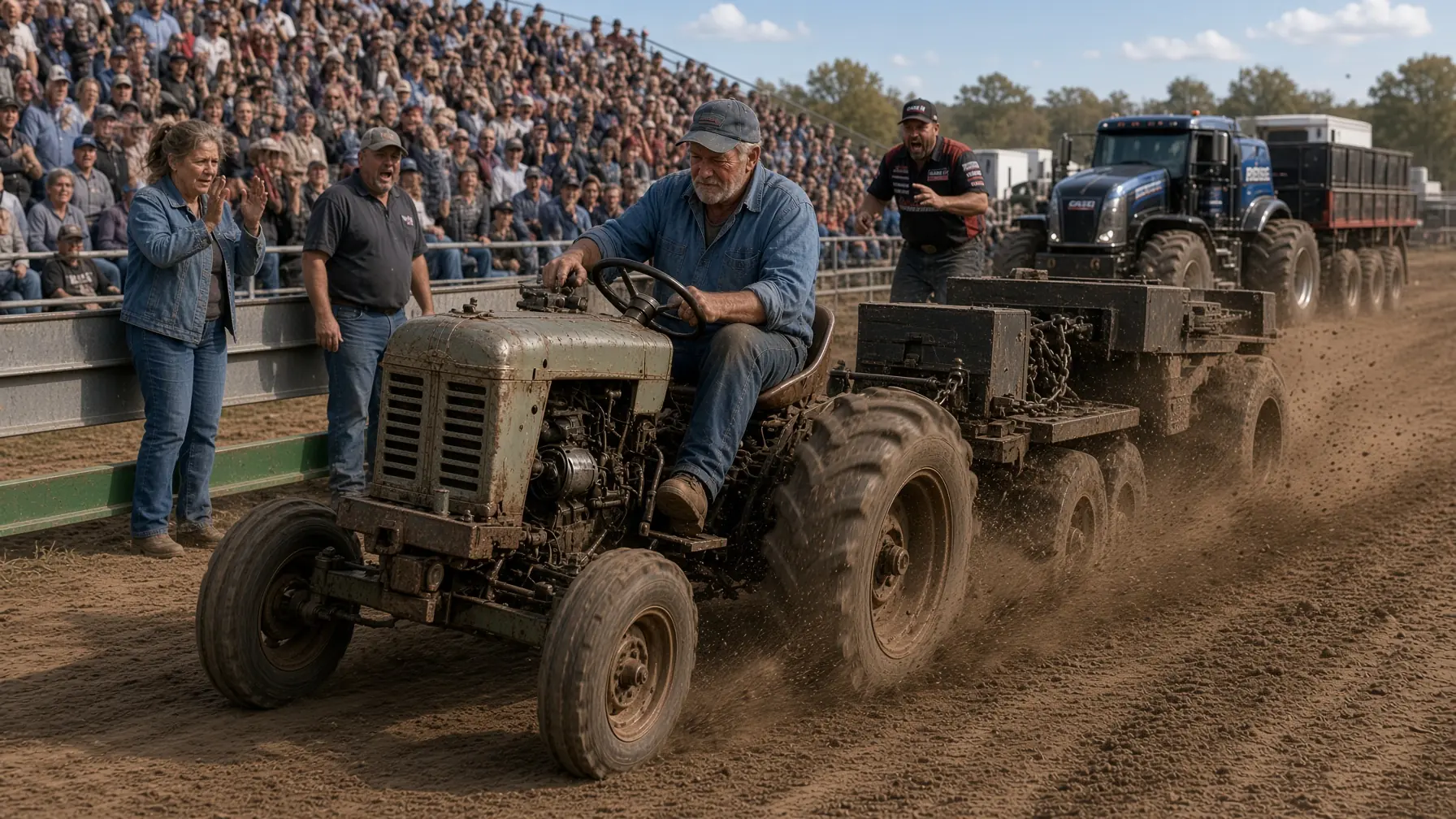
Then it died.
Not gracefully.
The engine coughed once, shook hard enough to rattle the homemade hood, stumbled through another few revolutions, and stopped with a metallic shudder that left the entire machine rocking on its tires.
For two seconds, nobody said anything.
Then somebody near the barn laughed.
Earl remained in the seat with one hand on the steering wheel and the other resting beside the throttle.
Another farmer leaned against the fence.
“You built that yourself?”
Earl climbed down.
“Yeah.”
The man looked over the tractor again.
It was not difficult to understand why people were amused.
The hood had come from an old farm tractor that had been wrecked fifteen years earlier.
The frame underneath it was fabricated from rectangular steel Earl had cut, measured, welded, cut apart, and welded again in the workshop behind his house.
The rear axle had started life beneath a different machine.
The steering components came from another.
And the engine had never originally been designed to sit in a farm tractor at all.
Earl had bought the six-cylinder industrial diesel from a dismantled irrigation unit at an estate sale.
It was heavy.
Simple.
Strong.
And completely uninterested in fitting neatly into anything Earl already owned.
Nothing matched.
That was the point.
At fifty-nine years old, Earl Maddox was not trying to build something beautiful.
He was trying to build something useful.
The farmer by the fence looked at the dead tractor and laughed again.
“Then don’t take it to the county pull.”
Several men around him chuckled.
Earl wiped his hands on his jeans.
“I wasn't planning to take it anywhere today.”
“That’s probably wise.”
Earl looked toward the tractor.
“We’ll see.”
He did not argue.
That irritated people more than if he had.
Because Earl had spent most of his life learning there were two kinds of criticism.
The useful kind told you where something failed.
The other kind only told you something about the person speaking.
He had no reason to waste time separating the second kind into smaller pieces.
He opened the hood.
The laughter continued behind him.
Earl ignored it.
Twenty-seven seconds was information.
And information was why the tractor existed.
Earl farmed three hundred eighteen acres outside Hamilton County, Missouri.
Corn.
Soybeans.
Hay.
Enough cattle to keep him working on days the crops did not need him.
He had never been wealthy, but until the previous few years, the farm had generally paid its bills.
Then machinery prices climbed.
A new tractor in the horsepower range Earl needed cost more than he was willing to finance at his age.
The tractor he already owned was dependable, but it was tied up too often during planting and hay season.
He wanted a second machine capable of pulling heavier equipment without spending six figures to get one.
At first, rebuilding an older factory tractor seemed like the obvious answer.
Then Earl started pricing them.
Anything cheap enough to interest him needed an engine.
Anything with a good engine needed a transmission.
Anything with both cost almost as much as he wanted to avoid spending.
That was when the industrial diesel appeared at an estate sale.
Earl stood beside it for nearly twenty minutes.
A neighbor named Wes Talbot eventually asked:
“What are you looking at?”
“Engine.”
“I can see that.”
Earl crouched beside the identification plate.
Wes shook his head.
“That thing ran a water pump.”
“I know.”
“You buying irrigation equipment now?”
“Maybe just part of it.”
Wes laughed.
“You gonna put it in a tractor?”
Earl looked up.
“Maybe.”
That had been fourteen months before the twenty-seven-second failure.
His wife, June, remembered exactly because Earl brought the engine home the day before their thirty-fourth wedding anniversary.
She stood at the kitchen window watching an old loader lower it beside the workshop.
When Earl came inside, she asked:
“What did you buy?”
“Engine.”
“I can see the engine.”
Earl opened the refrigerator.
June folded her arms.
“What is it for?”
“Tractor.”
“We own tractors.”
“This one's going to be different.”
June looked through the window again.
“How different?”
Earl took out a bottle of water.
“Depends how much trouble it gives me.”
That should have worried her.
Instead she laughed.
She had been married to him long enough to understand that Earl’s favorite kind of problem was one that could eventually be measured with a wrench.
The first months were slow.
He built cardboard templates before cutting steel.
Measured drivetrain angles.
Designed engine mounts.
Changed them.
Discovered the first crossmember interfered with the oil pan.
Cut it out.
Built another.
The cooling system became a project of its own.
The original engine had been designed to sit in one place driving a pump at steady speed.
Now Earl wanted it to operate under constantly changing load while moving through dust and summer heat.
He installed a larger radiator.
Then discovered his first fan arrangement did not move enough air at low speed.
The clutch linkage had to be fabricated.
The throttle linkage had to be changed twice.
The transmission required a custom adapter.
The fuel return line developed a vibration problem.
One rear wheel sat half an inch farther out than the other until Earl tore the mounting assembly apart and corrected it.
Nothing happened quickly.
And because Earl worked during the day, most of the tractor came together after supper.
Lights burned in the workshop long after neighboring houses went dark.
June would sometimes open the door at ten thirty.
“You coming inside?”
“Soon.”
At eleven fifteen:
“Earl.”
“Almost.”
At midnight:
“I’m turning the porch light off.”
“That’s fine.”
“You know where the house is.”
“I think so.”
He enjoyed the work.
That did not mean it went well.
The tractor’s first start ended after twenty-seven seconds because the fuel return setup was wrong.
The second start lasted six minutes.
Then coolant temperature rose too quickly.
Third test:
Oil leak.
Fourth:
Clutch adjustment wrong.
Fifth:
A vibration appeared around one engine speed that rattled the dashboard so badly Earl could barely read the gauges.
By the time the tractor first drove across the yard under its own power, half the men in the area had heard about it.
Some stopped by because they were interested.
Others came because failure was more entertaining when it belonged to somebody else.
Earl did not care.
Every person who came gave him another set of eyes.
Sometimes the smartest thing anybody said came from the person he least expected.
One afternoon, sixteen-year-old Luke Hanson stared at the tractor and asked:
“Why is the engine so far forward?”
Earl almost gave the easy answer.
Because that was where it fit.
Then he looked.
And later, when he began struggling with traction, he remembered the question.
That was how the project evolved.
Not through one brilliant idea.
Through hundreds of observations.
Some useful.
Some wrong.
Some embarrassing.
The first serious field test came in early spring.
Earl attached a heavy disk that normally required his main tractor.
June stood near the fence.
So did Wes Talbot and two other neighbors.
Earl climbed into the homemade machine.
The engine started cleanly now.
No coughing.
No shaking.
Oil pressure settled where he wanted it.
Coolant temperature stayed low.
He eased into gear.
The tractor moved.
The disk entered the ground.
For the first hundred yards, Earl felt something close to relief.
The engine pulled.
The frame stayed straight.
The temperature remained stable.
He reached the end, turned, and headed back.
Halfway across the field was a softer patch where spring moisture had stayed longer.
The right rear tire slipped first.
Then the left.
Engine speed dropped.
Earl added throttle.
The tires spun faster.
The tractor stopped.
Wes laughed from the fence.
“Not enough power!”
Earl heard him.
Did not answer.
He tried easing the throttle.
No improvement.
The tires had dug shallow holes now.
He raised the implement, crawled out, and returned to firmer ground.
Then shut the engine down.
Wes walked over grinning.
“Told you.”
Earl crouched beside the rear tire.
“Told me what?”
“Needs more horsepower.”
Earl looked at the tread.
Then toward the hitch.
Then toward the front of the tractor.
“No.”
Wes laughed.
“It stopped.”
“Yeah.”
“Engine bogged.”