By eight o’clock on the first Saturday in October, six pickup trucks were parked along the fence line of Maya Doyle’s field.
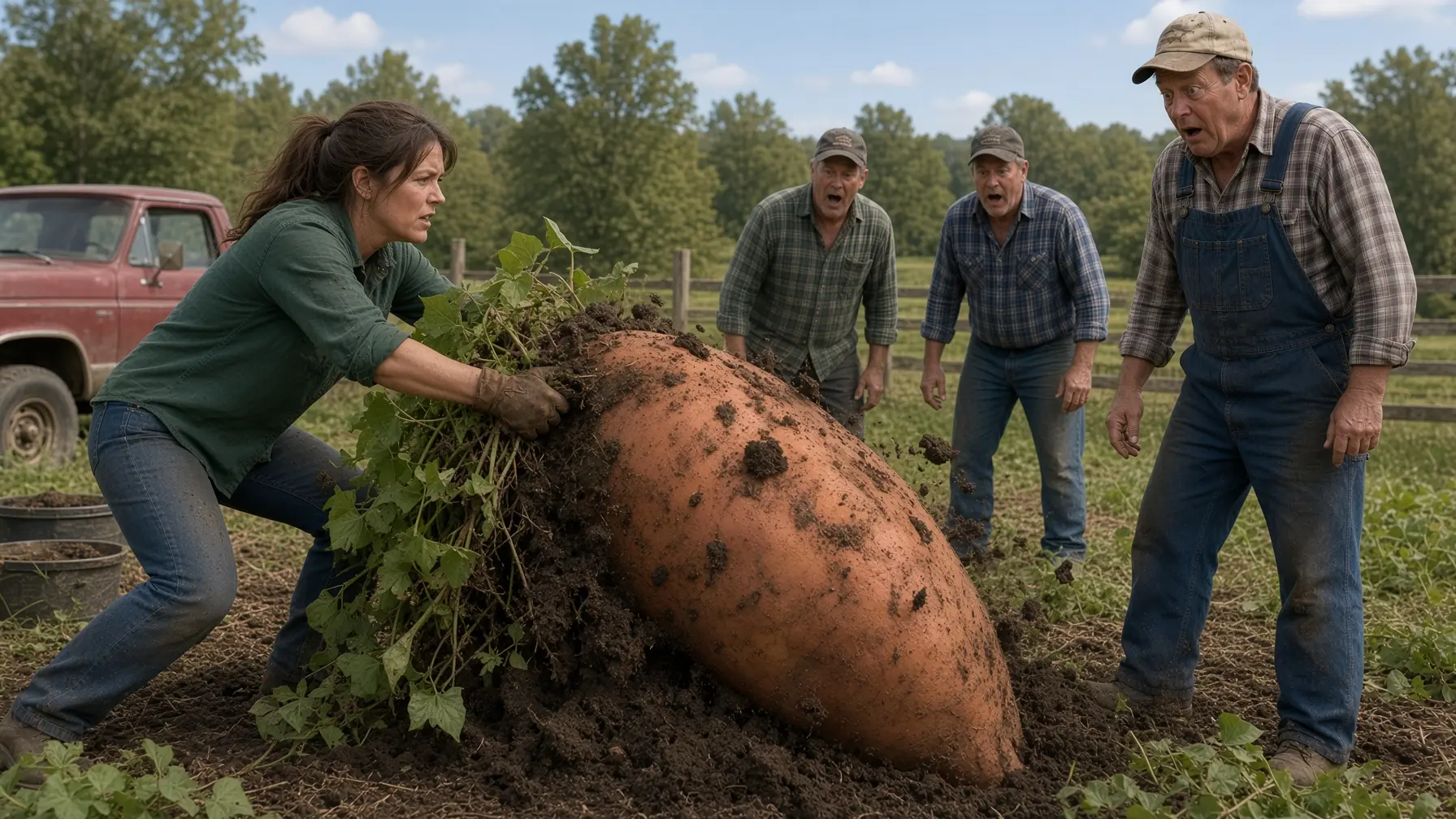
Nobody had been invited.
Nathan Briggs arrived first, shut off his diesel, and stood with both hands hooked through his belt loops. Two neighboring farmers followed. Then Tom Rourke from across the highway. By the time Maya came out of the shed carrying a harvest fork, half a dozen men were looking across four acres of land most of them had spent years trying not to smell.
The difference was that the smell was almost gone.
Where heaps of spoiled hay and manure had once collapsed into weeds, thick sweet-potato vines now rolled across raised beds in dark green waves. There were bare patches. One low corner had failed almost completely after a summer storm. Another section was thinner because Maya had deliberately withheld compost there for comparison. But the center rows had grown strongly enough that nobody standing at the fence could dismiss them as luck anymore.
Nathan stepped over the ditch.
He was sixty-one, heavy through the shoulders, and had grown corn, soybeans, hay, and vegetables on neighboring ground for most of his adult life. He had been one of the first people to tell Maya she had bought a cleanup bill rather than a farm.
Now he crouched, dug his fingers into the top few inches of soil, and rubbed it between his thumb and palm.
“What did you put in here?”
Maya rested the harvest fork against her shoulder.
“Nothing magical.”
Nathan looked toward the vines.
“I didn't ask if it was magical.”
“You're thinking fertilizer.”
“I’m thinking something.”
Maya smiled.
“Mostly time.”
He looked at her.
“That’s not an answer.”
“No.”
She pushed the fork into the first hill.
“Help me lift this one.”
Nathan took the other side.
Together they loosened the soil.
Maya reached beneath the vine crown and pulled gently.
The first sweet potato came free in her hand.
Then another.
Then three more connected by thin roots.
Nathan stopped talking.
Behind him, somebody whistled.
Maya looked down at the cluster and felt an emotion she had learned not to trust too quickly.
Pride, yes.
Relief too.
But mostly memory.
Because seven months earlier, when she had walked this exact ground in March, nothing about it looked like farmland.
The weeds were waist high.
Baling twine hung from fence posts.
Plastic vegetable crates had cracked into fragments along one ditch.
Rotten straw formed mats thick enough to make a boot disappear.
Near the southern edge, piles of old livestock bedding had compressed into layers black on the bottom and pale brown on top. Deer had been sleeping in one corner. Rats had tunneled beneath an abandoned pallet. Rusted wire, feed sacks, tomato vines, corn husks, moldy squash, broken irrigation tubing, and the remains of what had once been a wooden loading platform lay scattered across the property.
People called it the Massey Dump Lot.
That name was unfair in one sense.
It had never been a municipal dump.
No household garbage trucks came there. No refrigerators. No batteries. No demolition debris by the ton.
What Earl Massey had allowed for years was agricultural waste.
Spoiled hay.
Stable bedding.
Manure.
Culled vegetables from packing sheds.
Leaves.
Crop residue.
Loads farmers and produce operators did not want to pay to haul farther.
The trouble was that “agricultural waste” did not automatically mean safe compost.
Some loads contained baling plastic.
Some hay might have carried persistent herbicide residues.
Manure could contain salts, pathogens, weed seeds, or veterinary compounds.
Produce piles could go anaerobic and foul.
And nobody had kept records of everything dumped there.
That uncertainty was why people had stopped seeing four acres.
They saw liability.
Maya saw that too.
She simply kept looking.
At forty-one, Maya had approximately eleven thousand dollars in savings, a used Ford pickup that burned oil, no tractor, and enough agricultural experience to know that optimism was not a management plan.
She worked mornings at Weaver Feed & Seed twenty minutes away.
She had grown up on her grandmother’s small mixed farm two counties south, where vegetable gardening, chickens, hay, and a few cattle produced just enough work to make childhood feel like an unpaid internship. When her grandmother died, the property went to three adult children who sold it. Maya inherited no land.
What she inherited was a habit.
Her grandmother never asked whether soil looked pretty.
She asked what it did after rain.
Whether water disappeared or sat.
Whether a shovel entered easily.
Whether worms appeared.
Whether roots went downward or turned sideways.
Whether a field smelled sour when opened.
“Dirt tells on you,” she used to say.
Maya had not understood what that meant at twelve.
She understood by forty-one.
Earl Massey owned the four-acre parcel because it had once been part of a larger farm. He had sold the productive acreage years earlier but retained this awkward strip along the county road. Tax value was low. Cleanup estimates were not.
When Maya asked whether he would sell it, Earl laughed.
“You want it?”
“I’m asking.”
“I’d give it to you if the paperwork didn’t need a price.”
That was how twenty dollars entered the story.
The deed later listed nominal consideration of twenty dollars. Maya still paid recording costs, title work, back property taxes Earl negotiated into the transfer, and every dollar required to clean the place.
The land did not actually cost her twenty dollars.
The ownership interest did.
The difference mattered.
Maya knew it.
The people making jokes at Weaver Feed did not.
“You bought the Massey Dump Lot for twenty bucks?”
Pam Rourke asked the question loudly enough that two customers turned around.
Maya kept scanning a bag of poultry ration.
“Apparently.”
Pam stared at her.
“Honey, I wouldn't pay twenty dollars to walk across it.”
“That’s why Earl still had it.”
“What are you going to grow?”
“I don't know yet.”
“You bought land before knowing what you're planting?”
“I bought a question.”
Pam frowned.
“That sounds expensive.”
“It might be.”
Nathan Briggs was less amused.
He found Maya on the property her second weekend, cutting old twine from a fence.
“You understand you can't just till all this under.”
“I know.”
“Some of that manure is newer than the rest.”
“I know.”
“Could be herbicide carryover in the hay.”
“I know.”
He looked at her.
“Then why did you buy it?”
Maya pointed toward a mound ten yards away.
“You ever dig into that?”
“No.”
“Come here.”
She pulled away the dry outer straw.
Beneath it was material so dark it almost looked black.
Not sludge.
Not fresh manure.
Crumbly organic matter with pieces of old stems still visible but no recognizable vegetable tissue.
Nathan squeezed some.
“Compost.”
“Maybe.”
“Old enough.”
“Some of it.”
He dropped it.
“Doesn't make the whole place good.”
“I know.”
That answer irritated people.
Not because Maya was arrogant.
Because she refused to turn her gamble into a prophecy.
She never said the land was secretly rich.
She never told neighbors they were fools.
She did not know yet.
That first month, she spent more money investigating the property than planting it.
She divided the four acres into a rough grid.
Twenty-four sampling points.
Different depths.
Separate samples from the dark decomposed zones, the newer manure piles, the low wet corner, and the relatively undisturbed edges.
She sent composite samples to a laboratory through the county extension office.
The report gave her relief and problems in almost equal measure.
Soil organic matter was unusually high in the old accumulation zones.
Potassium and phosphorus were elevated.
Nitrogen availability varied widely.
pH ranged from slightly acidic to nearly neutral depending on location.
Soluble salts were elevated in two manure-heavy spots.
The low corner drained poorly.
The oldest composted area had good aggregate structure.
Nothing in the basic contaminant screen immediately ruled out food production, though the extension agent warned Maya that testing could never prove what had not been dumped there.
“You have incomplete history,” Lena Foster told her.
Lena was the county horticulture agent, forty-seven, practical, and allergic to stories in which compost solved everything.
“You know what that means?”
“Test more.”
“It means test intelligently. You can spend your entire savings account trying to prove a negative.”
They stood beside the south pile.
Lena pushed a soil probe downward.
“Any treated lumber?”
“None that I found.”
“Oil drums?”
“No.”
“Batteries?”
“No.”
“Paint?”
“No.”