Fifty tractors.
Every one of them dead.
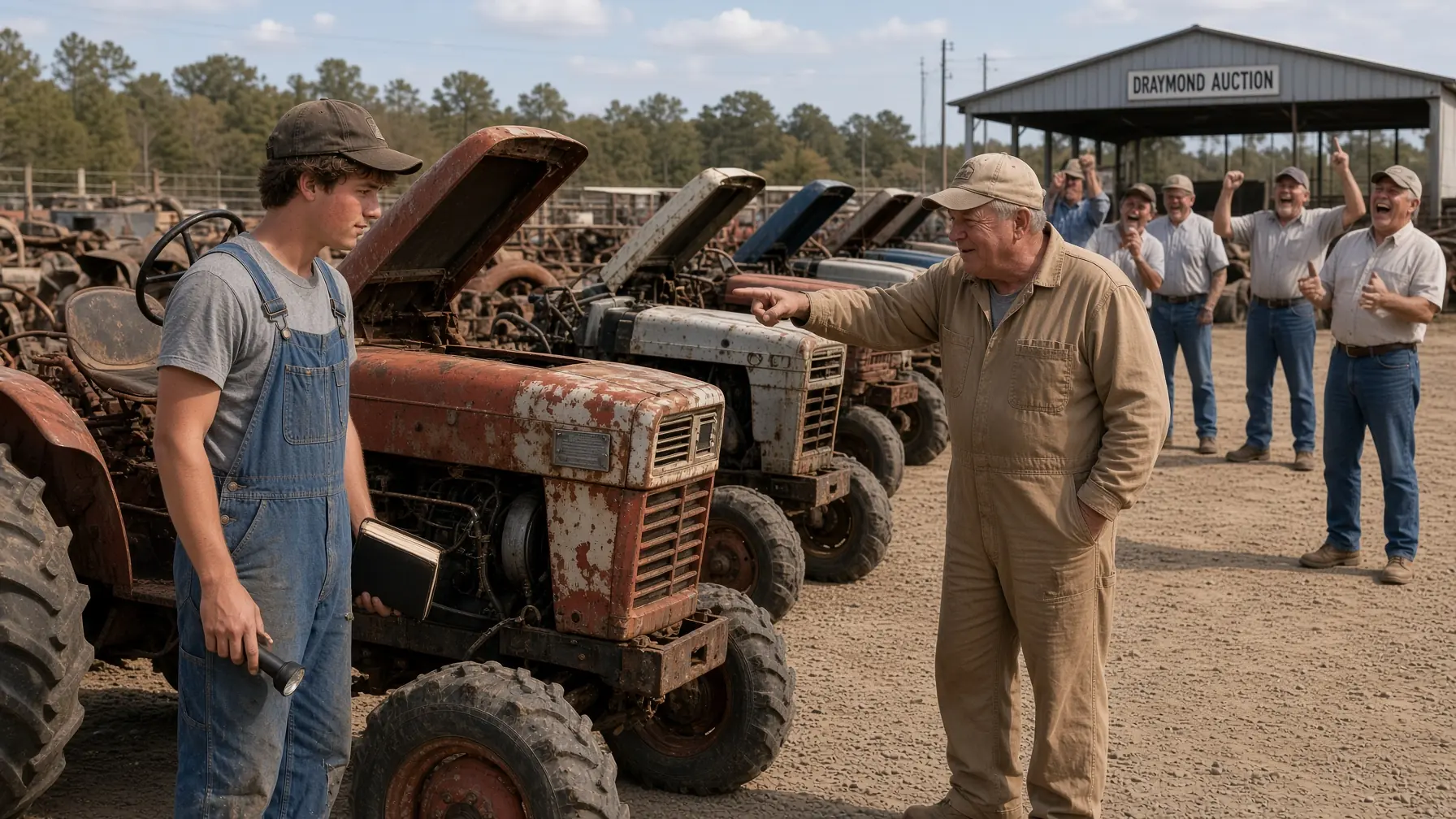
Dale Pruitt walked slowly down the row with both hands buried in the pockets of his coveralls, stopping at each machine just long enough to lift the hood, glance inside, and close it again.
Four seconds.
Sometimes less.
That was all Dale needed.
He had been buying and selling farm machinery for more than thirty years, and nobody at Draymond Auction Yard questioned his eye for worn iron.
He stopped beside the fifteenth tractor.
Looked underneath.
Spat into the gravel.
Then said loudly enough for everyone nearby to hear:
“Boys, you could melt this whole row down and get more for the steel than anybody’s ever gonna pay you for parts.”
Several buyers laughed.
Nobody argued.
Most had already reached the same conclusion.
Cold Brook Rentals had gone under that summer, and the auction was liquidating everything the company owned.
Mowers.
Loaders.
Aerators.
Trailers.
Skid steers.
Anything that still ran had attracted a crowd.
The compact tractors in the back corner had not.
They had spent years being rented to people who treated machinery like somebody else would eventually pay the repair bill.
Now they looked exactly like what they were.
Used up.
Flat tires.
Broken lights.
Bent PTO shafts.
Hydraulic hoses split and hardened from age.
A few engines seized completely.
Several transmissions made noises that suggested metal was circulating where oil should have been.
At least six tractors were missing enough sheet metal to prove somebody had already been taking useful pieces from them before the auction.
To Dale Pruitt, the calculation was simple.
Weight.
Scrap value.
Hauling cost.
Done.
At the far end of the row stood nineteen-year-old Isaiah Callaway.
He was one of the only Black buyers in a yard filled mostly with men twice or three times his age.
Unlike Dale, Isaiah was not opening hoods.
He carried a flashlight in one hand and an old grease-stained service ledger beneath his other arm.
He was reading identification plates.
Model numbers.
Production codes.
Serial ranges.
Year stamps.
Then writing them down.
The first few buyers who noticed him assumed he was wasting time.
One man asked whether he was taking inventory for the auction company.
Isaiah shook his head.
“No, sir.”
“What are you doing?”
“Looking.”
The man laughed.
“At what?”
Isaiah smiled.
“Still figuring that out.”
Twenty minutes later, he found it.
A pattern.
Not every tractor.
Thirty-three of the fifty.
Same manufacturer.
Same basic platform family.
Same three-cylinder diesel engine block used across seven consecutive model years.
Same underlying hydrostatic transmission case.
Hydraulic systems that had changed gradually from one production run to another but still shared more architecture than the outside appearance suggested.
Isaiah checked the first number again.
Then the tenth.
Then the twenty-seventh.
His heart started beating faster.
Nobody else in that yard had a reason to care.
Isaiah did.
Because his grandfather, Otis Callaway, had repaired that exact family of tractors for almost two decades.
Otis had never worked at a major dealership.
Not because he lacked the skill.
When he was young, dealerships in their part of Georgia were not especially interested in putting a Black mechanic on the service floor.
So Otis built his reputation another way.
He repaired what other shops turned away.
Mowers first.
Then tractors.
Then irrigation engines.
Whatever somebody could drag onto a trailer and bring behind the Callaway house.
His workshop had a corrugated tin roof, two homemade workbenches, a concrete floor stained almost black around the engine stand, and shelves full of labeled jars containing bolts that no reasonable person would have saved.
Farmers began bringing him machines dealerships said were too old.
Then machines dealerships said were not worth repairing.
Then newer machines after people discovered Otis could usually tell what was wrong before the service department finished filling out the paperwork.
Isaiah grew up in that shed.
At eight, he handed his grandfather wrenches.
At ten, he learned the difference between clean diesel fuel and contaminated diesel by smell.
At thirteen, he could change hydraulic hoses without being told which wrench to reach for.
At sixteen, he started understanding why his grandfather never called a machine junk until he had looked inside everything that could still be useful.
Otis used to tell him:
“Most folks ask whether the key starts it.”
Then he would tap the side of an engine block.
“I ask what’s still good even if it doesn’t.”
That sentence was in Isaiah’s head while Dale Pruitt walked toward the working equipment.
The auctioneer eventually reached the back row.
Nobody raised a hand.
He tried again.
“Gentlemen, fifty compact utility tractors. Selling as one lot, as-is, where-is.”
Silence.
Someone shouted:
“You throwing in the weeds too?”
Laughter.
The auctioneer grinned.
“Probably if you cut ’em yourself.”
Still nothing.
He dropped the opening number.
Nothing.
Again.
Finally Isaiah lifted his hand.
“Two thousand.”
The laughter stopped briefly.
The auctioneer looked at him.
“For the lot?”
“Yes, sir.”
A buyer behind Isaiah said:
“You got a scrap yard?”
Isaiah ignored him.
The yard manager leaned toward the auctioneer.
They spoke quietly.
The auctioneer scanned the crowd for another bid.
None came.
“Two thousand once.”
Isaiah’s stomach tightened.
“Twice.”
Dale Pruitt turned around now.
For the first time, he looked at Isaiah seriously.
“Sold.”
The gavel fell.
For $2,000, Isaiah Callaway owned fifty tractors that almost everybody else had already decided were worth less as machines than as metal.
Then reality began.
The auction purchase was the cheap part.
Moving fifty tractors from Draymond back to Harlo, Georgia, was not.
Isaiah rented a flatbed.
Borrowed another trailer.
Paid fuel.
Called in favors.
Made trip after trip.
By the time the last tractor was chained down behind his grandfather’s shed, the yard looked like an equipment graveyard.
Machines packed almost tire to tire.
Some leaned because their tires were flat.
Others had loader arms hanging at different heights.
One was missing a seat.
Another had weeds growing around the axle.
Isaiah stood in the middle of them after dark.
He counted his cash.
Eleven dollars.
His mother, Denise, stood inside the kitchen looking through the window.
She worked long shifts in a hospital kitchen and had the kind of tiredness that made anger too expensive.
When Isaiah came inside, she asked only one question.
“Do you have enough money left to fix any of those things?”
Isaiah opened the refrigerator.
“I’m working on that.”
“That mean no?”
“It means I’m working on it.”
Denise looked toward the yard again.
“You spent everything?”
“Almost.”
She closed her eyes.
Isaiah waited for the lecture.
It never came.
She simply said:
“I hope you know what you're seeing out there.”
So did he.
The next morning he started before sunrise.
Tractor one would not turn over.
Tractor two cranked but produced almost no oil pressure.
The wiring harness on tractor three had corrosion deep enough that several connectors had fused together.
Number four had water in the cylinders.
Number five had usable compression but a hydrostatic system that refused to move the machine more than six inches.
Two days passed.
Nine tractors opened.
Zero tractors running.
That fourth night, Isaiah sat alone in Otis’s workshop.
The fluorescent light above him buzzed.
His grandfather had been gone seventeen months.
The tools were still where Otis had left most of them.
A cracked stool sat near the workbench.
A coffee can full of sockets stood beside the wall.
And in front of Isaiah lay the old service ledger.
The pages were thick from grease and fingerprints.
Otis had written in it for years.
Torque specifications.
Recurring failures.
Substitute seals that worked.
Substitute seals that definitely did not.
Which production years tended to damage pump shafts.
Which electrical connectors trapped moisture.
Where a hydraulic pressure reading should settle hot versus cold.
None of it was elegant.
Some pages contained spelling mistakes.
Some notes were written sideways because Otis had apparently run out of space.
But what Isaiah held was thirty years of accumulated attention.
He opened the page for the engine family sitting outside.
Then another.
Then another.
A thought formed.
He went back outside.
Selected three tractors from the matched group.
Rolled them beside the shed.