Before sunrise, while the sky above Comfort Hollow was still the color of a bruise, Marisol Doyle was already on her knees in the dirt with a stone the size of a loaf of bread pressed against her chest. At seventy-three, she had learned to respect what her back could and could not do, so strips of old feed sack were wrapped around both palms and a battered wheelbarrow waited beside her. She carried the granite from the dry creek bed at the edge of the property, one load at a time, then placed it carefully across the struggling ground behind her barn. She was not dumping rubble at random. The larger stones went between planting rows, smaller pieces around the bases without touching the stems, and every few feet she left open channels where rainwater could enter. To anyone watching from Route 9, however, the distinction did not matter. It looked as if an elderly widow had finally lost her mind and was deliberately covering good farmland with rock.
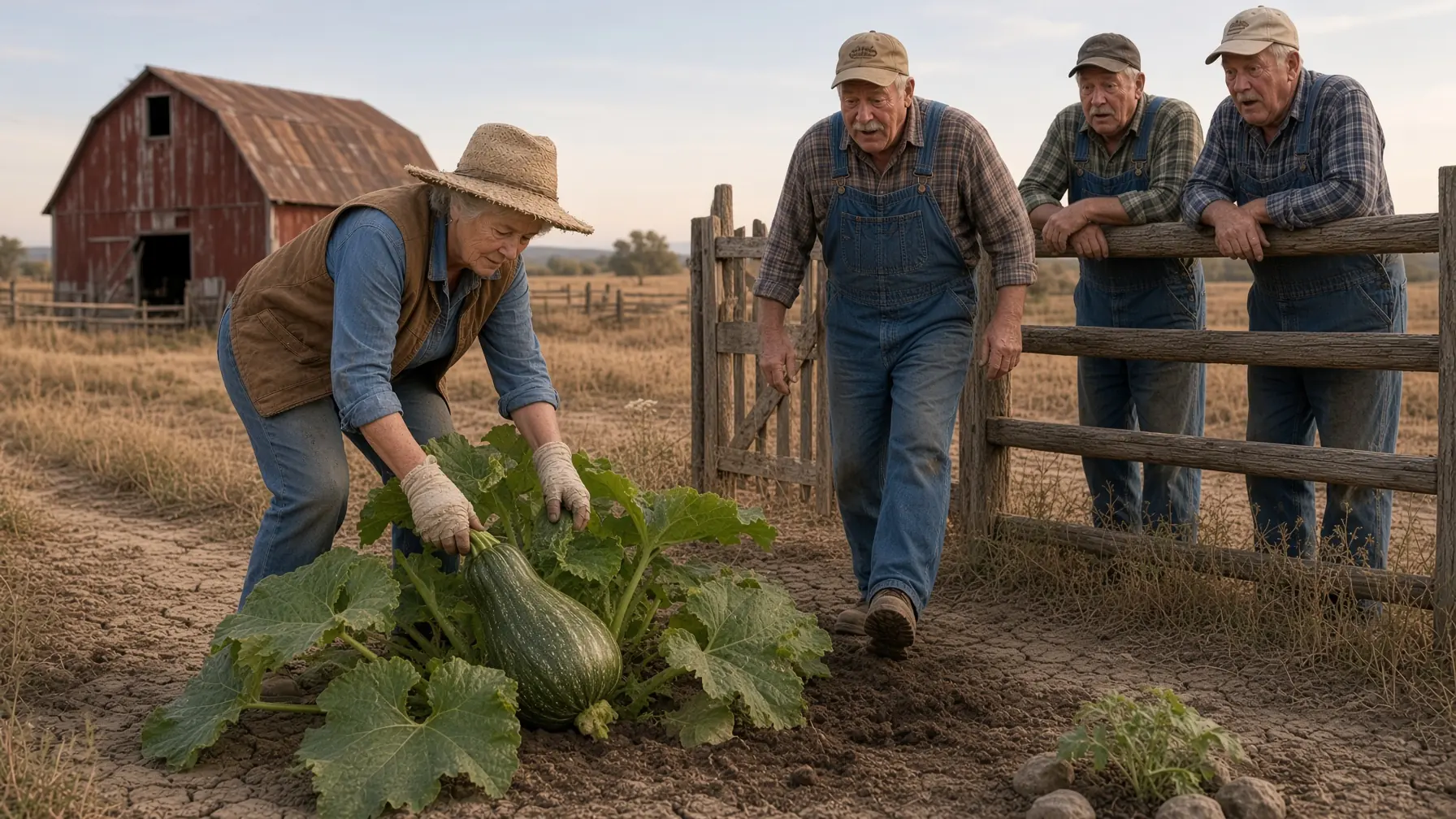
By the time sunlight cleared the eastern tree line, three neighbors had stopped beside her fence. Roy Callaway leaned against the door of his pickup with his arms folded while his younger brother Ellis stared openly at the stone-covered section. Beside them stood Henry Hargrove, whose family operated nearly two thousand acres with center-pivot irrigation, GPS-guided tractors, soil probes, and enough new equipment to make Marisol’s faded machinery look prehistoric. Henry pointed toward the wheelbarrow and asked, “You planning to grow granite this year?” Ellis laughed. Roy did not, although the concern in his face was almost worse. Marisol straightened slowly, pressed one hand against the small of her back, and answered, “No. Squash, beans, corn, and a little okra if the weather behaves.” Henry looked across the acre. “Under that?” Marisol smiled. “Around it.”
Henry shook his head. “You’re burying the best patch you’ve got.” Marisol glanced at the pale soil beneath her boots. “It hasn’t been the best patch in years.” He stepped closer to the fence. “Then add compost. Put in drip line. Don’t cover it with creek rock.” Marisol lifted another stone from the wheelbarrow. “You offering to buy the drip line?” Henry laughed again. “I’m offering common sense.” She crouched and placed the rock exactly where she wanted it. “I’ve got some of my own.” The men stayed another few minutes, watching her work in silence, before Henry finally climbed back into his truck. As he pulled away, Marisol heard him say through the open window, “Walt would have stopped her.”
That sentence hurt more than the laughter.
Walter Doyle had been dead for six years, but people in Comfort Hollow still spoke about him as though he might walk out of the barn carrying a wrench and settle every argument. Walt had possessed the kind of farming instinct that became exaggerated after death. He knew when rain was coming by the smell of the air, when corn needed nitrogen by the shade of the leaves, when a calf was beginning to go wrong before anyone else noticed it. Marisol had loved that about him. She had also known all the mornings he guessed wrong, the crops he replanted, the irrigation pump he swore did not need replacing until it failed during a heat wave. Dead men became legends because nobody remembered the invoices.
Marisol and Walt had bought the eighty-acre farm in 1978 when she was twenty-seven and he was thirty. The soil then was darker, deeper, and forgiving enough that mistakes rarely became disasters. They grew vegetables for local markets, planted feed corn, cut hay, and kept a small cattle herd through the years when beef prices made sense. Their two children learned to walk in the farmhouse, learned to drive on an old Ford tractor, and eventually learned that neither of them wanted farming badly enough to stay. Marisol never resented that. Her daughter became a nurse in Chattanooga. Her son worked in logistics outside Nashville. Both asked her to sell after Walt died.
The offers made sense. The Hargroves had approached her twice, most recently with a number large enough that Marisol could have bought a small house in town, invested the rest, and never worried again about fertilizer, equipment repairs, or whether a dry August would erase six months of work. She thanked them and declined. Her daughter called that stubbornness. Her son called it grief. Marisol considered both possibilities and kept farming anyway. “This land raised you,” she told her daughter once. “I’m not ready to turn it into somebody else’s expansion plan just because I got old.” Her daughter replied, “Keeping it is one thing, Mom. Killing yourself trying to farm it is another.”
That was the real problem. The farm had changed. Summers were hotter, dry periods seemed longer, and rain increasingly arrived in violent bursts that hit hard ground and ran toward the creek rather than soaking evenly into the fields. Years of tillage had not helped. Organic matter had declined in several sections, especially the acre behind the barn where Marisol’s vegetables once produced some of the best market crops in the county. By July, exposed soil there could become hot enough that kneeling on it through thin work pants was uncomfortable. Water applied in the morning often seemed gone by evening. The soil was not dead, but it was tired.
Two seasons before the stones, Marisol’s corn had produced poorly. The following year was worse. Squash aborted fruit in the heat, beans stopped setting, and the top few inches of soil baked into a hard crust after each watering. She could still grow enough to keep the farm operating, but not enough to pretend nothing had changed. Installing a modern irrigation system across all her vegetable ground would have cost more than she wanted to borrow at her age. Mulch helped but required material, labor, and annual replacement. She tried cover crops, reduced tillage, compost, and additional organic matter. Some improvements worked. None solved the problem by themselves.
That winter, while looking for old tax records, Marisol opened a wooden chest that had belonged to Walt’s grandfather, Silas Doyle. Inside were faded receipts, seed envelopes, a rusted pocketknife, and a leather-bound notebook with pages warped by humidity. Silas had farmed the same land before rural electrification reached half the county. His handwriting wandered between weather records, livestock remedies, church notes, crop yields, and advice written with no clear audience. Marisol read it slowly over several evenings because some ink had faded almost beyond recognition.
One entry from the summer of 1936 stopped her.
Silas described a dry year so severe that cattle were being moved off neighboring farms and corn leaves rolled tight before noon. In one garden plot near the farmhouse, he wrote that he had placed creek stone between rows after remembering a method an older farmer showed him as a child. The stones shaded sections of soil, reduced crusting, slowed surface evaporation, and broke the impact of hard rain when it finally came. Silas did not call it a miracle. He complained that moving the rock was miserable work and warned that heavy coverage made cultivation difficult. But he recorded something Marisol could not stop thinking about: the stone-covered rows remained workable and damp longer than exposed rows beside them.
Marisol spent the next month reading. At the library she found references to stone mulches used in different dry regions of the world, from volcanic gravel agricultural systems to rock-covered gardens where scarce rainfall needed to be conserved. The methods varied enormously. Some depended on porous volcanic material. Some moderated soil temperature. Some reduced wind evaporation. Others redirected condensation or runoff. The scientific literature was far less romantic than Silas’s notebook and made clear that results depended on stone type, thickness, crop, climate, soil, and placement. Heavy dark rock could even increase heat under some conditions. Improper coverage could interfere with planting and cultivation.
That did not discourage Marisol. It made her more careful.
She did not cover twenty acres. She marked out a trial smaller than one acre behind the barn. Half would receive stones placed mainly between rows and around root zones with open soil left for planting. The other half would remain under her usual system of light organic mulch and hand cultivation. She bought three inexpensive soil thermometers and several simple moisture meters. Her son, after laughing at the idea, mailed her a digital sensor kit as a birthday present. “If you’re going to do something strange,” he told her, “at least collect numbers.” Marisol replied, “I raised you better than to call measurement strange.”
The stones came from an old dry channel where seasonal flooding had deposited granite and quartz pieces for generations. Marisol did not strip the creek itself or disturb the active banks. She collected loose material from a permitted area well above the ordinary flow line on her own property. Most pieces were smaller than the bread-loaf stones her neighbors saw. She chose flatter rocks when possible and placed them with gaps instead of constructing a solid pavement. It was slow, exhausting work. Some mornings she managed only three wheelbarrows before her back demanded surrender.
That was what Comfort Hollow noticed.
Not the measurements.
Not the control rows.
Not Silas’s notebook.
They saw a seventy-three-year-old widow spreading rocks across a vegetable field and reached the easiest conclusion.
Ruth Callaway, who ran the general store, told one customer, “I’m worried grief finally caught her.” By the end of the week that sentence had become, “Marisol’s burying her farm because she thinks Walt told her to.” Children on bicycles began calling the plot Widow Doyle’s Rock Garden. At the feed store, a younger farmer joked that Marisol had solved drought by eliminating soil altogether. Even people who cared about her questioned whether she was making decisions she would later regret.
Her daughter drove down one Saturday without warning.
She found Marisol repairing the wheelbarrow beside the barn.
“Mom.”
“That tone means you’ve been talking to Ruth.”
“I’ve been talking to everybody.”
“Dangerous habit.”
Her daughter, Elena, ignored the joke. “Are you okay?”
“I’m sweaty.”
“You know what I’m asking.”
Marisol set down the wrench.
“Yes. I know.”
Elena looked toward the stones. “Why didn’t you tell me?”
“Because you live three hours away and have patients, children, and a husband who thinks vegetables come from a refrigerator drawer.”
“He does not.”
“He called a zucchini a cucumber at Thanksgiving.”
“He was tired.”
“He was forty-three.”
Elena fought a smile. “Mom, seriously.”
Marisol took her inside and showed her Silas’s journal, the extension articles she had printed, and the notebook where she had begun recording morning and afternoon soil temperatures. Elena read everything twice. “So this is an experiment?” she asked. Marisol nodded. “A small one.” “And if it doesn’t work?” “I stop.” Elena looked relieved. “You promise?” Marisol thought for a moment. “If the evidence says it doesn’t work, yes.”
That answer mattered later.
By late May, both sections had emerged reasonably well. Marisol planted corn in narrower trial strips, squash on wider spacing, beans along low trellises, and a smaller section of okra. The rock treatment was not identical around every crop because she learned quickly that crawling vines needed different spacing than upright plants. She also discovered one immediate disadvantage: weeds emerging between stones were much more annoying to remove. A hoe could no longer move freely. She spent more time hand-pulling vegetation than she expected.
Henry Hargrove noticed that.
“Looks efficient,” he called one morning as Marisol worked on her knees.
She looked up. “You want to help?”
“No.”
“Then we agree.”
He laughed and drove away.
But beneath the jokes, the measurements were beginning to show something. On clear afternoons, temperatures several inches beneath the stone-protected soil were commonly lower than comparable exposed sections. The effect varied with depth and location, and the stones themselves could become hot in direct sunlight, but the soil beneath them warmed more slowly. Moisture readings after irrigation also declined more gradually in several of the treated rows. The difference was not enormous every day. After cloudy weather, it nearly disappeared. During hot, dry periods, it became noticeable.
Marisol began irrigating the two trial areas separately.
She did not eliminate water from the rock-covered section. That would have ruined the comparison and probably the crops. Instead she tried to maintain similar plant condition while measuring how often each side actually needed supplemental irrigation. By early July, the stone-covered rows generally went longer between waterings, particularly around the squash and corn where roots shaded beneath the protected surface. Organic mulch in the control plot helped too, and some rows performed almost as well. Marisol wrote that down honestly.
One evening Roy Callaway stopped by.
Unlike Henry, Roy did not make a joke. He took off his hat and crouched beside a squash plant.
“This soil’s cooler.”
Marisol smiled. “You have fingers.”
Roy dug carefully into an exposed gap. The earth beneath was darker than the surface soil twenty feet away.
“You watering this more?”
“Less.”
“How much less?”
“Depends on the week.”
“That sounds like farmer talk.”
“It is.”
He looked toward her notebook.
“You actually measuring?”
“Trying.”
Roy rubbed soil between his fingers.
“Could be the stones slowing evaporation.”
“Could be.”
“Could also be that this section has better soil.”
“That’s why I left control rows right beside it.”
Roy looked at her.
“When did you become a scientist?”
“When everyone decided I was crazy.”
He laughed.
By mid-July, the county entered drought conditions. Then the drought worsened. High pressure settled over the region and seemed unwilling to move. Days passed beneath a hard blue sky with temperatures in the upper nineties. Several afternoons crossed one hundred. Rainstorms appeared on radar, split around Comfort Hollow, and reunited ten miles east as though the town itself were cursed.
The Hargroves’ irrigation systems did what they were designed to do, but water availability became the constraint. Their wells remained functional, yet pumping capacity had limits and diesel costs climbed. They prioritized high-value fields and accepted stress elsewhere. Smaller farmers had fewer options. Pastures browned. Unirrigated corn fired upward from the bottom leaves. Vegetable gardens wilted before noon.
Marisol’s farm suffered too.
She did not possess a magical oasis.
Her hay yield dropped.
The outer vegetable acreage struggled.
Several tomato rows developed blossom-end problems during irregular moisture.
The unprotected corn behind the barn curled badly on the hottest days.
But the stone-protected trial remained visibly better.
The difference was not subtle anymore.