The wagon came into Iron Creek just after noon, and the whole town stopped pretending it had work to do.
Rain had fallen hard the night before, turning the main street into a brown ribbon of mud that sucked at wheels, boots, hooves, and dignity with equal hunger. Men stepped out of the saloon. Women paused outside the general store. Children climbed onto barrels and porch rails, eager to see the brides everyone had been whispering about for three weeks.
There were ten of them inside the canvas-covered wagon.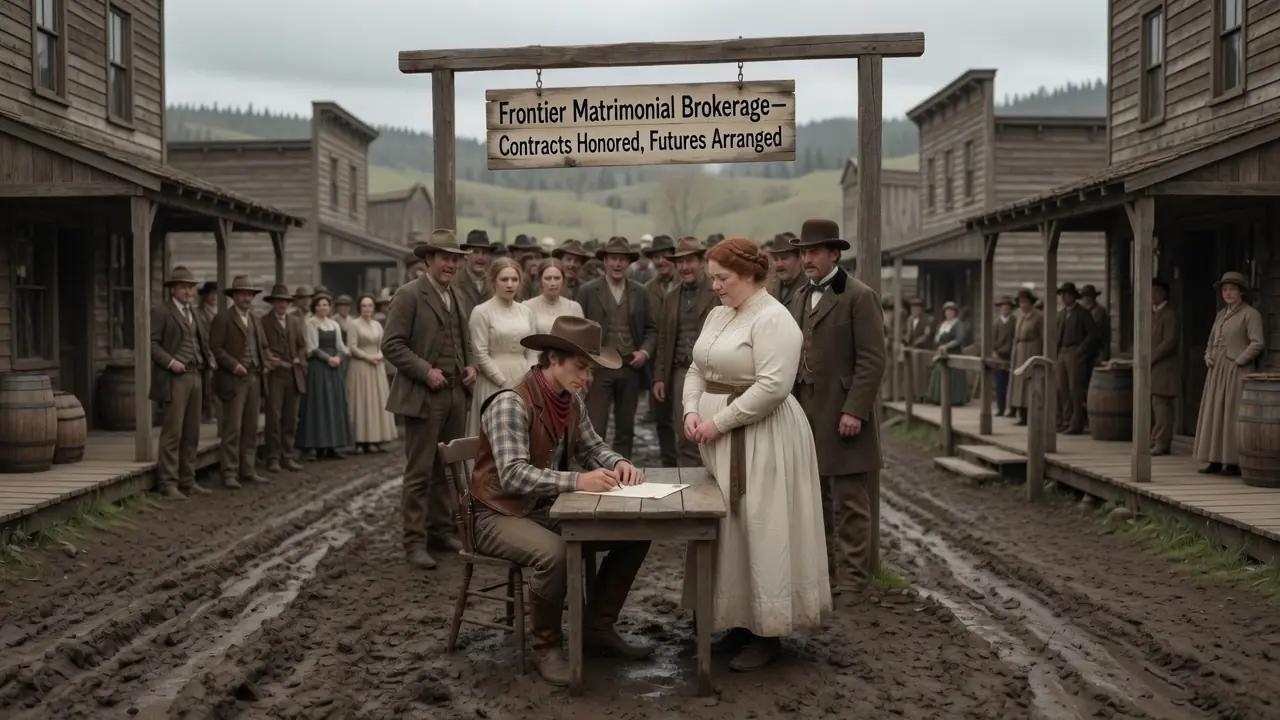
Ten women from the East, brought west by a matrimonial broker who promised lonely miners, ranchers, and shopkeepers that a proper wife could still be arranged if a man had money, a cabin, and the ability to sign his name. The women sat shoulder to shoulder on hard benches, their bags pressed between their knees, their faces pale from travel and exhaustion. Some looked hopeful. Some looked terrified. Most looked like they had already learned not to expect too much from men who made promises on paper.
At the far end of the bench sat Eliza Quinn.
She had been quiet for most of the journey.
Not because she was shy.
Eliza had spent seven years working in a Boston textile mill, and shy women did not last long in rooms full of screaming machines, bitter foremen, and wages small enough to insult the hand that accepted them. She had learned to speak when speaking mattered and save her breath when it did not. On that wagon ride, most things did not.
She was thirty-one, Irish-born, broad-shouldered, full-figured, and stronger than most people guessed before they saw her lift something heavy. Her auburn hair was pinned in a practical knot at the back of her head. Her green eyes were direct in a way that made some men uncomfortable because they mistook a woman’s willingness to look back as defiance.
Eliza had not come west for romance.
Romance was a luxury she had stopped trusting in Boston, somewhere between a handsome liar named Patrick Lane and the night she realized love could become another room where a woman learned to make herself smaller. She had crossed an ocean, then half a country, because she wanted a different life. Not an easy one. Just one that belonged to her.
Iron Creek did not look like a place where dreams were waiting with clean hands.
The town sat low in a valley below the Bitterroot Mountains, with rough wooden buildings leaning into one another like drunk men after closing. There was a feed store, a church with a bell that had cracked in winter and never been repaired, a blacksmith shop, two saloons, and a squat office with faded blue letters painted across the front window.
Silas Mercer’s Frontier Matrimonial Agency.
Contracts honored. Futures arranged.
Silas Mercer himself stood in the street waiting for the wagon like a man receiving merchandise.
He was narrow, restless, and overdressed for a mud town. His hat was too fine for his face. His coat had been brushed recently. His mustache was shaped with the care of a man who believed appearance could substitute for character if maintained carefully enough.
“Gentlemen,” he called, opening his arms as the wagon stopped. “Your brides have arrived.”
The men laughed, cheered, and shifted forward.
The women inside the wagon grew still.
The first bride down was small, blond, and young, with blue eyes and a frightened smile. A rancher stepped forward immediately, removing his hat as if he had practiced the gesture in advance. The second woman was chosen almost as quickly. Then the third. Then the fourth.
Eliza watched it happen from the back of the wagon.
One by one, women stepped down and found a man waiting.
Some pairings were awkward. Some were businesslike. A few had a small, surprising softness to them, the kind that made Eliza think perhaps not every arrangement began as a mistake. But with each woman chosen, the space around Eliza grew larger.
By the time the ninth bride stepped into the street, everyone understood what was happening.
Eliza climbed down last.
Her boots sank into the mud.
The laughter started near the saloon.
Not loud at first.
Just a snicker, then another, then the shared little cruelty of men who wanted to feel brave because someone else had been made vulnerable. One man with a tobacco-stained grin leaned against a post and looked her over like she was livestock that had come in heavier than ordered.
“Well,” he said, loud enough to carry. “Looks like the wagon brought an extra horse.”
His friends laughed.
A few people looked away.
That was worse somehow.
Eliza stood in the mud, holding the handle of her single canvas bag, and watched the remaining men avoid her eyes. They looked at her face, then her body, then the ground, then anywhere else. Nobody stepped forward.
Nine brides chosen.
One left behind.
The crowd rearranged itself around that fact, leaving Eliza alone in a small circle of open mud.
Silas Mercer cleared his throat and glanced at his clipboard.
It was the kind of sound a man makes when he wants embarrassment to become paperwork.
“Miss Quinn,” he said, “it appears we have a slight irregularity in the matching process.”
“I can see that.”
“The contract does provide for alternative placement when a bride is not immediately selected.”
“I read the contract.”
“Then you understand—”
“I understand that if I am not matched, I am entitled to the return of my passage cost.”
Mercer blinked.
“Ah. Well. In practical application, that clause is often handled through credit toward a future placement.”
“I did not ask for credit.”
The man near the saloon laughed again.
“Future placement,” he said. “Maybe with a man who needs a barn moved.”
More laughter.
Eliza turned her head toward him.
“I can hear you.”
The laughter thinned.
She did not raise her voice.
“I want you to know that. I can hear every word.”
The man’s grin twitched. He made a mock bow.
“My apologies, sweetheart. Didn’t realize you were delicate.”
“I’m not,” Eliza said. “That is why you should speak carefully.”
A few people stopped smiling.
Mercer stepped closer and reached for her arm, his face pinched with irritation now.
“Miss Quinn, let us not make a spectacle. You will return to the wagon until I determine the proper next arrangement.”
Eliza pulled her arm back before he touched her.
“I am not cargo.”
Mercer’s smile sharpened.
“Under the terms you signed, you are under my placement authority until—”
Then the street changed.
It began with hooves.
Slow, heavy, deliberate.
Not the quick clatter of a rider coming into town for mail or whiskey, but the deep, grounded rhythm of a big horse carrying a man no one wished to challenge. Conversations died before anyone saw him clearly. People turned toward the northern road, and even the men near the saloon stopped laughing.
A black horse came through the misty sunlight, broad-chested and mud-splashed, with steam rising from its neck.
The rider was larger than any man Eliza had ever seen.
Not merely tall, though he was tall. Not merely broad, though his shoulders filled his dark coat like the coat had been built around a tree trunk. There was something in the way he sat the saddle, something settled and dangerous, as if violence had once known him well and had since agreed to leave him alone so long as no one tested the arrangement.
His hair was dark and too long, falling near the collar of a weathered coat patched neatly at the cuffs. A scar ran from his left temple down toward his cheek, not grotesque, but impossible to miss. His face had been carved by wind, snow, and old grief into something stern enough to make strangers lower their eyes.
Someone whispered, “Elias Ward.”
The name moved through the crowd.
Eliza heard fear in the way they said it.
Not gossip.
Fear.
Elias rode down the center of the street, and the crowd parted without being asked. He did not look proud of that. He barely seemed to notice. His eyes moved once over the town, over the brides, over Mercer, and finally landed on Eliza.
He stopped the horse fifteen feet from her.
For a long moment, he simply looked.
Eliza looked back.
She had been stared at all her life by people who believed her body gave them permission to decide her worth. This was different. Elias did not examine her as if looking for flaws. He looked at her like a man reading weather, trying to understand what stood before him without rushing to name it.
Then he turned to Mercer.
“You the broker?”
Mercer straightened quickly. “Silas Mercer, yes. Frontier matrimonial arrangements and—”
“You have a bride left?”
The sentence dropped into the mud between them.
Mercer’s mouth opened.
His eyes flicked toward Eliza, then back toward Elias, as if he hoped someone else would step in and explain the obvious.
“There is one woman not yet placed,” Mercer said carefully.
“I choose her.”
The street went silent.
Not quiet.
Silent.
The kind of silence that comes when a whole town realizes the story it was enjoying has been interrupted by a man who does not care for its ending.
The tobacco-stained man near the saloon gave a weak laugh.
“You can’t be serious.”
Elias turned his head and looked at him.
Just looked.
The man stepped back before he seemed to know he was doing it.
Elias turned back to Mercer.
“What do I sign?”
The paperwork took twelve minutes.
Eliza counted because counting gave her something to do besides feel the eyes of Iron Creek crawling across her skin. Mercer spread the forms on a folding table near the wagon and dipped his pen with hands that were a little less steady than before. Elias signed his name with slow, deliberate strokes.
Elias Ward.
Raven Peak Lodge.
Eliza watched from a few feet away, her bag in her hand and her future being transferred through ink.
She felt relief first.
Then anger at needing to feel relief.
Then something more complicated beneath both: the sharp awareness that a stranger had just chosen her when everyone else had left her standing in the mud, and she did not yet know whether that made him kind, desperate, foolish, or dangerous.
Perhaps all four.
When Elias finished, he came toward her.
He stopped at a respectful distance.
“I have a wagon half a mile north,” he said. “The road into town is too narrow for it.”
“All right.”
“I can carry your bag.”
“I can carry it.”
He nodded once. “All right.”
No argument.
No offended pride.
No attempt to prove he was generous by forcing help on her.
He turned and walked north.
Eliza followed.
Behind her, the town watched.
The man near the saloon called out, “God help you, woman.”
Eliza did not turn around.
“I do not expect help from Iron Creek,” she said. “But I thank you for the prayer.”
That earned one laugh.
Not cruel this time.
Surprised.
The wagon waited where Elias had promised, pulled off beside a stand of aspens. It was sturdy, well kept, and loaded with supplies arranged by category rather than accident: flour, beans, coffee, nails, rope, tools, blankets, dried fruit, lamp oil, seed packets, and several wrapped bundles she could not identify.
This was not the wagon of a careless man.
Elias checked the harness before climbing up.
“How far?” Eliza asked.
“Three days in good weather.”
“And in bad weather?”
He glanced toward the mountains.
“Longer.”
She appreciated that he did not decorate the answer.
“May I sit up front?”
“That is where the seat is.”
“I meant beside you.”
He looked at her briefly.
Then nodded.
She climbed up.
The wagon began north, and within minutes Iron Creek disappeared behind a bend in the road, though Eliza could still feel the town in her bones like a bruise.
For a while, neither of them spoke.
The road climbed steadily toward the mountains, leaving the wet valley behind. Pines thickened on both sides. The air grew colder, sharper, cleaner. Eliza watched the land change and wondered if her life was changing with it or merely being carried into a new form of danger.
Finally, she asked, “Why did you choose me?”
Elias kept his eyes on the road.
“I needed a capable woman.”
“There were nine others.”
“They were chosen.”
“You know what I mean.”
The horses pulled them around a bend.
Elias was silent long enough that she thought he might not answer. Then he said, “You did not look at the ground when they laughed.”
Eliza absorbed that.
“That is not much of a reason to marry someone.”
“It is enough of a reason to begin.”
She looked at him then.
His face gave nothing away.
“For now,” he added.
For now was not romance.
It was not tenderness.
It was not even trust.
But it was honest, and Eliza had learned to value honest things even when they arrived plain and unsoftened.
“My name is Eliza Quinn,” she said after a while. “I was born in Galway. My family farmed land that belonged to someone else. I came to Boston at twenty-four and worked seven years in a mill. I can cook well enough, sew better than that, read, write, keep accounts, lift what needs lifting, and I do not faint easily.”
Elias nodded.
“Elias Ward. I have lived on Raven Peak twelve years. I hunt, trap, build, mend, and keep mostly to myself.”
“I noticed people are afraid of you.”
“They have reasons.”
“Good reasons?”
“Some.”
It was the kind of answer that told her nothing and something at once.
They camped beside a creek the first night.
Elias built the fire quickly, tethered the horses where they could reach grass, and placed their bedrolls on opposite sides of the flames without making a speech about propriety. He cooked beans with salt pork, wild onion, and dried sage, turning simple food into something warm enough to feel like mercy after the day she had survived.
Eliza ate in silence for several minutes.
Then she said, “You cook better than I expected.”
“I have been alone a long time.”
“That does not always improve a man.”
His mouth shifted slightly.
Not a smile.
Almost.
She decided she liked almost.
That night, under a sky full of hard white stars, Eliza lay awake listening to the creek and the horses and the occasional pop of the fire. Elias slept on his back, still as stone, one arm near his rifle but not touching it. She wondered what kind of life made a man sleep like he expected danger but had grown tired of fearing it.
She expected to be afraid.
Instead, she felt alert.
There was a difference.
Fear made the world smaller. Alertness made it sharper. Eliza had spent too much of her life inside fear to mistake one for the other.
The second day brought rain.
Cold mountain rain, driven sideways by wind, soaking everything it touched and turning the road into a series of arguments between wheels and mud. Elias handed Eliza an oilskin coat without comment. She pulled it on and tied it tight under her chin.
By midday, the wagon’s left rear wheel sank deep into a rut.
The horses strained.
The wagon did not move.
Elias climbed down, studied the wheel, then pulled a long pry board from the wagon bed.
“I need weight on this end when I say.”
Eliza stepped into the mud beside him.
“Show me where.”
He pointed.
“Push down. Not forward. Let the board lift.”
“I know how leverage works.”
He looked at her.
She looked back.
Then the corner of his mouth did the almost-smile again.
“When I say now.”
They worked together, rain running down their faces, mud sucking at their boots. When Elias called, they threw their weight onto the board. The wheel rose with a wet, reluctant groan. The horses pulled, the wagon lurched forward, and Eliza nearly landed face-first in the mud before Elias caught her elbow.
His hand was large, steady, and gone as soon as she had her balance.
“You all right?”
“I have been better.”
“That was well done.”
“I was covered in mud and close to falling.”
“You still did it right.”
She wiped mud from her sleeve.
“I worked in a mill, Mr. Ward. I have moved machines larger than your wagon with three women, a bad rope, and a foreman shouting uselessly nearby.”
He looked at her with a new kind of attention.
“Elias,” he said.
“What?”
“Mr. Ward was my father. Elias is fine.”
“Eliza, then,” she said.
He nodded.
“Eliza.”
The way he said her name was plain, without flourish, but it settled somewhere in her chest all the same.
On the third day, they climbed above the lower pines and into country that seemed too large to be meant for human beings.
The mountains rose around them, dark green at the base, silver and white at the peaks. Snow clung to the high ridges. The air was thin, cold, and clear enough to make every sound feel separate. Eliza could smell pine, rock, water, and the clean absence of towns.
Then Elias pointed.
“There.”
Raven Peak Lodge sat in a fold of the mountain beneath a line of old pines, built of stone and timber as if it had grown there by stubbornness. It had two chimneys, broad windows, a sloping roof blackened by weather, and a workshop attached to the back. To the south lay a garden plot, still sleeping under the last of winter. Beyond it, the land dropped toward a valley so wide it seemed impossible to own.
Eliza stared.
She had expected a rough cabin.
A hermit’s shelter.
A place built by a man avoiding the world.
This was a home.
A real one.
“You built that?” she asked.
“Most of it.”
“How long?”
“Twelve years.”
She glanced at him.
He was looking at the lodge with an expression she had not seen before. Not pride exactly. Not joy. Something quieter and more painful, as if the place held both what he had made and what he had lost.
Eliza said nothing.
Some things were not meant to be stepped on too soon.
The first morning at Raven Peak, Eliza woke before dawn in the larger downstairs bedroom.
She had noticed the night before that Elias had taken the smaller room near the workshop without discussion. Her room had a real bed, a washstand, shelves, and a window facing the south slope where sunrise touched the land first. The mattress smelled faintly of pine and dried grass.
She lay still for a few minutes, listening.
Silence on the mountain was different from silence elsewhere.
In Boston, quiet always had something hiding inside it: machines resting, pipes knocking, footsteps in the hall. Here, quiet seemed like a living thing, patient and enormous. It pressed against the windows but did not enter without permission.
When she stepped into the main room, she stopped.
Books covered the eastern wall from floor to ceiling.
Not decorative books. Used books. Loved books. Their spines were cracked, repaired, marked with scraps of paper and leather strips. Poetry, natural history, law, farming manuals, Spanish novels, medical references, maps, and old journals lined the shelves.
Eliza stood in front of them for a long time.
Outside, an axe struck wood in a steady rhythm.
She found Elias on the south side of the lodge splitting pine.
He completed the swing before acknowledging her.
“Coffee is on the stove.”
“I heard you working.”
“I do not sleep late.”
“Is the wood urgent,” she asked, “or are you putting something into it?”
He paused with the next log balanced on the block.
“What do you mean?”
“Some people split wood because it needs splitting. Some split wood because their head is too full.”
He looked at her steadily.
“The wood needs splitting.”
“All right.”
She went inside and poured coffee for both of them.
When Elias came in twenty minutes later, she handed him a cup.
He accepted it without surprise, as if her being there had already become a fact the lodge was making room for.
“What needs doing today?” she asked.
“You do not have to start working.”
“I know what I have to do. I asked what needs doing.”
He considered her.
“The cellar needs checking. Winter stores. I have not inventoried properly since February.”
“Show me.”
The cellar was carved into the mountain under the lodge, cold, dry, and organized with the care of someone who understood winter as an enemy that respected preparation. Potatoes and turnips sat packed in sand. Smoked meat hung from beams. Preserves lined the walls in crocks marked with Elias’s angular handwriting.
Eliza worked through everything.
Three crocks of plum preserve had spoiled from bad seals. A sack of cornmeal had damp at the bottom and needed spreading before mold took hold. The smoked elk was in good condition. The beans were low. Salt was lower than he seemed to realize.
She climbed back into the kitchen with a list in her head.
Elias listened without interrupting.
When she finished, he said, “You know stores.”
“I grew up on a farm.”
“What kind?”
“Cows, pigs, potatoes, kitchen garden. My mother ran the house. My father ran the animals. Everyone ran the pigs because the pigs listened to no one.”
It came out before she meant it to.
For a moment, her chest ached with the memory of Galway rain, her mother’s hands, and her father cursing at a pig that had more strategy than any animal had a right to.
Elias did not rush to fill the silence.
She appreciated that.
“The plum trees are good on the east slope,” he said finally. “In late summer. More fruit than I can use alone.”
The word alone sat between them.
Then he added, “I can show you when it comes.”
It was a small thing.
A practical thing.
But it was the first time either of them spoke as if she might still be there in late summer.
Eliza nodded.
“Then show me.”
Days began to take shape.
Mornings were work. Cellar, garden, mending, cooking, hauling, cleaning, learning the mountain’s habits. Afternoons were often quieter. Elias disappeared into the workshop. Eliza read by the window or walked the ridge where she could see the valley below.
She learned that Elias painted.
Not because he told her.
Because one evening, the workshop door stood half open and she saw a canvas propped against the wall: the mountain at dusk, the sky caught somewhere between blue and purple. It was not perfect, but it was deeply seen.
He found her looking.
“They are not good,” he said.
“The color is nearly right.”
He stared at her.
She realized most people had either mocked his gentler work or praised it without looking.
She had done neither.
“The light changes too fast,” he said after a while. “By the time I mix what I need, it has already gone.”
“Mix some colors before the light comes.”
“I cannot predict it exactly.”
“You do not need exact. You need close enough to reach it before it leaves.”
He considered that as if she had handed him a tool.
“I may try that.”
She also learned he played music.
Late one night, a low, strange sound drifted up through the floor. Eliza woke and followed it quietly downstairs. In the workshop, by firelight, Elias sat with a fiddle resting low across his knee, bowing music that did not move like ordinary songs. It wandered, circled, searched, retreated, and returned.
When he finished, he noticed her in the doorway.
“How long?”
“Most of it.”
“I do not usually play when anyone can hear.”
“I can understand why.”
His face closed.
She stepped into the room. “I mean, because it sounds private. Not because it sounds bad.”
He looked down at the fiddle.
“It is not really music.”
“It is thinking with strings.”
He looked up.
Something unguarded moved across his face.
“Maybe.”
Trust did not arrive all at once.
It came in small things.
A packet of sugar left on top of her bag after he noticed her measuring the last of hers carefully. A chair he made for her without asking, the height exactly right, the back curved to fit her body instead of forcing her to fit it. A Spanish word taught after supper, then another, until winter evenings began to gather around books, language, and the quiet pleasure of learning something useless for survival and necessary for being human.
Two months passed before she asked about his past.
They were sitting by the fire in April, the snow retreating from the lower slopes and the garden beginning to show dark soil beneath thawing frost.
“The town fears you,” Eliza said.
Elias looked into the fire.
“Yes.”
“I would like to know why.”
“You may not like the answer.”
“I am not asking to like it. I am asking to know who I live with.”
That landed differently.
He was silent for a long time.
“My wife and daughter died eight years ago.”
Eliza did not move.
“Fever,” he said. “I was on the mountain. They were in the valley visiting her sister. By the time word reached me, they were already buried.”
The fire shifted.
“What were their names?” Eliza asked.
He looked at her then.
Not because the question hurt.
Because it mattered.
“Anna,” he said. “And Rose. Rose was four.”
Eliza held the names carefully.
“And Iron Creek?”
“Afterward, I was not right for a time. There was a dispute with men at the trading post over land and money. I went down to settle it and did not settle it well.”
“Were they killed?”
“No.”
“Injured?”
“One badly.”
“And the town decided you were a monster.”
“The town decided a simpler story was easier.”
Eliza understood that.
People love simple stories because they do not ask much of the teller.
She told him about Patrick after that.
Not everything.
Enough.
How Patrick had been handsome, charming, warm in public, cold in private. How he made apology feel like generosity when it was really just a pause between cruelties. How she had stayed too long because she kept calling fear practicality. How one morning in a mill washroom, she looked in a cracked mirror and realized she no longer recognized the woman looking back.
“I left because I would rather be unknown in a new place than invisible in the old one,” she said.
Elias did not offer comfort too quickly.
He only said, “I understand that.”
And she believed he did.
By May, Raven Peak felt less like his place and more like theirs.
Not legally.
Not romantically, not yet.
But through labor. Through repetition. Through the way Eliza knew which part of the kitchen floor creaked and which window caught the first sun. Through the way Elias began saying “we” without noticing. Through the way her chair stayed by the fire because no one questioned that it belonged there.
Then the rider appeared below the tree line.
Eliza saw him first from the garden.
He was not on the road. He moved through the trees parallel to the lodge, stopping where the pines opened enough to give him a view. He stayed there too long to be passing through.
That evening, she told Elias.
He listened without dismissing her.
“Hunter?” she asked.
“No. Hunters watch the ground. He was watching the lodge.”
Three days later, Elias returned from Iron Creek with supplies and a folded letter.
He placed it on the table after supper.
“Mercer gave this to me,” he said. “A man left it at his office two weeks ago.”
Eliza opened it.
The letter came from Caleb Rusk, owner of Rusk Territorial Mining, a man out of Helena who claimed to have acquired mineral rights adjacent to Raven Peak. Recent geological surveys suggested significant silver deposits. Rusk wished to purchase the property at a fair market value. He hoped Elias would understand that civilized arrangements were always preferable to less civilized ones.
Eliza read the last line twice.
“How long have you known about the silver?” she asked.
Elias went still.
“Since I built the lodge.”
The room rearranged itself around the answer.
“You brought me here without telling me the mountain sat on silver.”
“I did.”
“You thought that was not relevant?”
“I did not know who you were yet.”
She set the letter down carefully.
“And since then?”
He looked at her directly.
“I was afraid of what it would change.”
“That is not an answer that improves the first one.”
“No.”
At least he did not defend himself.
That helped.
Not enough, but some.
“Where is it?”
“North slope. A natural shaft I widened years ago. The vein runs deep.”
“And you never mined it?”
“No.”
“Why?”
“Anna and I did not come here for silver. We came to build a place. After she died, working the mine would have meant banks, buyers, men coming up here with ledgers and questions. I wanted none of it.”
Eliza looked toward the window, where the mountain stood dark beyond the glass.
“And now they want it.”
“Yes.”
She turned back to him.
“Then we think carefully.”
He nodded.
“I should have told you earlier.”
“Yes,” she said. “You should have.”
“I am sorry.”
She believed him.
She did not forgive him instantly.
Both things could be true.
The first man from Rusk Mining came one week later.
His name was Nathan Bell, a smooth-faced representative in a clean coat riding a horse too fine for mountain paths. He smiled as if smiling were a professional instrument and he had sharpened it that morning.
Elias met him in the yard.
Eliza was turning soil in the garden.
“Mr. Ward,” Bell said. “I represent Caleb Rusk. I trust you received his letter.”
“I received it.”
“Then you understand he is interested in a purchase.”
“I understand he is interested.”
Bell’s smile cooled slightly.
“The offer is generous.”
“The property is not for sale.”
Bell glanced toward Eliza.
“I understand you have recently married. A new wife changes a man’s responsibilities. Money can provide comfort. Security. A better life for her.”
Eliza stood and wiped her hands on her apron.
“Mr. Bell.”
Both men turned.
“You came to speak to my husband. He has answered. The property is not for sale. Not for a fair price, not for an unfair price, not for any price.”
Bell studied her.
“Mrs. Ward, this is a business matter.”
“Yes,” she said. “That is why I am using clear language.”
Elias looked down briefly.
She suspected he was hiding almost a smile.
Bell’s pleasant face had gone cold.
“I will relay your position.”
“Please do,” Eliza said. “Accurately.”
After he rode away, Elias looked at her.
“You called me your husband.”
“In front of a man like that, yes.”
“Only in front of a man like that?”
She looked at him.
“That depends on what kind of man you are when he is gone.”
His eyes stayed on hers.
“I am trying to be the right kind.”
“That is a better answer than most.”
Rusk changed tactics quickly.
By June, rumors had begun in the valley towns.
Eliza Quinn had been illegally purchased by a dangerous mountain man. She was trapped on Raven Peak against her will. Elias Ward was unstable, violent, hiding a silver deposit that should benefit the territory. Someone needed to intervene for her safety and the public good.
Eliza listened to the trapper who brought the news and felt cold anger settle into her bones.
“They are using me,” she said after the trapper left.
“Yes.”
“As a reason to take the land.”
“Yes.”
“And people believe it?”
“People believe stories that give them permission to want what they already wanted.”
Eliza stood by the window.
“Then we tell our own story.”
“How?”
She sat at the table, pulled paper toward her, and began writing.
One letter to the territorial land office. One to the editor of the Cedar Falls Gazette. One to the sheriff in Helena. One to Silas Mercer, reminding him that he possessed signed documents proving the marriage arrangement had been voluntary and legal.
Her letter to Mercer was shortest.
You know what was signed. If asked to confirm a lie, understand that lies can make contracts worthless. Your business depends on contracts being believed. I trust you will make the practical decision.
Eliza Quinn Ward.
Elias read it and looked at her with open admiration.
“That is not an appeal to his honor.”
“No,” she said. “I do not know that he has enough to appeal to. I appealed to his self-interest.”
“That may work better.”
“It usually does.”
The letters created a record.
They did not stop Rusk.
By late June, another trapper arrived with warning. Eight armed men were moving from Cedar Falls toward the mountain, accompanied by two deputies from a nearby settlement. They carried a paper calling the visit a welfare check.
Eliza laughed once.
No humor in it.
“A welfare check with ten armed men.”
Elias’s face had gone still.
“They mean to remove you from the lodge, claim I was holding you, and use that to challenge the deed.”
“Then they will be disappointed.”
“You could leave before they come.”
She stared at him.
“No.”
“Eliza—”
“No.”
He stopped.
She stood across from him in the main room, the fire low behind her, the mountain dark beyond the windows.
“I left Galway. I left Boston. I left Patrick. I left Iron Creek’s mud and the men who laughed. I am done leaving places because men have decided I should make room for their comfort.”
His expression changed.
“This is mine,” she said. “Not because of a deed. Because I chose it. Because I worked the garden. Because my chair is by that fire. Because your dead wife’s plans and your living hands and my stubbornness are all somehow tied up in the same place now.”
Her voice softened, but only slightly.
“I am not running from a life I chose.”
For a long moment, Elias did not move.
Then he said, “All right.”
Not surrender.
Not defeat.
Recognition.
“Then we do not run.”
They spent eleven days preparing.
Elias reinforced the shutters with iron brackets from the workshop. They moved food, water, bandages, and ammunition into reachable places. They walked the perimeter twice a day. He showed her the two routes up from the south, the blind angles near the workshop, the place where the ridge gave cover, and the north slope no horseman would attempt in numbers.
Eliza asked to learn the rifle.
Elias taught her properly.
Not with condescension.
Not with drama.
He showed her the Winchester’s mechanism, how to load, how to check, how to hold, how to breathe, how to pull the trigger without flinching. She was not good at first. She said so. He disagreed only with the harshness, not the fact.
“Skill is mostly time,” he said.
“And if time is short?”
“Then we use the time we have.”
By the fourth afternoon, she could hit a pine mark at fifty feet more often than not.
“That is close,” she said.
“Yes.”
“Too close.”
“Yes.”
“So the goal is not to need the rifle.”
“The goal is never to need the rifle,” Elias said. “The purpose is to make sure needing it does not find you helpless.”
On the final evening before the men arrived, they sat by the fire.
Eliza in the chair he had made for her.
Elias in the old leather chair near the hearth.
No one spoke for a long while.
Then she said, “Tell me about a book.”
He looked at her.
“What?”
“One from the shelves. One you’ve read so many times it’s falling apart.”
He chose Cervantes.
He spoke slowly at first, then with more rhythm, explaining that the book was not only about foolishness or madness, but about the stories people tell themselves to keep moving when reality is too sharp to touch directly. What happens when those stories crack. What remains when a man can no longer hide from the truth he has dressed up as purpose.
Eliza listened.
“I think you are right,” she said.
“You’ve read it?”
“No. But I know something about stories people tell themselves.”
“What was yours?”
“That I was practical. Staying with Patrick was practical because leaving was disruptive. Working myself to the bone in Boston was practical because the wage was steady. Coming west was practical because I had no better option.”
She looked into the fire.
“I called fear practicality for years.”
“And now?”
“Now I am sitting in a mountain lodge with a rifle near my chair, waiting for hired men to come take land that is not theirs.”
She looked at him.
“That is not practical at all.”
“Do you regret it?”
“No.”
The answer came easily.
That surprised her.
Before either of them could say more, the sound came.
Hooves.
Many of them.
Too fast.
Too near.
Elias stood.
Eliza was already moving.
The shutters closed. The fire was banked low. Rifles came down. Water buckets were placed by the workshop wall. The preparation of eleven days took control of their bodies and left no room for panic.
The first shot came from the trees.
It tore through a shutter and buried itself in the far wall.
Eliza dropped low behind the kitchen table.
Elias moved to the north window.
“Warning shot?” she asked.
“Test.”
A voice called from the yard.
“Elias Ward! We have legal authority to conduct a welfare inspection. Open the door and come out peaceably.”
Elias cracked the shutter only enough to speak.
“Hold the paper up under lantern light.”
A pause.
“Come out and read it.”
“I can read from here.”
The silence that followed told them enough.
A second shot shattered the front window behind the reinforced shutter.
Then another.
Then three more from the east.
They were testing the house.
Stone took the bullets without complaint.
Timber did not.
Eliza smelled smoke before she saw flame.
“The workshop.”
Elias was already moving.
Someone had set fire to the eastern wall where old pine met stone foundation. It caught fast. Elias grabbed a bucket and went through the back, and shots immediately followed him.
They had expected him there.
Eliza moved to the front shutter, opened the narrow firing gap the way he taught her, and saw three riders near the yard watching the workshop side.
They had not accounted for her.
That was their mistake.
She aimed at the ground near the lead horse and fired.
The horse reared sideways.
The rider cursed, pulling hard at the reins. The other two scattered, and for three seconds the pressure on Elias broke.
Three seconds was enough.
He got water onto the flames and came back inside with one sleeve scorched and smoke in his hair.
The fight lasted nearly an hour.
Time stopped behaving normally. Shots came in bursts. Men shouted from the trees. Smoke drifted through the lodge. Eliza coughed so hard her eyes watered, then steadied the rifle because coughing did not change the work.
Two men tried the east side.
Elias drove them back.
One tried to reach the cellar entrance.
Eliza fired near his boot, close enough to take bark off the log beside him, and he decided courage had limits.
Then they rammed the front door.
The frame cracked on the second hit.
The third tore it inward.
Two armed men rushed into the main room.
Eliza did not have the rifle in her hands.
She had a clay water jug.
So she threw it.
Thirty pounds of water and fired clay hit the first man in the shoulder and knocked him sideways into the second. He stumbled, swearing. Eliza crossed the room, took the Winchester from where it leaned against the table, and pointed it at them.
“Out.”
The men stared at her.
Hard men.
Hired men.
Men used to women being frightened into stillness.
Eliza’s hands shook, but not enough to matter.
“I have been shooting this rifle for the better part of an hour,” she said. “I am not guessing where the trigger is.”
The first man backed up.
The second hesitated.
Eliza lifted the barrel a fraction.
“Try me when you have better odds.”
He left.
Elias came around from the workshop side a moment later, rifle in hand, blood running from a cut above his eyebrow. The men saw him, saw Eliza, saw the stone walls still standing, and made the calculation hired men make when pay no longer matches risk.
They ran.
Hooves thundered down the road.
Then faded.
The mountain filled the silence back in.
Eliza stood in the ruined doorway and realized only after it was over that her hands were shaking badly.
Elias crossed the yard toward her.
His coat was burned at the sleeve. Blood had dried near his temple. His chest rose and fell harder than usual.
“Your arm,” she said.
“Not bad.”
“Show me.”
He obeyed.
Inside, she cleaned the burn with boiled water and dressed it with salve and cloth she had prepared days earlier. He sat still, not because it did not hurt, but because he trusted her hands.
When she finished, he looked at her across the table.
“You threw a water jug at an armed man.”
“It was what I had.”
“You could have been killed.”
“I know.”
He seemed to have no place to put the fear that sentence left in him.
She reached across the table.
He took her hand.
His hand was large, rough, warm, and injured.
Hers was still shaking.
They sat there in the dark, holding on, while smoke hung in the rafters and the mountain kept its old silence outside.
Nothing more was said that night.
Nothing more was needed.
The territorial sheriff arrived three days later.
His name was Marshal Amos Larkin, a gray-haired man from Helena with tired eyes and a notebook he used like a weapon. He walked the property, studied the bullet holes, inspected the burned workshop wall, and took statements from Eliza and Elias separately.
Their accounts matched.
So did the statements from the two deputies who had come with Rusk’s men and retreated to the trees once the shooting began. They had expected a welfare check, they said. What they witnessed looked very much like an armed attempt to seize property.
Eliza’s letters had arrived before the attack.
That mattered.
The land office had received her statement. The Gazette had received hers too. So had Mercer. So had the sheriff’s department. Rusk could not claim confusion where a record existed first.
“You understood the importance of documentation,” Larkin said to Eliza.
“I understood the importance of men not being able to tell the only story.”
The marshal looked at her for a moment.
Then wrote that down.
The legal fight lasted months.
Rusk hired lawyers. They challenged mineral boundaries, questioned the marriage contract, suggested Elias was unstable, suggested Eliza had been coerced, suggested the lodge was not properly filed, suggested everything except the simple truth: that Rusk wanted silver under land he did not own.
Silas Mercer testified truthfully.
Not nobly.
Practically.
His business depended on contracts being valid, and Eliza’s letter had made dishonesty expensive. He confirmed that Eliza Quinn had entered the arrangement voluntarily, that Elias had signed properly, and that no one had dragged her anywhere except, nearly, back onto the broker’s wagon before Elias arrived.
The Cedar Falls Gazette published the story in July.
The headline traveled faster than either of them expected.
THE BRIDE LEFT IN THE MUD AND THE MOUNTAIN RUSK COULD NOT BUY.
The editor, Samuel Penn, wrote not only of silver and land, but of Iron Creek’s laughter, Elias’s choice, Eliza’s letters, the siege, the burned workshop, and the fact that the supposed captive woman had defended the door herself with a rifle and a water jug.
Stories changed when told by someone who bothered to look.
By autumn, Rusk’s claim was denied.
His appeal failed in December.
Two deputies resigned under inquiry. One of Rusk’s lawyers withdrew. The mining company turned its attention elsewhere, toward easier land and people with fewer documents, fewer witnesses, and less stubbornness.
Raven Peak remained Raven Peak.
In October, the aspens turned gold.
Eliza had not known a mountain could burn without flame, but the lower slopes glowed so fiercely in the late afternoon that she stood still for ten minutes the first time she saw it. Elias found her there, holding a basket of apples from the east slope, smiling before she realized she was doing it.
Later that week, he brought a painting from the workshop.
He set it on the table without ceremony.
It was the mountain at dusk, the view from the yard, the exact strange purple-blue light that had troubled him for years. This time, he had caught it. Not perfectly, perhaps, but truly enough that perfection no longer seemed the point.
“You mixed the color in advance,” she said.
“Six attempts.”
“You got it.”
“Close enough.”
“Better than close.”
He looked at the painting, then at her.
“I thought you might want it in your room.”
Eliza shook her head.
“Above the fireplace.”
His expression shifted.
“Where both of us can see it?”
“Yes.”
They hung it that night.
The first attempt was too high. The second too far left. On the third, Elias hit his thumb with the hammer and cursed in Spanish. Eliza laughed so hard she had to sit down. For a second, he looked offended. Then he laughed too, a deep, surprised sound she suspected Iron Creek had never heard from him.
The painting ended slightly crooked.
They left it that way.
Some things are right without being perfect.
Winter came quietly.
Snow covered the rebuilt workshop roof, the garden beds, the woodpile, and the road that led down to the valley. The lodge held warmth. The shelves held books. The cellar held preserves Eliza had made from fruit Elias had once let rot because he could not use it all alone.
One evening in November, with snow falling thick beyond the windows, Elias stood by the fire and said, “Anna had a plan.”
Eliza looked up from the book in her lap.
“What kind of plan?”
“For the mountain. A settlement. Not a mining town. A real place. Families, workshops, gardens, a schoolhouse eventually. People who wanted to build, not take.”
He reached toward the shelf and pulled down an old notebook.
“I could not open it for eight years.”
“And now?”
“I opened it last month.”
Eliza closed her book.
He handed her the notebook.
Inside were Anna Ward’s careful drawings, lists, crop estimates, building plans, water calculations, notes on which families might manage high-country winters, and ideas for a schoolroom with south-facing windows.
Eliza touched the page gently.
“She was serious.”
“She was always serious once she loved an idea.”
“Would she mind us finishing it?”
Elias looked into the fire.
“I think she would mind if I did not.”
The first families came the following spring.
Samuel Penn and his wife from Cedar Falls. A widow named Ruth Calder with two children and practical hands. Two brothers who were carpenters. A former schoolteacher who had lost his hearing in one ear but not his patience. People came slowly, carefully, with questions and tools and histories of their own.
Raven Peak did not become a town overnight.
It became a beginning.
Eliza helped mark garden rows, organize stores, and create rules plain enough that no man could twist them easily. Elias taught building, hunting, winter preparation, and the kind of mountain knowledge that kept people alive without making them foolishly confident.
Children ran past the south-facing rock where Eliza had once dried corn.
One little girl sat there in the morning sun and declared it the warmest place in the world.
Eliza smiled.
“It catches the light first,” she said.
That summer, she and Elias stood on the ridge above the lodge as the valley turned gold below them.
They were legally married by then in a small ceremony near the creek, though both privately believed they had belonged to one another long before paper caught up. He had told her he loved her during a snowstorm, sitting in the chair he made for her while the fire burned low.
He said it plainly.
No speech.
No poetry.
“I love you.”
Eliza had known for weeks, perhaps months.
Still, hearing it changed something.
“I love you too,” she said.
He nodded as if she had confirmed a fact he had been carefully hoping was true.
It was such an Elias response that she loved him more for it.
Years later, travelers passing through Iron Creek heard the story before they saw the mountain.
They heard about the bride left standing in mud while the town laughed. They heard about the scarred mountain man who rode in and chose her before everyone. They heard about the silver baron who thought land could be taken if a woman could be turned into an excuse. They heard about the night hired men went up Raven Peak and came back down faster than they intended.
Like all stories, it changed in the telling.
Some made Elias taller.
Some made Eliza a perfect shot.
Some claimed she had knocked three men unconscious with one water jug, which she never corrected unless the person seemed likely to believe it too strongly.
But the truth was better than the legend.
The truth was two wounded people meeting under the worst circumstances, without romance, without certainty, and without any grand promise that life would suddenly become gentle. The truth was work, silence, hard conversations, mistakes, apologies that did not fix everything instantly, and trust built slowly enough to hold weight.
The truth was a chair made to fit one woman exactly.
A packet of sugar left on a bag.
A dead child’s name spoken by firelight.
Letters written before violence arrived.
A rifle learned out of necessity.
A hand held in the dark after the danger passed.
On clear evenings, when the aspens caught the last light and the mountain turned that impossible blue-purple Elias had once spent years trying to paint, people sometimes saw them standing side by side on the ridge.
He was enormous, scarred, still frightening to men who judged too quickly.
She was broad-shouldered, steady-eyed, and no longer apologizing for the space she took in the world.
They did not always speak.
They did not need to.
Below them, smoke rose from the new cabins. Children called near the garden. Hammers sounded from the workshop. Raven Peak, once a fortress built from grief, had become what Anna dreamed and what Eliza helped make possible.
A home.
Not perfect.
Not easy.
But chosen.
And for Eliza Quinn Ward, who had once stood alone in the mud while a whole town laughed, chosen was not a small thing.
It was everything.