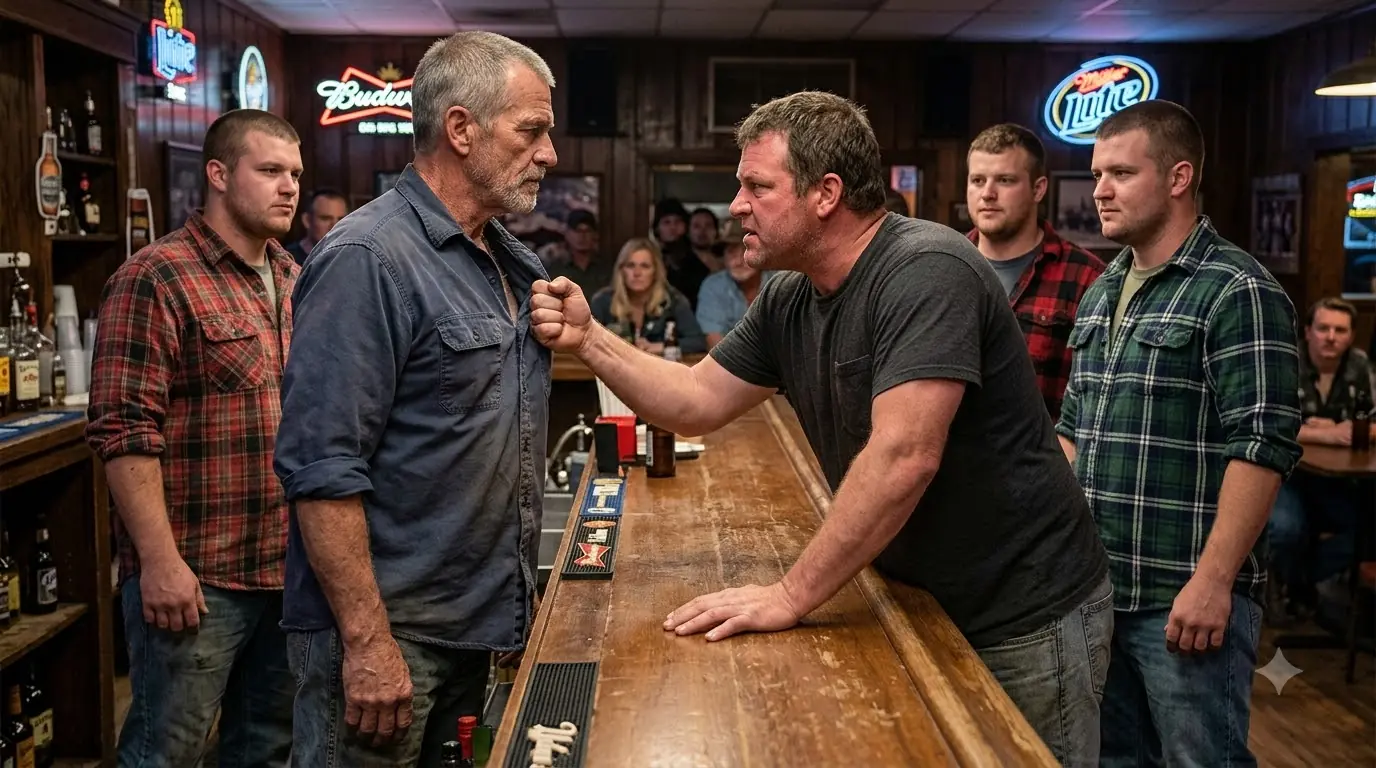
"You got about 30 seconds to get your hands off that man before this gets real ugly, real fast." Nobody moved. The whole bar went quiet. 14 bikers, two pool cues, one bartender with a busted lip standing between a drunk ex-con and the door. And not a single person in the room knew who they were actually looking at.
If you've never seen a man hold a room still with nothing but his voice and his eyes, you've never met Cole Decker. The Rusty Spur Roadhouse sat at the edge of Harrisville, Tennessee, on a two-lane state road that most GPS systems still hadn't bothered to name. It was the kind of place that had existed in one form or another since before the interstate was built. A low wide building with a gravel parking lot, a hand-painted sign above the door, and a jukebox inside that had been playing the same hundred songs since 1987. The building smelled like cedar smoke and draft beer and something older than both.
Something that lived in the wood of the bar top itself, worn smooth by 40 years of elbows and arguments and quiet conversations that nobody outside those walls ever needed to hear. Cole Decker had been working behind that bar for 11 months. He wasn't from Harrisville. Anyone who spent more than 10 minutes talking to him understood that immediately, though nobody could have told you exactly what it was that gave him away. It wasn't his accent.
He'd grown up in enough different places that his voice had stopped belonging to any single one of them. It wasn't the way he dressed either. He wore the same thing every shift. Worn jeans, a plain work shirt, boots that had seen serious weather. No rings, no watch, nothing that caught the light.
What gave him away was something harder to name. It was the stillness. The way his eyes moved across a room without seeming to move at all. The way he listened to a conversation three bar stools down while appearing to focus entirely on the glass he was drying. The way he positioned himself, always slightly off center, always with a clear line to the door, always knowing where every person in the room was standing without looking.
Patrice Odum, who owned the Rusty Spur and had been running it since her ex-husband walked out in 2009, noticed it the morning Cole Decker walked in off the road, and asked if she had any openings. She didn't normally hire strangers. She had a rule about it, three references minimum, at least one of them local. But something about Cole made her set that rule aside. He wasn't charming.
He didn't try to be. He just stood across the counter from her and answered her questions directly without embellishment, without the kind of nervous energy that men usually brought when they needed something from her. She asked him if he had experience behind a bar. He said yes. She asked him where.
He named three places in three different states, not famous places. Working bars, the kind where the customers were real people with real problems, and the bartender's job was to manage both. She asked him why he'd left each one. His answers were plain. He'd stayed as long as he needed to, then moved on.
She asked him why Harrisville. He said he'd been driving and the town felt right when he came through it. Patrice Odum had been in the business long enough to know that some people were running from something and some people were running towards something and some people were just traveling, carrying their own weight quietly and asking nothing from anyone. She looked at Cole Decker for a long moment and decided he was the third kind. She hired him that afternoon.
For 11 months, he showed up on time and left on time and never missed a shift and never called in sick. He remembered every regular customer's drink after the first time they ordered it. He broke up two arguments before they became fights. Both times using nothing but his voice and a particular way of stepping into someone's space that communicated very clearly that the conversation was over. He never explained how he'd done it.
He just went back to the bar and resumed what he'd been doing. And the men who'd been about to go after each other always seemed faintly confused afterward, unable to explain exactly why they'd backed down. The regulars liked him. Not in the warm, familiar way they liked Jimmy Crane, who'd been behind that bar for six years before a bad knee sent him into early retirement, but in a quieter way, the way you like a man who keeps his word and doesn't create problems and whose presence in a room makes the room feel more stable than it would be without him. His name in Harrisville was simply Cole.
Some people didn't even know his last name. It didn't seem to matter. He was Cole the bartender. Cole, who remembered you liked your bourbon neat and your water with ice. Cole, who fixed the ice machine without being asked, and patched the leaking pipe under the third sink without telling Patrice, until it was already done.
He lived in the rooms above the bar. Patrice had offered them as part of the arrangement, and he'd accepted without negotiating. The rooms were small and the plumbing was old and the window over the sink looked out onto the dumpster behind the building. But he never complained. He kept the space clean and quiet.
Nobody heard music through the ceiling. Nobody heard television. On his nights off, he sometimes sat on the small wooden staircase that ran up the outside of the building and drank one cup of coffee and watched the road. He didn't talk about his past. Not in a defensive way.
He wasn't hostile about it, wasn't evasive when people asked him things. He answered what was asked and offered nothing extra. People in small towns notice when someone does that. But in Harrisville, they mostly let it alone. There was an unspoken understanding in a place like this that a man who worked hard and kept his word and didn't bring trouble had earned a certain kind of privacy, and asking past the edge of it was bad manners.
The only person who ever pushed, even slightly, was Darnell Webb, retired school teacher, widower, a Harrisville native for all 68 years of his life, who came in every Tuesday and Thursday for a plate of Patrice's chili and a glass of sweet tea and stayed for 2 hours talking to whoever would listen. " You ever going to tell me where you actually came from?" Darnell asked one Thursday evening in early October, arranging himself on his usual stool with the careful movements of a man whose hips had been replaced twice. Cole set his tea in front of him. Tennessee, he said.
You're not from Tennessee, son. I've been in Tennessee before. Parts of it. That's not what I asked. Cole looked at him.
There was something in his expression that was almost warmth. Not quite a smile, but a kind of acknowledgement. The look of a man who found the question fair, even if he wasn't going to answer it fully. I've been a lot of places, Darnell. I like it here.
What'd you do before this work? That's not an answer. It's the honest part of one. Darnell stared at him for a moment, then picked up his tea. You know what you remind me of?