In a crowded graduation hall, a Black man stands quietly at the back, ignored, dismissed, mistaken for the janitor. But when the final award is announced, and his stepdaughter bursts into tears, the room goes still. The man everyone overlooked is called to the stage, not for her, but for who he is. The auditorium at Belgrave University gleamed in the late afternoon light. Long beams of sun filtered through the arched windows, catching on polished wood floors and casting soft reflections across the white-linen-covered tables.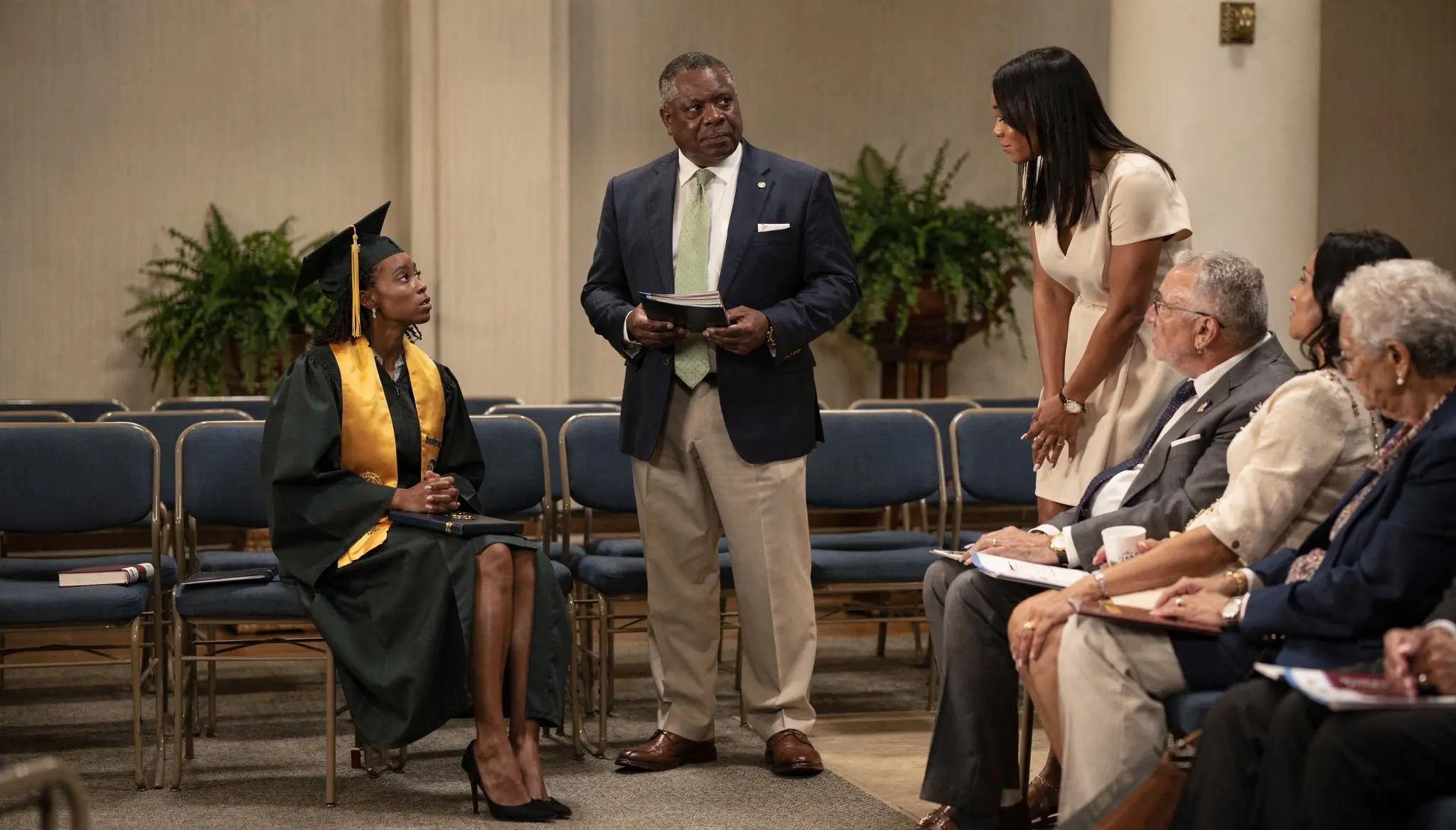
People moved through the reception hall in a kind of rehearsed elegance. Well-dressed parents with crisp suits and flowing dresses. Professors in robes. Proud grandparents clutching programs like prized certificates. Voices echoed in tidy, controlled laughter. It was the kind of moment meant for celebration.
It was a neat closing paragraph to years of effort. And in the center of it all stood Amelia Cole, diploma in hand, her cap slightly tilted, the gold tassel catching the light just enough to make her seem taller than she felt. She kept her spine straight as she walked, the click of her low black heels steady and measured. Beside her walked Benjamin Cole, the man who had raised her since she was 10. He wore a navy blue blazer that had seen better years, khaki slacks pressed carefully that morning and a pale green tie that Amelia had helped him adjust before they left the hotel.
It still sat a little crooked at the collar, but he hadn't noticed, or maybe he had, and simply chose not to fix it. His shoes, though clean, were worn at the toes. Soft, flattened leather that had spent more time working than walking carpets like these. Benjamin was a man who occupied space without demanding it. He walked with quiet dignity, not as someone who expected to belong here, but as someone who refused to shrink from it.
As Amelia made her way across the reception area, her eyes moved ahead, but she could feel it before she saw it. That slight change in the air, the subtle pause in conversation, the shift of eyes, her mother's side of the family, the Griffiths, stood in a loose circle near the refreshment table. Each person perfectly composed like part of a living portrait. Pearls, tailored jackets, polished shoes, and expressions that suggested patience more than joy.
They were waiting not for Amelia, but to be seen waiting. As Amelia approached, a whisper traveled just fast enough to reach her ears, but soft enough to pretend it wasn't meant to. Is that the electrician she brought? The voice belonged to someone she barely remembered, a cousin of her mother's. Maybe the tone wasn't sharp, but it didn't need to be.
A half laugh followed, muffled by a sip of sparkling water. I thought her mom left him years ago. I heard he's just her stepfather. Married in. Doesn't really count, does it? The words landed quietly but firmly like pebbles tossed into shallow water.
They didn't make a splash, but Amelia felt each one ripple through her ribs. She didn't stop walking. Her eyes stayed forward, but she felt her grip tighten slightly on the program in her hand. She didn't turn to see if Benjamin had heard. She already knew he had.
She could feel the shift in his breathing, subtle as it was. She could sense the way his eyes dropped to the floor just for a second before rising again as if nothing had touched him. That was his way. Always had been.
Take the hit. Keep walking. Benjamin's hands stayed tucked neatly in his pockets. He gave a polite smile to a professor walking by, nodding once with the kind of quiet grace that made it clear he understood where he stood in this room and it wasn't center stage.
He didn't push back. He didn't shrink either. But Amelia saw what others didn't. She saw the way his jaw tensed, not visibly, just barely. The way his fingers moved slightly in his pocket like they were holding on to something he couldn't drop.
She stepped a little closer, enough that her elbow brushed his. Her voice stayed quiet, her eyes forward. "You okay?" she asked, barely louder than a breath. Benjamin glanced sideways, his lips lifting just slightly. "You're the one in heels," he said, his voice low and steady.
She smiled without meaning to. He always did that. Always knew when to say just enough to cut the tension in half, but not make it disappear. That was the thing about Benjamin. He never tried to pretend things didn't hurt.
He just didn't let the pain take the lead. As they approached the drinks table, one of the staff, young college-aged, white shirt and black apron, stepped around Benjamin with a tray, barely pausing to acknowledge him. The student looked past him toward a woman in a floral wrap dress who smiled politely and took a glass of cider. Amelia noticed the small shift: the student had offered drinks to everyone in the Griffiths' cluster but skipped Benjamin like he wasn't part of the party. Benjamin didn't flinch. He never did.
They stood together in silence for a moment. The room buzzed around them. Cameras clicked in rhythmic bursts. Laughter rose and fell like background music. The Griffiths kept their distance, though Amelia noticed a few of them glancing in her direction, lips pressed in quiet disapproval, eyes darting to Benjamin and then away again.
Her aunt Alva, always the most refined voice of judgment, looked directly at Amelia as if waiting for her to explain herself. When Amelia offered nothing, Alva turned to Sapphire, her daughter, and whispered something that earned a light, controlled laugh. Amelia exhaled slowly. The kind of breath you take when you know this will not be the last thing said, just the latest in a line of small, sharp wounds that no one ever bothers to call cuts. The photographer hired by the university passed nearby and stopped a few feet from Amelia.
"Graduate and family?" he asked politely, motioning toward the polished backdrop set near the front of the hall. Amelia nodded and stepped forward, but Benjamin hesitated. His hands left his pockets for a second, then returned. "You go ahead," he said quietly. Amelia looked up at him.
"Come with me," she said. He glanced toward the Griffiths. They weren't looking at him, not directly, but they were watching all the same. He took a moment, then nodded. They walked toward the camera setup and the photographer adjusted his lens.
"Parents on the left," he said casually, then paused. "Oh, are you her father?" Benjamin looked at Amelia. She looked directly at the photographer. "Yes," she said. There was a beat of silence just long enough for her voice to fill it completely.
The man nodded and raised the camera. "All right. One, two." The flash snapped. Benjamin didn't say anything afterward.
He never did. Not about things like this. But Amelia noticed something in his stance. His shoulders, which had been slightly pulled in since they entered, were just a little straighter now.
As they turned to walk away, Amelia caught a glimpse of her cousin Sapphire whispering to someone behind a paper program. Her eyes rolled with theatrical flair. Her voice just loud enough to carry. "I guess they'll let anyone into these ceremonies now." It wasn't loud. It wasn't direct, but it was enough.
Amelia stopped just for a second. Her back still turned, her eyes focused on nothing. Then she took Benjamin's arm, looped hers through it tightly, and kept walking. Benjamin didn't speak.
Neither did she. But in that simple act, she answered everything. Amelia didn't say anything as they walked away from the photo station.
Her hand remained looped through Benjamin's arm, her steps slow and deliberate. She could feel her breath working hard to stay even, her throat tightening with something she wouldn't call anger. Because anger would have given them too much credit. It wasn't rage. It was something quieter. A dull, familiar ache in her chest, like pressing on a bruise you'd forgotten was still healing.
They moved to a quiet corner of the reception hall where a row of empty chairs stood near the tall windows away from the crowd. Benjamin sat first, cautiously as if unsure the seat was even meant for him. He rested his hands on his knees, fingers laced. Amelia stood beside him for a moment, watching the way the sunlight softened the deep lines in his face, how the light caught on the grays at his temples.
Her mind drifted uninvited to the memory of another quiet moment 12 years ago, almost to the day. Her father had left on a Tuesday that she remembered clearly not because of anything he said, but because of what he didn't. He had packed a single suitcase and told her mother he just needed some time to figure things out. There had been no shouting, no final embrace, just the dull click of the front door closing behind him.
Amelia had stood at the top of the stairs, holding the banister with both hands, not sure if she should go down or pretend she hadn't heard it. She waited for her mother to come looking for her, but no one did. The next morning, Benjamin had been the one to knock gently on her bedroom door. He didn't come in. He didn't call her kiddo or try to tell her things would be okay.
He just said softly, "Breakfast is ready," and waited until he heard her footsteps before he walked away. She remembered entering the kitchen and seeing two bowls of oatmeal on the table, steam curling into the still air. Her mother wasn't there. Benjamin was standing at the counter pouring juice into a glass, his shoulders square, his back to her.
She didn't speak. She didn't sit. He turned around, slowly held out the glass.
"Orange or apple?" he asked. Amelia shrugged, her eyes on the linoleum floor. He nodded. "Both it is, then," he said, placing both glasses on the table and sitting across from her like it was the most ordinary morning in the world.
She didn't eat much. Neither did he. But he stayed there with her silent but present like a pillar in the middle of a room that didn't need words to keep the walls up.
Later that week, it had been Benjamin who picked her up from school. The office secretary had hesitated when she called her name over the intercom. "Your stepfather is here," she'd said. Amelia had paused, her mouth tightening. The word had sounded strange, like it didn't belong to her.
She walked slowly to the front of the school where Benjamin was waiting outside, leaning on an old pickup truck that had a dented front fender and a door that creaked when it opened. He wore his navy-blue work shirt with a stitched name tag, and his hands had grease marks that soap never seemed to fully remove. She heard it before she saw him. Is that your uncle or your Uber driver? A boy in her class laughed, nudging his friend. Another chimed in.
Bet he fixes air conditioners. They weren't loud, but they were loud enough. Amelia had flushed. She remembered that heat in her cheeks, the sting behind her eyes. She had wished more than anything that someone else had come instead. She climbed into the truck quickly, head down, backpack in her lap.
She didn't look at him, not once. Benjamin didn't ask her about it. He didn't say he understood. He didn't make a joke to lighten the moment. He just reached into the drink tray and handed her a small paper cup. It was warm.
She looked at it. "Hot chocolate," he said quietly. "Figured it might be that kind of day." She took it, still staring at the floor. He started the engine. The truck growled to life.
As they pulled out of the school parking lot, she took a sip. It was too hot. It burned a little. She drank anyway. That night, she found a note in her backpack. It was written in his handwriting, a little crooked, like he'd been trying to keep it neat.
If you don't want me to pick you up again, I understand. Just let me know. I'll still make you hot chocolate when you get home. She never brought it up, never answered the note. But the next day, she waited for him outside the school.
That had been the start. Over the months, he began helping her with science-fair projects, even though he said circuits gave him a headache. He spent an entire weekend turning the living room into a disaster zone of cardboard and wires, reading every instruction like it was a sacred text. She got third place. He cheered like she'd won the state championship.
He fixed her nightlight after it shorted out. She hadn't asked. He sat through her violin recital even though she hit so many wrong notes. The conductor winced.
He clapped like she was performing at Carnegie Hall. And every time her mother forgot a school meeting or missed a dentist appointment or spent another evening on the phone in the kitchen with the door closed, Benjamin never said a word. He just filled in the gaps one after another like it was part of some invisible contract only he had signed.
Amelia blinked, pulled herself out of the memory. She was still sitting beside him, back in the bright, echoing reception hall of her graduation. Benjamin had shifted slightly in his seat. He looked out the tall windows as if trying not to disturb the moment. His hands rested calmly on his lap, his tie still just a bit off center.
You thinking about something? He asked, not turning his head. She hesitated. Yeah, she said. Anything good?
She nodded. Yeah, some of it. He smiled faintly. The kind of smile that didn't press for more.
She reached over and adjusted his tie. He let her. It's still crooked, she said. He looked down, chuckled.
Some things just don't want to be fixed. She tilted her head. I don't know.
"I think they just need a second try." His eyes met hers. He didn't reply, but in that look, she saw it again. That same quiet patience, that same presence that had gotten her through everything without asking for credit or attention or even thanks. She took a deep breath and leaned back in her chair.
Behind them, the room buzzed on. Laughter floated in from the other side. Camera flashes blinked like fireflies, and the Griffiths, still across the room, still watching, hadn't moved. But Amelia didn't care.
Not now. Because while everyone else saw a man in an old blazer and scuff shoes, she knew better. She always had.
He was the one who stayed. Amelia's phone vibrated softly in her purse. She reached for it without thinking her fingers brushing past the folded program and the lip balm she had nervously reapplied three times already. The screen lit up with a single name: Mom. But it wasn't a missed call, just a silent notification. No new messages.
She stared at it for a moment. The kind of moment that stretches out longer than it deserves. Then she turned the phone face down on the table between them. Benjamin didn't ask. She could feel him there beside her, still calm, his legs slightly apart, his elbows resting on his knees in a relaxed but alert posture. The kind of stance that always made her think of him waiting outside parent-teacher meetings or leaning against the wall during school plays.
She knew he had seen her check. He had seen the name, the lack of message, the silence that followed, but he didn't say anything, and that was somehow worse than if he had. Amelia picked the phone up again and stood. "I need some air," she said, her voice, flat, but not angry. Benjamin nodded once, didn't move to follow her, just said, "I'll be right here." She stepped out into the hallway.
The air outside the reception room was cooler, quieter. The hallway was wide lined with tall windows and framed certificates of academic excellence from past years. Her heels tapped softly against the floor as she moved to a small bench near the corner. She sat down and stared at the wall for a long second before unlocking her phone and dialing the number she knew by heart. It rang twice before Rosalyn answered.
"Amelia." Her mother's voice was brisk but not unfriendly. "I was just thinking of you. How's the ceremony?"
Amelia hesitated. "Still going."
"Oh," Rosalyn replied. "I hope everything went smoothly. I heard the chancellor can be terribly long-winded."
Amelia let the pause hang. "You didn't call."
"I assumed you'd be busy. I didn't want to interrupt."
"You didn't come."
Rosalyn's voice shifted slightly, the edge softening. "I told you, sweetie. I wasn't feeling well. Flying out just didn't make sense right now. I've had that sinus thing again, and with the pressure change—"
"Is it because of him?" Amelia interrupted.
Another pause followed, longer this time. "Amelia," Rosalyn said, her tone slower now, almost careful, "this is not the time to revisit things that have already been settled."
"It's not settled for me."
Rosalyn exhaled. Amelia could hear it, that long, disappointed kind of breath someone gives when they are too tired to argue but too proud to concede. "I know you're close with him," she said finally. "But that chapter of my life—"
"He raised me."
"I know."
"Do you?"
Rosalyn did not answer right away. Her silence was not cold, but rehearsed, the kind developed over years of choosing what not to confront. "I'm happy for you," she said. "For your graduation. That's what today is about."
Amelia closed her eyes. "Okay."
"I'll send something later this week," Rosalyn added. "A card. Maybe something for the apartment."
"Thanks."
They ended the call with a clipped goodbye. Not warm, not cruel, just finished. Amelia sat there for another minute, the phone resting in her lap, the buzz of the overhead lights faint in the background. When she returned to the hall, Benjamin was still there, just as he said he would be seated in the same chair, hands folded loosely. He glanced at her, but didn't ask anything. She sat beside him.
Her posture straightened automatically, but her hands were tight in her lap. Benjamin looked forward, not at her, and for a moment he let the quiet hang there. He had never liked filling silences just to keep people comfortable. He didn't need to ask to know the call hadn't gone well. He remembered Rosalyn the way you remember a place you once stayed when the world felt unstable.
Not because it had been home, but because it had walls and a roof, and for a while that had been enough. He had never resented her. Not truly. He had loved her. Or at least he had tried to. She was beautiful in the kind of way people noticed: perfect posture, a polished smile, the kind of woman who walked into a room and made people check their posture.
When she had asked him to dinner the first time, he thought it was a mistake. He had double-checked the message twice, but she had looked at him with those sharp eyes and said, "I know what I'm doing." And maybe she did. Maybe at the time she was tired of always being around men who only knew how to pretend.
Benjamin never pretended. He was real, solid, and predictable in the ways that mattered. He never made promises he couldn't keep. He showed up.
That had been enough for a while, but slowly over time, he watched her pull away. Not in one dramatic gesture, but in small ways. Dinners skipped, conversations shortened, invitations to family events that somehow never included him. She never said he didn't belong, but she didn't fight to make him feel like he did either. He remembered the last few months before she left.
How she would look past him at breakfast. How she stopped touching his shoulder when she passed behind his chair. How she didn't correct anyone when they assumed Amelia was staying with her father. She didn't lie, but she didn't tell the truth either. When she left, she said she needed space. He didn't argue.
He just asked what Amelia needed. Rosalyn said she didn't know. Then she left them both. He had raised Amelia without ever trying to replace her father. He just stepped in where things broke and tried to make sure nothing else cracked under her feet.
And now watching her sitting beside him, older, stronger, wearing that same stubborn set in her jaw that she had even as a child, he felt something between pride and grief. Pride for who she had become. Grief that she still had to carry that weight. "You want to talk about it?" he asked.
She shook her head. He nodded. "Okay."
She turned and really looked at him. "Do you ever think about her?"
He did not answer right away. When he did, his voice was low. "Sometimes. Not as much as I used to."
"Do you hate her?"
"No."
Amelia looked down at her hands. "I think I do. A little."
"That's your right," Benjamin said. "But don't let it take more from you than she already has."
Amelia said nothing for a long moment. Then she leaned back in her chair, letting her shoulders relax. "She said she'd send a card," she muttered.
Benjamin smiled faintly. "That's something."
"It's not."
"No," he agreed. "It's not."
They sat in silence again, but this time it didn't feel empty. It felt like a pause between breaths, a necessary space. From across the room, Alva Griffiths caught Amelia's eye, her expression unreadable, a cocktail glass perfectly still in her hand. She turned away a moment later, whispering something to a man in a blazer who nodded too politely. Amelia didn't look away. She didn't smile.
She simply took a breath and turned back to Benjamin. "You ever regret it?" she asked. He tilted his head slightly. "What? Staying?"
He thought for a moment, then looked her in the eye. "Never." She nodded. And for the first time that day, the knot in her chest loosened.
Not gone, but no longer choking her. The ceremony would continue soon. There would be more names, more applause, more speeches. But for now, in that quiet pocket of the reception hall, there was something more important than celebration. There was clarity, and there was truth.
The light inside the auditorium had shifted. The late afternoon glow had faded into a cooler, dusk-toned hue, casting longer shadows against the rows of seats filling up fast. Ushers moved through the aisles, holding programs in neat stacks, calling out assigned sections with practiced cheer. Families gathered around their graduates, posing for photos, straightening ties, adjusting gowns, and whispering final words of encouragement. Everything buzzed with expectation.
And yet, in the middle of it all, Amelia felt something start to slide sideways. Benjamin stood beside her near the entrance of the main hall. He looked down at the folded ticket in his hand, the one she had printed for him a week ago. The same ticket that now apparently wasn't quite enough. A young woman in a navy staff blazer stood between them and the row of family seats, a clipboard pressed to her chest.
She gave Amelia an apologetic smile that did not quite reach her eyes. "I'm sorry," the woman said, tapping her list. "His name isn't on the confirmed seating chart. Only registered guests are assigned seats in the front section."
Amelia felt her jaw tighten. "I submitted the form. He's on my list. He's my guest."
The woman nodded as if she had heard the same line from ten others already. "I understand, but I have to follow the list I was given."
Benjamin stepped in, his voice even and calm. "It's all right. I can stand."
Amelia turned to him. "No, you shouldn't have to."
"I'm fine," he repeated. He gave the staff member a small nod and a half smile that asked nothing of her. Then he stepped away from the rows of neatly arranged white chairs with their paper name tags and gold-ribbon programs.
He found a space near the back wall beside a potted fern and stood with his hands loosely clasped in front of him. Amelia watched him for a long second, her stomach twisted. The room looked beautiful. It was designed to. White roses lined the aisle.
Light piano music drifted from a speaker tucked in the corner. A student from the music department adjusted her sheet music on stage, but there was something sharp about the beauty today, something that scratched against the edges of fairness. She moved toward her seat slowly. Her name was printed on a small card in elegant script placed at the front row, reserved for top honor students. Just behind her, the Griffith family had already arranged themselves like pieces in a posed photograph.
Alva sat with a flute of sparkling water, her posture rigid. Sapphire scrolled through her phone legs, crossed precisely as if every movement were for an audience. As Amelia lowered herself into her seat, she heard it not loud, but close enough. "He knows his place, at least," Sapphire whispered to Alva.
Alva didn't respond with words, just a slow, tight nod. Amelia didn't turn around. Her eyes stayed forward, but her fingers pressed hard against her knees, her nails biting into the fabric of her dress. She wanted to say something. She always did, but the moment never seemed to invite it.
The seat beside hers remained empty. Out of the corner of her eye, she could still see Benjamin standing alone. He wasn't looking at her. He looked ahead, focused on the stage on the podium where the chancellor would soon speak. His expression was quiet, unreadable to anyone who didn't know him. But Amelia did.
She knew that stance. She knew that stillness. She had seen it at violin recital, at science fairs, at parent teacher nights, when he had sat quietly in a room of strangers, never fully acknowledged, never addressed directly. He was used to being the shadow at the edge of the frame. But just because he'd learned to live with it, didn't mean it didn't cost something.
She thought of all the times he had shown up, not just physically, but emotionally, mentally, wholly, when no one else had. When her mother had chosen distance over presence, when others had turned affection into performance, Benjamin had stood where no one else had wanted to stand. And yet now, in the most public, most symbolic moment of her academic life, he was once again placed in the back. Not by his own doing, but by a system that never planned for someone like him.
A few minutes later, as the room quieted and the chancellor took the stage, Amelia glanced back once more. She saw Benjamin straightened slightly, his shoulders lifting. He gave a polite nod to someone passing by who didn't return it. He adjusted his tie, still a bit crooked, and kept his eyes on the front. She turned back around and felt something solid settle in her chest.
Not anger, not yet, but a quiet resolve, the kind that doesn't rise in your throat, but anchors itself in your spine. She folded her hands together and looked toward the podium. They could keep him at the back of the room, but she knew exactly who had stood at the center of her life. The auditorium had settled into a steady hum. The main doors were closed now, and the air had shifted into that familiar mix of reverence and mild restlessness that precedes official ceremonies.
Benjamin remained near the pillar by the sidewall, a fixed point amid the movement around him. No one asked him to move. No one asked if he needed a seat, but no one looked entirely comfortable standing near him either. He held his program loosely at his side, his posture relaxed, but not passive. From where he stood, he had a clear view of the stage of Amelia sitting upright in her row, her eyes scanning the crowd, occasionally pausing on him each time just for a moment.
He did not return the glance every time, but when he did, he smiled, a small one, the kind that said he saw her, and that was enough. Professor Michael Howard was not part of the ceremony that day. His name wasn't listed on the speaker schedule or printed in the program, but he had shown up anyway, wearing a blazer over his corduroy shirt, holding a single envelope in his inner pocket. He'd been teaching at Belgrave for over 20 years, and during that time, he had seen dozens of graduations, heard hundreds of speeches, but something about this one had kept him from skipping it.
Maybe it was a conversation he remembered from a hallway 6 years ago when Amelia had nervously pitched her thesis idea after class and he'd seen a man Benjamin waiting quietly outside the building, arms crossed, not pacing, not checking his watch, just waiting with a patience you did not often see anymore. Howard spotted him now and walked over. He didn't hesitate, didn't scan for approval. He simply approached, extended his hand, and said in a low voice, "I'm glad you came."
Benjamin looked up, surprised but calm, and shook his hand. "Thank you. Nice to see you again."
Howard smiled. "You were always there, weren't you? Back of the room at volunteer nights, helping with student tutoring. I remember seeing you fix the heater in the lounge one winter. No one ever said thank you, but I saw it."
Benjamin did not shift. He nodded once. "It needed fixing."
Howard chuckled. "Funny thing about places like this. We're good at naming buildings after donors, but not so good at remembering who kept the lights on."
Benjamin offered a small nod, though his expression did not change. Howard hesitated, then added, "I hope today changes that. I hope people see what I've seen."
"That's not why I came," Benjamin said.
"I know," Howard replied, his voice softening. "That's why it matters."
The conversation ended without fanfare. Howard gave a respectful nod and returned to his seat near the faculty section. Benjamin remained standing. A few minutes later, a security officer, one of the campus veterans who had been working these events for years, made his usual slow walk through the side aisles. He recognized Benjamin immediately paused, nodded.
"Didn't expect to see you again," the officer said under his breath.
Benjamin smiled faintly. "Didn't expect to be here."
"Still walking in and out like a ghost," the officer said. "You know, my cousin still talks about that night class you used to help with. Said he would have failed statistics if not for you."
Benjamin gave a light shrug. "He did the work."
The officer laughed once and patted him on the arm. "Some of us noticed, even if we didn't say it."
Benjamin nodded in thanks. The officer moved on.
Not far from them, near the back entrance, the director of the university's outreach scholarship program sat flipping through her notes. She was reviewing a speech she might have to give depending on timing. When she looked up, her eyes caught Benjamin's silhouette against the light from the windows. For a brief second, her expression changed. Recognition, then understanding. She didn't stand, didn't wave, but she gave a single slow nod.
And though no one else saw it, Benjamin did, and that was enough. Amelia, still seated near the center aisle, caught fragments of all of this in the periphery. The handshake, the officer's pause, the small nod. She didn't speak, but she felt the knot in her chest loosen slightly. For years, she had watched him move through spaces like this, respected by those who knew better, ignored by those who didn't want to know.
Now, just for a moment, there was acknowledgement. Not loud, not dramatic, but real. Still, for every person who saw, there were 10 who didn't. A woman in a navy blue suit brushed past Benjamin and clutched her purse a little tighter. A young man in a pinstriped jacket moved to stand on the other side of the pillar instead.
A group of parents glanced over, saw him, then looked quickly away. The room hadn't changed. Not really, but a few people inside it had, and that was something. Benjamin remained where he was, silent and still. Not invisible, just unclaimed.
The auditorium had not changed, but the energy inside it had. The lights dimmed further as the chancellor stepped up to the podium, her voice amplified just enough to reach every corner of the room without overwhelming it. The formal opening remarks began, welcoming families, recognizing faculty, thanking donors, the usual rhythm of academic celebration. But something in the air was shifting and those who were paying attention could feel it before they could name it.
The speeches moved forward with practiced elegance, and the graduates sat straight, programs folded neatly in their laps. Near the sidewall, Benjamin remained still, the program held lightly in both hands, now edges curled slightly from the pressure of his thumbs. He was listening, but not leaning in. He was present, but not part of the frame.
Then the student speaker was introduced, a tall young woman with a confident gait, a calm presence, and a voice trained for clarity. Her name was Clara Mendoza. Amelia had seen her around campus but never spoken to her. Clara was known for her resilience, her volunteer work, her thoughtful writing. She reached the podium and took a slow breath before speaking. The room stilled.
"I want to thank this institution," she began, "for giving people like me a place to grow, to be challenged, and to matter. But before I speak about today, I want to tell you a story that has been with me for almost ten years, a story I have never shared in public until now."
There was a pause, not dramatic but intentional, the kind that drew people in without forcing them. Benjamin shifted slightly. Amelia noticed.
Clara continued. "When I was fourteen, I was riding the subway home with my brother. We were on the lower platform of the Seventh Street station. It was cold, and I remember arguing with him over who would carry the backpack. Then everything went black."
A rustle moved through the room, not of discomfort but attention. Clara's tone stayed steady. "There was a sound I can't describe, like metal screaming. Then smoke. Then panic."
"People started running. Some were hurt. Some were trapped. I couldn't breathe.
I couldn't see. I remember reaching out and feeling nothing but the floor. I thought I was going to die there."
In the side aisle, Benjamin's fingers curled slightly around the folded edges of his program. His shoulders rose once and settled. He did not blink.
"But then," Clara said, her voice tightening, "two hands grabbed me. Firm, steady hands. They didn't shake. They didn't rush. They pulled me up and dragged me away from the fire."
"I remember coughing so hard I couldn't speak. I didn't see his face, but I remember his jacket. It was too big, and it smelled faintly of engine grease and old fabric softener. He wore work boots scuffed at the toes.
One lace was held together with electrical tape. His hands were dark and strong, like the hands of someone who worked with tools every day. He held me as if I were glass while the world was falling apart."
Gasps echoed softly from scattered rows. A few audience members exchanged glances. One whispered, "That was the Subway Samaritan story."
Clara nodded as if she had heard. "I never found out who he was. The news ran stories for weeks looking for him, but he never came forward. No interviews, no credit, just silence. I carried that story with me."
"I carry it still. And today, as I stand here, I want to say thank you, even if he never hears it. Thank you for saving my life." A long pause followed her final words, the kind that sits in the air like a held breath.
The chancellor stepped forward and thanked Clara for her powerful message. Applause followed, measured, respectful, slightly delayed as people absorbed what they'd heard. Amelia was not clapping.
She was watching Benjamin. He had not moved. His hands were still, but his jaw was set. His eyes were not blinking as often, and there was a tension in his posture. She had seen before once when she was 16, and had come home crying after a teacher assumed she had cheated on her exam because her last name didn't match her GPA.
She turned toward him more fully now, her breath slowing. She had never heard the story before, but something about the details, the timing, the way Clara described those hands, it wasn't evidence, it was instinct. It was the way you know your house by sound in the dark. She looked at him for confirmation. He didn't look back.
Near the back of the hall, someone else whispered, "Didn't he pull out like eight people I remember?" They said he vanished before anyone could talk to him. Another voice chimed in. They said he used his shirt to stop someone's bleeding. Didn't even leave a name. Benjamin stood in profile, his eyes on the stage, but his grip on the program had deepened.
The crease now ran sharp along the centerfold. His feet were planted shoulder-width apart, still calm, still silent. But Amelia saw everything, the restraint, the memory flickering just behind his eyes. The emotion pushed deep where it couldn't interrupt the moment. He didn't need to say a word, and she didn't need to ask.
Back on stage, Clara had taken her seat again, and the ceremony resumed. Names were called. Degrees announced. The air slowly reset itself as if pretending it hadn't just touched something sacred.
But Amelia couldn't go back to the program. Not yet. Her mind replayed Clara's words. Her heart pounded louder than the applause.
And for the first time since this morning, she realized she might not know everything about the man who raised her. Benjamin remained by the wall. The room moved on. But the story had already been planted, and the story was not done. The program resumed with a steady rhythm.
Names continued to be read. Graduates filed across the stage. Handshakes were exchanged, smiles posed for cameras. Parents clapped, some standing awkwardly for quick pictures, others dabbing at proud tears. The ceremony was moving forward the way such ceremonies always do, predictably with reverence and formality. But for Amelia, everything had changed.
The words Clara Mendoza had spoken still echoed in her chest, tightening around her ribs. She kept glancing toward Benjamin, who stood just where he had before. Back straight and shoulders relaxed, his grip on the program had not loosened. There was something brewing under that stillness, now something unspoken and heavy. Then the chancellor returned to the podium.
She adjusted the microphone slowly and paused, letting the silence settle across the room. She did not open the program again. Instead, she looked out across the audience and smiled gently. It was warm and measured, the kind of smile that told everyone something unscripted was coming. "Before we close today's celebration," she began, her voice carrying clearly without being loud, "we have one final recognition."
Amelia sat up straighter. So did several faculty members. Even a few parents paused mid-conversation.
"This award is not printed in your program," the chancellor continued. "It is a special commendation reserved for rare individuals who embody integrity, selflessness, and an enduring impact on our community."
The room hushed. Chairs stopped shifting. A few people leaned forward, sensing a moment.
"For months, we worked quietly to confirm the details. For years, many of us knew only pieces of a larger story. But what we have learned is that some heroes do not step into the spotlight. They require us to bring the light to them."
A quiet ripple of curiosity passed through the room.
"More than a decade ago, during a tragic incident at the Seventh Street subway station, one man, without formal training or protective equipment, rushed into danger while others fled. He pulled victims from wreckage, performed first aid using nothing but his shirt and his hands, and disappeared before authorities arrived. He gave no name, claimed no recognition, and quietly walked away."
Murmurs began. A few people whispered, "Is this about the Subway Samaritan?"
"Since then," the chancellor said, her voice warming, "that story has lived in fragments. Recently, through our alumni outreach program and a series of scholarship endowments traced to anonymous donors, we found a name."
Amelia's pulse quickened, and her hand tightened around the armrest.
"We also found students and graduates, many in this room, who were mentored, guided, and supported by this same man. A man who showed up not for praise or position, but because someone needed him. He never asked for a seat at the table. He often did not receive one."
"He did not wear the clothes that attract notice. He carried no title. But his presence changed lives. One of those lives belongs to a graduate sitting here today, and countless others have been shaped by his quiet strength."
Amelia could barely breathe, her heartbeat so hard it seemed to echo off the walls.
"Ladies and gentlemen," the chancellor said, looking toward the back of the auditorium, where he still stood, "please join me in honoring Mr. Benjamin Cole."
The name dropped into the room like a stone into water. For a second everything was still, then slowly a few heads turned.
A few gasps were barely audible. Then silence again. Amelia was the first to rise. Her hands came together, applause ringing out with precision.
Then others followed. Row by row, chairs shifted as people stood. Hands met hands. Applause swelled like a wave expanding through the room.
Not chaotic, but full, deep, respectful, meaningful. Benjamin didn't move at first. His eyes widened just slightly. He looked at the chancellor, then at Amelia. The noise around him grew, but he stood frozen as if trying to understand if this was truly meant for him.
From the front, Amelia nodded once, firm and steady, her eyes glassy with pride, and slowly Benjamin took a step forward. He walked down the aisle, not with swagger, not with self-consciousness, but with quiet clarity. His shoes tapped against the floor, soft but deliberate. The applause did not fade. If anything, it grew louder, richer, as people saw what they had missed before.
The man they had mistaken for a janitor or a driver was walking toward the stage. The Griffith family remained seated. Alva's mouth was slightly open. Sapphire had her eyes fixed on her program, now crumpled in her grip. Rosalyn, watching remotely from home, leaned closer to her screen, frozen.
Benjamin reached the steps. A faculty member extended a hand to help him up. He nodded politely, but climbed unassisted. His movements were precise, cautious, but strong. The chancellor stepped aside and gestured toward the microphone.
Benjamin stood before it, blinking once. The applause still filled the room. He waited, not asking for silence, but letting it settle on its own, and slowly the room quieted. The claps faded.
Phones stopped recording. Even the air seemed to pause. He cleared his throat.
"I wasn't expecting this," he said, his voice calm, worn, but firm. "I came here today just to see my daughter graduate."
He glanced toward Amelia. Her eyes met his.
"I'm not good with speeches, but I'll say this. I didn't do what I did that day for a plaque. I didn't run into that subway for a thank-you. I saw people who needed help, and I was close. That's it."
A long breath moved across the crowd.
"I don't have a fancy degree. I didn't finish school myself, but I believe in showing up. Not once. Not only when it is convenient."
"Always. Every time. That is what someone did for me, and that is what I have tried to do for others."
He looked down for a second, then back at the crowd. "You don't need a title to be someone's reason to keep going. Sometimes you just need to stay."
He stepped back. The chancellor placed the engraved plaque into his hands. He looked at it not as if he doubted it, but as if he was unsure how to hold something like that. Then the applause returned, and this time it was thunder.
Benjamin stood there, the plaque heavy in his hand, the microphone standing before him like a question, waiting for an answer. His shoulders lifted with a slow breath and then lowered again as if the weight of everything—the moment, the room, the memories—was being adjusted and rebalanced inside him. The applause had finally settled into a quiet reverence, not silence, but something softer, something that asked not for more noise, but for meaning. He looked up, eyes scanning the crowd briefly, not seeking approval, not even understanding, just taking in the fact that they were looking, that they were listening, that for the first time in a long time, they weren't looking past him.
"I'm not used to this," he began, his voice low but clear. "I don't speak in front of crowds. I wasn't raised to talk much about myself. I was raised to work, to show up, and to stay quiet unless something truly needed saying."
He paused, his fingers grazing the edge of the plaque, his eyes flicking toward Amelia.
"I came here today to see my daughter graduate. That was it. I wasn't expecting anything like this."
The words "my daughter" landed with intention. There was no caveat and no "step," only truth.
"I know some of you probably looked at me earlier today and didn't think much. I understand. I'm not wearing anything fancy. My suit is a little loose."
"My shoes are old. I know how people see me. I've seen it all my life. I've heard the whispers."
A few people in the audience shifted, visibly uncomfortable. He did not soften.
"But that's not why I'm standing here. I'm standing here because someone decided to look deeper. Someone remembered. Someone saw what most people never bothered to ask about."
He adjusted the microphone slightly. "The day of that subway explosion, I didn't think. I heard the blast. I saw the smoke."
"People were running and screaming, and I moved. I didn't stop to wonder who they were or what might happen to me. I saw someone's child trapped under concrete and thought, If I don't help, who will?"
The auditorium was still.
"I left after the paramedics arrived because I didn't want attention. I figured the people who needed help had received it, and that was enough. But afterward, I couldn't forget. I would see their faces in my sleep. I knew I had to do something more."
"So whenever I could, I gave back quietly and anonymously. I helped fund some of the programs at this school, programs that gave people like me a chance. Not because I had money to spare. I didn't. I did it because I remembered what it felt like to need help and have no one show up."
He swallowed, gripping the edge of the lectern for a moment.
"And then there is Amelia. She was ten when her father left. He simply left, with one bag and a lie about needing time. I remember her face that day."
"She didn't cry, not then. She sat on the couch, small, angry, and quiet, waiting for someone to come back. Her mother had her own way of dealing with it, but I knew what I had to do."
He looked straight ahead.
"I didn't try to replace her father. I didn't try to become the man he should have been. I stayed. I made breakfast. I drove her to school."
"I helped with science-fair projects, even though I never finished high school myself. I read books with her slowly, even when I stumbled over the words. I sat through her violin recital, and I clapped, even when she hit the wrong notes. I showed up."
His voice remained steady.
"Over the years, she let me in. Not always with words, but in the way she started calling me Dad without thinking about it. In the way she left notes when I worked late or saved me a piece of cake after school events. In the way she reached for my hand at gatherings like this, not because she was embarrassed, but because she didn't want me to feel alone."
He looked at her again. "She is not my blood, but she is my heart. I wasn't born her father. I became one by choice, by time, and by presence."
Amelia's hands were clenched tightly in her lap, her eyes fixed on him, her breathing shallow but steady.
"I don't need this plaque to know what I've done or to feel proud of who she has become. But perhaps it's good that someone said it aloud. Perhaps it's good for the people who never asked and never saw. Perhaps it's time they did."
He paused one final time. "I never thought people noticed, but I guess they do." With that, Benjamin stepped back. He did not bow. He did not smile broadly.
He simply nodded once and stepped away from the microphone. As the applause built again, this time not in a wave, but in a storm. A standing ovation followed louder, more unified than before. People who had been silent earlier now stood, clapped with both hands, some with tears running down their cheeks. Professors, staff, students, strangers.
The ones who had once looked through him now stood for him. And Amelia standing too felt her chest lift with a pride so immense it left her breathless. Behind her, Alva Griffiths sat motionless, her hands folded tightly in her lap. Sapphire glanced down, eyes red. And somewhere far from the room, Rosalyn Griffiths watched from her screen, not moving her face, unreadable lips pressed thin, but her eyes glistened.
Benjamin left the stage with the same slow walk he'd entered. But this time, every step landed differently. Every step echoed with the sound of acknowledgement, of truth heard, of years unseen now visible. And he did not walk alone. As he stepped down from the stage and walked slowly back toward the edge of the hall, Amelia stepped into the aisle and met him halfway. She didn't speak.
She didn't need to. Her arms wrapped around him in a tight, quiet hug, and they stood there in the aisle, father and daughter, not by law, but by everything that ever mattered more. The applause still echoed in some corners of the hall, but near the reserved family section, a different kind of silence had settled thick, awkward, and inescapable. Alva Griffiths, once so poised in her posture and sharp in her observations, sat motionless.
Her hands, which had earlier clutched a flute of sparkling cider with aristocratic indifference, now rested quietly in her lap. She didn't look at Amelia. She didn't look at Benjamin. Her gaze was fixed somewhere between the floor tiles and her own shoes, as if unwilling to face the reality she'd spent years sneering at. Sapphire, seated beside her, shifted uncomfortably.
The same girl who had whispered about Benjamin's shoes now seemed much smaller in her chair. Her polished expression dulled into something more human: uncertainty. Her brows were furrowed. Her lips parted slightly. Then she leaned toward her father and whispered, "Why didn't we ever hear about him before?" Her father, a man usually eager to lecture or assert, merely sighed through his nose and stared forward.
He had no answer, none that would sound right anymore. From behind their row, a woman, one of the Griffiths' cousins, who earlier had laughed about Benjamin looking like the maintenance crew, stood up, slowly hesitated, then walked around the side of the aisle. Her heels tapped softly against the floor. Her face was taut, her eyes darting between Benjamin and the floor as though her own voice might betray her. She finally reached him just as he was preparing to leave the aisle with Amelia.
"Excuse me," she said, barely above a whisper. "I... I didn't know." Benjamin turned his head, his face unreadable but composed.
He studied her for a breath, not judging, not offering warmth either. Just waiting. "You didn't ask," he said simply, his voice even.
She opened her mouth as if to explain, then closed it again. There was nothing more to say. She gave a nod, almost imperceptible, and stepped back into the shadows she came from. Amelia watched this quietly, her arm still linked with Benjamin's. Her heart pounded, not with anger, not even vindication, but something harder to name, something that lived between pain and peace.
She didn't feel triumphant. She felt settled. As they walked down the aisle toward the back of the auditorium, small clusters of guests parted to let them pass. No more laughter, no more glances, just silence and, on some faces, reflection. Professor Howard nodded respectfully again. A janitor near the exit stood a little straighter as if witnessing something sacred.
At the edge of the room, one last voice called softly, "Mr. Cole. Dean Russell had stepped forward from the front row, his expression warm and deliberate. "Please join us. We have arranged a seat for you next to Amelia.
It is where you have always belonged. Benjamin blinked slightly, caught off guard. He glanced at Amelia, who gave a small nod of encouragement, her hand gently squeezing his arm. Without speaking, he turned and followed her back down the aisle, not toward the doors, but toward the front.
This time, people did not merely part. They leaned back, respectfully, eyes no longer glancing, but watching with purpose. Benjamin walked with the same quiet dignity, but now each step seemed to resonate with something heavier than applause: recognition. He took the seat next to Amelia, the one that had been empty all this time. The air shifted slightly around them, not louder, not grander, but fuller.
There was no announcement, no spotlight, just a chair finally filled and a place finally honored. The rest of the family section sat still, unsure of what to say. Alva crossed her arms tightly. Sapphire stared forward, blinking rapidly. None of them moved.
None of them spoke. And that silence, unlike the one before, was not indifference. It was understanding finally arriving late and clumsy, but real. Inside that simple act of sitting down, Benjamin reclaimed what had never been offered, not because someone gave it to him, but because it was already his. It was, and had always been his seat.
The house was quiet. Not the kind of silence that comes with absence, but the kind that arrives after a storm when the wind has settled and the dust has dropped and there's only breath and stillness. Late afternoon sunlight filtered through the sheer curtains, casting long golden stripes across the living room floor. The ceiling fan rotated slowly, the soft whir of its blades barely audible beneath the distant hum of a lawn mower from across the street.
Somewhere in the neighborhood, a dog barked once, then again, the rest was calm. Amelia stood in front of the refrigerator, two framed items in her hands. One was a drawing she had made when she was just a child, third grade, perhaps. The lines were clumsy, colored in uneven strokes of crayon. A tall figure, dark and smiling, stood beside a small house.
On the bottom corner, in crooked handwriting, the words read, "My Hero, Benjamin." The second frame was new. It had only been printed that morning. It was a photo taken while he stood onstage, the spotlight wrapping around him like a quiet crown. The medal around his neck gleamed against his worn blazer. Behind him, a crowd rising to their feet, applause frozen in motion.
His eyes looked outward, shocked, proud, and uncertain. She stared at the old drawing for a long moment, fingers grazing the edge of the frame. The tape had yellowed, the corners curled. It had lived on that fridge door for over a decade through school years and science fairs, heartbreaks and growth. It had been a constant, a symbol, and a secret only they had ever acknowledged.
Quiet truth in a child's scrawl. With care, she stepped to the bookshelf, opened a wooden memory box, and laid the drawing gently inside. It didn't belong in the spotlight anymore, but it deserved reverence. She closed the lid, her breath catching for just a second, then turned back to the fridge. She placed the new photo in the center of the door, straight and level.
She stepped back and looked at it. There was no ceremony, no announcement, just a shift from memory to public truth. Behind her, Benjamin walked into the kitchen, wiping his hands on a dish towel. He paused when he saw the new photo. His eyes stayed on it for a while, then drifted to her.
He didn't smile right away. He just looked. "You didn't have to do that," he said quietly.
"I know," Amelia replied, her voice calm but thick at the edges. "But I wanted the world to see what I've always seen." He nodded.
No argument, no modest protest. He understood. That was enough. In the living room, the couch creaked gently as they sat down together, not touching, not speaking, just sitting side by side in the kind of silence that wasn't empty, but full.
The TV was off. The world outside carried on, indifferent. But something in their home had shifted.
Not in noise or structure, but in gravity, in placement. Benjamin leaned back, arms resting loosely on the couch cushions. He was still wearing the same shirt from earlier, sleeves rolled up to his elbows, now the fabric faintly wrinkled from a long day. His hands, those familiar calloused hands, rested open on his knees. His breathing was even, unhurried.
Amelia glanced at him, noticed the way the light caught the gray at his temples, the way his jaw remained steady even now. There was a time she used to look at him and wonder why he didn't say more. Why he didn't push back when people dismissed him, but now she understood. He never needed noise to prove value. He just needed space.
And now he finally had it. He turned his head slightly, catching her gaze. "You all right? She gave a small nod. "Yeah.
"You?" His smile was soft. "I will be." They didn't speak for a while after that.
They didn't need to. Outside, children's laughter echoed faintly from somewhere down the street. The scent of the half-eaten chocolate cake still lingered in the air, the same kind Benjamin always picked up when there was something worth celebrating, even if it was just making it through a hard week. Amelia rose after a few minutes and walked over to the cake. She cut a slice, then another, carried them back to the coffee table and handed one to him.
He took it with a simple thanks, and they ate in silence, forks tapping lightly against the plates. As they finished, she looked around the room. It wasn't grand. The couch was older. The rug had a small tear on the edge, but every inch of it was home. Every scratch on the coffee table, every picture on the wall, they told the story of a man who didn't build a mansion, but built something stronger, a life that held.
She leaned her head against the back of the couch and closed her eyes for a second. "You know," she said softly, "I used to be angry about it, that people didn't see you, that they thought you were just background." He didn't respond right away. When he did, it was without bitterness.
"People see what they want to see. Some folks need a stage to understand. Others don't look up unless there's a spotlight."
She nodded. "But they looked today."
"Yeah," he said. "Today they did." There was peace in that. Not satisfaction, not revenge, just peace. The sun dipped lower, shadows lengthening across the floor.
The moment didn't try to be profound. It just was. No camera flashes, no speeches, just a girl and her father sitting in a room filled with quiet pride. Nothing more needed to be said because in that space, in that stillness, everything had finally been heard.