The Duke laughed before Lady Verity Fenwick had even brought her horse to a proper halt. It was not a cruel laugh by intention. His Grace, Caspian Vale, Duke of Lockmere, was too disciplined for anything so vulgar as open mockery in front of guests. The sound was brief, low, almost accidental, shaped by surprise rather than malice. Yet, because it came from a duke, it became permission.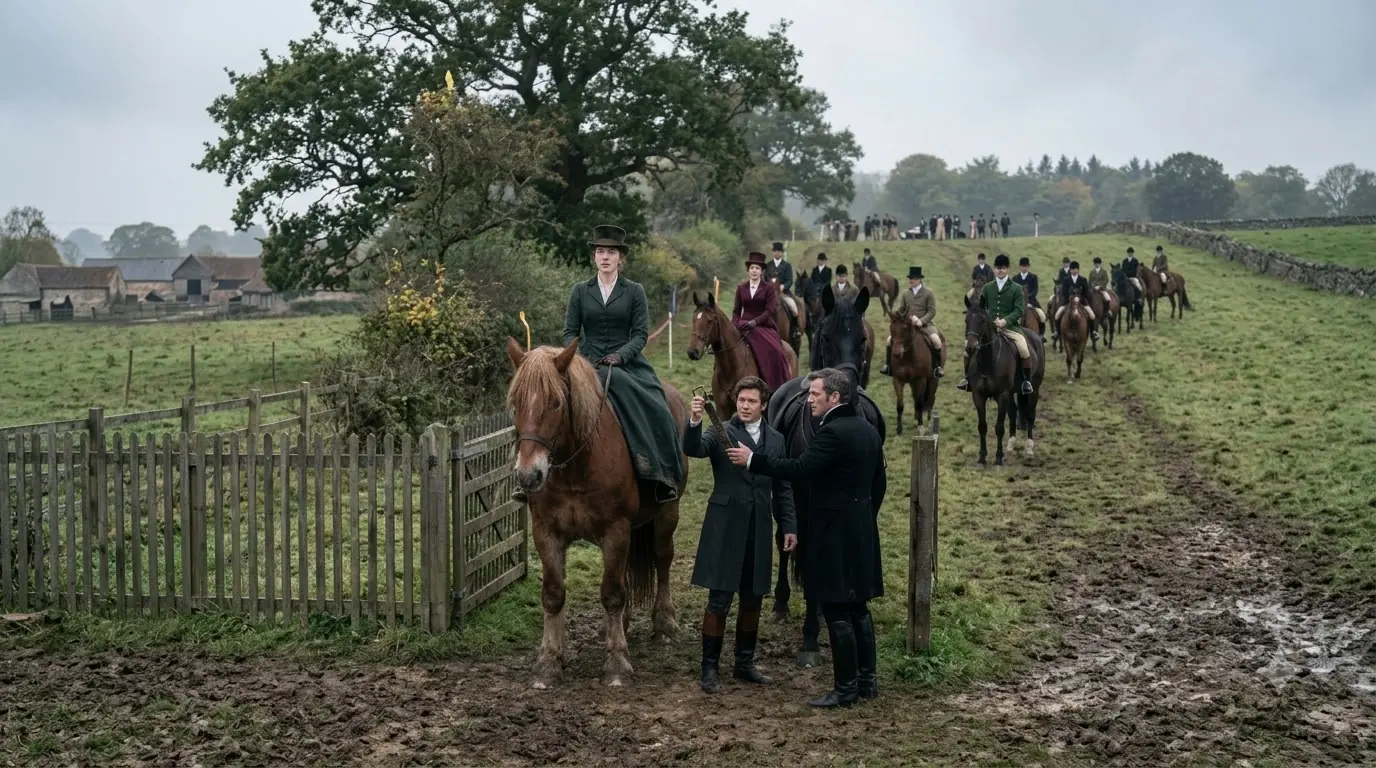
The stable heard it and obeyed. A smile passed from one polished rider to another. A young gentleman covered his mouth too late. Two ladies turned their heads toward each other, shoulders trembling with delicate amusement. Even one groom, who should have known better than to judge any horse before seeing its feet in mud, looked down quickly as if the stones had suddenly become fascinating.
Verity felt the laughter before she heard all of it. It touched the back of her neck, the worn seam of her glove, the faded sleeve of her dark green riding habit, and the old brown horse beneath her who had carried heavier things than shame. Mallow stood square in the center of Lockmere Park's stable yard, broad-backed, rough-coated, and unimpressed by rank. He lowered his large head and nosed at the gravel as if duchesses, daughters, heirs, and hunters were all minor inconveniences placed between him and a mouthful of hay. Hampshire's October morning lay pale and bright around them.
The great house rose beyond the yard, all pale stone, tall windows, and inherited confidence. Carriages waited along the sweep, their wheels flecked with damp road dust. Lockmere's grooms moved among shining hunters with the brisk silence of men trained beneath a powerful household. Every guest horse looked bred for admiration. There were chestnut mares with arched necks, gray geldings with silver tails, and a black stallion near the mounting block that seemed carved out of pride itself.
Every bridle flashed. Every saddle had been polished until it reflected light. Every rider looked as though poverty were a story told by other people. Then there was Mallow, an old plow horse with dried mud caught above his hooves, a winter-thick mane, though winter had not yet come, and a worn leather bridle mended in three separate places. At his left cheek, a cracked brass buckle held the strap in place.
Verity had polished it at dawn until the split shone like a thin line of fire. It did not help. Polished poverty remained poverty to those who had never needed to mend anything twice. "Good heavens," murmured a gentleman near the rail. "Has the lower farm lost its cart horse?" A few people laughed more freely now. Mallow flicked one ear.
Verity placed her hand along his neck, feeling the warmth beneath the coarse hair, and kept her spine straight. Her riding habit had once been fine enough for the youngest daughter of the late Earl of Briarwick. It had survived too many seasons, too many careful brushings, too many attempts to make reduced circumstances look like restraint. Her gloves were clean, but the right forefinger had been stitched with thread a shade too pale. Her boots were blacked, but the leather had softened from years of real use.
She knew exactly how she appeared among them. She had known before she entered the yard. That was why she refused to look down. Lady Octavia Sedwick sat upon a bright bay mare near the Duke's stallion, her wine-colored riding habit fitted so perfectly that even the fold seemed to understand ambition. She was beautiful in the expensive manner, all smooth skin, bright eyes, and gentleness sharpened into a weapon.
Her gaze moved over Mallow's heavy legs, the patched bridle, the cracked brass buckle, and finally Verity's face. "A plow horse for a ruined lady," she said softly enough to remain ladylike and clearly enough to be heard. That was the practiced art of social cruelty. It never raised its voice. It only invited everyone else to understand where the wound should go. Verity did not answer at once.
Anger would have pleased them. Tears would have fed them. Apology would have confirmed them. She turned her attention instead to the Duke. Caspian Vale stood beside the black stallion, one gloved hand resting near the animal's glossy neck. He was tall, dark-haired, and still in the way of men accustomed to being obeyed before they needed to explain themselves.
His riding coat was severe, and perfectly cut. His boots were polished to a military shine. His face was not soft enough for easy charm. It was controlled, watchful, and built for command. Yet his gray eyes had changed since the laugh escaped him.
They had sharpened, not with amusement now, but with the uneasy awareness that a small sound from a powerful man could become a blade in lesser hands. "Lady Verity Fenwick," announced the steward from the gate, though by then the whole yard had already made her name unnecessary by staring. Verity inclined her head. "Your Grace." Caspian's gaze moved from her to Mallow, then to the old buckle.
"Lady Verity, I confess I had not expected you to ride today." "No, Your Grace," she said. "I gathered as much." A groom looked sharply at his own hands. Lord Perrin Vale, the Duke's cousin, leaned against the rail with the easy insolence of a man who lived near power and mistook proximity for possession.
"Does the creature still answer to commands, or does one submit requests in writing?" The laughter came again, not loud but polished. Mallow breathed out warm and patient. Verity stroked his mane once. "He answers when there is sense in the request."
Lord Perrin's smile thinned. The Duke looked at her then truly looked. Verity felt the change and disliked how swiftly she noticed it. His attention left the ridiculous picture they made and settled on smaller things: her seat, her hands, the loose steadiness of the reins, the way Mallow stood amid unfamiliar horses without fussing or showing fear. He saw something.
Not enough to repair what his laugh had begun. Not enough to call respect, but something. It was almost worse than laughter. Being seen, even briefly, could disturb the careful armor a woman built around humiliation. The head groom, Mr. Tallow, approached with professional caution.
He was a square-shouldered man with silver in his whiskers and a sensible distrust of spectacle. His eyes went at once to Mallow's feet, then to the bridle. "Shall I have a boy take him around to the lower yard, my lady?" "No, thank you," Verity said.
"Mallow remains with me." "As you wish, my lady." His voice was neutral, but his gaze lingered one heartbeat too long on the cracked brass buckle. Verity marked it. So, she thought, did the Duke. Lady Octavia gave a little laugh.
"How loyal. One does admire devotion when it has nowhere else to go." Verity finally turned to her. "Then today may offer many opportunities for admiration." The reply was quiet.
Too quiet for open rudeness. Sharp enough to be understood. Lady Octavia's eyes cooled. Lord Perrin straightened slightly. The Duke said nothing, but the corner of his mouth no longer held any trace of amusement.
Verity slid from Mallow's back before anyone could offer assistance. Her boots touched the gravel. Mallow turned his head and nudged her shoulder with slow familiarity, as if reminding her that a yard full of strangers did not alter the truth of one old friend. Another ripple of laughter began near the rail. It died sooner this time.
Verity checked the bridle with her own hands. The leather was worn but supple. The stitching beneath the cheekpiece had held through rain, mud, and years of use. The cracked brass buckle sat firm beneath her thumb. It had belonged once to an old field harness at Briarwick, something no fashionable rider would have valued, but Verity knew its history better than any pedigree in that yard.
It had held when the roads flooded. It had held when finer straps snapped. It had held when there had been no money left for new. "You trust him greatly," Caspian said. Verity did not look up from the buckle.
"He has earned it." "Has he?" "Repeatedly." A small silence opened. The Duke seemed to weigh that answer with unexpected seriousness.
Before he could say more, a footman brought a tray of folded route cards to the yard. Caspian took one, glanced over it, and turned to the assembled guests. When he spoke, his voice carried with the calm authority of land, title, and generations of obedience. "Since everyone appears eager for sport, this morning's circuit will remain gentle. East Meadow, Lower Wood, and back by the brook.
Two days from now, however, we shall hold the full Lockmere Challenge." Interest stirred through the riders. Lady Octavia sat taller. Lord Perrin's smile returned. "The route will begin at the north paddock, pass the Lower Wood, cross the brook, and continue toward the old south gate before returning by the rise."
The Duke said, "It is not a race for speed. It is a test of judgment, seat, and endurance. Any rider may withdraw with dignity." "The rider still properly mounted at dusk will be honored before the house party that evening." "Dusk!" The word moved through the yard like a promise made to pride.
Several gentlemen exchanged eager looks. Lady Octavia's bay mare stamped, feeling its rider's ambition through the reins. Verity kept her hand on Mallow's neck. Beneath her glove, the old horse's warmth was steady. "How generous, Your Grace," Lady Octavia said. "A challenge in which even the slow may participate. Especially the slow," Lord Perrin added. "They will have so much more time to enjoy defeat."
Verity looked toward the far line of trees beyond the stable roofs. Somewhere beyond them lay the old south gate. Mallow lifted his head slightly as if the words had touched some memory in him. His ears pointed forward, not sharply, not fearfully, with recognition. Verity felt it through the reins.
A question rose in her and settled there unanswered. The Duke noticed the movement. His gaze flicked from Mallow's ears to Verity's face. He had seen it too. "Will you join the circuit this morning, Lady Verity?" he asked. The safer answer would have been no.
Safety had become familiar at Briarwick, but it had never saved the south roof, paid the steward, or kept winter from entering tenant cottages. Verity gathered the reins and mounted without help. Mallow accepted her weight with a deep, patient breath. "Yes, Your Grace." Lady Octavia smiled as if kindness pained her.
"How brave." Verity settled her skirt and looked once at the Duke. "He knows how to come home," she said. The words quieted those nearest her, though none could have explained why. Caspian did not laugh this time.
He only watched as Verity turned the old horse toward the meadow gate, where the polished hunters waited, restless and shining, for a kind of test they did not yet understand.
The morning circuit ended with less laughter than it had begun, though Verity knew silence was not the same thing as respect. She returned to Lockmere Park near noon with damp earth on Mallow's fetlocks and a thin line of mud along the hem of her riding habit. The polished hunters came back tossing their heads as if offended by uneven ground. Mallow merely stopped beside the lower yard, lowered his nose, and began considering a tuft of grass growing between two stones with more interest than he had shown the entire house party. Verity slid down before any groom could hurry forward.
Her legs felt the miles, but not unpleasantly. Work left an honest ache. Humiliation left another sort entirely. "Well done," she murmured, loosening Mallow's girth. His left ear turned toward her voice. Across the yard, a few riders dismounted with careful indifference, as though no one had noticed that Verity's old horse had chosen better footing twice and never once fought the rein.
Lady Octavia Sedwick did not look at her at all, which was more pointed than a stare. Lord Perrin Vale laughed with two gentlemen near the rail, but his gaze slipped once toward Mallow's bridle and stayed there a fraction too long. Verity marked it. She had spent too many years in declining houses not to notice when a person looked at a weak place. A young groom stepped toward Mallow.
"I can take him, my lady." "Thank you, but I will see to him first." "His Grace ordered all guest horses tended by Lockmere staff." "Then His Grace is generous." Verity ran her hand beneath the bridle cheekpiece and checked the cracked brass buckle.
It held firm. "Mallow is old enough to distrust sudden generosity." The groom blinked, uncertain whether to smile. "As you wish, my lady." Mallow nudged her shoulder and this time the gesture did not draw laughter, only a pause.
That was something though Verity did not make the mistake of calling it victory.
By the time she climbed the back stairs to the east wing, the house had already absorbed the morning and translated it into whispers. Lockmere Park was built to make wealth seemed natural. Its corridors were wide where important people walked and narrow where inconvenient guests slept. Its carpet swallowed footsteps. Its portraits watched from gilded frames with the calm of ancestors who had never wondered whether the south roof would survive another winter.
Verity's room stood at the far end of a pleasant passage overlooking the kitchen garden. The distinction was subtle enough to be denied. She had not been insulted with poor lodging. She had simply not been placed where anyone of consequence would accidentally seek her out. Aunt Elspeth sat by the window when Verity entered, her gray gown neat, her cane beside her chair and a folded letter open on her lap.
She looked up over the rim of her spectacles. You returned with your seat intact. Mallow returned with his dignity intact. Mine remains under public consideration. That is better than public execution.
You are in a comforting humor today. I am in a practical humor. Comfort rarely mends roofs. Verity's eyes went to the letter. The seal had been broken cleanly, but the wax still showed the tired impression of Briarwick's crest, a fox beneath a thorn branch.
The sight of it made the grand room shrink. "Mr. Anstey?" she asked. Aunt Elspeth's expression gave the answer before her words did. The south roof has worsened. Two tenant cottages need timber before the cold settles.
Mrs. Bell's youngest is coughing again, and Mr. Anstey has delayed his own wages another month. Verity removed her glove slowly. The right forefinger, stitched in pale thread, caught for a moment against her nail. She freed it with care because one learned in a house like Briarwick not to tear what could not easily be replaced. How much?
Aunt Elspeth named the sum. In Lockmere Park, it would have been a dinner's floral expense, a pair of gloves, perhaps a new saddle blanket no one needed. At Briarwick, it was winter standing at the door with its hand out. Verity crossed to the wash stand and poured water into the porcelain basin. Her hands were dusty from the ride.
The water clouded at once. "Then I cannot leave early," she said. "No, even if Lady Octavia sharpens every smile before using it." "Especially then." Aunt Elspeth folded the letter.
Your mother once showed kindness to the Dowager Duchess when kindness could not advance her. That is a rare currency. We are here because old kindness may yet open a door. "Patronage," Verity said. "Not charity." "Of course."
I will not have Briarwick carried into that drawing room like a beggar's bowl. Then do not hold it like one. Verity looked toward the window. Below, beyond the kitchen garden, the stable roof showed between copper beeches. Somewhere there, Mallow would be taking hay from a rack, entirely unaware that an estate's dignity might rest on the back of a horse everyone had mocked.
Her throat tightened, but she did not let the feeling rise into her face. Briarwick had trained that out of her. When her father, the late Earl of Briarwick, died, he left behind ledgers full of polite ruin. Gentlemen called debts obligations when they wished to die respected. Verity had learned the true words later, as silver left the cupboards, the better carriage pair went to auction, and the steward began pausing before he brought her accounts.
Mallow had lowered his head, leaned into the harness, and dragged the wheels free inch by inch, while Verity walked beside him with rain in her boots, whispering nonsense, because courage sometimes needed a human voice. Her mother had lived three more weeks. Not enough to say goodbye. That was why the cracked brass buckle mattered. It had held when finer things had failed.
Voices drifted from the corridor beyond the door, light, feminine, and careless because they believed the paneling would protect them. I saw the bridle in the yard, one woman whispered. The buckle is split clean through. I would not trust it on a donkey cart. Another voice answered, sweet and precise—Lady Octavia.
Perhaps Lady Verity keeps it for sentiment. When one has only one relic left, one must polish it fiercely." A third voice giggled. "Do you suppose she sleeps beside the animal?" "Do not be vulgar," Octavia said. "I imagine the horse has better sense." The voices moved away, leaving violet perfume and insult behind them. Aunt Elspeth's hand tightened on her cane.
Verity stood still beside the wash stand. Humiliation wanted reaction. It lived on flinching, denial, tears, any visible proof that the knife had found its place. She gave it nothing. After a moment, she crossed to the chair where a footman had left Mallow's bridle without her permission.
That troubled her more than the whispering. A thing belonging to Mallow should not have passed through the house as amusement. She took it up, sat by the window, and drew a small cloth from her trunk. There was polish inside, and waxed thread and a narrow strip of old leather saved for repairs. Aunt Elspeth watched as Verity cleaned the brass with slow, careful circles.
You know they are not worth your grief, she said. I am not grieving them. No, you are grieving the fact that they can still wound you. Verity's thumb paused on the cracked buckle. Only because their words travel farther than they deserve.
Then make yours travel farther. Before Verity could answer, a sound came from the passage. Not a voice, a stopped step. The door had not latched fully. Through the narrow opening, just beyond the shadow line of the corridor, stood the Duke of Lockmere.
He had no hat, no crop, and no audience. His gaze rested not on Verity's face, but on her hands, on the bridle across her lap, on the old brass buckle being polished as if it were not an embarrassment, but a witness. For one suspended second, no one spoke. Aunt Elspeth rose halfway. "Your Grace," Verity stood, the bridle still in her hands. Your Grace.
Caspian inclined his head. If embarrassment touched him, rank concealed it. Yet his voice had lost the cool edge of the stable yard. "Forgive the intrusion." I was told one of the grooms brought your tack upstairs by mistake.
By mistake, Verity repeated. His eyes moved to the bridle. So I was told. The answer was careful. Too careful.
It told her he did not fully believe the explanation either. "Mallow prefers familiar hands," she said. "So I have begun to understand." The words were plain, but the silence around them was not. Somewhere below the lunch and bell rang bright and polished, summoning everyone to behave as if cruelty did not echo in corridors.
Caspian stepped back. I shall have the matter corrected. Verity did not ask which matter he meant. The bridle, the servants, the laughter, perhaps himself. She only lowered her head. Thank you, Your Grace.
He turned to leave, then paused. Lady Verity. Yes. His gaze returned to her hands. "Who taught you to sit a horse like that?"
The question reached deeper than praise would have done. Praise could be a courtesy. This was observation. Verity closed her fingers around the worn leather. "A horse who had no patience for falling."
She said for the first time since she had entered Lockmere Park, the Duke of Lockmere seemed to have no ready answer. He bowed, slight but unmistakably respectful, and left her with the bridle in her hands, Aunt Elspeth watching in silence, and the unsettling certainty that His Grace had finally begun to see the thing everyone else had chosen to mock.
By the next morning, the stable yard had learned to watch Verity differently, though not yet kindly. That was the nature of a great house. It did not change its opinion all at once. It rearranged its glances first. Verity entered through the side gate just after 8:00, her riding habit brushed clean, her gloves mended, and the old bridle hanging over her left arm where no careless hand could claim it.
The air smelled of straw, damp leather, and the sharp freshness of horses newly fed. Grooms moved between stalls with pails and cloths. Harness chains chimed. Somewhere beyond the open yard, a carriage wheel rolled over gravel, carrying late arrivals toward Lockmere Park's front entrance, where Polish mattered more than weather. Mallow lifted his head before she reached his stall.
He had finished most of his hay and was considering the rest with the solemn patience of an animal who understood that haste rarely improved anything. "Good morning," Verity murmured. He pressed his nose against her sleeve, leaving a pale mark of chaff. "Yes, I am aware. You are tragically neglected." A sound behind her made her turn. A stable boy with fair hair and anxious eye stood near the rack of guest tack holding a handsome black bridle that had not been there the day before. "My lady," he said, nearly dropping it. "I was told to make Mallow ready."
Verity's fingers tightened around her own bridle. Were you? Yes, my lady. He glanced toward the yard as if hoping someone stronger would arrive and rescue him from truth. With this, she looked at the black bridle.
It was finely made, new enough to be stiff, with silvered buckles and a browband too narrow for Mallow's broad head. It belonged on a young hunter trained to respond to a light, stylish hand, not on an old horse who preferred honesty over decoration. "Who told you?" she asked. The boy swallowed. "Mr. Hobb said Lord Perrin thought it best." Verity held his gaze.
"Did Mr. Tallow agree?" "I do not know, my lady." "Did His Grace?" "Mr. Hobb said it had been approved." A slow coldness entered Verity's chest. She had been laughed at because Mallow looked plain.
Now someone wished to make him look acceptable by making him less himself. The gesture was small enough to be called kindness by anyone who wanted to escape blame. That made it dangerous. Before she could answer, Lord Perrin Vale's voice drifted from the open yard. Surely you cannot object to improvement.
Lady Verity. Even a plow horse may benefit from the appearance of civilization. He stood near the mounting block, already dressed for riding, his crop tucked beneath one arm. His smile held the lazy confidence of a man accustomed to pricking others and calling the wound conversation. Beside him, Lady Octavia adjusted her wine-colored glove, pretending not to listen while making certain she missed nothing.
Verity stepped out of the stall, still holding Mallow's bridle. Civilization is a noble word for meddling. Perrin laughed. You wound me. I was concerned for your safety.
Then your concern has traveled by a very unusual road. The fair-haired boy looked as if he wished the ground would open politely beneath him. Verity softened her voice for him alone. "Put that bridle back where you found it." "Lady Verity," Perrin said. "That is not wise." "No, it is mine." The yard quieted. A few grooms slowed without appearing to do so.
Mallow stepped forward until his great head filled the stall doorway, ears pricricked, his calm presence larger than Perrin's amusement. The old horse did not threaten. He simply stood with verity, which somehow made Perrin's polished figure look less substantial. Your attachment is touching, Perrin said. But sentiment should not govern equipment, nor should spite.
His eyes sharpened. Before he could answer, a deeper voice cut across the yard. Who ordered Lady Verity's tack changed? The Duke of Lockmere had entered through the far arch with Mr. Tallow at his side. Caspian wore dark riding clothes and carried his gloves in one hand.
He did not raise his voice. He did not need to. The yard settled under him as quickly as water under frost. The fair-haired boy bowed so fast the black bridle swung against his knee. "Mr. Hobb, Your Grace."
Mr. Tallow's face hardened. "I gave no such order." Caspian looked at Perrin. Did you? Perrin smile returned thinner now. I made a suggestion.
One wishes lock mere to appear considerate toward all its guests. A suggestion given to a groom can become an order when spoken by a gentleman under my roof. Then perhaps your grooms are too impressionable. Perhaps my guests are too free with what is not theirs. The words landed quietly and that made them worse.
Lady Octavia's gloved fingers paused at her wrist. Verity felt every eye in the yard turned toward Perrin, then away again, as if even witnessing a Duke's displeasure required permission. Caspian held out one hand, and the stable boy surrendered the black bridle at once. The Duke examined it briefly, then passed it to Mr. Tallow. Return it to its proper place.
Lady Verity's tack is not to be removed, altered, polished, repaired, replaced, or carried from this yard without her permission or mine. If there is concern regarding safety, Mr. Tallow will bring it directly to me and to Lady Verity together. He turned his head slightly. Is that understood? Yes, Your Grace, said Mr. Tallow.
The nearest grooms echoed him. Perrin's color rose. You take a small matter seriously. Small matters reveal large habits. For the first time since Verity had arrived at Lockmere, Perrin had no easy reply.
Caspian did not look triumphant. That too, Verity noticed. He had not defended her as a performance. He had corrected a trespass because he had recognized it as one. The difference mattered more than she wished it to.
Mr. Tallow approached Mallow and stopped at a respectful distance. May I look at the bridle, my lady? Yes. Verity handed it to him only after a heartbeat's hesitation. His hands were capable and careful.
He checked the leather, the stitching, and the cracked brass buckle with a groom's seriousness, not a gentleman's condescension. "Old," he said. "But sound if treated properly. He has been treated properly," Verity replied. "So I see." He returned it to her. The small acknowledgement warned her more than praise from any drawing room could have done. Caspian's eyes moved to her hands as she fitted the bridle herself.
She knew what he saw. The faint roughness across her palms, the slight stiffness in the finger she had once sprained when Mallow shied from a falling branch, and she refused to blame him for thunder. "These were not fashionable marks. They were a record." "You are very certain of him," the Duke said. "No," Verity answered, fastening the throat latch. "I am very acquainted with him." "Certainty without acquaintance is merely vanity." The answer made mister. Tallow glanced down to hide something that might have been approval.
Caspian's gaze remained on her. A fair correction. Perrin gave a dry little laugh. We have reached a fine age when dukes accept lessons in philosophy from failing estates. Verity's handstilled on Mallow's neck.
Not because the insult surprised her, because it had found Briarwick without being invited. Caspian turned to Perrin. You will not speak of Briarwick in this yard. I spoke of estates in general. Then take care that your generalities do not acquire names.
Perrin smile vanished. For one sharp second, Verity saw what lived beneath his idleness. Not boredom, resentment. He disliked being checked by a man whose roof supported him. He disliked even more that the correction had been made for her.
Lady Octavia moved at last. Her bay mare stepping lightly beneath her. Your Grace, the morning is too fine to spend on tack and temper. Surely, Lady Verity is eager to show us how well loyalty travels over grass. The sweetness of it almost disguised the challenge. Almost.
Caspian looked at Verity. Are you ready for the meadow? She gathered the reins. Mallow has been ready longer than the rest of us. That earned the smallest curve at the corner of the Duke's mouth. not laughter, something quieter and more dangerous to composure.
He stepped aside as she led Mallow toward the mounting block, then stopped himself before offering assistance. She saw the restraint. So did he. It changed the air between them by less than an inch. Yet the inch mattered.
Verity mounted cleanly. Mallow took her weight with his usual deep breath and waited. The Duke swung onto his black stallion. The animal gathered itself beneath him, all pride and power. Mallow blinked at the stallion without envy.
Lady Verity, Caspian said, bringing his horse beside hers, but not too near. About yesterday. Her fingers rested lightly on the reins. Which part? Your Grace.
The first part. The laugh. He accepted the word without flinching. Yes. The yard seemed to lean toward them.
Verity kept her voice low enough that only he could hear. "You did not mean to be cruel." "No, but you were powerful." He was silent. That silence was the first honest answer he had given her.
Then he said, "You are right." She looked at him, then truly looked, and found no polished apology prepared for convenience. Only a man measuring the size of a mistake he had made in a smaller moment than he had understood. "Then look before you laugh next time," she said. "I shall try to do better than that." Lady Octavia called from the meadow gate bright with impatience.
Your Grace, shall we? The Duke's gaze held Verites one second longer. We shall. As the riders moved out, Perrin fell behind them just far enough to speak without appearing to. A little favor from His Grace will not carry you through the south gate, Lady Verity.
Verity did not turn. Mallow's ears pricricked at the words as if the old place had a sound only he remembered. "No," she said. "That is why I brought a horse." The meadow opened before them, green and slick under the morning light, and for the first time since arriving at Lockmere Park, Verity felt the yards eyes follow not the oddity of Mallow's age, but the question of what he might know that finer horses did not.
The meadow received them with a shine that looked harmless until the first horse put weight upon it. Rain from the night before had settled beneath the grass, leaving the top bright and the ground treacherous. Verity felt it in the first dozen yards. Mallow's stride changed, not shortening from fear, but deepening with caution. His ears moved once toward the younger horses ahead, then returned to the ground before him.
Several riders chose the straight line toward the lower wood, eager to prove that yesterday's easy circuit had not tested them enough. Their hunters stretched into smooth, handsome motion. Cloaks lifted, spurs flashed. Lady Octavia's bay mare glided over the grass like a painted creature brought to life for admiration. Verity let them go.
Mallow took the left edge where the meadow rose slightly and the soil held firmer beneath old roots. Are you withdrawing already? Lord Perrin called from behind. No, Verity answered. I am declining the muddiest invitation.
How rustic. How useful. The Duke rode several lengths to her right on his black stallion, close enough to hear, far enough not to crowd. Verity did not look at him. She had learned long ago that men of rank noticed more when one did not plead to be noticed.
Mallow stepped over a shallow rut, then avoided a patch of gleaming grass that looked smooth, but would have sucked at a narrower hoof. Behind them, one of the younger gentlemen swore softly as his bay slipped and recovered. No one laughed at him. Gentlemen were granted mishaps. Women in reduced habits were assigned character.
The lower would drew nearer, a stand of beaches and oaks where the path narrowed between damp leaves and exposed roots. The riders slowed by necessity. Miss Helena Roth, a fair young lady with anxious hands and a spirited gray mare, found herself boxed between Lady Octavia ahead and Perrin to her left. Her mare tossed its head once. Verity saw the warning before the girl understood it.
The reins were too tight. The mare's mouth had grown busy. Its ears flicked backward and stayed there. "Miss Roth," Verity said, keeping her voice level. "Give her another inch." The girl glanced back, startled and embarrassed. "I beg your pardon." "Your hands! She is asking for room."
Lady Octavia looked over her shoulder with a faint smile. How generous. Instruction from the field. Miss Roth flushed and tightened the reins further. The grey mare s sideestepped.
The path bent downward toward a lane where water had washed the soil loose. A cart had passed there earlier, leaving two slick grooves filled with brown water. Lady Octavia's bay crossed neatly at the higher edge. Perrin followed with showy ease, then turned his head just enough to see whether Verity watched. She did not.
Her attention remained on Miss Roth, whose mare now hesitated with its front hooves at the first groove and its hind quarters angled toward the slope. "Do not pull her back," Verity called. "Sit deep and soften your fingers." Panic made the girl stiffen. The gray tossed its head higher, stepped sideways, and nearly placed a hind hoof into the deeper rut. A gasp rose from the riders's behind. Verity pressed her calf slightly against Mallow.
The old horse understood pressure better than urgency. He moved forward, broad shoulder angling between the mare and the slope, not touching, simply occupying the space into which fear wanted to go. Look at me, Miss Roth, Verity said. The girl's eyes found hers wide and shining. I can't make her cross.
You don't need to make her. Let her think. Loosen your right hand. Breathe out. That's it.
Mallow lowered his head and stood like a gate built of patience. The gray mare's quivering eased by the smallest measure. Miss Roth loosened one rein, then the other. Now ask her forward with your leg, not your hand. The mare stepped.
One hoof entered the shallow groove, then lifted free. Another followed. The gray crossed the lane with an awkward little scramble, but it crossed. Miss Roth reached the firmer side and bent over the mare's neck, half laughing, half near tears. Thank you, she whispered.
She thanked you by not falling, Verity said. Trust that first. The answer steaded the girl more than sympathy would have done. Perrin's voice came from the rise above. I had not realized Briarwick trained riding masters.
Now, a few riders smiled because habit was easier than courage. Verity guided Mallow up the slope after Miss Roth. Mud clung to the old horse's feathers, but his breathing remained steady. She looked at Perrin only when she reached level ground. Then usefulness is not so poor a quality as some believe.
Lady Octavia's smile called. Usefulness is admirable in its proper place. So is elegance, Verity said. When it does not get in the way. Miss Roth pressed her lips together to keep from smiling.
The Duke did not. He had ridden back at some point without Verity hearing him approach. And now he sat just beyond the lane, watching the place where Mallow had stood between the mare and the slope. Enough, Caspian said. The word was not loud.
It ended the exchange. Perrin's amusement hardened. I merely complimented Lady Verity's practical experience. You mistook insult for compliment. It is a common error among men who rely on tone to excuse meaning.
The silence after that was sharper than laughter. Perrin looked away first. Verity should not have felt anything. Protection from a duke could be another form of spectacle. Yet this had not been staged for effect.
He had rebuked Perrin after watching what happened. Not before. He had looked. That difference again unsettled her. The circuit continued toward the brook.
The water was not deep, perhaps 2 feet at the center, but the bank had been churned by earlier crossings. Several hunters danced at the edge, offended by mud touching their polished legs. Mallow approached as if the brook were an old acquaintance with a tiresome story. He chose a lower entry where reads marked firmer ground beneath the water. Verity gave him his head.
The cracked brass buckle rested against the side of his cheek, dark and plain. It held without complaint. Mallow stepped in, paused while the water moved around his legs, then climbed out on the far side with no flourish whatsoever. Behind her, the Duke's stallion crossed in a clean, powerful leap that drew admiring murmurs. Verity heard them and smiled faintly despite herself.
A leap was beautiful. A safe crossing was better. Caspian brought his stallion beside her as the path widened along the edge of the south meadow. You saw the mare's fear before Miss Roth did, he said. Mares are often more honest than riders.
An old plow horses. They are honest without caring whether anyone admires them. He looked at Mallow. That may be his advantage. It is one of them.
The Duke's gaze returned to her. I suspect he is not the only one I underestimated. The words were almost too gentle. Verity kept her eyes on the path. Suspicion is not proof.
Your Grace, no, but it encourages investigation. That was dangerous. Not improper, not flirtatious in any vulgar sense, but dangerous because it was attention given with restraint. Lady Octavia called from ahead before Verity could answer. Your Grace, is this the way toward the old south gate?
Caspian drew slightly ahead, and Verity was grateful for the interruption. Not today. We turn at the low rise. The old south gate stood perhaps a quarter mile beyond, half hidden beyond a line of hedges, and where the darkened oaks. Verity saw only a portion of it through the trees, a sagging shape of wood and iron.
Mallow saw more. His head lifted, both ears fixed forward. His stride slowed, not from fatigue, but recognition. Verity felt his back change beneath the saddle, a gathering of memory as clear as a spoken word. What is it?" she whispered.
Mallow breathed out and took one step toward the distant gate before she checked him lightly. The buckle shifted beneath her fingers. It held. She felt the Duke watching. When she looked up, Caspian's eyes were not on her face this time.
They were on Mallow's ears, on the old horse's fixed attention, on the line between them and the south gate. "Has he been here before?" he asked. "Not with me." You are certain. I would remember bringing Mallow to Lockmere. Would he? The question lingered longer than it should have.
Verity looked again toward the gate. Briarwick lay many miles away, and yet old horses carried history's humans misplaced. Mallow had been bought from a tenant farmer years before her mother's illness. He had worked fields before he carried Verity. He had known road she had never traveled.
The old south gate seemed suddenly less like a boundary and more like a memory half buried in another person's land. Perrin rode up behind them, catching the last of the words. "Do not tell me the beast is admiring architecture. Perhaps he recognizes a place where sense is needed," Verity said. Perrin smiled, but Anise moved through it. Lady Octavia looked from Mallow to the distant gate, and something quick passed through her eyes. calculation perhaps or only annoyance that attention had shifted where she did not direct it.
The Duke lifted his hand and turned the riders back toward Lockmere Park. We returned by the rise. The full challenge will take the south gate route in two days. Verity turned Mallow with the others, but the old horse looked back once before obeying. The motion was small.
The Duke saw it. So did Perrin. So did Lady Octavia. By the time the house roofs appear beyond the meadow, the morning had given the guests a story they did not yet know how to tell. The poor lady had not fallen.
The plow horse had not embarrassed himself. A nervous young woman had crossed a dangerous lane because Verity had spoken and Mallow had stood. And somewhere beyond the trees, the old south gate waited, holding a piece of knowledge that only the mocked horse seemed to remember.
Dinner at Lockmere Park turned every wound into a polished instrument. By candlelight, poverty could be made to look like poor taste, courage, like presumption, and restraint like proof that one had nothing worth saying. Verity understood this before the first course was cleared. She had been seated below Lady Octavia Sedwick, not insultingly low, only low enough that no one could be accused of cruelty and no one of generosity. Aunt Elspeth sat across the table beside an elderly colonel who spoke to her with real courtesy, which Verity counted as one mercy.
The dining room glittered with silver, crystal, and the careless abundance of a house that had never had to choose between repairing a tenant roof and replacing a worn saddle. Tall candles burned in branches along the table. Wine moved from hand to hand. Servants passed without sound. Above the mantle, a portrait of a former Duke of Lockmere looked down as if all guests had been sorted by Providence into proper chairs.
Lady Octavia seemed born to the candle light. Her ivory shoulders rose from wine-colored silk. Her voice carried just far enough, and every laugh she gave sounded like approval bestowed by society itself. Twice older ladies turned toward her when the conversation paused. Twice she filled the silence gracefully, mentioning a charitable subscription in Bath, a cousin's presentation at court, and the importance of improving estate cottages without encouraging dependence.
Verity set down her spoon before her hand tightened around it. It was a small discipline, but a necessary one. There were forms of insult that arrived dressed as virtue. You have estate cottages, Lady Verity, do you not?" Octavia asked as if the thought had only just occurred to her.
A hush did not fall. Nothing so dramatic. Instead, attention tilted. Fork slowed. A gentleman at the far end stopped speaking mid-sentence.
Verity lifted her eyes. Briarwick has tenants. Yes. How admirable that you remain involved. Some ladies would find such responsibilities heavy.
They are heavy. Verity held her gaze. That is why they must not be dropped. The Dowager Duchess seated near the head of the table gave the smallest movement of her cane against the floor. It might have been approval.
It might have been age. With that lady, one could not safely assume either. Lord Perrin Vale leaned back in his chair, wine glass held carelessly between two fingers. Responsibility is a noble word. One hears it often from estates that have little else left to display.
A faint smile touched two mouths. Verity felt the blow, not because it was unexpected, but because it was accurate enough to bleed. Briarwick did have little left to display. The good silver was gone. The south roof was failing.
Mr. Anstey had delayed wages. Mrs. Bell's youngest coughed through the night in a cottage whose window frame needed replacing. Yet there was honor in a failing house if one refused to let it fail the people beneath it. Display is a difficult habit to afford. Verity said, "Fortunately, honor travels more cheaply."
Perrin's brows rose. And does it repair roofs? No, but it may keep a man from selling another person's shelter to preserve his own comfort. The table quieted more sharply this time. Perrin's fingers tightened around his glass.
Lady Octavia's smile remained, but it acquired an edge. The Duke of Lockmere had been listening from the head of the table with the stillness Verity had come to recognize as dangerous thought. "Lord Perrin," he said. "Lady Verity is a guest beneath my roof." Perrin tipped his head. I intended no offense. Then you will take care not to achieve it by accident.
A servant refilled a glass too quickly and almost spilled. No one mentioned it. Perrin looked down the table at Caspian and for a second the cousinly ears vanished. Something older and less charming showed beneath it. Resentment, yes, but also fear.
Verity saw it because fear had become familiar in houses where money thinned. Perrin feared losing something, not reputation. Men like him treated reputation as a coat someone else would brush clean, something more practical. Your Grace has grown fond of revisions lately, Perrin said lightly. Roots, tack, old household practices.
Even family arrangements, I hear. The Duke's expression did not alter, yet the temperature around the table seemed to lower. Family arrangements that depend upon indulgence should withstand examination. Indulgence, Perrin repeated, smiling now with his teeth. An austere word between relations.
An accurate one where accounts are concerned. Lady Octavia glanced at Perrin. It was quick, but not quick enough. Verity caught the exchange and understood only its outline. Caspian had begun reviewing some old allowance, advisory privilege, or comfortable shadow in which Perrin had lived.
Perrin did not merely dislike being rebuked for her sake. He disliked that the Duke's attention, once fixed on what had been neglected, might not stop at a bridle. It might reach accounts. Influence old freedoms mistaken for rights. Octavia's voice entered smoothly before the silence could reveal too much.
How dreary accounts are. Lady Verity, do you hunt a Briarwick? No. No. How wise.
Hunting can be expensive. So can pretending not to notice what is expensive. The Dowager Duchess gave a dry little cough that might have concealed amusement. Octavia's eyes cooled. I only meant that one must choose where to spend one's strength.
I agree. Verity took a careful sip of water. I prefer spending mine where it protects something weaker than myself. She had not meant to think of Mrs. Bell's child then, but the image came anyway. A small face flushed with fever, a thin blanket tucked beneath a chin, a cottage window rattling under rain.
Verity kept her expression composed because if she let that tenderness show, Octavia would find the seam and pull. Caspian looked at her from the head of the table, and this time she did not look away in time. His gaze had changed again, not softened exactly, but deepened. The morning's curiosity had become something more troubling. Respect had wait.
It required an answer.
After dinner, when the ladies withdrew to the drawing room, Lady Octavia placed herself near the pianoforte, where lamplight made her profile look almost tender. Verity stood by a table of botanical prints with Aunt Elspeth nearby and listened to conversation float around her in ribbons. Muslin invitations, a duchess in Kent, a new soprano in London. Nothing cruel enough to answer. Everything arranged to remind her she had entered a world that could close like a door without making a sound.
Octavia approached with two other ladies and a smile bright enough to warn. Lady Verity, I hope Lord Perrin's remarks did not distress you. Men can be clumsy when discussing hardship. How fortunate that ladies never are. One of the ladies glanced down to hide a smile.
Octavia did not. You are very brave. You have said so before because it bears repeating to arrive with so little and shown no embarrassment. It is almost inspiring. Almost.
One would not wish to overstate. Verity felt Aunt Elspeth shift, but she answered before her aunt could spend anger on her behalf. No overstatement is wasteful, like cruelty disguised as concern. Octavia's eyes hardened. Some families have nothing else left to display.
Then we must display it well. The words landed quietly. Octavia inclined her head as if verity had bored her, but her fingers pressed once against the pearl button at her glove. Wine-colored kid. Fine stitching.
A small vanity perhaps, but Verity noticed it because Octavia seemed to notice every plain thing Verity owned. The gentleman entered soon after, bringing warmth, brandy scent, and louder voices. Caspian did not go to Octavia first, though half the room seemed to expect it. He crossed to the window where Verity had retreated with Aunt Elspeth. The propriety of it was faultless.
He remained in view. Aunt Elspeth sat 3 ft away with her work bag open and her ears sharper than any chaperon's fan. Lady Verity, he said. May I ask about Briarwick? The question tightened every muscle in her back.
You may ask Your Grace. I may not answer. Fair. Most people ask about Briarwick only after deciding what they wish to think of it. I am trying not to be most people.
That was dangerously simple. Verity looked out of the dark glass of the window. Behind her reflection, Candle shivered in the room. Briarwick is old, proud, and underrepaired. Its tenants have endured more uncertainty than they deserve.
Its steward works harder than he is paid. Its daughter has learned that need must be embroidered until it resembles gratitude, or society becomes uncomfortable. Caspian stood silent for a moment. That is not desperation. No, it is duty.
The word reached her before she could stop it. Not because no one had said it before, but because he said it without pity. Verity's reflection blurred slightly in the glass. She blinked once and recovered. Duty without means is often mistaken for desperation.
Then the mistake should be corrected. He spoke quietly, but Octavia was close enough to hear something. Verity saw the other woman near the mantle, head turned slightly, expression mild and attentive. Perrin entered late, accepted a glass, and looked from Octavia to the Duke to Verity. His mouth curved, but his eyes did not.
Then Mr. Tallow appeared at the drawing room door, unusual among silk and lamplight, his face controlled but grave. He caught the Duke's eye. Caspian saw him at once. "Excuse me," he said. Verity watched him cross the room. Perrin also watched.
Octavia's gaze dropped briefly to her wine-colored gloves. A few moments later, Perrin set down his glass and slipped through a side door with the ease of a man who knew the house too well to be noticed by those who mattered.
That night, after the drawing room emptied and Lockmere Park settled into its grand silence, the stable yard lay under a thin moon. Mallow slept standing in his stall, one hind hoof relaxed, old head low. Near the tack room, a door opened without a creek. A shadow crossed the straw. Careful fingers found the worn leather bridle hanging where Verity had left it under Mr. Tallow's order.
The cracked brass buckle caught a thread of moonlight. The hand closed around it, not to admire, but to measure how easily a small thing might be made to ruin a woman.
Verity woke before the bell because unease had been sitting beside her bed long before morning entered the room. Lockmere Park remained quiet beyond the east wing windows, its chimneys dark against a pale sky, its lawn silvered with mist. Somewhere below, a groom would already be opening stable doors. Somewhere beyond the kitchen garden, Mallow would be waiting with the patient disapproval of an old horse who believed humans made dawn unnecessarily complicated. Verity dressed without ringing for her maid.
She had never liked making servants hurry for things she could do with her own hands. And that morning she wanted no audience while she fastened the worn buttons of her riding habit and drew on gloves already shaped to her fingers. Aunt Elspeth stirred in the adjoining room when Verity passed the door. "You are early," she said, her voice thick with sleep and suspicion. "The challenge begins in 2 hours." "Then why are you going now?" Verity paused with one hand on the latch. She did not lie. because last night ended too quietly.
Aunt Elspeth was silent for one breath. Take care of the quiet. Then Verity nodded and went down by the servants' stair, moving through corridors where the house had not yet put on its grand face. In the main rooms, Lockmere was all polished command. At this hour, it smelled of banked fires, damp stone, and bread rising somewhere below.
A house was most honest before its guests came down. The stable was honest, too. Cold air moved under the arch horses shifted in their stalls. A boy carried water with both hands and nearly stumbled when he saw her. Verity smiled faintly to calm him, but her attention had already gone to Mallow's stall.
The old horse lifted his head at once. He did not call out. He simply looked at her, and the steadiness of that gaze made her chest loosen. "Good morning," she whispered. "Let us make certain no one has improved you." She unlatched the stall and stepped inside. Mallow nosed her shoulder, then lowered his head as she reached for the bridle hanging on the peg outside.
For the first second, nothing seemed wrong. The leather lay where it should. The repairs were familiar beneath her thumb. The cheek piece carried its old crease. Then her fingers reached the buckle.
Verity went still. The brass had been dulled, dirted, even scratched to imitate age. But the crack was wrong. Her cracked buckle split upward at the right edge, like a branch reaching toward light. This one bore a shallow mark near the center, too straight, too deliberate, and the color beneath the tarnish was brighter than it should have been.
She turned it gently. The tongue sat poorly. The hole had been stretched with haste. The metal looked sound from a distance, but under pressure, it would pull unevenly. Not a replacement for safety, a replacement for purpose.
No, she said softly. Mallow breathed against her sleeve. Verity checked the leather around it and found a fresh scrape where the old buckle had been removed. Her stomach tightened, but her hands remained steady. Panic would help whoever had done this.
So would anger shown too soon. She stepped out of the stall and nearly collided with the fair-haired stable boy from the day before. He held a folded cloth and looked as though he had been caught stealing when he had only been afraid. Tom, is it? Verity asked.
He swallowed. Yes, my lady. Who touched this bridle after Mr. Tallow's order? His eyes filled with dread. I did not, my lady.
I did not ask if you did. I asked who did. Tom glanced toward the tack room, then the yard. Mr. Hobb was near the stall late last night. Lord Perrin's groom.
Yes, my lady. He said he was checking guest tag for the morning. I told him Mr. Tallow had said no one was to touch Mallow's bridle and he said His Grace had approved it. Verity looked down at the false buckle. A lie became most useful when it borrowed a duke's name.
Did you see where Mr. Hobb went afterward? The boy's face tightened toward the south path. The old south gate seemed to rise in Verity's mind, half hidden beyond hedges and oaks, Mallow's ears fixed upon it as though memory had called him by name. Did you tell Mr. Tallow? He was with His Grace after dinner.
Then Mr. Hobb told me Lord Perrin would know if I carried tales. His voice shook on the last word. Verity's anger moved then clear and quiet. Not at the boy. Never at the boy.
Fear was a coin powerful people spent from other people's purses. You are telling me now, she said. That matters. Tom looked at her as if no one had ever separated fear from guilt for him before. Footsteps crossed the yard behind them.
Mr. Tallow appeared, coat buttoned wrong in his haste, his expression sharpening the moment he saw the bridle in Verity's hands. My lady, this is not my buckle. He took the bridle only when she offered it, then bent close. His capable fingers tested the metal, the tongue, the strain of the leather. His face went grim.
No. Can it be ridden? With care on a quiet road, perhaps in a field with other horses pressing, it may hold, it may not. If the rein is pulled hard, or if Mallow throws his head, this could fail. Tom made a small sound of dismay.
Verity looked at Mallow. The old horse stood with his head lowered, not understanding accusation, sabotage, pride, or the thousand small ways humans made loyalty expensive. He understood reins. He understood her hand. He understood home. "Find the original," Verity said.
Mr. Tallow's jaw tightened. "I will have every stall and tack hook searched quietly. My lady, His Grace must know. Then tell him I shall. He turned sharply to Tom. Fetch His Grace.
Say it is urgent and concerns Lady Verity's tack. Speak to no one else. Tom ran. Verity remained with Mallow while Mr. Tallow examined the bridle again. The sky brightened beyond the yard.
Hooves began to stamp. Guests would soon descend in silken confidence, expecting sport, rivalry, perhaps another chance to laugh. Verity fastened and unfassened the false buckle twice to learn its weakness. It clicked under her thumb, a small treacherous sound. She was still holding it when the Duke entered the yard without hat or greeting.
Tom breathless behind him. Caspian came directly to her. His eyes went first to her face, then the bridle, then Mallow. What has happened? Mr. Tallow answered.
The buckle has been changed. Your Grace. Caspian held out his hand. Verity hesitated for a heartbeat, then gave him the bridle. He examined it with more attention than many gentlemen gave a signed contract.
He had seen the original. She knew the exact moment he remembered. His expression closed. This is not the same. No, Verity said.
Tom saw Mr. Hobb near the stall. Perrin's groom. "Yes," Mr. Tallow added, "and going toward the south path." Afterward, Caspian's eyes lifted. There was anger in them now, but controlled anger was still power deciding how to spend itself. "I will question Hobb after the challenge begins," Verity asked. before if I can find him and if you cannot. The question lay between them.
Beyond the yard, voices had begun to gather. Lady Octavia's laugh floated through the morning air, bright and harmless to anyone who had not learned its edge. Caspian looked toward the sound, then back at Verity. You cannot ride with this. I can ride Mallow.
Not safely. He and I have managed worse footing with less help. That is not the point. His voice tightened, not with command yet, but with urgency. I will have a lockme saddled for you.
Quiet, experienced, soundly fitted. You may still ride the challenge without risking yourself. Verity felt the offer as he meant it. Protection, immediate, and practical. She also felt what it would become in the mouths waiting outside.
The old horse had failed before the field. The poor lady had needed a duke stable after all. Every insult from the first morning would ripen into proof. No Caspian's brows drew together. Lady Verity.
No, Your Grace. This is not a matter of display. It is entirely a matter of display because others have made it one. I am trying to prevent injury by replacing the one creature here who has not insulted me. He stepped closer then stopped himself as though remembering that nearness could become pressure.
That is pride speaking. Verity's hand came to rest on Mallow's neck. The warmth there steadied the words before they left her. "You call it pride because you have never owned so little that loyalty became wealth." The yard seemed to quiet around them.
Mr. Tallow looked away. Caspian did not. Something in his face changed, struck not by wit, but by truth. I did not mean to diminish him. You did not need to mean it for the room to hear it.
The challenge horn sounded once from the north paddock, distant but clear. Mallow lifted his head. The false buckle clicked under the small movement. Caspian heard it. So did Verity.
Then let me postpone the ride, he said. No, there is cause. There is suspicion. Suspicion postponed in private becomes rumor in public. Lady Octavia will pity me.
Lord Perrin will smile. By dinner, Mallow's bridle will be a story of cowardice dressed as concern. I can forbid that. Can you forbid people thinking it? He had no answer because power had limits and she needed him to understand them before he tried to save her with one.
Mr. Tallow stepped in carefully. My lady, if you ride, keep your hands soft. Do not let another horse crowd him. If the buckle pulls unevenly, give him his head rather than fight. I understand.
Caspian turned to him. Have a groom ride near her. No, Verity said at once. The Duke looked back. No.
If I am shadowed like a child, every person watching will know His Grace believes I cannot manage my own horse. I believe someone has tampered with your tack. Then believe also that I know how to sit the horse wearing it. For one long breath, he looked like a man standing between two wrong choices and learning too late that both had been built before he arrived. Finally, he said, "Mr. Tallow will remain close enough to see, not close enough to guide."
Verity considered it. At a distance, the horn sounded again. From the yard entrance, Lady Octavia called, "Are we delayed Your Grace?" Her voice was sweet. Too sweet.
Perrin stood beside her, adjusting one glove, his expression mild enough to accuse no one. Verity held his gaze across the yard. He looked away first, but not before she saw satisfaction flicker and disappear. Caspian saw it, too. That mattered.
It did not solve anything. Verity fitted the bridle onto Melo with her own hands. The false buckle clicked once as she secured it. It held for now. She mounted from the block, settling lightly, giving Mallow the reins with more trust than the metal deserved.
Caspian stood near her knee, looking up, his face controlled, but his eyes troubled. "If anything feels wrong, you withdraw. If anything feels wrong, I decide." His jaw tightened. Then he bowed his head once. Not agreement.
Exactly. Recognition. Verity turned Mallow toward the paddock. The old horse stepped forward, broad, plain, and steady, beneath a bridle carrying a lie. Behind them, Lockmere's polished riders gathered for judgment, sport, and whatever trap had been laid between the meadow and the old south gate.
The challenge began with the clean, bright sound of the horn, and the soft cruelty of expectation. Riders moved from the north paddock in a ribbon of color and polished leather, their horses eager beneath them, their laughter carried lightly across the damp morning grass. Verity rode near the rear, not because Mallow lacked spirit, but because old wisdom did not waste itself on an opening flourish. The false buckle clicked once as he settled into stride. It was a small sound, almost hidden beneath hooves and voices, yet Verity heard it as clearly as a warning spoken at her ear.
She kept her hands low and soft, giving Mallow the freedom to balance himself. Every instinct of pride urged her to ride closer to the others to show them that she had not been frightened by whispers, false metal, or the Duke's troubled eyes. Pride was not the same as judgment. Mallow had carried her through worse than laughter, because she had learned not to confuse courage with haste. Ahead, Lady Octavia Sedwick rode like a portrait made restless, her wine-colored habit vivid against the pale green field.
Lord Perrin Vale kept near her for the first quarter mile, then drifted back just enough to place himself where Verity would feel his presence without any witness calling it interference. Duke Caspian rode to the right of the group on his black stallion, watchful in a way that did not disguise itself as ease. Twice his gaze came back to Verity. Twice she refused to meet it. She did not need his concern to become another rain in her hand.
The first stretch across the east meadow tested patience more than daring. The ground that looked firm from the paddock softened in patches where rainwater had gathered beneath the grass. Two young gentlemen pushed ahead and paid for speed when their horses stumbled in the shallow ruts. One laughed loudly to cover embarrassment. Another cursed beneath his breath and withdrew before the lower wood, pretending a loose girth had forced the decision.
No one mocked him. Verity let Mallow choose the higher edge near the hedgerow. His ears flicked toward every shift of ground. The false buckle held, though it gave a faint sharp click when he dipped his head to assess a muddy seam. Verity loosened her fingers before the pressure could strain the metal. "Easy," she whispered. "I know."
Mallow breathed out as if the reassurance had been meant for her. At the lower wood, the route narrowed between beeches where wet leaves covered the path. The full challenge had drawn more watches than the morning circuit. Guests who did not ride had taken carriages to the rise overlooking the brook and old gate road. Stable boys had been sent to mark the course.
Servants, always expected not to have opinions, somehow found tasks near windows and walls where the riders might pass. Social judgment traveled faster when it could pretend to be observation. Lady Octavia slowed at the entrance to the wood and glanced back. Lady Verity keeps a very measured pace. Measured things tend to last, Verity said.
Octavia smiled. If lasting is the aim, yes. Perrin's horse came too close on Mallow's left, not enough to touch, enough for the old horse to lift his head. The false buckle clicked again. Verity's left hand softened at once, but her spine tightened.
Caspian's voice cut through the damp air. Perrin, give Lady Verity room. Perrin turned with theatrical surprise. I was nowhere near her. Then you will find it easy to be farther.
A few riders heard. Perrin's mouth curved, but he moved aside. Verity did not thank the Duke. She could not afford gratitude for every act of basic justice. The path descended toward the brook where the bank had already become slick from earlier hooves.
Lady Octavia's Bay crossed with a small anxious leap, catching applause from a lady in a carriage above the rise. Two hunters followed, one cleanly, one with a scramble that sent mud up the rider's boot. Mallow approached without flourish. Verity felt his attention settle into the bank, the water, the exit. He chose the reed-marked place again.
Not the showiest crossing, not the shortest, but the one that held. The water rose around his fetlocks, then his knees. He stepped through, paused at a stone hidden beneath the surface, shifted his weight, and climbed out so steadily that the grooms on the rise exchanged looks before remembering not to admire too openly. Verity felt the old horse's effort under her. He was not young.
Each choice cost him. That was why every choice had to matter. They turned south after the brook, following a lane bordered by Thorn Hedge and Low Oaks. The old south gate lane nearly a mile ahead, we wathed with beneath a leaning tree. Mallow saw it before Verity did.
His ears went forward, his back changed, and the memory she had felt in part of the earlier circuit returned stronger now. It passed through him like a road waking beneath grass. "So you do know it," she whispered. Perrin, riding several lengths ahead now, glanced back at the sound, though he could not have heard the words. Octavia saw Mallow's focus, too. Her expression remained mild, but her eyes narrowed with calculation.
How curious, she called. Lady Verity's horse seems almost acquainted with Lockmere land. Old horses know many places, Verity replied. An old habits can be useful, Octavia said, especially if one has studied the route. The sentence floated gently, not quite an accusation.
It left a stain anyway. The group approached the south gate. The official marker ribbon hung from a post near the center track, but the ground before it had been churned by cartwheels and overnight rain. Verity saw at once that the direct line would pull at Mallow's hooves. To the right, the bank rose by a thorn hedge where roots gripped the soil.
It was still within the mark boundary, though less direct. She guided Mallow toward it. "There," Perrin said sharply. "There," Verity asked. "You are leaving the course." Several riders slowed. Octavia drew her bay to a delicate halt. Concern arranged beautifully across her face.
Surely not. Lady Verity would not do so knowingly. The kindness was worse than accusation. Verity stopped Mallow before the hedge, keeping one hand loose on the rein. The marker allows the right bank.
The direct center is unsafe. Perrin laughed. How convenient that the old cart horse knows the safer secret way. It is visible to anyone who looks down or to someone who has prepared. The word struck the air harder.
Riders turned in their saddles. A gentleman behind Verity frowned. Miss Helena Roth, who had followed at a cautious pace after her fright the day before, whispered, "The bank is within the course." No one answered her. Perrin dismounted.
Verity watched him carefully then, every nerve awake. He did not search the boundary. He did not look along the posts, the hedge, or the track. He walked straight to one small patch of mud near the lower rail as a man goes not to discover but to retrieve. Her stomach tightened before his hand touched the ground. "What are you doing?" she asked.
Perrin bent and lifted something from the mud. Brown water ran off brass. A buckle, cracked and darkened, lay in his gloved palm. For an instant, the field seemed to tilt. The riders gathered closer.
Octavia made a soft sound of distress, perfectly timed. "Oh, Lady Verity." "That is not mine," Verity said. Her voice came calm, though her heart had begun to pound. "Indeed." Perrin held it higher. It appears remarkably like the buckle everyone admired upon your bridle. No one admired it.
Observed then? He smiled. Perhaps used. Caspian rode forward. Give it to me.
Perrin placed the muddy buckle in his hand with exaggerated innocence. It was half-buried beside the bank she chose. Your Grace. A useful private marker. One might think.
No. Verity said. She turned to Caspian. Examine the buckle on Mallow's bridle. Ask Mr. Tallow what he saw this morning.
Ask Tom what he saw last night. Octavia's brows drew together. But if there is a buckle on the bridle and one in the mud, could she not have changed one after placing the other? Poor Lady Verity has been under such strain. Briarwick's difficulties are known.
Desperation makes people do things they would once have despised. The cruelty was so smooth that several faces shifted from shock to pity in the space of a breath. Pity was more dangerous than hatred. It made condemnation feel merciful. Caspian dismounted and came to Mallow's head.
He looked first at Verity, then at the false buckle. His hand was careful when he touched it, but even that light pressure made the metal click. His face changed. This is not the same buckle I saw yesterday. No, Verity said.
It was changed. By whom? Perrin asked. By someone who knew the bridle would matter today. A broad accusation from a lady standing beside planted evidence.
You did not find it, Verity said, turning on him at last. You went straight to it. A few heads turned toward Perrin. His smile flickered only for a second because the mud was disturbed. It was disturbed everywhere.
Silence spread uneasy now. Caspian looked from parent to Octavia to the muddy buckle in his hand. Verity saw the conflict in him. She saw that he believed something was wrong. She also saw the weight of witnesses pressing against his judgment.
A duke could command a yard. He could not unmake a scandal by wanting it false. Not if he hesitated where everyone could see. Mr. Tallow, he called. The head groom, who had been following at a distance as agreed, rode up quickly.
His eyes moved to the muddy buckle and then to Mallow's bridle. Your Grace. Is this the original? Caspian asked, holding out the buckle Perrin had produced. Mr. Tallow took it, wiped mud from the crack, and frowned.
It resembles it. Verity's breath caught. Resembles, she said. notice. I cannot swear in the field, my lady. I need the bridle in hand, light, and time.
Perrin spread his hands. How unfortunate that certainty disappears when it is needed. Octavia lowered her voice, though not enough. Perhaps the kindest thing is to pause before Lady Verity is further exposed. Further exposed?
The phrase wrapped ruin in silk. Caspian looked up at Verity. The pain in his eyes was real. So was the mistake forming behind it. Until this matter is settled, he said, each word measured, Lady Verity will not continue the ride.
The world became very quiet. Verity felt the sentence travel through the riders, the grooms, the watchers on the rise, and settle over her like a verdict. He had not said guilty. He did not need to. Public stopping spoke in a language society preferred.
It allowed everyone to pretend mercy while accepting suspicion. Mallow shifted beneath her and the false buckle clicked again. Caspian heard it. His jaw tightened. This is for your protection.
Verity looked down at him. The Duke of Lockmere stood with mud on one glove and concern in his face. And still he had placed caution where trust should have stood. As Your Grace commands. He flinched slightly.
Enough. A groom stepped forward to take Mallow's reins. Verity gathered them before his hand reached. No, Caspian's eyes lifted. Lady Verity, I can ride a straight path home.
At least allow an escort. The field has seen enough assistance. She turned Mallow carefully, giving him his head so the false buckle would not strain. Miss Roth's face was pale with distress. Mr. Tallow looked troubled and angry.
Octavia lowered her eyes as if sorrow had overcome her. Perrin tucked his gloves together and watched with quiet satisfaction. Verity rode back toward Lockmere Park alone, slow enough for dignity, careful enough for danger. Behind her, the old south gate remained in the damp light, and somewhere in the mud or hedge near it. Truth waited where only someone without society's permission would think to look.
By the time Verity returned to Lockmere Park, the silence had outridden her. It waited in the stable yard before Mallow's hooves reached the stones. It stood in the doorway where a footman forgot to step back. It hung above the lowered heads of two maids crossing from the laundry passage with folded linen in their arms. No one accused her.
That would have required courage. Instead, they looked and looked away, which society often mistook for mercy. Verity dismounted without help, careful not to pull the rein hard enough to strain the false buckle. The small metal tongue clicked as Mallow lowered his head. She heard it and closed her eyes for one breath.
The sound had become almost unbearable, not because it was loud, but because it reminded her that a lie could be made to fit badly and still hold long enough to harm. "You did nothing wrong," she whispered, pressing her gloved palm to Mallow's warm neck. The old horse breathed against her sleeve. His sides moved steadily. Mud darkened his legs. He was tired but not defeated.
That steadied her more than kindness would have done. Mr. Tallow came from the tack room with his face set hard. My lady, do not remove the bridle yet, Verity said softly. His Grace may wish to examine it again. His Grace will wish many things when he remembers what should have been wished sooner.
The bitterness in the groom's voice surprised her. Verity looked at him. You must not say that where it can cost you. No, my lady. But his eyes said he had meant it.
She handed him the reins. Mallow trusts you. Mr. Tallow took them as if she had handed him something more fragile than leather. He will be safe. That is all I ask.
It was not all. It was simply the only request she could trust the house to honor. A footman approached from the side entrance, stiff with discomfort. Lady Verity, His Grace requests that you join the company in the drawing room. Verity looked once toward Mallow.
He had already begun nosing the straw near Mr. Tallow's boots, indifferent to Scandal now that food was possible. "Of course," she said. Her voice sounded calm. It had learned that trick long before Lockmere.
The corridor from the stable side to the main house seemed longer than it had that morning. Beeswax shone on the floorboards. The walls held hunting prints in gilt frames. Each horse arched and noble. Each rider forever victorious because paint did not record mud, fear, or unfair witnesses.
Verity could feel the false buckle's click in her memory, though the bridle was no longer with her. It had become a pulse beneath the skin. At the drawing room doors, she paused only long enough to smooth one glove over the other. Mud marked her hem. Her face, reflected briefly in a glass panel, looked pale but intact.
That would have to be enough. The doors opened. Conversation did not stop at once. It softened, thinned, and then died as one guest after another turned toward her. The drawing room had arranged itself into judgment with excellent manners.
Lady Octavia sat near the hearth, her expression tender with concern, her wine-colored gloves folded on her lap as if even her hands had been trained in pity. Lord Perrin stood near the mantle, speaking to two gentlemen, who now looked as though they had accidentally heard something private and intended to enjoy it discreetly. Miss Helena Roth sat by her mother, pale and unhappy, twisting a handkerchief until its lace edge curled. Aunt Sith rose the moment Verity entered. Verity met her eyes and gave the smallest shake of her head.
Not yet. One ally must remain among them, not be drawn into the doorway with her. The Duke stood beside the central table. The muddy buckle in his hand. He had not changed from the field. His boot still bore damp earth.
His face was controlled, but control no longer looked like strength to Verity. It looked like a locked gate. Lady Verity, he said. Your Grace. She crossed far enough into the room that no one could say she had hovered like guilt near the door.
Lady Octavia rose halfway, then sank back as if overcome by delicacy. I am so relieved you returned safely. It was all terribly distressing. Verity looked at her. For whom?
The question was mild. The room felt it anyway. Octavia's eyes widened with practiced hurt. For everyone, surely. How generous of everyone to share it.
Perrin smiled faintly into his glass. Caspian's gaze moved from Verity to Octavia, then back again. I have asked Mr. Tallow to examine both buckles more carefully. Good. Until then, no conclusion will be drawn under this roof.
That is a noble intention, Verity said. Unfortunately, the field drew one before I left it. A faint stir moved among the guests. Perrin set down his glass. You mistake caution for condemnation.
No, Lord Perrin, I mistake neither. I merely recognize the difference between what is said and what is understood. Caspian stepped forward. Lady Verity, I intend to manage this quietly until proof is in hand. The word fell between them with more weight than he seemed to expect.
Manage. Verity felt it close around her like a curtain. Not defend. Not declare. Not return.
Manage. The room heard it too, and relaxed by the smallest degree, because a scandal managed quietly was a scandal stored away where the innocent could be asked to sit beside it. "Manage it," she repeated. Caspian seemed to hear the word through her voice, and understand too late what he had offered. His hand tightened around the muddy buckle. "I mean to prevent further injury." "To whom?" "To you." "Then you must know that hiding an accusation does not heal it." Lady Octavia lowered her eyes.
His Grace is trying to spare you. Many ladies would be grateful for such protection. Many ladies have not been asked to be grateful for the appearance of guilt. Octavia's mouth tightened. Perrin's expression sharpened, but he did not intervene.
He did not need to. The room was doing his work for him. Caspian lowered his voice, though not enough to exclude those nearest. I am trying to keep this from becoming public scandal. Verity held his gaze.
It became public when you stopped me before witnesses. He flinched then slightly, not enough for most to see, but she saw it because she had needed so badly for him not to make that mistake. His eyes changed, and she knew the realization had reached him. He had meant to shield her, and in doing so had placed her beneath a cover that looked exactly like shame. Lady Verity, he said, "Quiet now.
Allow me time. Time." The wealthy always spoke of time as if it were an available room one could enter until danger passed. At Briarwick, time was winter in the roof, wages unpaid, coughs worsening in damp cottages. In a drawing room, time was a courtesy.
For a woman accused publicly, it was a stain drying into fabric. Verity looked down at the small green and silver ribbon pin to her habit, the Lockmere guest token each rider had been given before the challenge. It had seemed harmless that morning. Now it felt like a claim the house had not earned. She unpinned it.
The tiny hole left in the cloth appeared absurdly visible. Aunt Elspeth's hand tightened on the back of her chair. Verity crossed to the Duke and held out the ribbon. He looked at it as if she had placed a blade across her palm. Do not do this, he said softly.
She wished he had commanded. Command would have been easier to resist. This sounded almost like pain. I cannot be your guest only while I am convenient to defend. That is not what this is.
Then say before this room that I did not cheat. Silence struck harder than any answer. Caspian did not look away, but he also did not speak. The evidence was not complete. The duke in him could not make a public declaration without proof.
The man in him understood that waiting had already cost her. Verity saw both truths and hated that one of them still left her standing alone. I thought so, she said. His face tightened. I believe you have been wronged.
Belief that cannot stand upright in public is only comfort. I need my name. The room had become so still that the fire seemed loud. Verity placed the ribbon on the table before him. I will not accept protection that makes me look guilty.
I will not be hidden for the convenience of those who harmed me. I will not let Briarwick's name be folded into silence because Lockmere finds discretion more comfortable than truth. Lady Octavia stood fully now. Lady Verity, no one wishes to harm Briarwick. No, Verity said, turning toward her.
Some only wish to use it. For the first time, Octavia's composure slipped. Only a flicker. Enough. Verity saw it and stored it with Perrin's direct walk to the mud.
With Tom's frightened voice, with Mallow's recognition of the gate, with the false buckles wrong crack. Truth had begun to gather, not as one clear thing, but as fragments waiting for a hand brave enough to carry them. Caspian saw the flicker, too. His gaze sharpened, but the moment had passed, and Verity would not remain in the room to be observed like a wounded curiosity. She curtsied first to the Dowager Duchess, who had watched all of it with her cane upright and her eyes severe.
The old lady inclined her head with grave precision. Then, Verity Curtsided to the Duke. He did not return the gesture at once. When he did, it was not the brief courtesy of a host to a guest. It was the bow of a man who had received an accusation and could not deny its justice. "Where are you going?" he asked.
Verity looked at him across the little distance that should not have felt so large. To change my gloves. Perrin gave a soft laugh. "A practical concern at last." She turned to him. "Mud is terribly persuasive, Lord Perrin. But society prefers clean hands."
His smile faded. She left before anyone could call her back with kindness that would only delay her. In the corridor, the air felt colder and cleaner. Her knees trembled once. She placed a hand against the wall until they steadied.
Then she climbed the stairs to the east wing, not quickly, not dramatically, but with purpose sharpening every step. In her room, Aunt Elspeth's traveling cloak lay folded over a chair, and Briarwick's letter rested on the small desk. Verity picked up her older gloves from the trunk, the brown leather pair already stained by reins and rain. She drew them on finger by finger. She would not run from Lockmere.
She would not weep in a locked room while Perrin's lie hardened and Octavia's pity ripened into rumor. The old south gate waited in her mind, and Mallow had known that ground. Perrin had gone straight to the mud. The real buckle, or the truth of where it had been taken, was still out there. By evening, Verity would either find it, or society would remember her as a poor woman who had needed to cheat in order to be seen.
She looked once at her reflection, tightened the second glove, and went down toward the stable, not to flee, but to return to the place where the lie had been planted.
Verity had almost reached the lower stairs when Aunt Elspeth caught her. The older woman emerged from the corridor beside the east wing like a conscience wearing gray silk, one hand gripping her cane, the other holding the letter from Briarwick as if it had become evidence of a different trial. You are not going to your room, she said. Verity stopped. I have been to my room.
Aunt Elspeth looked at the brown gloves. And you are not dressed for surrender. No, then I shall ask only once. Where are you going? Verity glanced down the passage.
A maid turned a corner and vanished. Perhaps by chance, perhaps because the whole house had become a net of listening ears to the stable first, then to the south gate. Aunt Elspeth's face tightened. Alone. Mallow will be with me.
That is not what propriety means by company. Propriety was in the drawing room when I was accused. The answer struck them both into silence. Aunt Elspeth looked suddenly older, not weak, but wearied by all the years in which women had been expected to survive with manners what men created with power. She stepped closer and lowered her voice.
Tell the Duke. I did. Tell him where there are no witnesses and no Octavia to poison the air. He will want to manage it. He may want to help.
Those are not always the same. Verity looked toward the window at the far end of the corridor. Beyond the glass, afternoon had begun to darken with low clouds. If I bring him suspicion, he becomes judge. If I bring him proof, he must choose whether to stand with truth.
Aunt Elspeth studied her, and Verity could see the argument forming, danger, reputation. An unmarried woman riding out with scandal already around her. Yet beneath those practical fears was something else, something like recognition. Your mother did that. Aunt Elspeth said softly.
Made men choose by leaving them no comfortable lie. Did it save her? Not always. Aunt Elspeth's mouth trembled once, then steadied. But it saved the part of her no one else was allowed to own.
Varity swallowed. She had no room for tears. Not now. Then let me keep that part. Aunt Elspeth reached out and adjusted the edge of Verity's glove, though there was nothing wrong with it.
Come back before dusk if you can. I will try. No, do not try to comfort me with what you cannot promise. Verity nodded. Then I will come back with truth if truth is still there to be found.
She went down by the servants' stair because it was shorter and because the grand staircase belonged to people who could afford to be seen. The stable yard lay under a sky the color of dull pewter. Wind moved along the stones and carried the smell of wet straw. Mr. Tallow was speaking sharply to two grooms near the tack room, but he stopped as soon as he saw her. Tom stood beside Mallow's stall, pale and miserable, twisting his cap in both hands.
Mallow lifted his head over the half door and gave Verity the calm look of a creature who had no patience for human delay. My lady, Mr. Tallow said His Grace is still in the house. Then he is where society expects him. The head groom's eyes moved to her gloves. And you are not?
No. She stepped into Mallow's stall and took the bridle from its peg. The false buckle sat where it had been that morning. Cheap, wrong, and made more dangerous by its attempt to look familiar. She ran her thumb along the leather near the cheek piece and found again the fresh scrape she had noticed earlier.
In daylight, it appeared clearer. A short raw mark where a tool had bitten too quickly or an impatient hand had worked without care. This is where the original was removed, she said. Mr. Tallow came nearer. Yes.
His voice held anger now, not uncertainty. That was not where that was done. Verity looked at Tom. You said Mr. Hobb went toward the south path. The boy nodded.
Yes, my lady. Did you see anyone else leave by that way? Tom's eyes flicked to Mr. Tallow, then back. I saw Lord Perrin's horse brought out from the side yard after luncheon. Not by Mr. Hobb, by one of the lower boys.
I thought his lordship had ordered it for exercise. Mr. Tallow's brows drew together. Why was I not told? I did not know it mattered, sir. The boy looked close to tears.
After what happened, I thought it might. Verity felt the pieces shift into a clearer shape. Perrin had not needed to guess she would return to the gate. He had known enough to hope she would or he had ridden ahead to see whether the planted lie remained hidden. It matters, she said.
And you have done well to say it. Tom stared at the floor. I should have said more before. Fear often speaks late. It is still better than silence.
Mr. Tallow drew a breath through his nose, controlling himself with effort. My lady, I cannot let you ride out with that buckle. Can you replace it? Not properly. Not in minutes.
I can reinforce beneath it with a leather thong enough if you keep a soft hand and do not ask him for speed. Then do that. His Grace gave no order. Did His Grace forbid it? Mr. Tallowmett her eyes.
He was loyal to the Duke, but he was also a horseman, and horsemen understood that some roads had to be taken before Weather stole them. No, then, please. He worked quickly. The leather tie he added beneath the false buckle was plain, practical, and ugly. Verity liked it for that.
It did not pretend to be original. It simply helped a weak thing hold until truth could replace it. Mallow stood patient beneath their hands. Once he turned his head and pushed his nose against Tom's shoulder. The boy gave a startled little breath and patted him awkwardly. "He doesn't blame me," Tom whispered. "Horses rarely waste blame where fear was used," Verity said. "Humans could learn from them.
Mr. Tallow helped her mount from the block, though she did not need it. His hand did not linger, and his face remained grave. The south path will bring you to the old gate in less than 2 mi. The cart track is firmer by the hedge. Avoid the center where the wheels have cut deep.
I know if Lord Perrin is there, then he will learn I do not scare as prettily as Lady Octavia hopes. Mr. Tallow did not smile. I will send someone after you. No, come, lady. If a groom follows close, they will say I needed guidance.
If he follows far, he will not help in time. Stay here. Tell His Grace where I went only when he asks a direct question. Do not lie for me. I would not.
I know. She turned Mallow toward the south path. The old horse moved willingly but not hurriedly as if he understood urgency and refused to let it become panic. The yard fell behind them. Lockmere Park widened into land, and land was more honest than rooms.
The narrow track dipped past a line of wet hawthorn, crossed a shallow runnel, and climbed toward the fields behind the lower wood. Verity kept the reins loose. The false buckle clicked twice, each time softly enough that she could have pretended not to hear. She did not pretend. She adjusted her hands, let Mallow choose his footing, and trusted the body beneath her more than the metal at his cheek.
The old south gate appeared at last through a break in the hedge, weathered dark by rain and time. The spot where Perrin had lifted the muddy buckle lay near the lower rail, still scarred by hooves and footprints. Verity dismounted before reaching it. Slowly now, she whispered. Mallow lowered his head at once, nosing the ground as if reading a language she could only partly understand.
She searched the obvious mud first because obvious things had to be dismissed before hidden things could speak. Nothing lay there but churned earth and the imprint of too many boots. Perrin had chosen the patch well. It looked guilty, even empty. Verity moved to the hedge.
Thorn branches bent outward near the rail, one twig broken where fabric might have caught. Mallow stepped beside her and breathed into the leaves. "You know," she said. "Show me." The old horse nudged the hedge, not where the mud was deepest, but 3 ft beyond, where roots made a small hollow under matted grass. Verity knelt, careless now of her skirt, and pressed her gloved fingers into the cold soil. For a moment, she felt only wet earth, grit, and the slick thread of a route.
Then her fingers struck metal. She stopped breathing. Slowly, she worked it free. Brass emerged beneath mud, warm- toned even in the failing light. The crack at the right edge bent upward like a branch reaching toward light.
Her buckle, the true one. relief hit so sharply that she had to close her fist around it and bow her head. It was a small thing, an old thing, a thing no one in that drawing room would have valued until it became capable of saving her name. Mallow touched her shoulder with his nose. Verity let out one breath that almost broke. "Yes," she whispered. "I know." Then she saw the thread.
It clung to a thorn just above the hollow, fine, and dark red against the gray bark. wine-colored kid. Lady Octavia's gloves had shone that same deep shade at dinner at the drawing room mantle in the field when she had folded pity over accusation. Verity unwound it with care and looped it around the cracked buckle. The proof looked fragile in her palm. It was not touching, said Lord Perrin veil behind her.
Verity stood slowly. Perrin stepped from the shelter of the leaning oak beyond the gate, his boots too clean for the mud, and his expression too pleasant for surprise. No horse stood near him, but a broken twig on the far path told her one had been tied beyond the hedge. The pretense was gone from his eyes now. "In its place was calculation stripped thin by impatience. I wondered whether you would be clever enough to come," he said. "I confess, I hoped you'd be too frightened."
Verity closed her hand around the buckle and thread. Hope seems to disappoint you often. His smile hardened. Give it to me. Give what to you.
Do not make this more foolish than it already is. A woman in your position cannot afford another mistake. My position is exactly why I cannot afford your lie. Perrin took one step forward. Mallow moved before Verity touched the reins.
He placed his broad shoulder between them. head lowered, feet planted in the firmer ground by the hedge. He did not rear. He did not bear teeth. He simply stood as he had stood in lanes, flood water, and ridicule, making a wall of patience where fear expected emptiness. Perrin stopped and gave a short laugh that failed to sound amused.
Still hiding behind the farm beast. "No," Verity said, standing beside the only honest creature here. "No one will believe you." A muddy buckle. A thread you could have placed yourself. A frightened boy, a failing estate. You think Caspian will ruin his cousin for that?
I think he will have to choose. He already chose in the field. The words found the bruise. Verity felt them, and because she felt them, she made her voice even steadier. Then I shall give him a better chance.
From far across the meadow, faint but distinct, came the sound of a man calling her name. Another voice answered. Lantern riders, though dusk had not fully fallen. Perhaps Mr. Tallow had spoken sooner than she asked. Perhaps the Duke had finally asked the right question.
Perrin heard it too. His eyes flicked toward the path. Verity gathered Mallow's reins with one hand, the true buckle hidden tight in the other. You should move, Lord Perrin. Why?
She looked at the old horse whose ears had turned toward home. Because Mallow knows this ground. Mallow stepped forward, slow, steady, and immovable in purpose. And this time, Verity did not ask him to wait.
Perrin yielded only because Mallow gave him no graceful alternative. The old horse stepped forward with his broad chest angled between Verity and the gate. Not rushing, not threatening, simply claiming the strip of firm ground as if patience itself had weight. Perrin moved back one pace, then another, his boot sliding a little on the wet grass. His face darkened when he realized he had retreated from a horse everyone had mocked.
Verity did not waste the opening. She gathered the reins in her left hand, kept the cracked buckle and wine-colored thread hidden tight in her right glove and mounted from the low bank before Perrin could restore his courage with words. The false buckle clicked sharply beneath Mallow's cheek. Perrin heard it and smiled with sudden malice. "You will not reach the house if that breaks. Then you should have chosen better metal.
She turned Mallow toward the cart track. You were never meant to ride back with anything but shame. And yet here I am with proof. His eyes fixed on her closed hand. No one will call that proof once I am finished speaking.
A desperate lady may find whatever trinket she needs in the mud. Briarwick has trained you well in making little things look valuable. The word struck near enough to pain to prove he had chosen them carefully. Verity touched her heel to Mallow's side. Briarwick trained me not to waste breath on men who spend other people's money and call it breeding.
Perrin's expression flashed. That landed good. She did not look back again. Mallow moved into the track with the enchoy steadiness that had carried carts, burdens, grief, and now a woman's good name. He was not fast.
He would never be fast in the way the hunters were fast. all spring and shine and elegant impatience, but he did not panic, and that mattered more than speed. A frightened horse would have strained the false buckle apart in the first hundred yards. Mallow chose the ground. He avoided the deep wheel ruts, stepped through the shallow margin near the hedge, and climbed the rise where roots held beneath the grass. The buckle clicked again when he lifted his head toward a sound behind them.
Verity loosened her fingers at once. Not yet, she whispered. Home first. Her right hand achd around the proof. The true brass buckle pressed into her palm with its familiar cracked edge.
The wine red thread clung to it so fine it seemed impossible that such a delicate thing could drag down a polished lady's lie. Yet Verity had learned that ruin often began in smallness. A small laugh from a juke. A small change in a buckle. A small silence when public trust was needed.
Perhaps restoration could begin just as small. The meadow opened ahead, dim under the lowering sky. Afternoon had thinned toward evening, and the mist had begun to settle in the hollows. Lockmere Park stood beyond the rise, too far to reach by dignity alone. Verity felt Mallow's effort beneath her.
His breath was steady, but deeper now. His old shoulders rolled with each stride. "I know," she said softly. "Only a little farther." "Behind them," Perrin called her name once, not loudly enough to summon witnesses, only sharply enough to test whether fear would turn her head. She did not answer. The cart track bent near a stand of wet beeches. There, lantern light moved through the trees.
At first, Verity thought it was the evening catching on water. Then she heard hooves. Several horses. A man's voice carried across the field, controlled but urgent. Lady Verity.
Mallow lifted his head and gave a low breath from deep in his chest. Caspian Vale came through the break in a hedge on his black stallion, dark coat moving like a shadow against the gray air. Mr. Tallow followed with two grooms, one holding a lantern high, though dusk had not fully fallen. Caspian drew reined hard enough that his stallion stamped, then dismounted before the animal had settled. He did not look first at her hand.
He did not look first behind her for scandal or witnesses. He looked at her face. "Are you hurt?" The question struck more deeply than she wanted. It came in the right order. "Too late, but right." "No," her voice sounded rough. "Mo is tired. The false buckle is worse.
Caspian took one step toward the horse, then stopped. "Permission again." The restraint mattered because he had failed it once. "May I look?" Verity nodded. He came to Mallow's head slowly, murmured something low to the old horse, and touched the bridle with careful fingers. The false buckle clicked under his thumb, strained now, the tongue pulled at an angle despite Mr. Tallow's leather tie.
Caspian's face changed. Not dramatically, more dangerously. All warmth left it. This could have failed. Yes.
And still you rode out. Yes, because I left you no better road. Verity looked at him. Then the lantern light caught the damp on his hair, the mud on one boot, the hard remorse around his mouth. He had not dressed his guilt in noble phrasing.
That made it harder to keep hers sharp. I found what I needed, she said. He held out his hand, then seemed to think better of taking proof from her. Will you show me? Not give it to me, not let me handle this.
Show me. Verity opened her right hand. The true brass buckle lay against the brown leather of her glove, mudded along one edge, cracked upward at the right side, exactly as memory knew it. The wine-colored thread looped around it like a captured whisper. Mr. Tallow drew a sharp breath.
That is the original. Caspian did not touch it. His eye stayed on the buckle for a moment, then on the thread. Where? Hidden near the lower rail of the old south gate beneath the hedge.
Not where Lord Perrin pretended to find the planted one. 3 ft beyond it under the roots. Mallow found the place before I did. Mr. Tallow looked at Mallow with a reverence. He did not try to hide. Good lad.
Caspian's gaze lifted to verity and the thread caught on a thorn above it. Lady Octavia's gloves were wine-colored yesterday and this morning. One of the grooms muttered an oath too softly to become disrespectful. Caspian did not correct him. Perrin was there waiting.
He asked for it. He asked. Then he threatened disbelief. That was always the larger weapon. The Duke looked past her toward the south gate, where mist had begun to fold itself around the hedge.
For one instant, his profile seemed carved from the same cold authority that had wounded her in the field. Then he turned back, and the authority was still there, but its direction had changed. I made you carry alone what I should have helped you prove. Verity's throat tightened. The sentence did not excuse him.
It did something more useful. It named the exact injury. Yes, she said. He absorbed it without flinching. I asked for time while you were losing your name.
Yes, I thought caution was protection. Caution protected your room from discomfort. It did not protect me. His eyes closed once briefly. When he opened them, there was no defense in them.
Tell me where to stand, and I shall stand there. The words entered the damp air quietly. They were not a declaration for witnesses. They were an offering of power placed at her disposal instead of over her head. Verity looked at the old buckle in her palm, at Mallow standing tired but steady beside her, at Mr. Tallow's grim face, at the groom's pretending not to hear what no servant could miss.
"I do not want this settled quietly." It will not be. I do not want Lady Octavia pitied into safety. She will answer. I do not want Lord Perrin excused because he bears your name.
He will learn that my name is not a stable door he may hide behind. And I do not want you to speak for me as if my innocence is your gift. That was the hardest part to say. It was also the most necessary. Caspian bowed his head.
Then I will speak only where truth requires my office. You will hold the proof. Verity closed her hand around the buckle again. The accusation began before witnesses. Then the restoration begins before witnesses.
He turned to Mr. Tallow. Can he return to the finishing field. Mr. Tallow was already examining the bridle at a walk. Your Grace, no hard check, no crowding. I can reinforce the tie once more.
Do it. The head groom worked quickly, adding another strip of leather beneath the false buckle and adjusting the pressure away from the weakest point. It looked crude beside Lockmere's polished tack, but Verity trusted it more than anything shining in that yard. Mallow stood quietly as if he understood that ugliness used honestly was no shame. When Mr. Tallow finished, he laid one rough hand on the old horse's neck.
There, take her home, old lad. Caspian mounted again, but placed his stallion slightly behind Mallow's right shoulder, not ahead. The grooms took the lanterns to either side. Verity understood the formation at once. They would protect space around her without claiming the road.
She looked at the Duke. You are behind me. Yes, a duke may dislike that. This one requires the lesson. She almost smiled.
Almost. Then Mallow moved and the small procession began across the meadow toward Lockmere Park. The house rose through the mist, windows catching the first glow of lamps. Beyond the rise, the finishing field remained dotted with figures. Guests had not dispersed.
Some had lingered for the Duke's return, some for gossip, some because scandal was more compelling than dinner. Lady Octavia stood near the field table, pale silk cloak drawn around her shoulders. Perrin had reached the company before them by another path and now turned at the sight of lanterns moving out of the gray. Even from a distance, Verity saw his confidence tighten. The false buckle clicked once as Mallow stepped into the field.
It held. Caspian rode forward just far enough for his voice to carry across the waiting guests. "No one is to leave." Conversation stopped. Every face turned toward Verity, toward the mud on her skirt, toward the old horse who had returned from the south gate with proof hidden in his rider's hand.
Caspian looked back at her once, not commanding, not managing, only asking whether she was ready. Verity lifted the cracked brass buckle into the lantern light. The wine red thread trembled against it in the evening air. Mallow walked on, tired and plain and steady, and this time the silence that met them had no laughter in it.
The field did not know what to do with Verity's return. It had prepared itself for a simpler ending. The poor lady removed, the old horse dismissed, the awkward matter softened by dinner, and the story carried into drawing rooms as proof that desperation often dressed itself in courage. Instead, Verity rode back through the thinning mist with the cracked brass buckle lifted in one gloved hand and the Duke of Lockmere behind her. Not before her, behind.
That was the first thing the field noticed, though no one spoke it aloud. Caspian Vale's black stallion could have crossed the grass in three strides of command. Instead, he held him back at Mallow's shoulder, allowing the old horse to enter first. Lantern light moved over Mallow's rough mane, the mud on his legs, the plain leather tie Mr. Tallow had added beneath the false buckle. Nothing about him looked noble in the fashionable sense.
Yet the silence that met him had the strange weight of respect not yet willing to name itself. Lady Octavia Sedwick stood near the field table, one hand resting on the edge, her face pale beneath the soft hood of her cloak. Lord Perrin Vale was several paces away, speaking to no one now. Miss Helena Roth rose from a folding chair and pressed both hands together, her anxious eyes fixed on Verity, as if courage might be learned by watching closely enough. The Dowager Duchess sat beneath a carriage rug near the rise, her cane upright between her gloved hands.
She did not look surprised. That was almost comforting. The Duke rode to the center of the field and dismounted. The challenge was halted under suspicion, he said. His voice carried without effort.
That suspicion was permitted to stand before witnesses. It will not be carried indoors unfinished. A murmur moved through the company. Octavia's lips parted, but Caspian turned toward the remaining riders before she could speak. The rules were plain.
Judgment, steadiness, and endurance were to be tested until dusk. Any rider who wishes to withdraw may do so without shame. Any rider who remains will complete the final circuit to the brook rise and back before those gathered here. Perrin gave a small laugh. Are we now pretending the accusation did not occur?
No, Caspian said. We are allowing the field to see what accusation interrupted. That sounds remarkably like asking Lady Verity to prove herself twice. Verity answered before the Duke could. No, Lord Perrin.
It asked the field to prove whether it can see once. The words carried. A few faces shifted downward. Octavia's hand tightened on the table edge. The remaining riders looked at one another.
The horses had been standing too long, cooling unevenly, their energy spent in starts and stops. One gentleman withdrew at once with an awkward bow. Another followed after his hunter tossed its head and refused to settle. Miss Roth looked toward her gray mare, then toward Verity. "I shall not ride," she said quietly, "but I shall stay." Verity inclined her head.
That small loyalty mattered. Lady Octavia remained beside her bay mare, still mounted by pride, if not yet by saddle. To withdraw now would look like fear. To ride would risk comparison with the woman she had tried to reduce. She chose appearance as Verity had known she would.
I will continue, Octavia said. Her voice was smooth, but Verity saw the strain beneath it. One would not wish to abandon sport because of melodrama. Mallow shifted under Verity. The false buckle clicked faintly.
Caspian heard it and looked at her, but he did not speak. The choice was hers now. Verity lowered the true buckle back into her glove and gathered the reins lightly. The horn sounded once. It had been bright that morning.
Now it sounded solemn, like a question asked across a grave.
The final circuit began at a walk. It could not be otherwise. The light was thinning quickly, and the horses were tired. The route sloped from the finishing field toward the brook, then climbed the muddy rise before returning along the marked boundary. Less than a mile.
In daylight, on fresh horses, it would have been nothing. At dusk, with nerves worn roar and pride watching, it became a measure of character. Octavia urged her bay a head first. The mare obeyed for several yards, then tossed its head against the tight rein. Octavia's hands, so elegant at dinner, had become hard.
Verity let Mallow follow at his own pace. His breath was deep now, and she felt the old labor of his shoulders. He had already carried her father than fairness asked. "Only what you can give," she whispered. "No more." He flicked one ear back, then forward again. The brook lay ahead, darkening under the dim sky.
Octavia's bay reached the bank and hesitated. It remembered the morning's mud, the waiting crowd, the tension in its rider's hands. Octavia pressed with her heel. The mare stepped sideways. A groom near the water shifted but did not interfere.
Caspian stood near the rise with Mr. Tallow. His entire body held still by restraint. Verity knew it cost him. Good. Let him learn what restraint felt like when action would have been easier.
Mallow chose the reed-marked entry without needing direction. He approached the brook as one approaches an old task. Neither eager nor afraid, the water touched his hooves. He lowered his head, found the stone beneath the surface, and crossed. The bay marare, seeing another horse commit, followed with a nervous little leap that splashed Octavia's hem.
A gasp passed through the watchers. Octavia flushed and pulled too hard. The mare threw its head softly. Verity called. Octavia's eyes flashed.
I don't require instruction. The mare slid one hoof on the muddy exit bank. Not enough to fall, enough to frighten horse and rider. Verity brought Mallow close, careful not to let the horses touch. Your mare does.
The field heard it. Octavia heard it. More importantly, the bay heard Mallow's slow breathing and settled half an inch toward him. Verity softened her own rain deliberately, letting the old horse stand as a calm example. Give her the bank, she said.
Don't pull her mouth away from the ground. She needs to see. For one dangerous second, Octavia's pride fought sense. Then the mare's hind hoof slipped again, and fear stripped elegance from the lady's face. Octavia loosened her hand.
The bay found its footing and climbed. Verity did not look at Octavia in triumph. She turned Mallow toward the rise. That mercy wounded Octavia more visibly than any insult could have done. The muddy rise tested the rest.
One gentleman's horse refused halfway and backed carefully down. He withdrew with a red face and no laughter from anyone. Another rider reached the top but dismounted there, unwilling to force a tired gelding down again. Octavia pushed on, but the bay mar's nerves had been spent at the brook. It faltered near the final bend, dancing sideways each time the crowd came into view.
Octavia sat rigid, caught between fear of falling and fear of being seen afraid. Verity passed her at a walk. Mallow steps were slower now. The false buckle clicked once, then held. Verity felt the line between effort and exhaustion and asked for no speed.
A horse like Mallow did not win by show. He endured by refusing unnecessary struggle. The last slope up to the field seemed longer than it had that morning. Lanterns had been lit along the boundary. Faces blurred in the gloom.
Verity heard nothing but Mallow's breathing, the soft pull of mud at his hooves, and the faint strain of old leather doing its final duty. At the line, Mallow took one last steady step and stopped square. Dusk had settled fully enough that the trees were black shapes against a pearl gray sky. Verity remained mounted. No other rider did.
Octavia had halted short of the line, still seated but not properly in motion, her mare turned sideways and trembling. The others had withdrawn, dismounted, or stood aside. The truth of the field required no speech. The old horse everyone had laughed at had carried the only rider still mounted at dusk. Silence followed.
It was not empty. It was the sound of people discovering that their judgment had been poorer than the mud. Miss Roth began to clap once, then stopped, uncertain. The Dowager Duchess struck her cane lightly against the ground. The sound cracked through the field. "Well ridden," she said. "Two words, enough to give the room permission to recognize what it had resisted.
This time the reinsponse did not become applause. It became something better, a collective lowering of eyes, a shift of posture, a reluctant honor offered without performance." Caspian walked toward Mallow and stopped beside him. He did not reach for Verity. He did not touch the horse until he had bowed his head slightly, as though greeting someone whose worth he had publicly failed to measure.
Then he turned to the gathered guests. When Lady Verity arrived at my stable yard, I laughed because I saw age where I should have looked for courage. I saw plain leather and an old horse, and I mistook what was unfashionable for what was unworthy. Lady Verity saw steadiness. She saw judgment.
She saw heart. She was right. The words moved across the field and did what private regret could not. They returned the wound to the place it had been made. Verity felt them reach her, not as rescue, but as witness.
Her throat tightened. She did not answer. Not yet. Caspian looked up at her. His voice softened, but it still carried.
"Lady Verity, I am sorry." The apology settled into the dusk. It did not erase the field at the south gate. It did not undo the drawing room, but it stood upright where his earlier silence had bent. Verity opened her gloved hand.
The true buckle lay there with the wine red thread looped around the cracked brass. She placed it carefully into the duke's palm. His fingers closed around it with visible care. Then she turned her eyes to Lady Octavia, whose face had lost every trace of pity. "Your Grace," Verity said, clear enough for every witness to hear. "Now ask Lady Octavia about her gloves."
The great hall of Lockmere Park had been built to hold lineage, not apology. Its walls rose high above the gathered company, dark with oak paneling, and the stern portraits of Vale ancestors whose painted eyes had watched marriages arranged, debts forgiven, servants dismissed, and guests honored according to the convenience of power. That evening, under the candle branches and the long shadows of the beams, the hall held something less comfortable than ceremony. It held truth waiting to be named. Caspian did not sit in the carved chair at the head of the room.
He stood before the hearth with the two buckles placed on a silver tray beside him, the planted muddy one, and the true cracked brass buckle Verity had found beneath the hedge. The wine red thread lay coiled beside it, thin as a vein. Mr. Tallow stood to one side with Mallow's bridle in his hands. Tom, the fair-haired stable boy, waited near the lower end of the half circle, pale but upright. Aunt stood beside Verity, one hand on her cane, small and unyielding.
The Dowager Duchess had taken a chair near the hearth, not because she was tired. Verity suspected, but because no one could overlook her when she sat like judgment itself. Lady Octavia Sedwick stood near her aunt with her hands bare. The absence of her gloves looked indeently loud. Lord Perrin Vale lingered a few feet away, not close enough to be allied, not far enough to appear afraid.
No one has been summoned here for spectacle, Caspian said. His voice carried through the hall with no need for force. Lady Verity Fenwick was accused before witnesses. The answer will be given before witnesses. Octavia lifted her chin.
Your Grace, surely this matter might be handled with less severity. Severity began when a guest under my roof was made to appear dishonest. His eyes moved to Perrin. We are merely allowing it to find its proper owner. A murmur passed and died.
Caspian turned to Mr. Tallow. You will say only what you know. Yes, Your Grace. The head groom stepped forward holding the bridle so the candle light caught the false buckle still attached to it. This bridle belonged to Lady Verity when she arrived.
I saw it on the first morning and again after the meadow circuit. The original buckle was old brass with a crack rising at the right edge. The one on the bridle this morning was not the same. It had been dulled and scratched to resemble age, but the metal was newer, the tongue poorly set, and the fit unsafe under strain. Caspian touched the false buckle on the bridle.
Could Lady Verity have mistaken it? No, Your Grace. Not if she knew the original as she plainly did. Could she have replaced it herself after Lord Perrin produced the muddy buckle at the south gate? Ping gave a faint laugh.
An excellent question. Mr. Tallow did not look at him. Not without removing the true buckle before the ride, hiding it beyond the hedge, fitting this false one, and doing all of it while under stable observation. I cannot swear what happened in every minute, but I can swear the bridle was tampered with by someone who wanted the change overlooked until the field. Tom swallowed audibly.
Caspian looked toward him. Tom. The boy stepped forward. His cap was crushed in his hands. Speak plainly.
No one in my service will be punished for telling the truth tonight. The word steadied him. Verity saw his shoulders lift a little. Mr. Hobb came near Mallow's stall late last night. Your Grace.
He said he was checking guest tack. I told him Mr. Tallow had ordered no one to touch the bridle. He said it had been approved. By whom? He used Your Grace's name.
Caspian's face did not change, but the room felt the offense. And afterward I saw him go toward the south path. Today after luncheon, Lord Perrin's horse was brought out from the side yard. I did not know why until Lady Verity asked. Perrin gave a soft contemptuous sound.
A frightened boy repeating what a frightened lady wishes to hear. Verity turned her head. "Fear is not false, Lord Perrin." Tom looked at her then, gratitude and shame mingling in his face.
Perrin's mouth tightened. Caspian picked up the planted buckle from the tray. Mud still marked its edges. This is the buckle Lord Perrin produced before the riders at the old south gate. He set it down and lifted the true one.
This is the original found later by Lady Verity beneath the hedge near the lower rail, not at the place Lord Perrin claimed to discover evidence. Verity stepped forward because this was her name and she would not let it be returned as if she had not carried it through the mud herself. Lord Perrin did not search the boundary. she said. He went directly to the patch where the planted buckle lay. At the time I could not prove why that mattered.
Now I can. The true buckle was hidden 3 ft beyond it under roots where Mallow led me. The thread was caught above it on a thorn. Caspian held up the wine red strand. Lady Octavia, where are your gloves?
Octavia's face remained composed, but the breath before her answer was too careful. misplaced Your Grace. A lady may lose a glove without being accused of conspiracy. A glove? Yes, the Dowager Duchess said dryly. A pair of wine red kid gloves with pearl buttons admired by half the drawing room yesterday less easily.
Octavia's eyes flashed. Many ladies own red gloves. Not many were heard pitying Lady Verity beside the mantle while watching every movement of that bridle story. Aunt Elspeth said her voice was quiet. It cut cleanly.
Perrin shifted. This is becoming absurd. If Lady Octavia's glove was near the hedge, perhaps she walked there. If Hob touched the tack, perhaps he misunderstood. If Lady Verity found a buckle, perhaps she placed it.
You are building a ruin out of scraps because Your Grace is embarrassed by a poor guest's discomfort. Caspian's gaze hardened. Name her properly. Perrin blinked. What?
Name her properly. The Duke's voice lowered, and the hall seemed to draw closer around it. She is Lady Verity Fenwick, daughter of the late Earl of Briarwick, a guest of Lockmere, and the only honest rider in the field today. Poverty does not make her nameless for your convenience. Verity felt the words enter the place where insult had been lodged since the first morning.
She did not smile. She stood taller. Perrin saw the room shift and made his mistake from pride. He turned slightly toward Octavia, his voice becoming colder. If a lady's glove thread has caused confusion, perhaps Lady Octavia should explain her own movements.
It would be unfortunate for others to suffer from feminine jealousy. Octavia's composure cracked. Not fully. Enough for fear to show behind beauty. You would put this on me.
Perrin's eyes warned her too late. I put nothing anywhere. I merely observe that ladies have been known to act unwisely when their expectations are threatened. My expectations. Her laugh came sharp and breathless.
You said the old horse would make it easy. You said no one would doubt it if the poor Briarwick girl looked desperate enough. You said Caspian would protect his name before hers. The hall went utterly still. The words had left her mouth before she understood what they had done.
Perrin's face went white, then dark. Octavia. No. She snapped, turning on him because panic had made truth stronger than calculation. You had Hob take the buckle.
You chose the mud patch. You told me a thread would mean nothing if it were ever found because everyone would be too busy laughing at the horse to look at the hand that planted the lie. Miss Roth covered her mouth. A gentleman near the rear stepped back as if from something unclean. Tom stared at the floor, shaking.
Mr. Tallow's grip tightened on the bridle until the leather creaked softly. Caspian let the silence last just long enough for every person present to understand that the confession had not been forced by law or threat, but by the villain's willingness to abandon one another. That is sufficient, he said. Perrin recovered first because men like him mistook arrogance for survival. You cannot mean to credit hysteria.
I credit pattern, Caspian said. I credit access, motive, movement, false evidence, and a confession made before witnesses. He turned to the lower end of the hall. Mr. Hobb is to be dismissed without favorable character. If he wishes to state whose instruction he followed, I will hear it before he leaves Lockmere soil.
Perrin took one step forward. Caspian, Your Grace, Caspian corrected. The correction landed with more force than shouting could have done. Your place in Lockmere estate affairs is ended. The allowance extended by my farther's indulgence will cease from this quarter forward.
You will leave tomorrow after breakfast and will not represent yourself as speaking with my authority again. Perrin's mouth opened, but no useful words came. Caspian turned to Lady Octavia. She had gone very still. All beauty reduced to calculation after the collapse of charm.
You will depart tomorrow with your aunt. My mother's patronage is withdrawn. You will not be received at Lockmere Park again. Octavia looked toward the Dowager Duchess with sudden desperation. Your Grace surely not for a thread.
The Dowager Duchess rose slowly with her cane. Not for a thread, my dear. For cruelty without courage. The thread merely saved us from tolerating you longer. That ended what remained of Octavia's composure.
She said nothing more. Caspian faced the room. Letters will be sent tonight to every family represented here. They will state that Lady Verity Fenwick was falsely accused, that the evidence was contrived, and that any repetition of the lie will be treated as an insult to Lockmere. Verity's fingers closed at her side.
Briarwick's name, dragged toward pity, had been pulled back into light. That was all she had wanted when she first entered the house, though she had not known it would cost so much to ask. Caspian turned to her. The Duke remained in him, but it no longer stood between them. Lady Verity, I laughed when I should have looked.
I hesitated when I should have trusted. I tried to manage scandal when I should have defended truth. I asked for time while you were losing your name. I ask your pardon before the same witnesses who saw my error. For a moment, Verity could hear only the fire settling in the half.
Then she said, I wanted Briarwick's name returned clean. It is, he answered, "And it will remain so." Not because it belongs to you to cleanse. "No," his voice softened. "Because it was never stained." She looked at him then, and what stood between them was not forgiveness yet, but the first honest ground on which forgiveness could someday stand. Caspian took the true buckle from the tray, wiped the last mud from it with his own handkerchief, and placed it in her palm.
He did not close her fingers around it. He let her do that herself. "This belongs to you." Verity held it, feeling the cracked edge press through her glove. "Yes," she said. "It does." The company began to break apart in uneasy quiet, people bowing lower than they had bowed to her before. Aunt Elspeth's hand found Verity's arm and rested there warm and fierce.
Caspian remained where he was, not claiming the moment. When Verity looked back at him, he seemed to understand before she spoke. "I shall leave Lockmere in the morning," she said. Pain moved across his face, accepted and deserved. He did not command. He did not plead. he bowed.
"Then I shall earn the right to call at Briarwick." Verity looked at the old buckle in her hand at the hall where her disgrace had been answered at the man who had finally learned not to take a step toward her without permission. "We shall see, Your Grace," she said. And this time the silence around her was not judgment. It was space returned.
Briarwick Hall looked smaller after Lockmere Park and Verity loved it more for refusing to pretend otherwise. One month had passed since she had left Hampshire's grandest house at dawn, with Aunt Elspeth beside her in the carriage, and Mallow led behind by a lockme groom, who treated the old horse with such solemn care that even Aunt had approved before pretending not to. The road home had been wet, rutted, and long. By the time Briarwick's gray roof appeared beyond the bare elms, rain had begun to fall in narrow silver lines, tapping the carriage roof with the familiar persistence of unpaid bills. Nothing had been transformed overnight.
The south wing still carried the scent of damp plaster. The upper corridor still needed a new window latch. Mrs. Bell's youngest still coughed when the weather turned cold, though warm broth and better blankets had eased the worst of it. Mr. Anstey still brought ledgers with a careful face. Yet something in the house had changed.
Not by miracle, not by charity flung like coins from a carriage. It changed first through letters. His Grace. The Duke of Lockmere wrote to every family present at the house party and stated plainly that Lady Verity Fenwick had been falsely accused, that evidence had been contrived beneath his roof, and that any repetition of the lie would be treated as an insult to Lockmere. The Dowager Duchess wrote to Aunt Elspeth in a hand as sharp as her cane, renewing an old connection Verity's mother had never used for advantage.
Then came a more practical letter from Lockmere's estate steward, requesting permission to consult with Mr. Anstey regarding drainage, roof timber, and repairs to tenant cottages as a matter of neighboring estate efficiency. Verity read that phrase three times. Neighboring estate efficiency, help stripped of spectacle, respect, dressed in work clothes. It was the first gift from Lockmere me that did not ask her to lower her eyes. On the 31st day after her return, while Verity sat in Briarwick's morning room mending the sleeve of a tenant child's cloak, a maid entered with a calling card on the dented silver tray that had once belonged to Verity's grandmother.
Aunt Elspeth took the card, read it, and looked over her spectacles with a severity that failed to hide interest. His Grace has come to knock. Verity's needle paused halfway through the cloth. Outside the window, Mallow grazed on the wet lawn with the philosophical air of a creature who had outlived society's opinion. Today, visitors are often troublesome in that way.
Aunt Elspeth held out the card. His Grace, the Duke of Lockmere. Beneath the engraved name in Caspian's own hand, were the words, "If Lady Verity will permit it." Verity sat very still. He had written twice before this, never pleading, never assuming, never dressing apology as romance.
He had asked whether the letters had reached the necessary families. He had asked whether Mrs. Bell's youngest had improved. He had asked whether Mallow had forgiven Lockmere for its company. He had not asked to come until the first roof timber had been delivered through proper agreement between stewards, and until Mr. Anstey, proud old Mr. Anstey, had admitted that the arrangement injured no dignity. Show him in," Verity said.
Her voice remained steady. Her hands did not. Aunt Elspeth noticed naturally and had the mercy to leave the observation unspoken. Caspian entered the morning room without the force of Lockmere Park surrounding him, though no man like Caspian Vale could ever seem ordinary. He wore dark blue rather than black, and rain marked the shoulders of his great coat.
He bowed first to Aunt Elspeth, then to Verity, and did not step farther into the room until Aunt Elspeth invited him. That small restraint entered Verity's heart before she gave it permission. "Lady Verity," he said. "Your Grace, Miss Fenwick," Aunt Elspeth inclined her head. "You found our roads passable. Possible for a carriage," he said. "Useful for humbling pride. Good. Pride benefits from ruts.
A faint warmth touched his eyes. Then he turned to Verity. I brought something that belongs here. He opened a narrow leather case and drew out Mallow's bridle. Verity stood before she had meant to.
The leather had been cleaned, strengthened, and oiled, but not replaced. Every worn place remained where memory required it. New stitching secured the weak points without disguising them. At the cheekpiece sat the original brass buckle, polished and firm, its crack still visible at the right edge. Not hidden, not smoothed away.
Honored, Verity reached out, then stopped just short of touching it. You did not replace it. No, most men would have. I was one of them a month ago. The honesty struck more deeply than flattery could have done.
He held the bridle out with both hands, not as a gift, but as a thing returned. Mr. Tallow repaired what needed strength and left what needed memory. Verity took it. The buckle rested beneath her thumb, warm from the room and no longer dark with mud. Aunt Elspeth rose with suspicious practicality.
I shall inquire about tea. Aunt. The door will remain open. Aunt Elspeth said, I am elderly, not careless. She withdrew to the adjoining room, close enough for propriety and far enough for mercy.
Caspian remained standing. Verity laid the bridle across the table beside the half-mended cloak. "The cottages near the lower lane have new timber stacked beside them," she said.
"Yes."
"You arranged it."
"I introduced the men who could arrange it properly."
"Briarwick accepted no charity."
"You made certain of that."
"You made certain first." She looked at him fully. "Then why?"
The question was small, but it carried Lockmere's stable yard, the south gate, the great hall, and every silence between. Caspian did not answer quickly. She valued that now.
"Guilt brought me to the road," he said. "Respect kept me from turning back. Love taught me to knock instead of command."
The room became very quiet. Outside, Mallow lifted his head from the grass and stared toward the window as if he had been summoned by dangerous sentiment. Verity almost smiled.
"Do you know which of those I should trust?" she asked.
"Not yet." His voice was low. "I have not earned it yet."
"That is a strange answer from a duke."
"It is a necessary answer from a man who confused protection with control."
The word stood plainly between them. No velvet over the wound. No demand that apology become forgiveness on his schedule. Verity touched the cracked buckle.
"You may call again, Your Grace." His breath left him slowly, not triumphantly, but with relief, so restrained that it was almost painful to witness. "Thank you." "Do not thank me too soon. Aunt Elspeth will make you discuss drainage before courtship."
"I have studied drainage." "Then perhaps you are serious." This time he smiled, and there was no cruelty in it, no careless amusement, only the quiet joy of a man allowed one step nearer, and wise enough not to take two.
Over the months that followed, he came properly every fortnight. He never arrived without sending his card. He never stayed beyond the bounds Aunt Elspeth permitted. He asked after Briarwick's tenants before speaking of London. He listened to Mr. Anstey on timber, to Mrs. Bell on smoke from repair chimneys and to Verity on Mallow's moods with the seriousness other men reserved for Parliament.
He did not ask for a promise until consistency had become more persuasive than rank.
When Verity returned to Lockmere Park several months later as Caspian's betrothed guest, the stable yard looked nearly as it had on the morning of her humiliation. The stones were swept, the horses gleamed. The house stood grand and pale beyond the arch. Some faces were new. Some familiar faces lowered their eyes as she passed.
Lady Octavia did not return. Lord Perrin's name had faded from Lockmere's affairs with remarkable speed, proving that influence built on indulgence vanished the moment indulgence ended. Mallow arrived at a walk because age had not made him theatrical. Mr. Tallow himself led him to a wide stall near the stable entrance, filled clean and deep with straw, not hidden in a lower yard. Above the stall, on a polished wooden peg, hung the repaired bridle.
The cracked brass buckle caught the afternoon light. Nearby, several young ladies and girls from reduced gentle families and estate households waited shyly for the weekly riding lessons Verity had agreed to patronize under Lockmere's protection. Not a charity display, but instruction and safety. A little confidence placed in hands that society too often left empty. Aunt Elspeth watched them gather and said almost to herself, "Briarwick's name has become useful without being pitied."
Verity could not answer at once. Caspian came to stand beside her, close enough that his sleeve nearly touched hers—but not quite. He had learned the grace of not assuming the final inch. "Is it too prominent?" he asked, looking at the bridle. Verity looked at Mallow, already nosing his hay in the yard where laughter had once tried to make her small, and at the buckle that had carried truth through mud and back into light. "No," she said. "It is exactly where it should be." Caspian rested one hand lightly against the wooden post beneath the buckle. "He brought you home." "He has always done that." Caspian turned to her, his eyes steady, humbled, and warm. "Then I owe him more than oats." "You owe him respect." "He has it. And me?"
His answer came without haste. "You have my respect. My name, if you still wish it. My house, when you choose to enter it. And my love, whether or not I deserve the rest." Verity looked at the cracked brass buckle shining above Mallow's stall. The world had called it old, poor, and broken.
Yet it had held long enough for truth to be found. She placed her hand in Caspian's, not because the yard watched, and not because any ending required her to, but because the choice was finally hers. "Then let us begin there," she said. Outside the late sun turned the stable stones gold, and the old plow horse lowered his head to his hay, as if he had never doubted that dignity, once found, would know the way home.