The laughter started somewhere near the back of the crowd.
A low, dry chuckle that spread through the rows of folding chairs like wind moving through tall grass.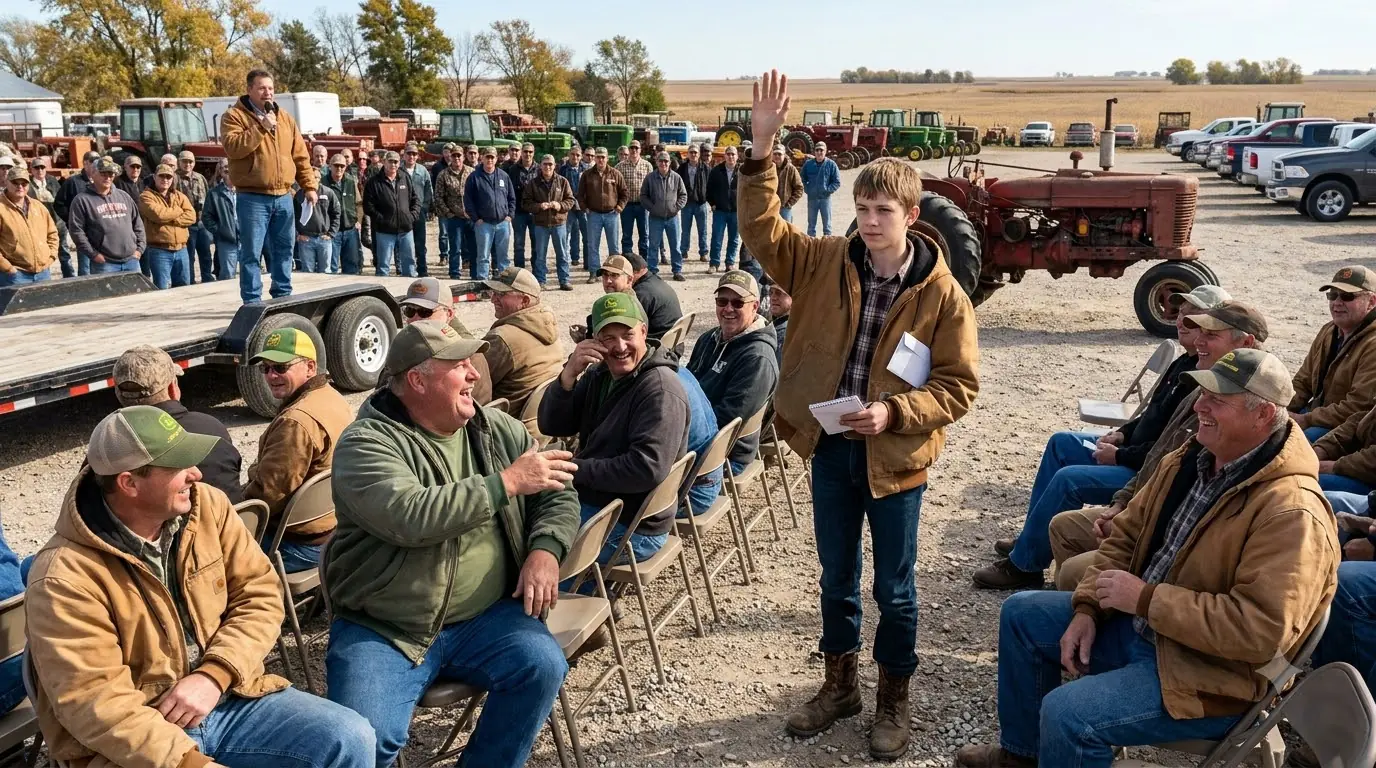
Men in worn caps turned to look. A few elbowed each other.
One older buyer near the front actually shook his head and smiled. The kind of smile a man gives when he's seen something he thinks he understands completely.
At the center of all of it stood a boy, maybe 16, with a hand still half raised in the air.
He hadn't said a word. He'd just lifted his hand at a number none of the dealers had wanted to chase on a piece of equipment most of them had already written off.
The man in the second row turned around to look at him, then turned back with a small, amused shake of his head. The way grown men do when they think a kid has wandered into the wrong conversation.
But the boy didn't lower his hand. He kept it there, steady, until the auctioneer called his bid.
That was the moment the room first started paying attention.
Not all at once, in layers.
The men at the back stopped laughing.
The buyer in the front row stopped smiling.
And something in the air, in that wide gravel yard outside a small Nebraska town, started to shift in a way nobody could quite name yet.
The auction yard sat about 9 miles outside a small town in eastern Nebraska.
The kind of town where the grain elevator is still the tallest thing for 40 miles in any direction. It was the second Saturday of October. Cold enough that breath showed in the air, but warm enough that nobody bothered with heavy coats. This was an estate auction. A man named Harold Bremmer had passed in late summer. 81 years old, no children, a widower for almost a decade. He'd farmed the same 600 acres for most of his life.
And when the lawyers finished sorting the estate, his nephew put everything on the block. Land would be sold separately. Later.
Today was equipment. Tractors, balers, a grain truck, two old combines, a workshop's worth of tools, and a long row of smaller items lined up on flatbed trailers.
The crowd was what you'd expect. About 150 people.
Most were local farmers.
A few from across the state line in Iowa. A handful of equipment dealers had driven up from Omaha and Lincoln. Men in clean jackets with coffee in steel cups. The kind who showed up at every estate sale within a 3-hour radius hoping to find something undervalued.
It was, by every measure, a working crowd.
People who knew the difference between a good machine and a tired one.
People who could tell you the year of a tractor by the shape of its grill.
People who didn't get fooled, which was why nobody, not one person, had paid much attention when the boy walked in alone. He'd come on foot from the road, which was unusual on its own. He'd walked up the long driveway with his hands in the pockets of a canvas jacket that looked like it had been his father's once. Brown work boots, scuffed but cared for.
Jeans that were clean but a little short at the ankle, the way clothes get when a boy is still growing faster than his family can keep up with.
He was thin without being small.
Quiet without being shy.
He carried a folded paper in his back pocket and a small spiral notebook in his hand. And when he walked the rows of equipment before the bidding started, he didn't touch anything for the first 10 minutes.
He just looked.
A couple of the dealers noticed him.
One of them, a heavy-set man in a green jacket, leaned over to the man beside him and said something under his breath. And they both smiled.
Not cruel, exactly.
Just amused.
A farmer near the registration table asked him, friendly enough, "You here with your dad, son?"
The boy shook his head.
"No, sir. Just me."
The farmer nodded the way you nod when you don't know what else to say, and went back to his coffee.
The boy kept walking. He stopped at the row of tractors.
He stopped longer at one in particular.
It was a tractor that nobody else stopped at.
It sat at the far end of the row, separated from the better machines by a gap of about 10 ft. The way auction crews instinctively separate the items they expect to move quickly from the items they expect to drag. It was an old model, faded red paint, the hood dented in two places, one tire flatter than the other three. A length of baling wire held part of the side panel in place.
The engine cowling was speckled with rust. And somebody had painted over the worst of it years ago in a color that didn't quite match. A small white tag wired to the steering wheel listed the model and year.
The estate had no service records for it.
Which was part of why nobody was looking twice.
With no paperwork, no maintenance history, no story attached to it, the tractor was just an old machine in poor cosmetic condition.
The auction listing described it simply as "Running condition. Sold as is."
The dealers had walked past it without stopping.
The local farmers, the ones who knew tractors the way other people know their own kitchens, had given it the kind of look you give an old dog at a shelter.
Sympathy, but not interest.
The boy stopped in front of it for almost 20 minutes. He walked around it three times. He climbed up on the step and looked at the dashboard.
He climbed back down, knelt by the front axle, ran his hand along a casting near the lower frame.
He stood up, opened his notebook, wrote something down, closed it again.
He pulled a small flashlight from his pocket and checked the stamped plate near the base of the steering column, the kind of plate most people wouldn't even know was there. Then he stepped back, looked at the tractor for a long moment, and walked away to find a seat near the middle of the crowd.
He didn't look at it again for the next hour.
The boy's name was Caleb.
He'd grown up about 30 miles east on a small place his grandfather had run before his father took it over.
His father had died 2 years earlier, lung cancer, fast. His mother worked at the hospital in town, and managed what was left of the farm with the help of a neighbor.
They weren't poor, exactly.
They were the kind of careful that being almost poor teaches you.
The envelope in Caleb's jacket pocket held money that wasn't, strictly speaking, his to gamble.
When his grandfather had passed 4 years earlier, he'd left Caleb a small inheritance, set aside in a savings account intended for college. After his father's death, his mother had quietly told him the money was his to use however he saw fit.
He had taken it out of the account 2 days before the auction, in cash, after a long conversation at the kitchen table that ended with his mother saying only, "Your grandfather would have trusted you with this. So I do, too."
What Caleb had that almost no one in that auction yard knew about was 4 years of evenings spent in his grandfather's workshop before the old man passed.
His grandfather had been a mechanic before he'd been a farmer, and a particular kind of mechanic. The kind who'd worked in a manufacturer's regional service shop in the 1970s.
He'd known certain machines, certain models, certain production runs, the way a watchmaker knows movements.
He'd taught Caleb to read casting numbers. He'd taught him about a small batch of machines built during a 6-month window when a supplier shortage had forced the company to use an entirely different engine block. One that became, in collector circles, one of the most sought-after power plants the company had ever produced. He'd taught him how to spot one. He'd taught him exactly where to find the casting number.
The auction started at 10:00. The auctioneer was a man in his 50s with a microphone clipped to his collar.
Working through the items with the smooth, practiced rhythm of someone who'd been doing this work for 30 years.
The good combine sold for 62,000.
The grain truck for 19,000.
A line of hand tools went in lots of 10 and 20.
By the time he reached the row of tractors, the crowd had warmed up.
Two of the better machines drew real attention, and one ended up in a small bidding war between a local farmer and the dealer in the green jacket.
The dealer won at 48,000 and made a small, satisfied gesture.
Then the auctioneer reached the last tractor in the row.
Lot 43, he said, glancing at his clipboard.
Old workhorse here, sold as is. No service records. We'll start the bidding low. Who'll give me 500?