Before I begin, I want you to know something.
The story you're about to hear is drawn from the agricultural traditions of Nebraska and inspired by the lives of Midwestern farm families during the farm crisis of the 1980s.
Names, places, and specific details have been changed and fictionalized for the purpose of storytelling. But the heart of it, the dignity, the patience, the quiet defiance of women like Mabel Holloway who built things that lasted, that part is true everywhere you look in farm country, if you know how to see it.
So, pour yourself a cup of coffee, settle in, and let me tell you about a Wednesday morning in late August of 1981 in a gravel auction yard in Harlan County, Nebraska, when a 15-year-old boy walked into a world of grown men and quietly changed the way every one of them looked at him before the sun went down.
His name was Wendell Holloway. Everyone who knew him called him Wen. And the morning this story takes place, he had $380 folded into a tobacco tin in his shirt pocket, a learner's permit in his wallet, and the borrowed keys to his uncle's Chevy pickup with a dent in the left rear fender.
He had driven himself 18 miles to that auction yard alone with no adult riding shotgun and no one in his family knowing where he was. His father thought he was helping a friend clean out a hay shed. His father was wrong. Now, before I tell you what happened at lot 22 that morning, you have to understand who Wendell Holloway was and where he came from and what was in his pocket besides that tobacco tin.
Because the most important thing he carried into that auction yard wasn't the money. It was a three-page service circular stapled in the corner dated March of 1954 that he had read so many times the paper had gone soft along the folds. And the woman who had saved that circular for 27 years had been dead for 18 months. Her name was Mabel Holloway.
She was Wen's grandmother. And before this story is over, you're going to know her almost as well as Wen knew her himself. Because Mabel is really the one this story is about. Wen just happened to be the boy she chose to leave it all to.
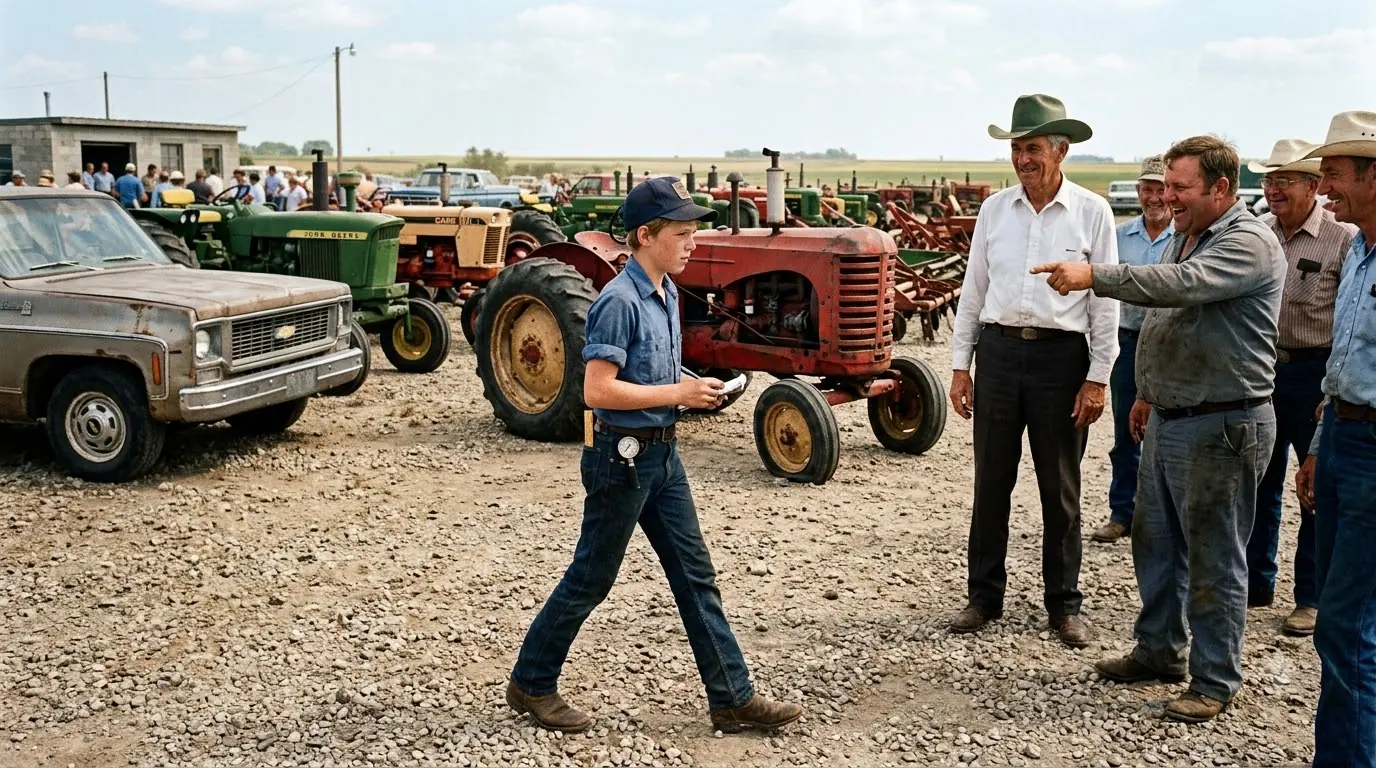
Picture the auction yard, if you can. It's a Wednesday in late August. The yard sits on the south edge of Alma, Nebraska. Two football fields worth of crushed gravel laid out behind a low cinder block office with a hand-painted sign that says Harlan County Equipment Auctions.
The morning is already hot. By noon, it'll be 92 degrees with no shade and no breeze. The air smells like diesel and cut alfalfa and the bitter coffee that's been sitting in stainless steel urns since 5:30. Men in seed caps and worn boots walk slow between the rows of equipment, their hands in their back pockets or wrapped around Styrofoam cups.
Their eyes moved over tractors and balers and disc harrows the way other men's eyes might move over horseflesh at a county fair. There are 71 registered bidders that morning. Most of them are in their 50s and 60s. Many have been buying and selling iron in this part of Nebraska since Eisenhower was in the White House.
They know each other by first name, by the trucks they drive, by the farms their fathers ran before them. And scattered around the edges of the yard, leaning on tailgates and chewing toothpicks, are the onlookers, men who came not to buy, but to watch. Because at a country auction, the show isn't always at the gavel. Sometimes the show is watching somebody make a fool of themselves in front of God and everybody.
When Wen Holloway pulled into that yard at 7 minutes past 8 that morning, the show, as far as most of those men were concerned, had just arrived. He was small for his age, not weak, not soft, but lean. The kind of lean that comes from working hay all summer and growing into your bones too fast. He wore a clean blue work shirt with the sleeves rolled to his elbows, dark jeans, and the brown leather boots his grandmother had bought him for his 13th birthday, the last birthday she'd seen.
Clipped to his belt loop was a compression gauge. In his back pocket was a folded carpenter's rule, the kind that opens in 6-inch sections. In his hand was a steno pad, blank except for the first page where he had written one line in pencil, lot 22, 1951 Massey-Harris 44 front end. He stepped down from the Chevy, closed the door gently, gently, mind you, the way his grandmother had taught him to close every door he ever closed, and walked toward the registration table.
And from across the yard, near the cinder block office, a tall man in a faded green Stetson and a clean white shirt watched him come. The man's name was Cyrus Penrose. Cyrus was 62 years old that summer, an implement dealer out of Alma whose family had been in the iron trade since before the depression. He had been buying and selling old machinery for 35 years, and there was almost nothing he hadn't seen come through a yard like this one.
Almost nothing. Cyrus turned to the man standing next to him, a younger dealer named Burdette Schaffer, and he said it loud enough for half a dozen men to hear. "Well, look at that. Somebody's out playing farmer. His daddy must have sent him in to hold a spot."
"Anybody got a number for the Holloway place? Boy might have wandered off the Ferris wheel." A few men laughed.
Burdette Schaffer laughed loudest, partly because he meant it and partly because Cyrus Penrose had said it, and that was the kind of laugh that had to come. Another voice from a different group called out, "Let me guess. He's going to buy that pretty green John Deere over on lot 31 because it matches his eyes." More laughter, louder this time. The kind of laughter that ripples outward in a yard like that one, traveling from group to group, picking up volume.
Wen kept walking. His ears had gone hot. He could feel them. He could feel the eyes on his back. And every instinct in his 15-year-old body told him to turn around, get back in that pickup, drive 18 miles home, and pretend he had never come.
Instead, he reached up, ran one hand along the brim of his cap the way his grandmother used to do when she was thinking, and he kept walking. Because somewhere underneath all of that hot embarrassment, in a place those men couldn't see, he was hearing his grandmother's voice. "Let them laugh. Laughter doesn't fix a steering spindle. It never has."
Now, before I tell you what Wen did next at that auction, I have to take you somewhere else. I have to take you back to a kitchen on a gravel lane in Franklin County, Nebraska on a cold morning in March of 1963, where a 45-year-old widow sat at a table with a cup of coffee gone cold and made a decision that 18 years later would walk into a country auction yard wearing her grandson's blue work shirt.
Mabel Holloway came onto her husband's family farm as a young bride in the spring of 1942 when she was 24 years old. She was tall, 5 ft 10 in in her stocking feet, taller than most of the men in Franklin County in those years, and she had gray eyes the color of a storm coming in over the wheat. Her husband's name was Otis Holloway.
He was a quiet man, 6 years older than her, who worked the same 160 acres his own father had broken with a team of mules in 1898. They had one son together, Garrett, born in the winter of 1944. And for the next 18 years, Mabel kept the books and the chickens and the kitchen garden, and she watched her husband and her growing son work that ground from sunup to sundown.
And then, on a cold afternoon in October of 1962, in the middle of the milo harvest, Otis Holloway stepped down from the seat of his Massey-Harris 44 to check a clogged elevator on the combine, sat down on the running board to catch his breath, and never got back up. The doctor in Franklin called it a heart attack. The neighbors said he'd been running himself too hard for too long. Garrett, who was 18 years old and had just enrolled at the community college over in Hastings, came home from class that evening to find his mother sitting in the kitchen with the lights off and her hands flat on the table, looking at nothing. That winter buried Otis, and that winter buried something else, too, though it took Mabel a few months to understand what.
In the spring of 1963, a problem developed with the grain drill. It was a small problem, a worn bushing on the seed shaft, the kind of repair any halfway decent dealership mechanic could have done in an afternoon. Mabel drove the 48 miles to the implement dealership in Hastings on a Tuesday morning. She wore her good dress.
She brought a list of parts written out in her careful hand. She walked up to the parts counter and asked to speak with the service manager. The man who came out from the back was 28 years old. His name was Calvin Strode.
He was tall and red-faced and he had the kind of confidence young men have when they've never been wrong about anything in their lives. He listened to Mabel for about 30 seconds holding a clipboard, not writing anything down, and then he said, "We'll send somebody out when we have time, ma'am." That was a Tuesday.
No one came on Wednesday. No one came on Thursday. No one came that whole week or the week after.
Mabel drove back to Hastings on a Friday morning 2 weeks later. Calvin Strode came out from the back again. This time, he didn't even pick up a clipboard. "Mrs. Holloway," he said, and his voice had something in it that wasn't quite scorn, but wasn't anything else, either.
"I've been thinking, you might want to consider selling that ground. Farming's a hard life for a widow. I know some folks in Hastings who'd give you a fair price."