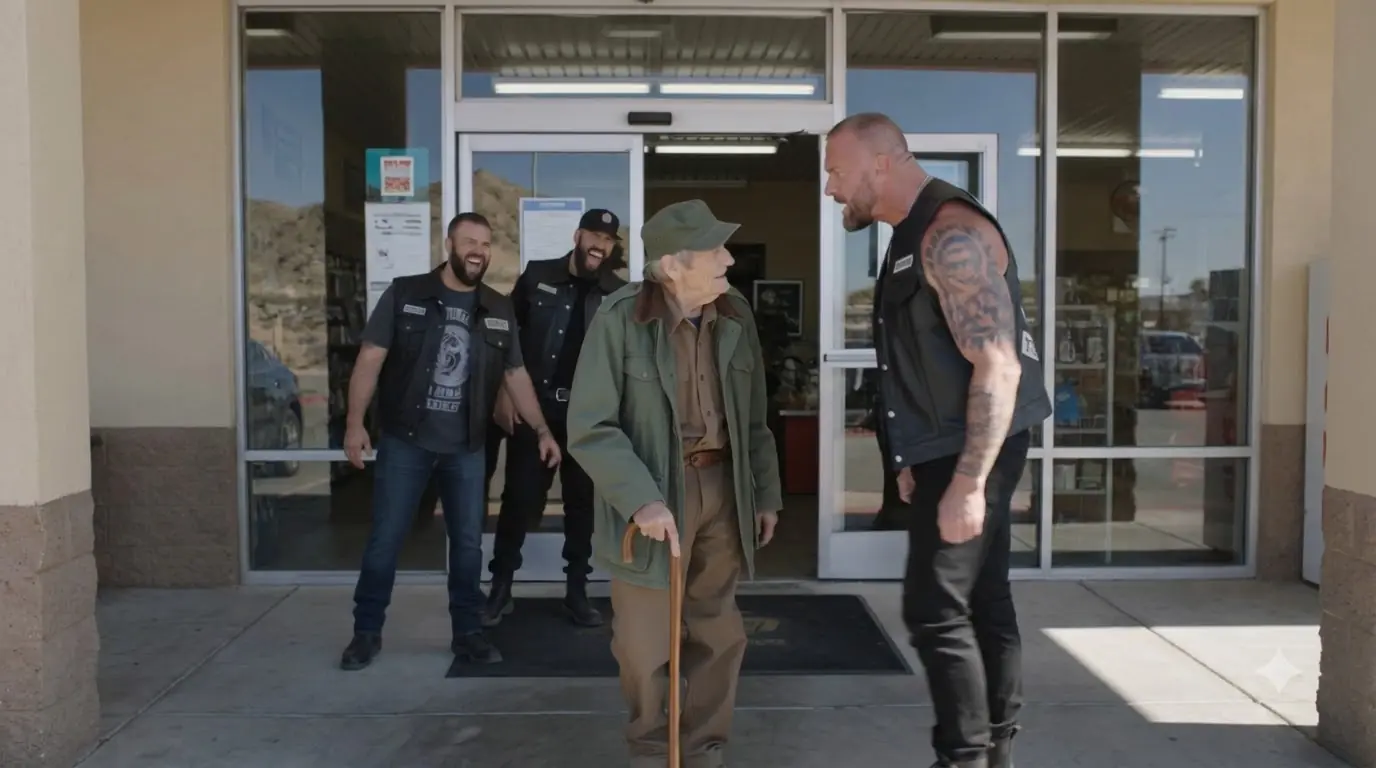
“Take that hat off, old man.”
The voice cut across the gas station parking lot like a bottle breaking on concrete. Raymond Ellis stopped beside Pump Three, one hand resting on the top of his wooden cane, the other still tucked into the pocket of his old field jacket. He was seventy-eight years old, thin through the shoulders now, but still carried himself with the careful dignity of a man who had learned long ago not to waste movement.
The faded cap on his head bore the worn emblem of the United States Marine Corps. The stitching had frayed around the edge, and the green fabric had been bleached by years of sun, rain, and use. Above the left pocket of his jacket, three service ribbons and two old medals sat pinned in a neat row, polished but weathered, the kind of decorations that did not need to shine to carry weight.
The five bikers near the store had been watching him since he pulled in.
They called themselves the Blacktop Crows, or at least that was what their leather vests said. Their motorcycles were lined up beside the ice machine, chrome bright, engines ticking as they cooled in the afternoon heat. The biggest one, Mason Vale, stepped away from his bike with a paper bag wrapped around a beer bottle and a grin that said he had found entertainment for the day.
Raymond kept walking toward the store.
Mason moved into his path.
“I said take it off.”
Raymond looked at him quietly.
“Why would I do that?”
“Because you don’t look like you earned it.”
The other bikers laughed.
One of them pointed at the medals on Raymond’s jacket.
“Bet he bought those at a flea market.”
Another reached for the brim of the Marine cap, grinning like a boy about to steal something from a weaker child. Raymond caught his wrist before the fingers touched the cloth. The movement was not quick, not flashy, and not meant to impress anyone.
It was simply exact.
The biker’s smile vanished.
Raymond’s hand trembled a little because age had taken that from him, but the grip still held. For one long second, he looked into the younger man’s eyes without anger. That made it worse. Anger would have given the biker something to understand.
This was not anger.
It was judgment.
Raymond released him.
“Don’t touch the hat,” he said.
Mason stepped closer, trying to cover the sudden uncertainty that had crossed his face.
“You threatening us, Grandpa?”
“No.”
Raymond adjusted the brim of his cap.
“I’m asking you to act like men.”
That made them laugh louder.
One of the bikers, a skinny man with a chain hanging from his belt, lifted his boot and kicked Raymond’s cane out from under him. The cane spun across the concrete, clattered against a trash can, and rolled to a stop near the store entrance. Raymond staggered hard, catching himself against a newspaper box as pain shot through his left hip.
Inside the store, twenty-year-old cashier Eli Parker froze behind the register.
He had been watching the Blacktop Crows for half an hour. They had already insulted a truck driver, complained about the coffee, and shoved one another around like men trying to prove they were dangerous in front of a camera that was not there. Eli had thought about calling the sheriff before things turned ugly.
Now they already had.
Raymond stood still for a moment, breathing through the pain. A piece of shrapnel had entered his hip in 1969 and had never come out. Doctors had told him removing it would do more harm than leaving it buried, so it had stayed there all these years like a small metal memory.
Most days, he managed fine.
That afternoon, the old wound woke like it had been waiting.
The bikers watched him cross to the cane.
He did not ask for help.
He did not curse them.
He did not even look embarrassed.
He bent slowly, picked up the cane, wiped dust from the handle with his sleeve, and stood again. His silence changed the mood more than shouting could have. What had begun as entertainment was starting to feel like something meaner, something that exposed the men laughing more than the man being laughed at.
Mason did not like that.
He wanted fear.
He wanted humiliation.
He wanted the old man to shrink.
Raymond only straightened his jacket, adjusted the medals above his pocket, and walked into the store.
The bell above the door rang with a bright, cheerful sound that did not belong to the moment.
Eli stood behind the counter with one hand near the phone.
“Afternoon, sir,” he said.
Raymond placed thirty dollars on the counter.
“Pump Three.”
Eli looked toward the door as the bikers followed Raymond inside.
“You okay?”
“I’m fine.”
Mason leaned against a rack of chips.
“Look at him. Still playing soldier.”
Raymond took out his wallet.
The leather was cracked at the edges, softened by decades of use. Inside, where most men kept a picture of grandchildren, Raymond kept a faded photograph of a young woman standing beside a white pickup truck, smiling under summer light. Her name had been Helen, and she had been gone eight years.
Mason saw the photograph.
“That your nurse from the home?”
Raymond ignored him and counted the money.
One of the bikers reached forward and flicked a finger against the medal nearest Raymond’s heart.
The tiny metallic sound moved through the store.
Raymond’s hand stopped.
For half a second, the gas station disappeared.
He was twenty-one again, lying in red mud under a sky that flashed with gunfire. Rain came down so hard it turned dust into blood-colored paste. Men shouted for ammunition, for stretchers, for God, for their mothers, for anybody still alive enough to answer.
A radio crackled nearby.
Corporal Eddie Mercer was pressed against a broken sandbag wall, one hand clamped around the handset, the other bleeding through a torn sleeve. He refused to leave the radio even when Raymond yelled for him to move. That transmission kept the evacuation route open long enough for the wounded to get carried down the ridge.
Raymond returned to the present.
The biker’s finger still rested near the medal.
Raymond raised his eyes.
“Move your hand.”
The biker did.
He did not understand why he obeyed.
Mason stepped forward.
“What happens if he doesn’t?”
Raymond turned toward him.
“I’ve heard louder men than you.”
Mason smiled.
“And what happened to them?”
Raymond looked past him, through the glass door, toward the highway.
“They never came home.”
The words were not spoken like a threat.
They sounded like grief.
That made them heavier.
For the first time, the bikers were not laughing.
Mason took off his sunglasses, his pride now wounded in front of his men. He needed the room back under his control. He needed the old man to be small again. So he stepped close enough for Raymond to smell beer, tobacco, and cheap cologne on his breath.
“Maybe I’ll take the hat myself.”
Raymond’s hand tightened around the cane.
“You don’t know what you’re doing.”
“Then teach me.”
Mason grabbed the brim of the Marine cap.
The bell over the door rang again.
A man stepped inside from the sunlight.
He was tall, late fifties maybe, wearing a black T-shirt under a worn canvas jacket, jeans, and dusty boots. Dark sunglasses covered his eyes, and a pale scar ran from his temple to the edge of his cheekbone. He stopped just inside the door and took in the room in one clean sweep.
Five bikers.
One old Marine.
A frightened cashier.
A chain at one man’s belt.
A knife clip in another man’s pocket.
Mason let go of the cap and turned.
“This is private.”
The stranger removed his sunglasses.
“No,” he said. “It isn’t.”
His voice was calm, but something in it changed the air. The bikers felt it before they understood it. He entered with empty hands, yet all of them suddenly became aware of their own hands, their own feet, and the distance between themselves and the door.
Mason forced a laugh.
“You got something to say?”
The stranger looked at Raymond’s ribbons.
Then at the Marine cap.
Then at the medal the biker had touched.
“That ribbon is real,” he said.
Raymond turned his head.
The stranger nodded toward his chest.
“Third Marine Division.”
Raymond studied him.
“Army?”
“Rangers.”
The stranger held his gaze.
“Seventy-Fifth.”
Nothing else needed to be said.
The two men recognized something in each other, not from uniforms, but from posture. A particular stillness. A way of measuring a room. A kind of sadness that never leaves the eyes completely, no matter how many years pass.
Mason looked between them.
“What, you two going to start hugging over old war stories?”
The stranger faced him.
“No.”
He slid his sunglasses into his jacket pocket.
“You’re going to apologize.”
Mason laughed again, but this time nobody helped him.
“To him?”
“Yes.”
“And if I don’t?”
The stranger took one step closer.
No raised voice.
No clenched fists.
No theater.
“You should.”
Mason glanced at his men.
There were five of them.
The stranger was alone.
Raymond could barely stand without the cane.
Numbers should have made Mason brave again.
They did not.
“Who are you supposed to be?” Mason demanded.
“Adam Cross.”
The name did not mean anything to Mason.
It did to Eli Parker.
Eli had seen that face before on a television broadcast from a veterans ceremony at Fort Lowell. Colonel Adam Cross had led a Ranger task force overseas, then retired with enough honors to fill a wall. Eli’s eyes widened, and he stopped pretending he was not listening.
Mason’s youngest friend leaned closer.
“He said Ranger.”
Mason ignored him.
“There are five of us, Cross.”
Adam Cross looked at the five men.
Then back at Mason.
“I counted.”
The words did not sound like a boast.
They sounded like a calculation already completed.
Mason reached toward the chain at his belt.
Raymond planted his cane firmly against the floor.
“Don’t.”
The word froze him.
For the first time, Mason looked at the old Marine the way a man looks at another man, not a target, not a joke, not a body weakened by time. Raymond was not preparing to fight. He was trying to stop Mason from stepping into a mistake that could not be undone.
Cross glanced again at Raymond’s medals.
“Where did you serve?”
Raymond hesitated.
“Vietnam.”
“Where?”
“Near Da Nang. Summer of sixty-nine.”
Cross’s face changed slightly.
“What unit?”
Raymond gave the designation.
Cross stood straighter.
He knew the report.
Most career officers did. A small Marine position had held through a terrible night against a larger force, protecting the withdrawal of wounded men down a ridge line that should have been lost before midnight. The official record was thin, the way records often were when too many good men died in places the public wanted to forget.
“Staff Sergeant Raymond Ellis,” Cross said.
The store went quiet.
Raymond lowered his eyes.
Mason’s hand moved slowly away from the chain.
Cross continued.
“Bronze Star. Purple Heart. Two commendations for valor.”
Eli whispered, “How do you know that?”
Cross did not look away from Raymond.
“My father was one of the men carried off that ridge.”
Raymond lifted his head sharply.
“Name?”
“Lieutenant Robert Cross.”
Raymond’s expression shifted.
“He had a chest wound.”
“Yes.”
“He kept trying to go back for the radio operator.”
Cross swallowed.
“He told that story until the day he died.”
Raymond looked down.
“There were many men on that ridge.”
“My father remembered one most clearly.”
Cross stepped closer.
“He said a young Marine dragged him downhill under fire with one arm around his chest and kept saying, ‘Stay awake, Lieutenant. You owe me breakfast.’”
Raymond’s hand tightened around the cane.
“I said that?”
“My father repeated it every Veterans Day.”
For the first time, Raymond looked old in a different way.
Not weak.
Not tired.
Heavy.
“When did he pass?”
“Six years ago.”
“I’m sorry.”
“He lived to meet four grandchildren because of you.”
Cross extended his hand.
Raymond stared at it for a moment, then took it.
The old Marine’s fingers trembled now, but not from fear.
Outside, a low rumble began along the highway.
At first, it sounded like thunder rolling over dry hills.
Then it grew deeper.
Steadier.
The windows vibrated in their frames.
The bikers turned toward the parking lot.
Motorcycles appeared at the far end of the road.
Not five.
Not ten.
Nearly twenty.
They rode in two disciplined lines, slow and controlled, keeping equal distance as they entered the lot. Their machines were black, silver, burgundy, old, new, patched, polished, and road-worn. On every rider’s vest was the same emblem: a silver star over an eagle wing.
VETERANS HIGHWAY ALLIANCE
BROTHERS THEN, BROTHERS NOW
The motorcycles parked in formation.
Every engine cut off almost at the same moment.
The silence afterward felt larger than the roar.
A woman dismounted from the lead motorcycle.
She was in her early fifties, with short gray hair, a Navy pin on her jacket, and the kind of walk that made people clear space before they knew why. She entered the store, glanced once at Cross, and lifted her hand in a clean salute.
“Colonel.”
Cross returned it.
“Commander Shaw.”
She lowered her hand, turned toward Raymond, and studied him.
Her face softened.
“Staff Sergeant Ellis?”
Raymond looked confused.
“Do I know you?”
“No, sir. But I know your name.”
She looked at the medals.
“I’ve read the ridge report from your unit.”
Raymond gave a small shake of the head.
“Reports leave men out.”
“They often do.”
Cross nodded toward Mason and the Blacktop Crows.
“These men were about to remove his cap.”
Commander Mara Shaw turned slowly.
Her gaze landed on Mason with a calm that made him look smaller than any insult could have.
“Did one of you kick his cane?”
No one answered.
Cross pointed to Mason.
“He was leading.”
Mason’s mouth worked once.
“We were just messing around.”
Raymond looked at him.
“No,” he said. “You were looking for someone who wouldn’t hit back.”
The truth sat in the aisle between them.
The other bikers looked at the floor, the coolers, the front window, anywhere but at the old Marine.
Mason swallowed.
He tried to put the old mask back on, but it no longer fit.
“My grandfather served in Vietnam,” he said.
Raymond’s eyes moved to his face.
“What was his name?”
Mason hesitated.
“Eddie Mercer.”
The store seemed to stop breathing.
Raymond’s face changed so quickly that even Mason saw it.
“Edward Mercer?”
Mason nodded slowly.
“Radio operator?”
Mason’s arrogance drained all at once.
“You knew him?”
Raymond closed his eyes.
The ridge returned.
Rain.
Smoke.
Eddie Mercer pressed to the radio with blood down his arm, yelling coordinates through static while bullets tore at the dirt above his helmet. Eddie refusing to leave until the last evacuation bird had a route. Eddie laughing once, impossibly, because someone cursed the mud in three languages.
Raymond opened his eyes.
“He kept the line alive when everything else was falling apart.”
Mason’s voice dropped.
“My father never told us much. Just said my grandfather died over there.”
“He died helping thirty-seven men get home.”
Mason looked down.
The paper bag in his hand crumpled softly.
“I didn’t know.”
“Most families didn’t get enough truth,” Raymond said. “And many men who came home had no words left for the ones who didn’t.”
Mason’s eyes reddened.
“My father hated anything military. Said the war took his dad and left him with a photograph. I guess I turned that anger into something ugly.”
Raymond watched him.
“Pain does that when nobody gives it a proper name.”
Mason looked at the Marine cap he had tried to take.
“I’m sorry.”
Raymond did not answer.
Mason’s voice broke.
“I mean it.”
Raymond stepped toward him slowly, leaning on the cane.
When he stood close enough, he placed one hand on the younger man’s shoulder.
“Sorry is a start,” he said. “It is not proof.”
Mason nodded, eyes wet now.
“How do I prove it?”
“You live different after today.”
Commander Shaw removed her riding gloves.
“This Sunday, the county veterans center is holding a memorial service. Edward Mercer’s name is on the wall.”
Mason looked up.
“His name is there?”
“Yes.”
“No one ever told us.”
“You’re invited.”
Mason swallowed.
Cross looked toward the other Blacktop Crows.
“All of you are.”
The men stood awkwardly beneath the buzzing fluorescent lights.
They had walked in believing intimidation was strength.
Now they stood surrounded by people who had known real danger and had no need to perform it.
One by one, the bikers removed their sunglasses.
Then their caps.
Mason picked up Raymond’s Marine cap from the counter where it had shifted during the confrontation. He held it carefully with both hands and gave it back. Raymond placed it on his head.
Outside, the American flag above the station snapped in the wind.
Commander Shaw opened the door and signaled to the riders waiting outside.
Every veteran removed a helmet.
Together, they raised their hands in salute.
Raymond froze.
His eyes moved across the line of men and women in the parking lot. Different ages. Different branches. Different wars. Different wounds, some visible, most hidden behind ordinary faces.
His hand rose slowly to the brim of his cap.
For one long moment, the entire gas station became silent.
The salute was not only for Raymond.
It was for Robert Cross.
For Eddie Mercer.
For the Marines who held the ridge.
For every name that survived only because someone else refused to forget.
Raymond lowered his hand.
“Thank you,” he said.
His voice nearly failed.
Cross stood beside him.
“You should have heard it years ago.”
Raymond looked toward Mason.
“Maybe today was when it needed saying.”
The memorial service took place the following Sunday.
Mason arrived without his Blacktop Crows vest.
He wore a plain white shirt and carried a small black-and-white photograph his father had kept in a shoe box for thirty years. In the picture, Eddie Mercer was twenty-three, standing beside a radio with one hand over his eyes against the sun, smiling like the world had not yet decided what it would take from him.
Raymond stood with Mason before the memorial wall.
The name Edward Mercer was carved in clean letters beneath a row of brass plaques.
For the first time, Mason touched the name with two fingers.
“My father never came here,” he said.
Raymond nodded.
“Some grief gets inherited without instructions.”
Mason looked at him.
“What was he like?”
Raymond smiled faintly.
“Funny. Too brave for his own good. Hated canned peaches. Wrote letters every Thursday to a girl named Linda, even when mail hadn’t gone out in weeks.”
“That was my grandmother.”
“I figured.”
Raymond pointed to the name.
“He was scared that night.”
Mason looked surprised.
“I thought men like him weren’t scared.”
“Only fools aren’t scared.”
Raymond rested both hands on his cane.
“Courage is when something else matters more.”
Mason stood there long after the service ended.
In the weeks that followed, the Blacktop Crows began to change.
Not all of them.
Not neatly.
Two members left because they had joined for fear and noise, not service. The ones who stayed started showing up at the veterans center on Saturday mornings. At first, they cleaned gutters and fixed loose boards because Commander Shaw asked them to. Later, they came without being asked.
Mason stopped drinking before rides.
He stopped letting men laugh at people who could not safely answer back.
He removed the Blacktop Crows patch from his vest and replaced it with a small stitched radio tower and the initials E.M.
When people asked what it meant, he told the story.
The gas station changed too.
Eli Parker convinced the owner to set up a small veterans display near the front door. What began with one photograph became a wall. Families brought old pictures, medals, letters, folded flags, unit patches, and stories that had sat in drawers for decades.
A photograph of Eddie Mercer went up beside one of Lieutenant Robert Cross.
Then another of Raymond Ellis, taken outside the station on the day everything happened. He stood with his cane in one hand, Adam Cross on one side, Commander Shaw on the other, and Mason standing several feet away with his head lowered. Under the picture, a bronze plaque carried seven words.
THE ROAD REMEMBERS WHAT HISTORY FORGETS.
People began stopping at the station for more than gas.
Veterans came in quietly and stood before the wall.
Children asked questions.
Truckers removed their caps.
Families traced names with careful fingers and told stories they had never planned to share in public.
Eli cleaned the glass every morning.
Sometimes Raymond came by and sat on the bench near the display. He always bought coffee, even when Eli tried to give it to him for free. He never asked to be recognized. He simply sat and watched people remember.
One afternoon in late autumn, Mason found him there alone.
The younger man carried no beer, no sunglasses, and no swagger.
He sat beside Raymond and opened his hand.
Inside lay a small metal radio operator’s badge, scratched along one edge.
“My father gave it to me,” Mason said. “Said it belonged to Eddie.”
Raymond looked at it.
“That should stay in your family.”
“I thought it might belong on the wall.”
Raymond closed Mason’s fingers around it.
“The wall is for memory. That is for responsibility.”
Mason frowned.
“I don’t understand.”
Raymond tapped the closed fist gently with one finger.
“You carry it. When you feel yourself becoming the man you were that afternoon, remember who carried this before you.”
Mason looked down at the badge.
“The best way to honor the dead,” Raymond said, “is to live a life worthy of what they lost.”
Mason nodded.
Commander Shaw arrived a few minutes later with three cups of coffee.
She handed one to Raymond, one to Mason, and kept one for herself.
“We’re holding another service next month,” she said. “We want you to speak.”
Raymond shook his head.
“I’ve spoken enough.”
“You told Mason a story his family needed.”
“That was different.”
“Then tell the town something it needs.”
Raymond looked at the wall.
So many faces.
So many years.
So many young men and women frozen in photographs before time could become cruel.
“Maybe,” he said.
That was the closest he ever came to yes.
Adam Cross could not attend that afternoon, but he sent a letter that Eli framed beside the memorial. It was short, written in a firm hand.
Some battles end on maps long before they end in families. Honor survives when one generation teaches the next what must not be forgotten.
People often stopped to read it.
That evening, Raymond, Mason, and Commander Shaw sat beside the memorial while sunset turned the highway bronze.
A few motorcycles passed in the distance, their engines blending with the wind.
Mason studied the photograph of his grandfather.
“I spent most of my life thinking nobody remembered him.”
Raymond took a slow drink of coffee.
“Someone always remembers.”
“What if they never say it?”
“Then the next generation has to ask.”
Mason nodded, holding the badge in his palm.
The last sunlight touched the bronze plaque beneath the station photograph.
For a moment, the letters seemed to glow.
The road remembers what history forgets.
Raymond looked at the faces behind the glass.
Some had lived long lives.
Some had remained young forever.
He thought of the ridge, the radio, the wounded lieutenant, the young man named Eddie who refused to leave, and the many names the official reports had not carried properly.
“They aren’t gone,” Raymond said quietly.
Mason looked at him.
Raymond smiled faintly.
“They just went on ahead.”
The wind moved through the gas station lot.
A dry leaf slid across the concrete near the spot where Raymond’s cane had once been kicked away.
Nobody laughed now.
People lowered their voices when they passed the wall. A father lifted his little boy so he could see the photographs. A truck driver stood with his cap in both hands. Eli turned off the television above the counter because the room did not need extra noise.
Raymond had come to that gas station intending only to buy fuel.
He left behind a place where people remembered.
Not because he demanded honor.
Not because he shouted down the men who mocked him.
But because dignity, when it refuses to break, has a way of making everyone else look at themselves.
Courage does not always enter loudly.
Sometimes it is an old man bending down to pick up his cane.
Sometimes it is a retired colonel walking through a glass door at the exact right moment.
Sometimes it is a cruel young man finally lowering his head, learning the name of his grandfather, and deciding not to pass his pain forward.
And sometimes, on an ordinary highway beneath an ordinary sky, remembrance begins with one sentence that should never have been spoken.
“Take off that hat, old man.”
By the time the town was finished answering, the hat meant more than it ever had before.