The whispers reached him before the music did. Standing alone at the edge of the great mirrored ballroom, the Duke of Deverell heard them travel the length of the room like a draft under a door.
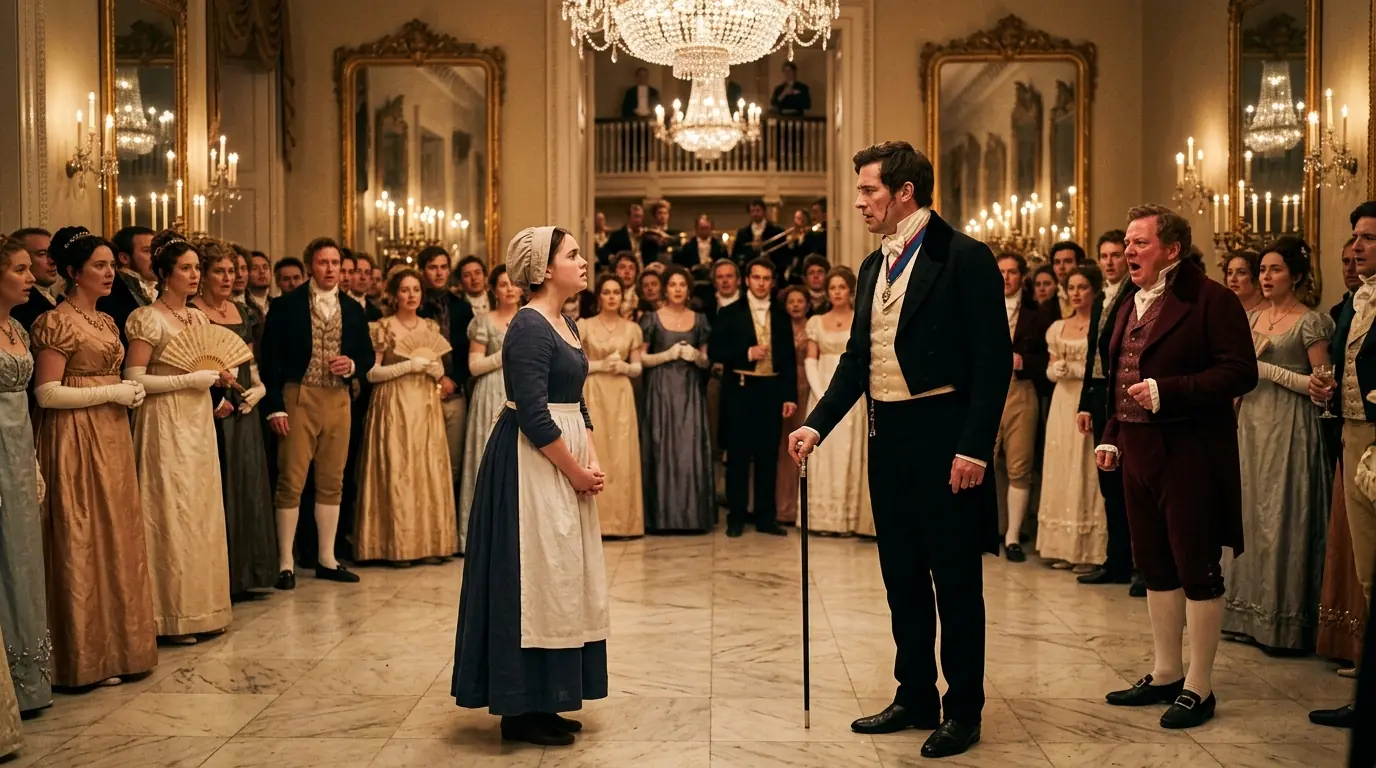
"There he is, the ruined one. They say he cannot even dance now."
And he kept his face still, because a soldier learns to keep his face still, and a duke learns it twice over.
Nathaniel Crane, Duke of Deverell, had come home from the war eighteen months ago with a saber scar down the left side of his jaw and a leg that had been broken and set badly under fire and never healed straight. So that he walked now with a cane and a slow, deliberate gait that cost him more than any of the glittering people watching him would ever guess.
He had been, before the war, one of the most sought-after men in England—tall, dark, rich, and whole. He had ridden to hounds and danced till dawn and been fought over by half the mothers in three counties. He had come back a different creature, and society, which had adored the whole man, did not know what to do with the broken one. And so it did what society always does with what it cannot place. It mocked him gently, cruelly, behind its fans.
He had not wanted to come tonight. The invitation to the royal ball had been a command more than a courtesy, and one did not refuse a royal command. And so he had put on his dark evening clothes and pinned on the two medals he had earned and detested, and he had come. And he had taken up a position against the far wall where he might watch and not be watched.
And he had been wrong about the last part, because everyone was watching and no one was speaking to him.
"They say the king only invited him out of pity," murmured a woman in primrose silk, not troubling to lower her voice quite enough. "One does feel for him, of course. But it is rather awkward, is it not, to have him stand there like a monument to something no one wishes to remember?"
"He was so handsome once," sighed her companion. "Such a waste."
Nathaniel heard every word. He had learned in a field hospital where men screamed through the nights that one could hear a great deal and betray nothing. And so he stood, and his hand rested light on the silver head of his cane, and his dark eyes moved over the dancers with an expression that gave away no more than a shut gate gives away a garden.
Inside the gate, it was another matter. Inside he was counting the minutes until he might decently leave, and he was thinking that he had faced cavalry charges with a steadier heart than he faced this scented, smiling, murderous room.
It was then that he noticed the girl with the tray.
She was a servant, one of the household maids pressed into service for the great occasion in a plain dark gown and a white apron, carrying a tray of untouched champagne with the careful concentration of someone who has been told exactly once that a single dropped glass would cost her a week's wages. She was young, perhaps two and twenty, with fair hair pinned severely back and a face that would have been unremarkable in the crowd of jeweled beauty save for one thing.
She was not looking at the Duke of Deverell the way the others looked at him. She was looking at him the way one looks at a person.
He caught her eye by accident across the width of the room, and instead of the swift embarrassed glance away that he had grown used to—the flinch, the pity, the sliding of the gaze down to the cane and hurriedly up again—she simply looked back at him steadily for a moment. And then, very slightly, she inclined her head. Not the deep obsequious bob of a servant to a duke. A small grave nod of one soul acknowledging another. And then she went on with her tray.
Nathaniel found, to his own surprise, that he was still looking at the place where she had been for some seconds after she had gone.
The music changed. The master of ceremonies announced a quadrille, and the floor filled with silk and satin, and the bright cruel laughter of people who had never in their lives had to be brave. And Nathaniel Crane stood against his wall and watched them dance the dance he could no longer dance, and felt the old grief close over him like water.
He had loved dancing once. It seemed a small thing to have lost beside the men he had buried, and yet it was the small things he had found that undid a man at midnight.
"Deverell." A hand clapped his shoulder.
Lord Percival Anstey, an old acquaintance from before. Florid now and half drunk with the particular cruelty of a weak man who wishes to seem strong before an audience.