“Would you look at this?”
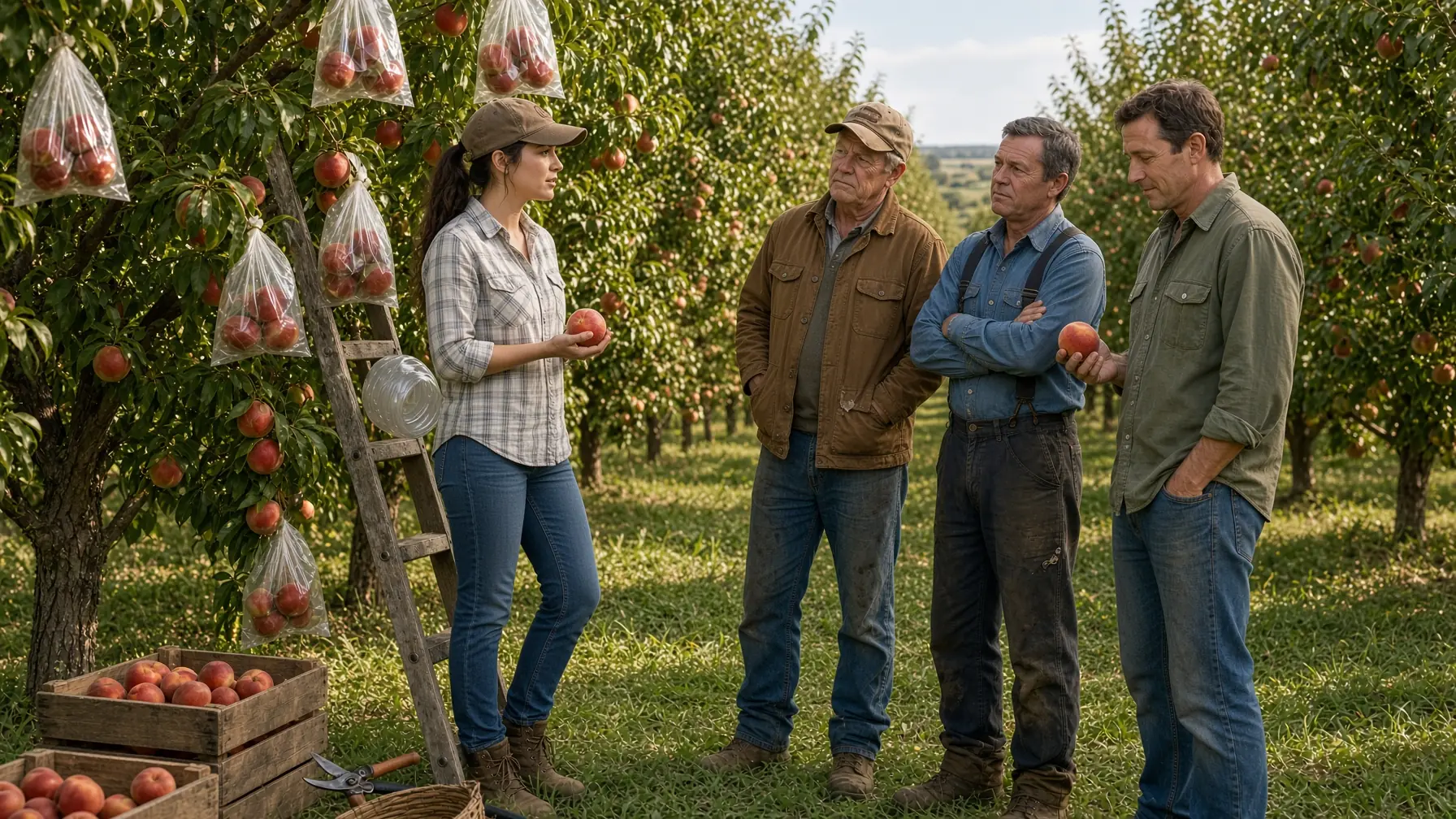
Dale Hargrove’s voice carried almost the length of the peach row.
“Bagging peaches one by one like they’re babies.”
His brother Roy laughed under his breath.
“At this rate, summer’ll be over before she finishes one row.”
Mason Pike leaned toward one of the clear plastic bags hanging from the branches and squinted at the peach inside as though somebody had hung a Christmas ornament in the middle of August.
“You growing fruit, Emily,” he asked, “or gift-wrapping it?”
The three men laughed.
Emily Carter did not.
She stood beside an aluminum orchard ladder with a roll of clear fruit bags looped over one wrist, her faded tan cap pulled low against the late-morning sun.
She was twenty-four years old.
Five-foot-five.
Slim, strong, sun-browned across the forearms, with dark hair tied low beneath her cap.
And for the past four hours, she had been tying protective bags around selected peaches one fruit at a time.
Not every peach.
Only the ones she believed had a realistic chance of making premium grade.
Dale apparently had not noticed that distinction.
Emily reached toward the branch in front of her.
She pulled the plastic gently around one last peach.
Tightened the tie at the stem.
Smoothed the bag with both hands.
Then she lowered her arms.
She looked at Dale.
Then Roy.
Then Mason.
“No,” she said calmly.
Dale’s grin widened.
Emily lifted one protected peach in her palm.
“I’m separating the fruit that gets sold…”
She glanced toward the unbagged peach Mason was holding.
“…from the fruit that gets rejected.”
Mason’s smile weakened.
Roy unfolded one arm.
Dale chuckled again.
“You really think a plastic bag is gonna decide who buys peaches around here?”
Emily let the branch settle back into place.
“No.”
She looked straight at him.
“The buyer will.”
Dale raised one eyebrow.
Emily continued.
“And tomorrow you’ll find out which orchard he was actually coming for.”
For one quiet second, nobody answered.
Then Dale laughed too loudly.
“Well, we’ll see about that.”
Emily nodded.
“Yes.”
She picked up another bag.
“We will.”
The Carter orchard sat six miles outside Mercer Ridge, Georgia, where red clay began giving way to low rolling fruit country.
Thirty-five years earlier, the Carter name had meant something in peaches.
Emily’s grandfather, Frank Carter, had planted the first twenty acres in the early 1960s.
Her father, Daniel, expanded the operation to nearly seventy acres.
At its best, Carter Orchard shipped peaches and nectarines to wholesalers in Atlanta, Birmingham, Chattanooga, and Nashville.
During harvest, trucks arrived before sunrise.
The packing shed ran until midnight.
Daniel Carter used to tell Emily that he could tell how good a season was by the sound of the packing line.
A good year had a certain rhythm.
Boxes sliding.
Rollers humming.
Workers calling grades.
Forklift reversing.
Truck doors slamming.
A bad year sounded like empty space.
Emily had grown up inside that noise.
At six, she rode beside her father on the tractor.
At nine, she could identify most varieties before tasting them.
By thirteen, she knew why fruit on one side of a tree colored faster than fruit on the other.
At sixteen, she could thin a peach tree faster than some seasonal workers.
She never expected to inherit the orchard at twenty-two.
Nobody did.
Her mother had died when Emily was fifteen.
Cancer.
Her father became both parent and employer after that, though he was much better at the second job than the first.
Then one April morning, Daniel walked from the packing shed toward the house, sat down on the porch step, and never got back up.
Massive heart attack.
He was fifty-three.
One hour earlier, he had been arguing with Emily about whether an irrigation pump sounded wrong.
By noon, she was answering questions from paramedics.
By evening, his work gloves were still sitting on the tractor hood.
The orchard did not stop because Daniel Carter died.
Fruit trees do not understand grief.
They bloom.
They set.
They thin.
They need water.
They get insects.
They get disease.
And when harvest comes, they ripen whether the person responsible feels ready or not.
Emily was not ready.
She farmed anyway.
The first year nearly broke her.
Not emotionally.
Financially.
Daniel had not left the farm in terrible condition.
But he had left debt.
A packing-line loan.
Equipment payments.
Operating credit from the previous season.
And two mediocre harvests had already reduced the cash reserve.
Then Emily’s first season alone brought trouble.
A late cold spell damaged some bloom.
Brown rot hit harder after a wet June.
Stink bugs scarred fruit in several blocks.
Plum curculio left crescent-shaped marks on peaches that might otherwise have graded well.
None of those problems destroyed the crop.
That was almost worse.
The trees still produced plenty of fruit.
It simply produced too much fruit that buyers did not want at the top price.
Peaches were brutal that way.
A beautiful peach might bring premium fresh-market money.
A peach with a small scar could lose a large portion of its value even if the flesh underneath was perfectly good.
Emily watched trucks leave with more second-grade fruit than her father would have tolerated.
She watched the numbers in the farm account move in the wrong direction.
People noticed.
Of course they noticed.
Mercer Ridge was the kind of town where people claimed not to discuss another person’s finances while somehow knowing the approximate balance on his equipment note.
At the hardware store, someone told Emily she ought to lease the orchard.
At the bank, a loan officer suggested selling twenty acres.
A retired grower told her:
“You’re young. No shame in deciding this ain’t the life.”
Emily did not feel insulted by all of them.
Some were trying to help.
But she noticed something.
Nobody told twenty-four-year-old men with struggling farms to grow easier crops.
They told them to hang on.
Get smarter.
Work harder.
Find another year.
When they spoke to Emily, the advice often started with leaving.
She did not want to leave.
So she began studying the problem differently.
In February, the county extension office hosted a specialty fruit meeting.
Emily almost did not go.
She had pruning to finish and an old sprayer pump leaking at one seal.
But the program included a session on premium fruit marketing, and premium was exactly what she was losing.
So she went.
The room held maybe forty growers.
Most were men.
Most older.
Emily sat near the back with a yellow legal pad.
A fruit consultant from South Carolina gave a presentation about high-value direct and specialty markets.
He talked about thinning.
Canopy management.
Targeted pest exclusion.
Then he put a photograph on the screen.
Peaches inside protective bags.
Someone near the front laughed.
The consultant smiled.
“Yeah. Everybody laughs at this slide.”
More laughter.
Then he explained.
Individual fruit bagging was labor-intensive.