The barn smelled of dust, sweat, and old wood baked by a relentless sun. Lanterns hung from rough beams overhead, their flames trembling as if they, too, felt the unease in the room. Boots shuffled across the wooden floor. Men who had spent their lives bargaining over cattle and horses stood unusually quiet, hats pulled low, eyes avoiding the stage. She stood there alone.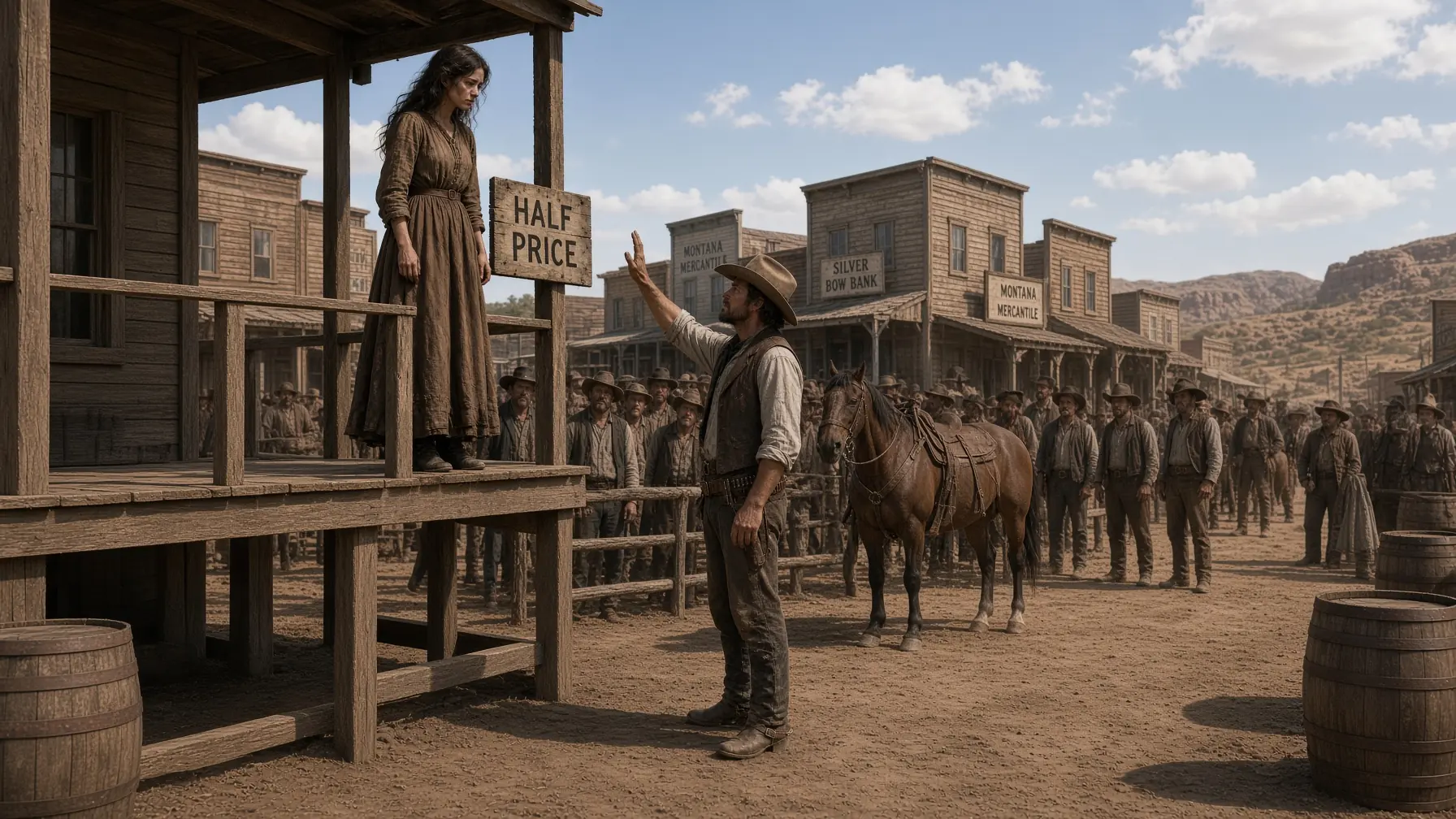
The platform beneath her feet felt unsteady, though it was nailed firm. A plain cotton dress brushed against her ankles, freshly washed but faded from years of wear. Her hands were clasped tightly in front of her, fingers laced together to stop their trembling. She kept her chin lifted, though her heart pounded so loudly she was sure everyone could hear it. A wooden sign hung beside her, the letters painted in bold black strokes.
Half price. The auctioneer cleared his throat, glancing at the crowd as though daring someone to challenge the silence. Healthy. Strong. Hardworking, he called out, forcing cheer into his voice.
Half the usual starting bid. The words echoed, then fell flat. No one raised a hand. Whispers moved through the barn like a cold wind. She's bad luck.
Didn't you hear about her pa? Whole farm burned to ash. Her stomach tightened. She had heard the whispers all her life. They followed her to church, to the market, even to the well when she fetched water.
The fire that took her home had taken more than wood and grain. It had taken her father, her safety, and any kindness left in the town's eyes. The auctioneer tried again, louder this time. Half price. That's a bargain by any measure.
She felt it in the way mothers pulled children closer. In the way conversations died when she walked past. In the heavy air pressing down on her now. Then the large barn doors creaked open. A gust of evening wind swept inside, carrying dust and a faint scent of sage.
Every head turned. Slow, steady footsteps broke the silence echoing against the wooden planks. A lone cowboy entered, hat shadowing his eyes. He didn't glance at the sign. He didn't listen to the whispers.
He looked straight at her. And after a long, heavy moment, he raised his hand. A ripple of shock moved through the barn so suddenly it felt like the whole building had shifted on its beams. Heads snapped toward the raised hand. A few men even stepped back as if boldness itself were contagious.
Silas Reed, someone muttered under his breath. The name carried weight. Silas Reed wasn't known for foolishness. He ran one of the largest ranches beyond the western ridge, land that had survived droughts and blizzards alike. He spoke little, worked hard, and answered to no man's gossip.
If he feared anything, no one had ever seen it. The auctioneer blinked, caught between disbelief and relief. You're bidding? He asked carefully. Silas lowered his hand just enough to nod once.
His voice, when it came, was calm and steady. Full price. The barn erupted in murmurs. She's marked. You'll regret it.
Half price is already too much. Silas didn't so much as glance at them. His boots carried him a few steps closer to the stage. Dust clung to his coat from a long day's ride, and his hat cast a shadow over sharp, unreadable eyes. The auctioneer swallowed.
Son, you heard me. She's half price. Silas's jaw tightened slightly. I heard you, he replied. I said full.
The distinction settled heavily in the room. He wasn't taking advantage of the discount. He wasn't buying damaged goods at a bargain. He was making a statement. The gavel came down with a crack that seemed louder than any before it.
Sold. The word echoed in her chest like a verdict. Silas approached the steps of the platform. For a moment, she wondered if this was the part where reality would turn cruel again, where his grip would be harsh, where his eyes would reveal doubt or superiority. Instead, he removed his gloves slowly, tucking them into his belt.
He climbed the steps and stopped a respectful distance away. Up close, she could see the lines of weather and sun across his face, the steadiness in his expression. He held out his hand. Not grabbing. Not demanding.
Offering. You don't have to come, he said quietly, his voice low enough that only she could hear. But if you do, you'll be treated fair. Same as anyone under my roof. No one had spoken to her like that in years.
Not with choice. Not with dignity. Her throat tightened, and for a second she feared her legs might give out. The entire barn watched, waiting for disaster, for lightning to strike, for proof that the rumors were right. Instead, she slowly lifted her trembling hand and placed it in his.
His grip was warm and steady. Together, they walked down from the stage, past the staring faces and whispered warnings, toward the open barn doors and the fading light beyond. Life on Silas Reed's ranch did not begin with thunder or tragedy. It began with quiet. The first morning she woke before sunrise, unsure of her place in the unfamiliar room.
Pale light spilled through the small window beside her bed, stretching across wooden floors polished by years of careful hands. For a long moment, she lay still, listening. No shouting. No suspicious murmurs outside her door. Only the distant lowing of cattle and the soft whistle of wind rolling over open land.
When she stepped outside, the ranch spread wide beneath a pink-streaked sky. Fences ran straight and sturdy across the fields. Horses grazed calmly near the barn. Silas was already awake, repairing a gate with steady movements, as though nothing in the world had ever shaken him. He nodded once when he saw her.
Coffee's on the stove. No suspicion. No hesitation. Just simple acknowledgement. The days that followed were filled with work.
Honest work. She mended tack, hauled feed, scrubbed troughs, and walked the fence lines. At first, she braced herself for something to go wrong. A spark in the hay. A sudden storm.
A sick animal no one could explain. But nothing happened. In fact, the opposite did. One afternoon, a restless mare that no one could saddle without a The began to calm under her touch. The animal's wild eyes softened as she whispered gently, her palm stroking its neck in slow circles.
Within days, the mare followed her without a rope. A calf born weak and shivering survived after she spent hours nursing it by the fire. Crops she planted near the South Field sprouted faster and thicker than the others. Silas noticed everything, though he said little. He watched how animals leaned toward her rather than away.
How even the ranch hands, who had arrived wary and tight-lipped, slowly relaxed in her presence. Weeks passed, and still no misfortune struck. One evening, as the sun bled orange across the horizon, Silas leaned against the fence beside her. "Who started it?" He asked quietly.
She didn't pretend not to understand. "The banker," she answered after a long pause. "My father wouldn't sell him our land. Said we'd keep it for the next generation. A week later, the fire came.
After that, people were too afraid to question anything." Silas's gaze darkened, not with fear, but with resolve. The curse had never been real. It had been planted. And like any lie buried deep, it had grown because no one dared to dig it up.
Silas straightened slowly, eyes fixed on the fading light. "Then it's time," he said. "Someone did." The town hall had not been this full in years. Every bench was taken, and men who once avoided her now stood shoulder to shoulder near the walls, murmuring under their breath.
The air felt thick, charged with the kind of tension that comes before a summer storm. Silas stood at the front beside a long wooden table. Papers were spread neatly before him, ledgers, contracts, letters. He didn't look nervous. He looked certain.
She remained a step behind him, not hidden, but not seeking attention, either. For so long, she had stood alone under accusing stares. Tonight felt different. Tonight, she was not on display. She was standing beside someone.
The banker sat across the room, face pale beneath the lamplight. His polished boots tapped impatiently against the floor. "This is nonsense," he snapped. "Superstition and bitterness." Silas didn't raise his voice.
He simply lifted one of the ledgers. "Strange coincidence," he said evenly. "Every family that refused to sell land to you suddenly fell into debt or disaster." A murmur rippled through the crowd. Another paper slid forward.
"And here," Silas continued, "a letter threatening foreclosure days before her family's barn burned. Signed by your office." The banker's jaw tightened. "Circumstantial." From the back of the room, an older farmer stood slowly.
"Not to me," he said, voice rough. "My well collapsed a week after I turned down your offer. You told folks I was cursed, too." One by one, others rose. Stories long swallowed by fear finally found air.
Crops sabotaged. Livestock poisoned. Debts manipulated. The curse unraveled like rotten thread. Faces that once held suspicion now carried something else, shame.
The banker's confidence cracked under the weight of witnesses. By the time the meeting ended, the town's fear had shifted direction. Not toward her, but toward the truth they had ignored. Weeks later, the same barn that had hosted her humiliation glowed with warm lantern light and music. Tables were lined with food.
Laughter bounced off wooden beams. It was a celebration of cleared names, of reclaimed land, of courage found too late, but welcomed all the same. She stood near the center of it, no sign nailed beside her, no whispers trailing her steps. The auctioneer approached with a sheepish smile.
"Seems we misjudged value that night," he said lightly. Silas looked at her, eyes softer than she had ever seen. He reached for her hand, not claiming, not commanding, asking. She squeezed his fingers gently, her answer clear without words.
Because she had never been half-price. She had never been for sale. And the only true bid that night had not been money. It had been faith.