The warehouse opened before daylight, the way tired places do.
Roll-up doors rattled upward into the gray November cold. Forklifts beeped in reverse between towers of cardboard, plastic wrap, and freight bound for cities most of the workers would never see. The air smelled like diesel, wet concrete, cheap coffee, and the kind of industrial cleaner that never truly covered up exhaustion.
At Mercer Ridge Logistics, people arrived quiet.
They scanned their badges, pulled on gloves, adjusted back braces, and moved toward their stations without lingering too long near the supervisor’s office. Nobody laughed loudly before six in the morning. Nobody complained where cameras could catch their face and a manager could call it attitude later.
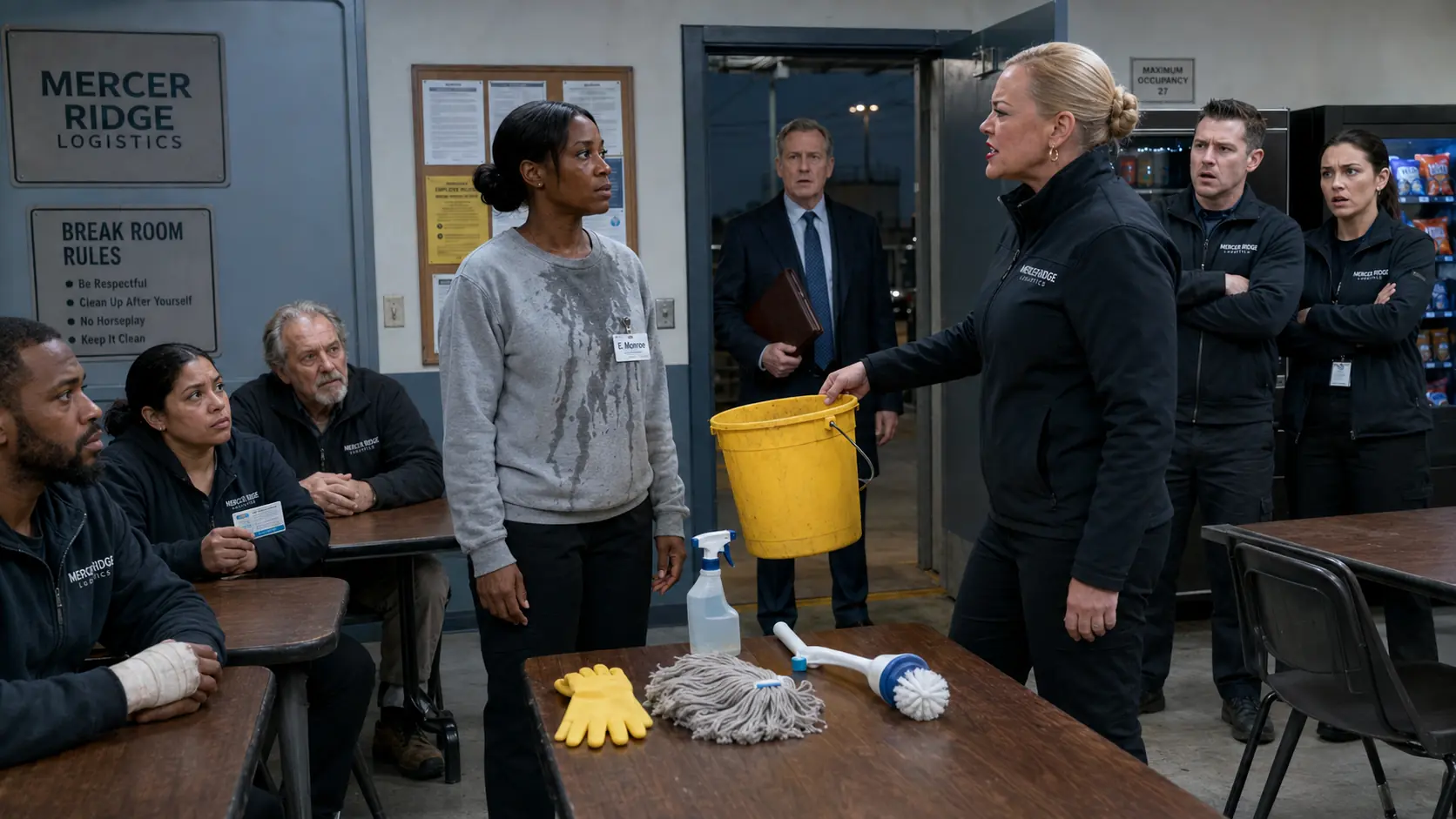
That was why Elise Monroe entered through the temporary worker door wearing scuffed sneakers, black work pants, a plain gray sweatshirt, and a badge that said E. Monroe, floor support.
Nothing about her looked important.
That was the point.
Elise had spent fifteen years building Monroe Freight Systems from one rented delivery van in Richmond into a national logistics company with warehouses in fourteen states. Her face had been on trade magazines. Her signature sat on major contracts. Her name belonged to buildings, scholarship programs, employee funds, and executive reports printed on paper thick enough to seem more honest than it always was.
But at 5:08 that morning, she looked like a woman who needed a shift.
That was how she wanted it.
For nine months, complaints about Mercer Ridge had reached her office in fragments. Anonymous emails. Photos sent from personal phones. A voice message from a man who sounded terrified even after he disguised his number. Exit interviews that said, “I found a better opportunity,” when every word beneath that sentence said, “I ran before they broke me.”
On paper, Mercer Ridge looked almost perfect.
Shipments were ahead of schedule. Injuries were down. Overtime costs were controlled. Employee complaints had dropped to almost nothing.
Elise did not trust perfect numbers.
Her father had worked loading docks in Norfolk for thirty-one years, and he used to say numbers can be dressed up faster than people can. A bad manager knows how to make a spreadsheet smile. A scared employee knows how to stay silent long enough to survive until Friday.
Elise came to Mercer Ridge because the silence had become too clean.
The breakroom sat beside Dock Two, square, cold, and ugly in the way warehouse breakrooms become ugly when no one with power ever eats there. Three vending machines buzzed against one wall. A microwave with a cracked handle sat beside a sink full of paper cups. The tables were scratched with initials, union jokes, old phone numbers, and one sentence carved near the corner: keep your head down.
Elise noticed that sentence first.
She stood near the coffee machine, holding a paper cup she had bought at a gas station six miles away. A young man at the first table wrapped athletic tape around his wrist with one hand, wincing every time he pulled too hard. A woman in a red hoodie sorted quarters and bus tokens from a plastic bag, counting twice because being short once could change the whole day.
Near the sink, an older janitor named Ben stood with his shoulders bent and his eyes on the floor.
No one looked rested.
No one looked surprised to be tired.
At 5:29, the breakroom door swung open.
Diane Carver walked in like she expected the air to move out of her way.
She wore steel-toe boots, a fitted company jacket, and a radio clipped high on her belt. Her blond hair was pulled back tight, and her lipstick was too red for the hour. Behind her came two shift leads, Nolan Pike and Tara Wynn, both younger, both smiling the way people smile when they want to be close to power without becoming its next target.
The room changed before Diane spoke.
The young man with the taped wrist dropped his eyes.
The woman with the quarters swept them quickly into her palm.
Ben turned toward the sink as if the empty cup in his hand had suddenly become urgent.
Diane saw all of it.
She enjoyed all of it.
“Well,” she said, looking around the room, “isn’t this inspiring. Five minutes before shift and half my crew looks like they’re waiting for somebody to tuck them in.”
Nobody answered.
Diane slapped a clipboard against her palm.
“Malik, if I see you babying that wrist again, I’m sending you home and marking you unavailable. I’m sick of people acting like tape makes them injured.”
The young man swallowed. “It swelled overnight.”
“Then maybe your wrist is lazy too.”
Nolan laughed first.
Tara followed a second later.
Elise watched Malik fold his hand under the table.
Diane turned toward the woman with the bus fare. “Rosa, returns better not be behind again. I don’t care if your babysitter quit, your car died, or your cousin got arrested. Your problems don’t unload trucks.”
Rosa’s face tightened.
She said nothing.
That silence told Elise more than a complaint file could.
Reports made cruelty sound tidy. Words like hostile tone, unfair assignments, retaliation concerns. They did not show how bodies learned to shrink. They did not show how workers stopped breathing when a supervisor entered the room. They did not show laughter from assistants who knew better but wanted safety more than courage.
Then Diane noticed Elise.
Her eyes traveled over the cheap sneakers, the gray sweatshirt, the temporary badge.
A decision appeared on her face.
“You.”
Elise looked up. “Yes?”
“Why are you standing around?”
“I’m waiting for an assignment.”
“Good. Bathroom near Dock Five is disgusting. Grab gloves, mop, brush, and get it shining.”
A few people looked down at their tables.
Rosa closed her eyes.
Malik’s taped wrist tightened into a fist.
Elise set her coffee down carefully. “I was told I would be helping with floor support.”
Diane stared at her for a moment.
Then she smiled.
“You were told?”
“Yes.”
“By who? Some agency clerk who has never set foot inside my building?”
“I’m asking for clarification.”
“No, you’re asking for attention.” Diane took one step closer. “And I don’t hand out attention before sunrise unless someone earns it the hard way.”
Elise kept her voice calm.
“Why did you pick me for the bathroom?”
The room went still.
Not quiet.
Still.
There is a difference. Quiet can be natural. Stillness is what happens when people wait to see who gets hurt first.
Diane’s smile turned sharper.
“Because I told you to.”
“That isn’t an operational reason.”
Nolan whispered, “Operational reason,” and snorted.
Tara covered her mouth, but not enough.
Diane’s eyes hardened. “Listen, temp. This is not orientation at a community college. This is a warehouse. People who belong here know how to move when I speak.”
Elise looked around the breakroom.
“Do people belong here only when they obey you?”
Diane stepped closer until the smell of mint gum and perfume cut through the coffee.
“You have been here six minutes, and you already sound expensive to manage.”
“I’m asking a fair question.”
“You’re showing attitude.”
“That word comes up a lot in your files, doesn’t it?”
Diane’s face changed.
It was small.
Enough for Elise to notice.
“What files?”
Elise did not answer.
Diane laughed, too loud now. “You know what? I was going to be nice and give you the bathroom. Now you can start with the men’s room, then the women’s room, then the spill bay. After that, you can wipe down every trash bin by Dock Five.”
Rosa looked up. “Diane, she’s new. She hasn’t even been shown where anything is.”
Diane turned on her. “Did I ask you to adopt her?”
Rosa lowered her eyes.
Diane pointed toward the hall. “Get the bucket.”
Elise did not move.
Diane’s voice dropped. “Do we have a problem?”
“We might.”
A breath moved through the room.
Diane seemed almost delighted.
She liked resistance when she believed she could crush it.
“You think you’re too good to clean toilets?”
“No.”
“You think a temporary badge gives you choices?”
“I think every worker deserves a job assignment that isn’t being used as humiliation.”
Diane looked at Nolan and Tara, inviting them to enjoy the moment.
They did.
“You hear that?” Diane said. “Humiliation. She’s been here long enough to learn the vocabulary but not long enough to know her place.”
Elise’s eyes stayed on Diane.
“My place?”
“That’s right.”
“And where is that?”
Diane leaned in. “Wherever I decide to put you.”
Something in the room seemed to lower.
Even the vending machines felt quieter.
Diane picked up Elise’s temporary badge between two fingers and flicked it against her chest.
“You people always come in here thinking the rules bend for you.”
Elise did not move.
“Say that again.”
Diane blinked.
“What?”
“You people.”
Diane’s expression tightened. “Don’t start that.”
“I didn’t start it.”
“Oh, please. Everybody wants to make everything racial when they don’t want to work.”
Ben finally turned from the sink.
His eyes were on Elise now.
Diane saw him watching. “Ben, unless that sink learned to supervise, turn around.”
Ben turned back slowly.
Elise looked at the storage closet across the breakroom.
Then she walked to it.
A few shoulders fell when she moved. People thought they were watching another person bend because that was what the room had taught them to expect. Survive. Swallow. Carry the insult until payday.
Elise opened the closet and removed a yellow bucket, rubber gloves, a mop head, disinfectant spray, and a toilet brush.
She carried them back to the table.
Then placed each item in a neat row.
Diane frowned. “What are you doing?”
“Making the assignment visible.”
“Pick them up.”
“No.”
Tara’s mouth opened.
Nolan stopped smiling.
Diane stepped forward and grabbed the bucket by its handle. There was dirty water at the bottom, gray and stale from the previous night. She shoved it hard into Elise’s chest, splashing water across the front of her sweatshirt.
The room reacted before it could stop itself.
Someone gasped.
Malik stood halfway.
Nolan moved toward him. “Sit down.”
Malik sat.
Diane pointed at Elise’s wet shirt. “Now you have a reason to clean something.”
Elise looked down at the water spreading across her sweatshirt.
Then she looked up.
“You just assaulted a temporary worker in front of witnesses.”
Diane laughed.
“No, sweetheart. I disciplined a mouthy temp who doesn’t understand chain of command.”
A voice from the doorway said, “Diane.”
Everyone turned.
Samuel Price, the regional director, stood at the entrance with a leather tablet case in one hand and panic already visible in his face. He was usually smooth, almost polished, but in that moment he looked like a man who had walked into a room and found the floor missing.
His eyes were fixed on Elise.
“Ms. Monroe,” he said quietly. “I didn’t know you had already arrived.”
Diane frowned.
“Ms. who?”
Samuel swallowed.
“Elise Monroe.”
For a second, the name meant nothing to Diane.
Then it meant everything.
Elise reached into the inside pocket of her jacket and pulled out a black credential card. She held it up, not like a magician revealing a trick, but like a person putting evidence on the table.
Elise Monroe.
Founder and Chief Executive Officer.
Monroe Freight Systems.
The breakroom went silent in a way silence had never been silent before.
Rosa’s hand covered her mouth.
Malik stared at the badge.
Ben closed his eyes for one second, then opened them again, as if making sure he was awake.
Diane stared at the credential.
Her face lost color slowly.
“I didn’t know,” she whispered.
Elise put the card back in her pocket.
“Yes,” she said. “That is what makes this useful.”
Diane blinked.
“I mean, Ms. Monroe, I had no idea you were visiting today.”
“I know.”
“I thought you were a temp.”
“I know.”
“I would never have spoken to you that way if I’d known.”
Elise’s voice stayed level.
“That is not a defense. That is a confession.”
Samuel stepped forward quickly. “Elise, I’m sure this looked bad, but Diane runs a high-pressure shift. She can be rough around the edges, yes, but Mercer Ridge is one of our top-performing sites. The numbers are exceptional.”
Elise turned toward him.
Samuel stopped talking.
“The numbers,” she said.
He swallowed. “Yes.”
“Do you want to know what else is exceptional?”
He did not answer.
“The fear in this room.”
No one moved.
Elise turned toward Ben. “Sir, what is your full name?”
The older man straightened.
“Benjamin Cole.”
“How long have you worked here, Mr. Cole?”
“Thirteen years.”
“Is what I just saw unusual?”
Diane snapped, “Ben, watch yourself.”
Elise did not look away from him.
“You can answer.”
Ben’s hands closed around the paper cup.
For a moment, he looked like a man standing at the edge of a bridge he had been afraid to cross for years.
Then he said, “No, ma’am. It’s not unusual.”
Diane’s face tightened.
Ben’s voice shook, but he kept going. “She talks to people like that every day. Gives bathroom duty to whoever she wants to shame. Cuts hours if people complain. Writes up workers who report injuries. Makes jokes about accents, families, and people needing the job too badly to leave.”
Rosa stood.
“She told me if I cared about my daughter’s asthma, I should find a husband with money.”
The room inhaled.
Malik lifted his taped wrist. “She made me unload heavy freight after I filled out an injury form. Said if I could sign paperwork, I could lift boxes.”
Another worker near the vending machine said, “Nolan locked the breakroom door once because the line missed quota. Said breaks were for productive people.”
A woman in a blue jacket spoke next. “Tara told me my English sounded like a customer service problem.”
Tara’s face went white.
Nolan looked at the floor.
Once the first truth entered the room, the others followed like water through a cracked wall.
One worker described unpaid overtime pressure.
Another described being punished with restroom duty after asking why his paycheck was short.
Another said Diane called temporary workers “rentals” and told them they could be returned broken.
Elise listened.
She did not interrupt.
She did not perform outrage.
She wrote nothing down because every person in the room needed to know she was not reducing their pain to notes before she had heard it with her full attention.
When the voices stopped, the room felt different.
Not healed.
Opened.
Elise turned to Samuel.
“How many complaints reached your office?”
Samuel’s lips parted.
“I would need to review the records.”
“I reviewed them last night.”
He went still.
Elise opened her backpack and removed a folder.
“Thirty-seven complaints in eighteen months. Twelve naming Diane Carver. Seven naming Nolan Pike. Five naming Tara Wynn. Ten describing retaliation after injury or payroll complaints. Twenty-three closed without interviews from the worker who filed them.”
Samuel looked at the folder like it was a weapon.
Elise turned one page.
“Your signature appears on nineteen closure approvals.”
Rosa looked at him with open disgust.
Samuel’s voice dropped.
“I relied on site management.”
“You relied on distance.”
“I thought Diane was difficult but effective.”
“Cruelty is often mistaken for effectiveness when the victims are not in the room.”
Diane began crying.
Angry tears.
Not sorry tears.
“This is a setup,” she said. “You came in here pretending to be nobody.”
Elise looked at her.
“No. I came in here as someone you believed was nobody.”
Diane wiped her face. “I have given this company eight years.”
“You gave fear eight years of office space.”
“I can apologize.”
“Yes.”
Relief flashed across Diane’s face.
“Start by apologizing to them on your way out.”
Her expression collapsed.
“Diane Carver,” Elise said, “your employment is terminated effective immediately.”
Diane gripped the chair nearest her.
“You can’t do this in front of everyone.”
“You humiliated them in front of everyone.”
Security appeared at the doorway.
Diane looked toward Samuel.
He did not meet her eyes.
That small betrayal seemed to break her more than the firing.
As security escorted her out, she cried that people were exaggerating. That she was under pressure. That nobody understood what it took to keep the trucks moving. Her voice faded down the hallway, swallowed by the beeping forklifts beyond the door.
Nobody clapped.
That mattered to Elise.
The workers did not want theater.
They wanted air.
Elise turned to Nolan and Tara.
“You laughed.”
Neither answered.
“You participated.”
Tara started crying.
Nolan said, “I was following Diane’s lead.”
“No,” Elise said. “You were hiding behind it.”
His face tightened.
“You are both suspended pending investigation. If you return, it will not be as leads. It will be after review, restitution where appropriate, and direct apology to the people you harmed. You will not supervise anyone while trust is being rebuilt.”
Tara nodded quickly.
Nolan looked angry but silent.
Then Elise turned to Samuel.
He straightened, as if dignity could still be arranged if his posture improved.
“Elise, I should have handled the complaints differently.”
“Yes.”
“I take responsibility.”
“You approved silence and called it stability.”
His jaw tightened.
“I have twelve years with this company.”
“And nineteen signatures on closed complaints you did not investigate.”
He looked around the room.
No one came to save him.
That is the trouble with convenient leadership. It rarely earns the kind of loyalty that survives truth.
“Samuel Price,” Elise said, “your employment is terminated effective immediately.”
His face changed.
Not shocked.
Calculating.
“Elise, firing a regional director in front of hourly staff sends a dangerous message.”
“Yes,” she said. “That is why I’m doing it.”
Security escorted him out too.
Unlike Diane, he did not cry.
He walked out looking like a man still trying to rewrite the room in his favor, but the room was no longer available.
When the door closed behind him, no one spoke for a long moment.
Elise placed the temporary badge on the table beside the wet bucket.
“This will not end with three people leaving the building,” she said.
The workers watched her carefully.
Hope can be harder to trust than fear when fear has been consistent.
“At noon, the warehouse will pause for an all-hands meeting. Independent investigators arrive tomorrow. Payroll records, injury reports, supervisor messages, complaint files, schedule changes, break logs, termination records, all of it will be reviewed.”
Malik asked, “Are we going to lose hours for this?”
“No.”
Rosa asked, “What if people retaliate later?”
“They answer directly to me.”
Ben’s voice was quiet.
“We’ve heard things before, Ms. Monroe.”
Elise nodded.
“I know.”
“Words are easy from people who can leave.”
That landed.
Elise did not defend herself.
“You’re right,” she said. “So judge me by what changes after today.”
Ben studied her.
Then nodded once.
At noon, the warehouse stopped.
Forklifts parked in straight lines. Conveyor belts went quiet. Dock doors stayed closed. Workers gathered between stacked pallets and loading lanes with the wary expressions of people accustomed to announcements that meant more rules, more pressure, or less pay.
Elise stood on a low metal platform near Shipping Lane Four.
She still wore the wet gray sweatshirt.
She had not changed.
She wanted every manager, supervisor, lead, and worker to see the stain Diane had left on her chest. Not because Elise wanted pity. Because sometimes leadership begins by refusing to clean up the evidence too quickly.
“My father worked in warehouses like this one,” she began. “He used to say the body can carry hard work if the spirit is not being stepped on at the same time.”
The warehouse listened.
Some workers crossed their arms.
Some looked down.
Some watched the office windows, where remaining managers stood stiff and pale.
“I founded Monroe Freight because I believed efficiency and dignity could exist in the same building. This morning, I learned that in this building, some leaders chose one and destroyed the other.”
Her voice carried across the floor.
“Productivity built on fear is not excellence. It is extraction. A clean safety report that comes from people too scared to report injuries is not safety. It is fraud with nicer formatting. Low complaint numbers mean nothing if complaints disappear before they are heard.”
A few workers looked at one another.
That sentence found its mark.
“Every complaint from Mercer Ridge will be reopened,” Elise continued. “Every injury report will be reviewed. Any employee retaliated against will be compensated where the record supports it. Any supervisor who ignored, covered up, or participated in abuse will be removed or retrained under outside oversight.”
She paused.
“Some people will say this hurts operations. Let me be very clear. The damage was already happening. We are only now deciding to stop pretending it was normal.”
The first clap came from somewhere near returns.
Rosa.
Then Malik.
Then Ben.
The sound spread slowly at first, uncertain, as if people were afraid applause might be written up later. Then it grew. It bounced off the concrete, the metal racks, the loading doors, and the high warehouse ceiling.
It was not celebration.
Not exactly.
It was the sound of people recognizing that someone had finally said out loud what they had been carrying in silence.
Elise stayed the rest of the day.
She did not go upstairs to an executive office. She did not send someone else to absorb the stories. She sat in a small conference room with bad lighting and listened until long after sunset.
Workers came one at a time.
Some brought documents.
Some brought screenshots.
Some brought nothing but memory and a voice that had been waiting too long.
A man from inbound cried because his son had watched him come home limping for months and asked why his boss hated him. A woman from inventory admitted she kept a second notebook of hours because her paycheck had been short too many times to be coincidence. A temporary worker said Diane once told him, “People like you are easy to replace because nobody remembers you were here.”
Elise listened to every word.
When people apologized for taking time, she stopped them.
“You are not taking time,” she said. “You are giving truth back to a room that stole it.”
By the end of the week, independent investigators had enough evidence to widen the review beyond Mercer Ridge.
By the end of the month, three more facilities were audited.
By the end of the quarter, Monroe Freight changed policies across every warehouse it owned.
Supervisors could no longer close complaints alone. Injury reports bypassed site management and went directly into a monitored safety system. Schedule changes following complaints triggered automatic review. Temporary workers received access to the same reporting channels as full-time staff. Break denial became a fireable offense unless tied to documented emergency conditions.
Payroll errors were corrected.
Back pay was issued.
Two former employees were contacted and offered restitution after investigators found they had been pushed out for speaking up.
Malik received medical care and paid recovery time.
Rosa was moved to a stable schedule that allowed her to handle her daughter’s treatments without begging for favors from people who enjoyed saying no.
Ben became facilities and safety coordinator, with a raise, an office the size of a closet, and enough authority to stop work when he saw a hazard.
The first time he used that authority, a manager started to argue.
Ben pointed to the new policy on the wall.
The manager stopped.
That made Ben smile for the rest of the day.
Six months later, Elise returned unannounced.
This time, she entered through Dock Two just after sunrise. The warehouse was loud, fast, and imperfect. Freight still moved. Deadlines still mattered. People still worked hard enough to go home tired.
But the air had changed.
It no longer felt like every conversation might become evidence against the person speaking.
In the breakroom, Malik was arguing with Ben about basketball while stretching his healed wrist. Rosa was heating oatmeal in the microwave and showing a new temporary worker how to read the shift board. A handwritten sign above the sink said: report hazards before they become injuries.
Elise stopped at the doorway.
The new temp dropped her badge clip.
It skidded under a table.
Before she could panic, Malik bent down and picked it up.
“First day?” he asked.
She nodded.
“Don’t worry,” Rosa said. “Ask questions. People answer here now.”
People answer here now.
Elise stood with that sentence for a moment.
No executive dashboard would capture it.
No board packet would measure it.
But it told her more than any performance review could.
Ben saw her and smiled.
“Morning, Ms. Monroe.”
“Morning, Mr. Cole.”
He nodded toward the coffee machine.
“Coffee’s still terrible.”
“I was hoping at least one problem would survive.”
He laughed.
The new temporary worker looked from Ben to Elise.
“Are you visiting?”
Elise smiled.
“No,” she said. “I work here.”
Nobody rushed to explain.
That pleased her.
For the next hour, Elise walked the floor. Not as an undercover CEO. Not as a surprise inspection. As a leader trying to keep the promise she had made while standing in a wet sweatshirt on a loading platform.
She watched a supervisor pause the line when a pallet leaned dangerously instead of blaming the nearest worker for slowing down. She watched a team lead help translate a safety notice for two employees who needed it in Spanish. She watched a temporary worker ask where gloves were kept and receive an answer without sarcasm.
It was not paradise.
Workplaces do not become healthy because one bad manager leaves.
But the place was learning.
That mattered.
Before leaving, Elise stopped outside the restroom hallway near Dock Five.
The hallway smelled clean. The bucket was stored properly. The brush had been replaced. A laminated checklist hung on the door, signed by rotating staff who cleaned the area as part of normal operations, not punishment.
She remembered Diane shoving the bucket into her chest.
She remembered the water spreading across her sweatshirt.
She remembered the workers looking down because they had seen too much to be shocked.
Then she remembered Ben’s voice.
It’s not unusual.
That sentence still bothered her.
It should have.
Leadership that cannot be bothered is management in costume.
A year after the incident, Monroe Freight added one sentence to every supervisor training manual, every orientation packet, and every site leadership contract.
Respect begins before rank is known.
Elise wrote it herself.
People in public relations wanted a softer version.
She refused.
There was nothing soft about the lesson.
Diane Carver had not treated Elise badly because Elise was the CEO. Diane had treated Elise badly because she thought Elise was not. That was the truth at the center of everything.
And it was the reason the story traveled across the company faster than any memo.
Workers told it differently depending on the building.
In some versions, Elise stood silently until Diane fired herself with her own mouth.
In others, Ben became the hero because he spoke first.
In others, Rosa’s testimony broke the room open.
Elise never corrected those versions.
They were all true enough.
Years later, when people asked why she went undercover instead of sending a consultant, Elise gave the same answer.
“Consultants can tell you what employees report. Rooms tell you what employees survive.”
That cold November breakroom had told her everything.
Who laughed.
Who flinched.
Who stayed silent.
Who was afraid.
Who still found the courage to speak when the old order cracked.
That was the part Elise remembered most.
Not Diane’s cruelty.
Not Samuel’s excuses.
Not the wet sweatshirt or the bucket or the temporary badge.
She remembered the moment Ben Cole looked around a room full of frightened workers and decided his voice was worth risking after thirteen years of swallowing it.
Change did not begin when Elise revealed her title.
It began when Ben told the truth.
Because power can open a door.
But truth has to walk through it.
From that day forward, nobody at Mercer Ridge was ever sent to clean a restroom as punishment again. Nobody lost hours for asking about a paycheck. Nobody got written up for reporting an injury. Nobody was called disposable by someone wearing a company jacket.
The work remained hard.
The days remained long.
The trucks still had to be loaded before noon.
But something essential had changed.
People stood a little straighter.
They asked questions sooner.
They learned each other’s names.
And every supervisor in that building understood that the next worker they tried to humiliate might not secretly own the company.
But that should never have been the reason to treat them right.