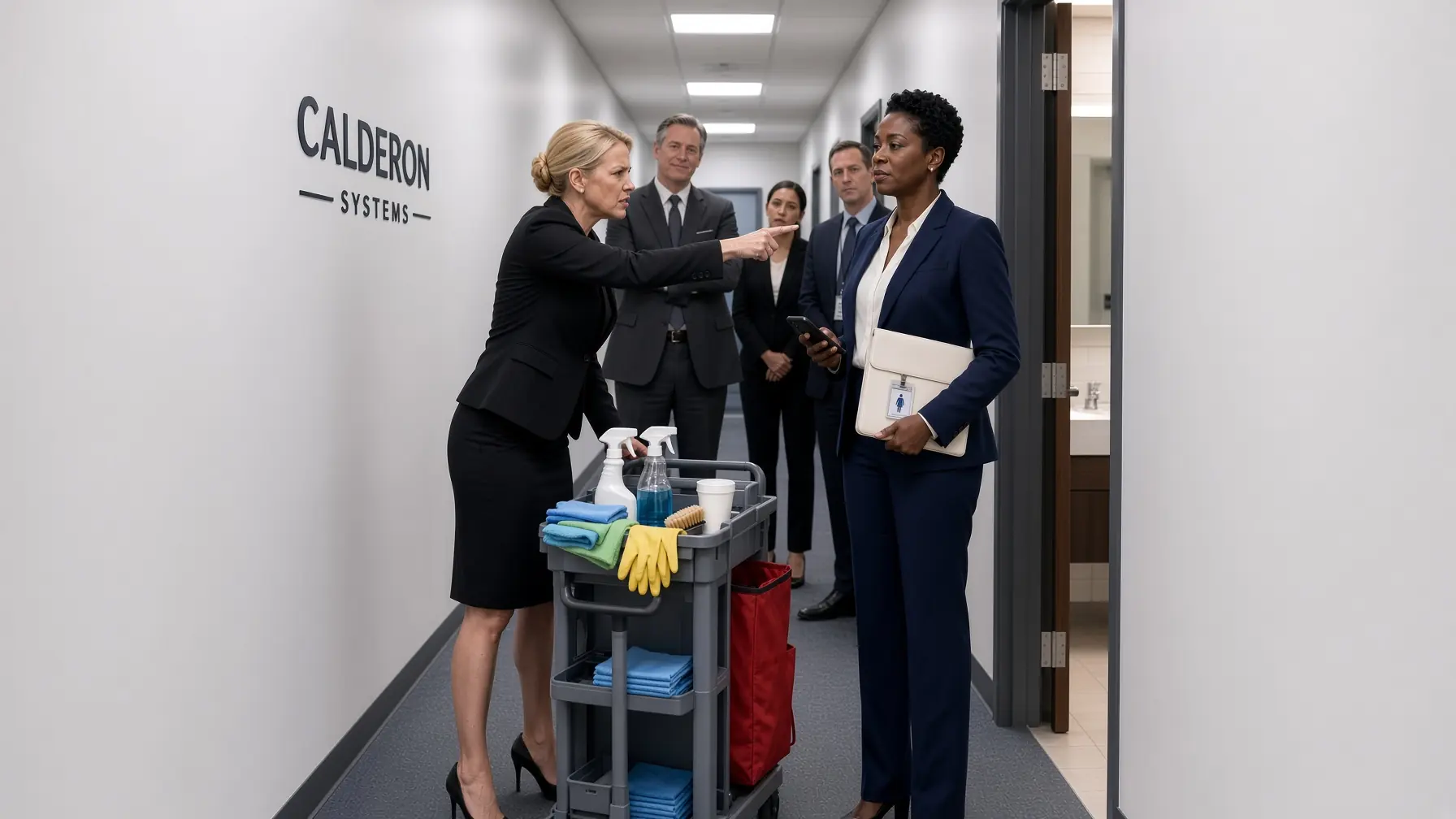
“On your knees. Do it properly this time.”
The command landed against the marble walls of the executive restroom with a flat, ugly echo. Naomi Pierce stood near the sink with a bottle of disinfectant in one hand and a plastic brush in the other, both items shoved at her so quickly she had barely had time to catch them. Her gray blazer was tailored, her black slacks neatly pressed, her leather flats expensive but quiet, and her hair was pulled back in a simple twist that made her look more like a consultant than cleaning staff.
That did not matter to the man standing in the doorway.
Clifford Shaw had already decided what she was.
He was white, fifty-four, broad through the middle, with the hard, impatient face of a man who believed every hallway existed to make room for him. His title was senior director of operations, but the way people stepped aside when he passed told Naomi the title did not fully explain his power. He pointed toward the far stall as if directing traffic around a stain.
“People like you always miss the corners,” he said. “Then the rest of us have to explain why standards are slipping.”
Naomi looked down at the supplies in her hands.
Then at Clifford.
Then at the polished restroom floor, which was so clean it reflected the ceiling lights in perfect white rectangles.
“This restroom appears clean,” she said.
Clifford laughed once, dry and dismissive.
“That is exactly the problem. You people think clean means good enough. Up here, good enough is failure.”
Behind him, two visiting consultants in navy suits stood awkwardly near the hall. One pretended to check his phone. The other glanced at Naomi, then away, embarrassed enough to know something was wrong but not brave enough to name it.
Clifford saw the discomfort and chose to perform harder.
“The new CEO is arriving today,” he said. “The executive floor needs to look flawless, not like some airport bathroom after midnight. So scrub it again, and don’t make me come back.”
Naomi held his gaze.
A long silence passed.
For a second, something moved behind Clifford’s eyes, a tiny irritation that she had not lowered hers quickly enough.
Then Naomi nodded.
“Understood.”
Clifford’s mouth curved with satisfaction.
He walked out with the consultants, still talking loudly about operational discipline and accountability. The restroom door swung closed behind him. Naomi stood alone beside the sink, brush in hand, disinfectant bottle pressed against her palm, her face calm enough that anyone watching might have believed she felt nothing.
That would have been a mistake.
Naomi Pierce had spent twenty-seven years in technology, finance, and corporate restructuring. She had been mistaken for an assistant in boardrooms where her signature approved the acquisition. She had been asked to fetch coffee at conferences where she was the keynote speaker. She had watched men read her strategy memo aloud and receive praise for ideas they had dismissed when she said them first.
She had learned not to waste anger in the room where the insult happened.
Anger was raw material.
You stored it.
Shaped it.
Sharpened it.
Then you used it where it could cut through something larger than one rude man.
Naomi set the brush on the counter, reached into her portfolio, and removed a black executive access badge. The badge carried the logo of Calderon Systems, the company she had acquired six days earlier through Pierce Meridian Capital. Beneath her photograph were the words Naomi Pierce, Chief Executive Officer.
She placed the badge beside the cleaning supplies.
Then she took out her phone and called her assistant.
“Evan,” she said when he answered. “Move the board introduction to four o’clock.”
A pause.
“Is something wrong?”
Naomi looked at the stall Clifford had ordered her to scrub.
“No,” she said. “Something is finally clear.”
She ended the call, opened her notes app, and typed one sentence.
Personal observation visit confirms culture risk is not theoretical.
Then she picked up the brush.
Not because Clifford had authority over her.
Because evidence sometimes required patience.
Naomi had not come to Calderon Systems that morning for ceremony.
The official announcement was scheduled for the next day. The press release had already been drafted. Board members had polished their talking points. The executive team expected a formal meeting, handshakes, controlled introductions, and the kind of polished corporate language that made every transition sound cleaner than it really was.
Naomi hated clean introductions.
They told her nothing.
So she entered through the main lobby at 8:10 a.m. with no entourage, no driver waiting at the curb, no diamond necklace, no visible symbols of power beyond the posture that came from having earned too much to ask permission anymore. Her badge remained tucked inside her portfolio. Her phone recorded nothing at first, because she wanted to see what people revealed before they felt watched.
The lobby was bright, all glass and pale stone.
Employees moved quickly through security gates with coffee cups, laptops, and faces already tired. Naomi noticed who held doors for whom. She noticed who greeted the front desk staff and who treated them like furniture. She noticed the clusters near the elevators, white men in quarter-zips laughing near the executive bank, younger employees of color waiting near the side elevators as if experience had taught them which spaces were safer to occupy.
Calderon Systems made enterprise workflow software for hospitals, state agencies, and logistics companies.
On paper, the company had strong products and weak margins.
In reality, Naomi suspected the numbers were hiding a deeper problem.
The acquisition review had already flagged unusual turnover among women and minority employees, repeated HR complaints closed without resolution, and promotion data that favored a narrow circle of managers connected to the old leadership team. But spreadsheets only showed outcomes. Naomi wanted to see behavior.
She got her first sample within seven minutes.
At the lobby security desk, a guard named Andre was being scolded by a woman in a charcoal dress.
The woman’s badge read Marlene Tate, Vice President, People Operations.
Naomi stood near the directory and listened.
“I don’t care if the badge system froze,” Marlene said. “Executives should not be delayed at security. Do you understand how that looks?”
Andre kept his voice low.
“Yes, ma’am. I was following the temporary protocol.”
“Protocols are for people who need them.”
Naomi made a mental note.
Marlene turned, noticed Naomi, and gave her a quick scan from shoes to face. There was no greeting in it. Only classification.
“You’re early,” Marlene said.
Naomi tilted her head slightly.
“Am I?”
“The contractor orientation is downstairs. Maintenance and facilities check in through the service hall, not the main lobby.”
Naomi let a small pause open.
“I was just getting familiar with the building.”
Marlene smiled with professional impatience.
“That is not how we do things at Calderon. We have procedures here.”
Of course you do, Naomi thought.
Procedures were useful.
They were also convenient hiding places.
Marlene pointed toward the service elevators.
“Sublevel one. Ask for facilities intake. They’ll issue your temporary uniform if they haven’t already.”
Naomi looked down at her blazer.
“My uniform?”
Marlene’s expression sharpened.
“If you’re with the new cleaning contractor, yes. If you’re not, then we have a different problem.”
Naomi nodded once.
“Thank you for clarifying.”
Marlene turned away, already done with her.
Naomi walked toward the service elevator, not because she had been ordered there, but because the order itself had value. Every assumption was a thread. Pull enough of them, and the fabric of a company began to show.
On sublevel one, she found the maintenance staff break area tucked behind two storage rooms and a loading corridor.
It was narrow, windowless, and smelled faintly of old coffee, floor wax, and damp cardboard. The chairs did not match. The microwave door was cracked along one side. A bulletin board carried outdated safety notices, most of them curling at the corners.
Five employees sat around a table.
Three Black women in cleaning uniforms.
One older Latino man wearing a facilities badge.
One young white man eating from a plastic container, looking nervous in the way new employees look when they are still learning what not to say.
Conversation stopped when Naomi entered.
A woman with a name tag reading Tasha looked her up and down.
“You lost?”
“Possibly,” Naomi said. “I was told contractor orientation was down here.”
Tasha laughed without humor.
“Of course you were.”
The older man shook his head.
“They see a Black woman with a folder and send her to us?”
Tasha looked toward the hall.
“Careful, Miguel.”
He shrugged.
“What are they going to do? Cut our hours again?”
Naomi pulled out a chair.
“Has that happened?”
The table went quiet again.
This silence was different from the first one.
The first silence had been caution. This one was calculation. Workers in companies like Calderon learned quickly that curiosity from strangers could be dangerous. Friendly questions often turned into reports. Reports turned into write-ups. Write-ups turned into suddenly poor performance reviews.
Naomi kept her voice soft.
“I’m not HR.”
Tasha smiled faintly.
“That’s exactly what HR would say.”
Fair.
Naomi nodded.
“Then don’t tell me anything you don’t want to.”
That answer did something.
Not enough to create trust.
Enough to keep the room from closing fully.
Miguel leaned back.
“They cut our supplies but complain the floors don’t shine. They track our bathroom breaks but the executives take two-hour lunches and call it relationship building. They denied Tasha a supervisor role twice, then hired a man from outside who asked her how to order mop heads.”
The young white worker looked at the table.
“That happened before I started.”
Tasha said, “It happened twice before you started.”
Naomi listened.
She did not write yet.
Writing too soon made people feel collected instead of heard.
A second woman named Denise spoke next. She had worked nights at Calderon for nine years. Her hours had been reduced after she complained about a chemical that made her cough. A third woman, Alana, said Marlene from HR once told her that braids were “too expressive” for the client-facing side of the building, though Alana never faced clients unless they got lost near the service hall.
Naomi asked three questions.
Specific ones.
Who said it?
When?
Was anything documented?
By the time she returned to the lobby, she had eight names, four dates, two potential retaliation patterns, and one growing certainty.
Calderon did not have a culture problem.
It had a caste system with software revenue.
On the executive floor, the problem stopped pretending.
The forty-first floor gleamed with money.
Glass walls.
White orchids.
Soft carpet.
Leadership portraits arranged along the hall in a line so pale and similar that the display looked less like company history and more like a family reunion. Naomi paused before the photos. Founder. Interim CEO. Chief Operating Officer. Chief Financial Officer. General Counsel. Every smile carried the same old message.
This is who power has looked like here.
From an office near the end of the hallway, Clifford Shaw’s voice floated out.
“No, I’m not worried about the new CEO. They always come in with transformation language. Give it ninety days, and the business reality beats the speeches out of them.”
Another man laughed.
Naomi moved closer, quiet on the carpet.
Marlene’s voice answered from inside the office.
“We just need to keep the reporting channels controlled. If every unhappy employee starts thinking the acquisition gives them permission to complain, we’ll drown in nonsense.”
Clifford said, “That is why HR exists.”
Naomi took out her phone and began recording.
A third voice spoke.
“What if the new CEO actually pushes diversity metrics?”
Marlene laughed.
“We have templates for that. Public commitment, internal review, listening sessions, one or two cosmetic promotions. We have done this dance before.”
Clifford added, “And if she tries to dig into operations, we slow-walk the data. Nothing gets to her without context from my office.”
Naomi recognized the third voice from the org chart.
Grant Weaver, finance director.
He sounded more anxious than committed.
“Still,” Grant said, “I looked up her record. Naomi Pierce is not ceremonial. She gutted Haverline’s executive team in six weeks.”
Clifford’s chair creaked.
“Haverline had amateurs. Calderon has infrastructure.”
Marlene replied, “Besides, if she is who they say she is, she’ll be sensitive to the optics of moving too aggressively. Women like that always have to prove they are not emotional.”
Naomi stood in the hallway, phone recording, face still.
Then she stepped away.
She had enough for the first file.
She did not yet have enough for the company.
That came twenty minutes later inside the executive restroom.
After Clifford ordered her to scrub the already spotless toilet, Naomi did exactly enough to remain in position. She put on gloves. She ran water. She moved a brush against porcelain that needed no cleaning.
Through the connecting wall, she could hear the executive lounge.
Clifford’s voice carried clearly.
“The post-acquisition containment plan is straightforward. We comply in form, delay in function. New directives go through operations before implementation. Anything disruptive gets buried under process concerns.”
One of the visiting consultants asked, “What about employee complaints? New owners often invite direct reporting.”
Marlene answered.
“We’ve already identified risk groups. Maintenance. Customer support. Implementation analysts. A few engineers with prior complaints. We can preempt most of it with performance documentation.”
Naomi slowly stopped moving the brush.
The consultant said, “That sounds exposed.”
“Only if someone reads the files without our summary,” Clifford said. “Which won’t happen.”
The second consultant, the younger one who had looked uncomfortable earlier, spoke quietly.
“What if the new CEO talks directly to staff?”
Marlene’s voice sharpened.
“Then we remind staff that proper channels exist for a reason.”
Clifford laughed.
“People at the bottom always think one new boss means the world changed. It never does.”
Naomi turned off the faucet.
She placed the brush in the sink.
Then she washed her hands with slow, deliberate care.
By the time she left the restroom, Clifford and the consultants had moved farther into the lounge. Naomi slipped into an empty conference room, locked the door, and called her legal lead.
“Priya,” she said. “We’re moving early.”
Priya Sethi did not ask if Naomi was sure.
That was why Naomi trusted her.
“How early?”
“Today. Four o’clock. Full executive team, HR, operations, legal, finance, and all department heads.”
“Cause?”
“Recorded discriminatory conduct, attempted obstruction, retaliation risk, and evidence of coordinated resistance to ownership transition.”
A brief silence.
Then Priya said, “So worse than diligence suggested.”
“Much worse.”
“Do you need security?”
“Yes, but quiet. I want Andre from lobby security included, not bypassed. And find out who supervises maintenance. I want their staff present at the all-hands.”
“Maintenance?”
“They have been the clearest truth-tellers in the building.”
Priya paused.
“Understood.”
Naomi ended that call and made another.
“Evan, tell the transition team to enter through the east executive elevator at 3:30. Bring the signed acquisition authority, emergency employment policy packet, and every executive personnel file from the data room.”
“Do we need press?”
“No.”
“Board?”
“Already authorized.”
“Naomi,” Evan said carefully, “how bad is it?”
She looked at the cleaning supplies still sitting on the conference table where she had placed them.
“They handed me a toilet brush.”
Evan was silent.
Then his voice went cold.
“Understood.”
Naomi hung up.
For the first time all morning, she let her expression change.
Not much.
Just enough for the anger to show in her eyes.
Then she put the mask back on and opened the door.
Clifford found her near the copy room twenty minutes later.
He was flushed, irritated, and surrounded by the kind of authority that required an audience to feel real. Marlene stood beside him with a tablet clutched to her chest. Two security officers trailed behind them, one of them Andre from the lobby.
Clifford pointed at Naomi.
“You. Stop right there.”
Naomi turned.
“Can I help you?”
His laugh was sharp.
“You can start by explaining why you were outside a restricted conference room taking notes.”
“I was observing.”
“Observing?” Marlene repeated. “You are not authorized to observe anything.”
Clifford stepped closer.
“Where is your badge?”
Naomi touched her portfolio lightly.
“Safe.”
“That is not an answer.”
“It is the accurate one.”
The hallway had begun to fill.
Employees watched from office doors and glass partitions. Some looked curious. Some frightened. Some satisfied, because public discipline of lower-status workers was part of how power reminded everyone else to stay in line.
Clifford turned to Andre.
“Escort her out. Check her bag for company documents and recording devices. Then revoke all maintenance contractor badges until further notice.”
Andre’s eyes flicked briefly to Naomi.
He knew.
Naomi saw the recognition.
He had been included in the transition briefing that morning. He knew exactly who stood in front of Clifford. To his credit, he did not overplay it. He simply stepped forward and said, “Ma’am, would you come with me?”
Clifford sneered.
“At least someone still understands chain of command.”
Naomi looked at Andre.
“Of course.”
They walked toward the elevator.
Once the doors closed, Andre spoke quietly.
“Ms. Pierce, I apologize.”
“No need. You handled it well.”
“They told us you might observe quietly. They didn’t tell us they’d mistake you for facilities.”
“They didn’t mistake me,” Naomi said. “They revealed themselves.”
Andre nodded once.
“Your team is on the way up.”
“Good. Bring me my badge.”
“Yes, ma’am.”
When the elevator opened again, the hallway was more crowded.
Clifford and Marlene were still there, waiting to watch the removal. That mattered to them. Power performed privately never satisfied people like them. They needed witnesses.
Clifford extended his hand.
“Before you leave, hand over whatever badge you used to access this floor.”
Naomi reached into her portfolio.
The executive elevator chimed.
Its doors opened.
Five people stepped out in clean formation: Priya Sethi from legal, Evan Brooks from executive operations, Daniel Cho from finance, Simone Reed from organizational transformation, and Chief Security Officer Andre Miles, who had taken the badge from the lobby guard and now walked beside them with calm authority.
Naomi lifted the badge.
The silver executive stripe caught the overhead light.
Clifford’s hand froze midair.
Marlene stared at the badge as if language had stopped working.
Naomi clipped it to her blazer.
“My credentials appear valid, Mr. Shaw.”
No one moved.
Then the hallway saw the name.
Naomi Pierce.
Chief Executive Officer.
The silence that followed was not empty.
It was full of people revising everything they had just witnessed.
Clifford’s face moved through confusion, disbelief, calculation, and fear so quickly it nearly became expressionless.
“There has been a misunderstanding,” he said.
Naomi looked at him.
“That word is doing a lot of work today.”
Marlene stepped forward with a brittle smile.
“Ms. Pierce, welcome to Calderon. This is obviously an unfortunate breakdown in communication. We were under the impression that you were with the contractor staff.”
“Yes,” Naomi said. “I know.”
Marlene’s smile weakened.
Priya opened a folder.
“Mr. Shaw, Ms. Tate, you will surrender company devices and badges pending investigation. You are being placed on paid administrative leave effective immediately.”
Clifford’s mouth hardened.
“You cannot do that.”
Naomi turned toward him.
“I can.”
He looked toward the gathered employees, searching for support. He found faces watching him with expressions he had not expected. Not loyalty. Not fear exactly. Something closer to hunger.
People who had spent years waiting for gravity.
“You have no idea how this company runs,” Clifford said.
Naomi’s voice remained calm.
“I learned more in four hours than your quarterly reports told me in four months.”
She looked toward the service corridor where Tasha, Miguel, Denise, and several maintenance workers had gathered cautiously.
“All staff access credentials remain active. Any credentials revoked in the last hour are to be restored immediately. Anyone sent home today will be paid for the full shift.”
Andre nodded.
“Already in motion.”
Naomi addressed the hallway.
“All-hands meeting in conference room A at four o’clock. Attendance is expected for leadership and open to every employee, including contractors. No one will be penalized for attending.”
That sentence moved through the hallway like weather.
Marlene whispered, “You’re going to invite contractors to an executive meeting?”
Naomi looked at her.
“I am going to invite the people who know how this company actually works.”
Conference room A had never held a meeting like that.
Executives took the front rows at first, out of habit, then began shifting awkwardly as maintenance staff, analysts, customer support workers, security officers, and engineers filled the room behind them. Naomi asked the rows to mix. Some people moved quickly. Others hesitated until Andre gently redirected them.
By 4:05, the room was full.
By 4:07, the company understood the old seating chart had ended.
Naomi stood at the front without a podium.
Her badge was visible.
The toilet brush sat on the table beside her.
Not dramatically displayed.
Just present.
A few people noticed it and looked away.
“Good afternoon,” she began. “I’m Naomi Pierce, CEO of Calderon Systems following the acquisition by Pierce Meridian Capital.”
No applause.
That was good.
Applause too early often meant people were still performing.
“I came here today without announcement because I wanted to see the company before it dressed itself for me.”
She let the sentence settle.
“What I saw was not one rude interaction. I saw systems. I saw assumptions built into security access, workplace space, promotion pathways, HR language, and executive behavior. I saw employees treated as disposable while being expected to keep the company functional.”
Clifford and Marlene were not in the room.
But everyone felt them there.
Naomi touched the edge of the table near the cleaning brush.
“This morning, I was handed cleaning supplies and told to scrub an already clean executive restroom because leadership assumed my place in this building before asking my name.”
A low murmur moved through the room.
She continued.
“That insult was personal. But the problem is structural.”
Priya advanced the first slide.
It showed promotion data by department, race, gender, and tenure.
No names.
Just patterns.
The patterns were enough.
Minority employees stayed longer in lower-paid roles. Women were concentrated in support functions. Promotions to management followed an informal sponsorship network tied to Clifford’s operations team. Complaints filed through HR resulted in higher transfer rates for complainants than for accused managers.
Naomi did not raise her voice.
Numbers did not need volume.
“This company has been wasting talent,” she said. “Not accidentally. Repeatedly.”
Marlene’s HR policies appeared next.
Outdated reporting protocols.
Subjective culture fit criteria.
Performance templates used disproportionately after discrimination complaints.
Then Clifford’s recorded comments played.
Not all of them.
Enough.
The room heard him discuss slowing directives, controlling information, preempting complaints, and maintaining old systems beneath new ownership.
Some executives looked at the floor.
Grant Weaver, the anxious finance director, looked ill.
Naomi turned off the recording.
“I am not interested in revenge,” she said. “Revenge is too small for what this company needs.”
She moved to the next slide.
“Effective immediately, Calderon Systems will begin a full organizational reset.”
Priya distributed digital policy packets to senior staff.
“First, all discrimination, harassment, and retaliation complaints from the past five years will be reopened by an independent outside firm. Not reviewed internally. Not summarized by the same people who closed them. Reopened.”
A ripple went through the employees.
“Second, promotion and compensation data will be audited across every department. Where disparities are found, corrections will be made.”
Daniel Cho stepped forward slightly, ready to own the finance portion.
“Third, HR reporting will no longer flow only through internal leadership. A third-party reporting system goes live tomorrow morning, with direct escalation to outside counsel and the board oversight committee.”
Marlene’s remaining HR staff looked stunned.
Some relieved.
“Fourth, no contractor, maintenance employee, security officer, or support worker will be removed from the building without documented cause and review. The people who clean this building are not easier to discard because their names are not on office doors.”
Tasha looked down at her hands.
Miguel stared straight ahead.
Denise wiped at one eye quickly, pretending not to.
“Fifth,” Naomi said, “we are creating a Workplace Integrity Council with representation from every level of the company. Not symbolic representation. Voting authority on operational policies affecting staff conditions, safety, and reporting.”
She looked toward the maintenance group.
“Tasha Greene, if you are willing, I would like you to serve as interim chair.”
Tasha’s eyes widened.
People turned.
She stood slowly.
“I clean this building at night,” Tasha said.
“I know.”
“I don’t have a management degree.”
“I did not ask for one.”
A few employees smiled.
Naomi continued, “You have documented unsafe conditions, trained new workers without title or pay, and according to Miguel, you know every place this company lies to itself.”
Miguel muttered, “I did say that.”
Tasha stared at Naomi for a long second.
Then she nodded.
“I’ll do it.”
That was the first applause.
Not loud at first.
Then stronger.
It came from maintenance, then customer support, then the analysts, then the engineers, and finally from a few executives who understood that clapping late was still better than not clapping at all.
After the meeting, the company did not change overnight.
Companies never do.
People who promise overnight transformation are either naïve or selling consulting hours. Calderon resisted. Quietly at first. Then more openly in pockets where old loyalties still had roots.
Some executives claimed Naomi had overreacted.
Some managers whispered that she had staged the whole day to justify purging the old leadership.
A few employees posted anonymously that standards were being lowered in the name of politics.
Naomi read those reports without surprise.
People who benefit from a tilted floor often describe leveling it as an attack.
The formal hearings began three days later.
Clifford arrived with an attorney and a face arranged into wounded dignity. Marlene submitted a statement describing the incident as unfortunate, isolated, and inconsistent with her values. Sandra phrases had many cousins in corporate America. Naomi had seen them all.
Priya presented evidence.
Chronology.
Audio.
Witness statements.
HR data.
Security footage.
Records of credential revocations.
Promotion denials.
Performance write-ups issued after complaints.
The toilet brush incident was only the opening door. Behind it was a hallway full of documents.
Clifford tried to defend himself.
“I made an assumption based on contractor activity during a high-risk transition.”
Priya looked at him.
“You ordered the CEO to clean a restroom.”
“I did not know she was the CEO.”
Naomi spoke then.
“That is not your defense. That is the evidence.”
Clifford’s attorney put a hand on his arm.
Marlene’s hearing was colder.
She understood language better than Clifford and therefore understood how badly the record condemned her. Emails showed she had closed complaints without interviews. She had advised managers on how to document employees as poor culture fits. She had personally edited performance reviews after workers raised concerns.
When asked about her comment hoping the new CEO was not “another diversity disruption,” she said the statement had been taken out of context.
Priya played the full recording.
Context did not help.
By the end of the week, Clifford Shaw was terminated for cause.
Marlene Tate was terminated for cause.
Three department heads resigned before their own hearings began.
Two managers were demoted.
One was cleared because the investigation showed he had objected privately and had been shut down. Naomi did not punish discomfort when it had not become complicity. But she also did not reward silence as courage.
Grant Weaver came to her office ten days after the all-hands meeting.
He stood in the doorway, pale and uncertain.
“I should have said something sooner,” he said.
Naomi looked up from a compensation audit.
“Yes.”
He flinched.
“I was afraid of losing my job.”
“I believe you.”
“I did not agree with them.”
“I believe that too.”
He looked relieved too soon.
Naomi closed the folder.
“But disagreement kept inside your own chest does not protect anyone but you.”
Grant nodded slowly.
“What do I do now?”
“You tell the truth in writing. Then you help finance identify every policy that made the truth expensive to tell.”
He did.
Not perfectly.
But honestly enough to matter.
Six months later, Calderon Systems no longer felt like the same company.
The building still stood in the same place.
The marble floors still shined.
The orchids were gone from the executive floor, replaced by staff artwork and product diagrams from teams who had never been asked what the walls should say. The leadership portraits had been moved to the archives, not destroyed, because Naomi believed history should be studied, not worshipped.
The executive floor opened physically first.
Then culturally.
Corner offices became team rooms. Senior leaders moved into shared workspaces. Maintenance and security offices were renovated before the executive lounge, which made some executives quietly furious and many staff quietly delighted.
Tasha Greene became director of workplace operations within nine months.
Not as charity.
Not as a symbol.
She earned it by finding inefficiencies the old leadership had overlooked for years because they never asked the people closest to the work. Supply waste dropped. Cleaning contracts became safer and fairer. Response times improved. Staff injuries declined.
Miguel became facilities training lead.
Denise joined the workplace safety council.
Andre rebuilt security procedures around respect, not suspicion.
The company’s products improved too.
That surprised outsiders.
It did not surprise Naomi.
A company that ignores half its people also ignores half its intelligence. Once Calderon began listening differently inside, it began solving differently outside. Customer support feedback reached product teams faster. Implementation analysts identified friction points executives had never seen. Engineers who had stopped volunteering ideas began speaking again.
Revenue rose by the third quarter.
Client retention improved.
Employee departures slowed dramatically.
The business press called it a turnaround.
Naomi called it proof that dignity was operational.
One year after acquisition day, Naomi returned to the executive restroom alone.
It had been renovated.
Not lavishly.
Thoughtfully.
The counters were lower in one section for accessibility. The lighting was softer. The supply closet had been moved to a shared service area where no worker had to enter executive-only space as if crossing a border. A small sign by the mirror read: Every space reflects who we value.
Naomi stood there for a moment.
She could still see Clifford in the doorway.
Still hear the words.
On your knees.
People like you.
She did not feel triumphant.
Triumph was too simple.
What she felt was older and steadier.
The knowledge that one humiliation had been forced to become more than pain. It had become evidence. Evidence had become action. Action had become structure. Structure had begun, slowly, imperfectly, to become culture.
A young engineer entered then, stopped, and smiled.
“Good morning, Naomi.”
Not Ms. Pierce.
Not CEO.
Naomi.
The company had asked for permission before adopting first-name culture, and Naomi had agreed only after it became clear the familiarity flowed both directions. Respect could survive informality. It could not survive fear pretending to be professionalism.
“Good morning,” Naomi said.
The engineer washed her hands, then hesitated.
“I wanted to tell you the new promotion framework helped me apply for team lead. I would not have done it before.”
“Did you get it?”
“Second interview tomorrow.”
Naomi smiled.
“Good. Make them explain why not, if they say no.”
The engineer laughed.
“I will.”
After she left, Naomi looked at the mirror.
The woman looking back at her was fifty now.
Older than when the industry first started mistaking her for someone else. Tired in some places. Sharper in others. Still here.
Later that day, she gave the keynote at a national leadership conference.
The organizers wanted her to tell the Calderon story because it had become popular in business circles: the Black CEO mistaken for cleaning staff who turned a toxic company into an industry model. They wanted the satisfying version. The one with a villain, a reveal, a firing, and a standing ovation.
Naomi gave them something harder.
“The lesson is not that Clifford Shaw mistook the wrong woman for maintenance,” she said from the stage. “There is no right woman to humiliate. There is no right worker to degrade. There is no job title low enough to make disrespect acceptable.”
The room went quiet.
Good.
Quiet meant the sentence had arrived.
She continued.
“The real issue was not one man’s prejudice. It was a system that allowed his prejudice to become procedure. It was an HR department that protected managers from consequences. It was a promotion process that rewarded sameness and called it fit. It was a workplace where the people closest to the truth had the least protection for telling it.”
She looked across the audience of executives, founders, investors, and managers.
“Culture is not what your website says. It is what happens to the person nobody thinks is powerful.”
That line traveled farther than she expected.
It appeared in articles, leadership decks, university lectures, and training programs. Some people quoted it sincerely. Others used it as decoration. Naomi knew the difference would always matter less than whether someone in a room somewhere finally looked at the cleaner, the guard, the assistant, the contractor, the junior analyst, and understood they were not background.
Back at Calderon, the work continued.
There were still complaints.
Still hard conversations.
Still managers who had to unlearn the belief that authority meant convenience.
Still employees who did not trust the new systems because old wounds do not close on a schedule chosen by leadership.
Naomi accepted that.
Transformation was not a speech.
It was maintenance.
The kind that had to be done regularly, carefully, and in the corners people liked to pretend were already clean.
On the second anniversary of the acquisition, Tasha invited Naomi to the renovated staff lounge.
It no longer sat hidden behind storage.
It had windows now.
Real chairs.
A clean coffee machine.
A bulletin board filled with promotions, baby pictures, union information, safety updates, and one printed photograph from the day of the first all-hands meeting. Naomi stood in the photo at the front of conference room A. Tasha stood halfway up from her chair, surprised and uncertain. The toilet brush sat on the table between them like an artifact from a worse civilization.
Naomi looked at the picture.
“Who printed that?”
Miguel raised his hand.
“History.”
Naomi laughed softly.
“Could have chosen a better angle.”
“No,” Tasha said. “That angle tells the truth.”
Naomi looked around the room.
At the people who had kept the building running when leadership refused to see them.
At the employees who had stayed long enough to help rebuild.
At the young managers who would never fully understand how bad it had been, and thank God for that.
She thought of Clifford Shaw, who had tried to turn her into a lesson about place.
He had succeeded.
Just not the way he intended.
Years later, when people told the story, they always started with the restroom.
They liked the shock of it.
A Black woman ordered to her knees.
A CEO badge on the counter.
A powerful man exposed by his own contempt.
That part was easy to tell because it had a clean twist. But the deeper story was not the moment Naomi revealed who she was. It was everything that happened before and after. The workers who had known the truth for years. The silence that had protected the wrong people. The data that turned private pain into public proof. The decision to fix the system, not simply punish the man.
Naomi never forgot what Clifford said.
People like you always miss the corners.
In one sense, he had been right.
People like Naomi had learned to study corners carefully.
Corners were where companies hid what they did not want visitors to see. Corners held the break rooms with broken chairs, the complaint files marked resolved, the performance reviews rewritten after someone spoke up, the names of people who left quietly because fighting cost too much.
Corners held the truth.
So Naomi cleaned them.
Not with the brush he handed her.
With audits.
Policies.
Witnesses.
Promotions.
Consequences.
Money.
Power.
And the stubborn belief that a company worth saving had to be made safe for the people who were never supposed to be noticed.
That was the real work.
Not the reveal.
Not the applause.
Not the headlines.
The real work was making sure that years later, when a Black woman walked through Calderon’s revolving doors in a blazer with a portfolio under her arm, nobody assumed she was lost.
And if anyone did, the system around them would no longer know how to protect that mistake.