Marcus Hale did not know the night was waiting for him.
At 9:43 p.m., he only wanted to get home.
He had spent fourteen hours inside a glass office tower on Wexler Avenue, listening to executives explain numbers they did not understand and watching tired analysts pretend they were not afraid of missing deadlines. His shirt collar felt too tight. His jacket was folded across the passenger seat. His laptop bag sat beside it, full of reports, notes, and the kind of paperwork that made honest work feel heavier than it looked.
The city had gone quiet by then.
Not peaceful.
Quiet.
There is a difference. Peace feels open. This kind of quiet felt like the streets were holding their breath. The traffic lights blinked over empty intersections, storefront gates were pulled down, and the few cars still moving through downtown Ashford seemed to pass one another without wanting to be noticed.
Marcus turned the radio low and headed east toward his apartment.
He was thinking about reheating leftovers.
He was thinking about calling his sister back before she got mad.
He was thinking about sleep.
Then headlights appeared behind him.
Bright.
Close.
Too close.
At first, he moved into the right lane so the car could pass. It followed him. He slowed slightly, thinking maybe the driver was drunk or impatient. The car stayed with him, hugging the rear bumper like it had been tied there.
Then the red and blue lights came on.
Marcus exhaled slowly.
His hands moved to ten and two on the wheel before the siren finished its first cry.
He had no criminal record.
No unpaid tickets.
No weapons in the car.
No reason to panic.
Still, his chest tightened the way it always did when a patrol car decided his night was no longer his own.
He pulled onto the shoulder beside an old pharmacy with a dark sign and a cracked parking lot. There were cameras on the corner, one above the traffic signal and one above the pharmacy door. Marcus noticed both without turning his head too obviously.
That habit had kept him alive in places where mistakes did not always look dramatic.
They looked like small assumptions made too quickly.
Two officers stepped out of the cruiser.
The first was Sergeant Calvin Briggs, a white man in his mid-forties with narrow eyes, a trimmed mustache, and the cold patience of someone who preferred control over conversation. His uniform was pressed clean. His boots were polished. His face carried the confidence of a man used to writing the first version of every story.
Behind him came Officer Dean Mercer.
Mercer was heavier, younger, and less disciplined. He moved with the loose swagger of someone who enjoyed being feared but had not learned to hide that enjoyment well. His flashlight swept across Marcus’s rear window, then down the side panels, then into the back seat like he was already disappointed he had not found something.
Briggs stopped at the driver’s window.
“License and registration.”
Marcus kept his voice even.
“Good evening, Officer. Can you tell me why I was stopped?”
Briggs angled the flashlight directly into his eyes.
“License and registration.”
Marcus blinked against the beam and reached slowly toward his wallet.
“My license is in my right back pocket. Registration is in the glove compartment. I’m going to get them now.”
“Just do it.”
Marcus handed them over.
Mercer walked behind the car.
Marcus watched him in the side mirror.
The officer paused near the trunk.
Then disappeared from view.
A second later, Marcus heard the trunk release click.
His body went still.
“Officer,” Marcus said carefully, “why is my trunk being opened?”
Briggs pulled the driver’s door open before answering.
“Step out of the vehicle.”
“I’m asking why my trunk is being searched.”
“Step out now.”
Marcus stepped out with both hands visible.
Cold night air pressed against his face. A passing car slowed, then kept moving. Somewhere down the block, a dog barked once and stopped. The city seemed far away all at once, as if the shoulder of the road had become a room with no witnesses.
Mercer stood at the open trunk.
He smiled before he spoke.
“Well, look at that.”
Marcus turned his head.
Inside the trunk sat a gray duffel bag he had never seen before.
Mercer unzipped it slowly, with the patience of a bad actor enjoying his close-up. He reached inside and pulled out thick bundles of cash wrapped in rubber bands. Then he pulled out a handgun wrapped in a dark towel.
For one strange moment, Marcus’s mind refused to accept the image.
The gun.
The cash.
His trunk.
Their faces.
It felt staged because it was staged, but knowing that did not make the danger smaller.
“That bag is not mine,” Marcus said.
Briggs took his arm and turned him hard toward the car.
“Hands behind your back.”
“I don’t know where that came from.”
Cold metal closed around his wrists.
Mercer laughed.
“They always start with that.”
Marcus looked back at him.
“I am telling you that bag was placed there.”
Briggs leaned close enough that Marcus could smell coffee and wintergreen gum on his breath.
“Then I guess you’re having a very unlucky night.”
They pushed him into the back of the cruiser.
The door slammed.
The sound was final in a way Marcus knew well. A locked door does not care whether you are innocent. A cage does not ask who wrote the report. The air inside smelled like old sweat, vinyl, and fear left behind by people who had sat there before him.
Through the windshield, he watched Briggs and Mercer stand at his trunk.
Mercer said something.
Briggs laughed.
Then they both looked at him.
That look told Marcus more than the gun had.
This was not a misunderstanding.
This was a practiced move.
The cruiser pulled away at 9:58 p.m.
Mercer sat in the passenger seat, rolling Marcus’s license between his fingers like a poker chip.
“You look nervous back there, Hale.”
Marcus said nothing.
Briggs glanced in the rearview mirror.
“Nervous men usually have reasons.”
“I want a lawyer.”
Mercer laughed.
“Already? We haven’t even had our conversation yet.”
“I want a lawyer.”
Briggs shook his head.
“Suit yourself.”
Then he added, not quite low enough to hide it, “Guys like him always think the lawyer saves them.”
Mercer snorted.
“Guys like him usually fold before morning.”
Marcus looked at the back of their heads.
Guys like him.
He knew the phrase.
It did not need a full explanation.
Men like Briggs and Mercer used those words when they wanted to say race, class, job, fear, or weakness without putting the full thought on record. They thought Marcus was just another Black man driving a decent car too late at night with no one important waiting to ask questions.
That was their first mistake.
Their second mistake was assuming he was surprised.
At the station, they brought him through a side entrance.
No lobby.
No front desk.
No casual chance for civilians to see him arrive.
They walked him past holding cells and into an interrogation room with a metal table, two chairs, and a camera in the upper corner. The camera had a small red light. Marcus noticed it, then noticed the second camera in the corner behind him.
Briggs uncuffed him from behind and recuffed one wrist to the table.
Mercer dropped a folder in front of him.
“You know Crestview Bank?”
Marcus looked at him.
“I know where it is.”
“Funny. It got robbed tonight.”
“I had nothing to do with that.”
Briggs sat across from him.
“Cash missing. Gun displayed. Suspect left in a dark sedan.”
“A dark sedan,” Marcus repeated.
Mercer smiled.
“You drive a dark sedan.”
“So do thousands of people in this city.”
“But thousands of people didn’t have cash and a gun in the trunk.”
Marcus leaned back as far as the cuff allowed.
“That bag was planted.”
Briggs opened the folder.
“Bad strategy.”
“It is the truth.”
“You know what truth looks like to a jury?” Briggs asked. “Evidence. The evidence is in your car.”
“Evidence you planted.”
Mercer came off the wall fast.
His palm struck the table hard enough to make the folder jump.
“You better watch yourself.”
Marcus did not flinch.
That bothered Mercer.
People usually flinched when he wanted them to.
Marcus kept his eyes on Briggs.
“I want a lawyer. I am not answering questions.”
Briggs studied him for a long moment.
“You sure?”
“Yes.”
“Because the gun already has prints.”
Marcus let the silence sit.
Mercer grinned.
“Your prints.”
Marcus looked at him.
“That would be difficult.”
“Why?”
“Because I have never touched that gun.”
Briggs closed the folder.
“People say all kinds of things when they’re scared.”
Marcus leaned forward.
“I am not scared of the truth.”
Mercer’s smile thinned.
“You should be scared of what happens before anybody gets to it.”
They held him overnight.
The cell smelled like bleach and old despair. A man on the opposite bench slept with his arm over his eyes. Another whispered to himself in short bursts. Marcus sat with his hands folded, feeling the cuff marks burn around his wrists and replaying the stop over and over.
The headlights.
The lane change.
The trunk click.
Mercer moving behind the car.
The bag appearing like a magic trick performed by men with guns.
He did not sleep.
At 6:10 a.m., an officer brought him coffee in a paper cup. It was bitter, lukewarm, and tasted faintly of the machine. Marcus drank it anyway because anger worked better when the body did not shake from exhaustion.
By 8:00, the story had reached the local news.
The television outside the holding area showed his face in a blurred image taken from his driver’s license photo. The anchor spoke with that smooth concern television people use when someone else’s life is becoming entertainment.
A local man is in custody after police say cash and a firearm connected to last night’s Crestview Bank robbery were found inside his vehicle during a traffic stop.
Marcus looked away.
His name was now a headline.
His work badge.
His apartment.
His face.
His innocence, at least publicly, had become an opinion.
A public defender came before noon.
Her name was Lydia Grant, and she did not look like the kind of lawyer men like Briggs expected. She was in her late forties, Black, tired-eyed, with a gray streak near her temple and a leather briefcase worn enough to suggest use rather than style. She entered the interview room, shut the door, and sat down without wasting a word.
“You’re Marcus Hale.”
“Yes.”
“You’re charged with armed robbery, possession of a firearm during commission of a felony, and possession of stolen currency.”
“I didn’t do it.”
“Most people say that.”
Marcus met her eyes.
“I know.”
That answer made her pause.
She opened the file.
“The officers say they stopped you for drifting over a lane marker. They say they observed your trunk partially open. They say they checked it for safety reasons and found a bag containing stolen cash and a gun.”
“They are lying.”
“Tell me exactly what happened.”
He did.
No emotion added.
No drama.
Only sequence.
The headlights. The stop. The trunk release. Mercer disappearing behind the car. Briggs opening the door before explaining anything. The bag already there when Marcus saw the trunk.
Lydia took notes.
When he finished, she said, “Where were you during the robbery?”
“At work.”
“Can anyone prove that?”
“My building badge. Parking garage entry and exit. Computer login. Emails. Conference room camera, maybe.”
“What time did you leave?”
“9:34 or 9:35.”
“The robbery happened between 9:06 and 9:12.”
“Then I was still at work.”
“That helps.”
“It proves I wasn’t there.”
“It proves you were not inside the bank,” Lydia said. “The state may argue you received the bag after the robbery or helped coordinate. If the cash and gun stand, they will build a theory around them.”
Marcus studied her.
“You believe me?”
Lydia did not answer too quickly.
“I believe officers plant evidence more often than prosecutors admit.”
That was the first honest comfort he had heard since the stop.
“But belief is not enough,” she continued. “We need proof.”
“There are cameras at the intersection.”
She looked up.
“You saw them?”
“One traffic camera behind the cruiser. One camera over the pharmacy door. Maybe a bus lane camera farther back.”
“Good.”
“You need to get them fast.”
“I know.”
Marcus lowered his voice.
“Before they disappear.”
Lydia held his gaze.
“They will not disappear if I get there first.”
Bail came late that afternoon.
A coworker named Evan Royce posted it after Marcus called his office. Evan did not say much when Marcus stepped out of the jail. He only handed him a clean shirt, a bottle of water, and a quiet nod that kept Marcus from breaking in front of the cameras.
Reporters shouted questions from behind the barricade.
“Mr. Hale, did you rob Crestview Bank?”
“Were you working with anyone inside?”
“How do you explain the weapon?”
“Did police find your fingerprints?”
Marcus kept walking.
He had spent enough time around investigations to understand that innocence spoken in panic can sound like guilt to people who already like the headline. So he said nothing. His silence became another clip on the evening news.
At home, his apartment felt both familiar and unreal.
The couch.
The dishes in the sink.
The jacket he had planned to throw over the chair.
The leftovers still in the refrigerator.
His life had continued sitting there, untouched, while the world outside decided whether he was a criminal.
He stood in the middle of the living room for a long time.
Then he called his sister.
Denise answered on the first ring.
“Marcus.”
Her voice broke on his name.
“I’m okay.”
“No, you’re not.”
“No,” he admitted. “I’m not.”
She cried quietly for a moment, and he let her. Denise was the only person who still remembered him as the boy who used to take apart radios on the kitchen floor, the teenager who wore church shoes until the soles split, the young man who left home promising their mother he would do something that mattered.
“You tell me the truth,” she said.
“I didn’t do it.”
“I know that.”
He closed his eyes.
That sentence nearly undid him.
Not everyone needs evidence before choosing to love you.
But the court would.
The trial came faster than Marcus expected.
The prosecution wanted momentum. Dirty evidence works best before people have time to examine the dirt. They built the case around simplicity, because simple stories win when juries are tired and afraid.
A bank was robbed.
A car was stopped nearby.
Cash and a gun were found in the trunk.
The driver denied everything.
The prosecution called that denial predictable.
Sergeant Calvin Briggs took the stand in dress uniform.
He looked clean, calm, and respectable.
That was part of the performance.
He described the stop with steady confidence. He said Marcus had drifted across lanes twice. He said the trunk appeared unsecured. He said Officer Mercer saw part of a bag through the opening. He said Marcus became defensive and evasive when questioned.
Each lie came out polished.
Each lie carried the weight of a badge.
Lydia cross-examined him without raising her voice.
“Sergeant Briggs, did Mr. Hale give consent to search his trunk?”
“No.”
“Did you have a warrant?”
“No.”
“Did dispatch identify Mr. Hale’s vehicle as connected to the bank robbery before the search?”
“No.”
“Did you see cash or a weapon before opening the trunk?”
Briggs shifted.
“Officer Mercer observed a suspicious bag.”
“That was not my question. Did you see cash or a weapon before opening the trunk?”
“No.”
“Did your body camera capture the trunk before it was opened?”
“It malfunctioned during part of the stop.”
Lydia tilted her head.
“It malfunctioned exactly before the evidence was discovered?”
Briggs’s jaw tightened.
“It stopped recording unexpectedly.”
“Has your body camera stopped recording unexpectedly before?”
The prosecutor objected.
The judge allowed a narrower question.
Lydia nodded and asked, “How many times in the past year has your body camera failed during a search?”
Briggs hesitated.
“I don’t have that number.”
“I do,” Lydia said.
The courtroom stirred.
The prosecutor objected again.
This time the judge told Lydia to save it for later.
But the jury had heard enough to know there was a number.
Officer Mercer testified after lunch.
He was less careful.
He described Marcus as nervous, sweating, looking around, refusing simple cooperation. He said the trunk lid was cracked open enough for him to see the gray bag. He claimed he opened it to prevent evidence destruction, though no one had asked how a handcuffed driver standing beside Briggs could destroy anything in a closed trunk.
Lydia watched him closely.
“You stated you saw the bag before opening the trunk.”
“Yes.”
“How far open was the trunk?”
“Maybe two or three inches.”
“Enough to identify a gray bag?”
“Yes.”
“At night?”
“With my flashlight.”
“And you did not photograph the condition of the trunk before opening it?”
“No.”
“You did not call for a supervisor?”
“No.”
“You did not wait for consent or a warrant?”
“No.”
Mercer smiled slightly.
“We had exigent circumstances.”
Lydia looked at him.
“Officer Mercer, do you know what that phrase means?”
The smile vanished.
The prosecutor objected.
Sustained.
But again, the jury heard it.
On the second day, the prosecution introduced the gun.
It sat in a clear evidence box, dull and ugly beneath courtroom lights. Marcus looked at it and felt nothing but cold recognition of how easily an object can become destiny when placed by the right hands in the wrong place.
The prosecutor said his fingerprints were on it.
Lydia challenged the chain of custody.
The analyst admitted the print report was partial, hurried, and based on a low-confidence match. She admitted the gun had been handled by multiple officers before reaching the lab. She admitted the original evidence bag had a torn seal.
The prosecution tried to move past it quickly.
Lydia did not let them.
By the third day, the case no longer looked clean.
But it still looked dangerous.
Juries do not always need certainty to convict. Sometimes they only need enough fear to believe the state would not come this far without reason. Marcus knew that. Lydia knew it too.
That night, she called him at 11:18.
“I found something.”
Marcus sat up.
“What?”
“Traffic camera footage from the intersection.”
He closed his eyes.
“And?”
“Come to court tomorrow prepared for everything to change.”
The courtroom was full the next morning.
The local news had begun sniffing something unusual. Harris and Mercer sat behind the prosecutor, both trying to look bored. Marcus watched them from the defense table and saw what they could not fully hide.
Tension.
Not fear yet.
But tension.
Lydia stood after the first witness.
“Your Honor, the defense has obtained video evidence from a city traffic camera that directly contradicts sworn testimony given in this courtroom.”
The prosecutor stood immediately.
“We object. We have had insufficient time to authenticate the recording.”
Lydia handed documents to the clerk.
“The city traffic office has provided chain-of-custody certification. The footage was retrieved from municipal servers through subpoena and delivered with timestamp metadata intact.”
The judge reviewed the paperwork.
Then he looked at the prosecutor.
“I am going to allow it.”
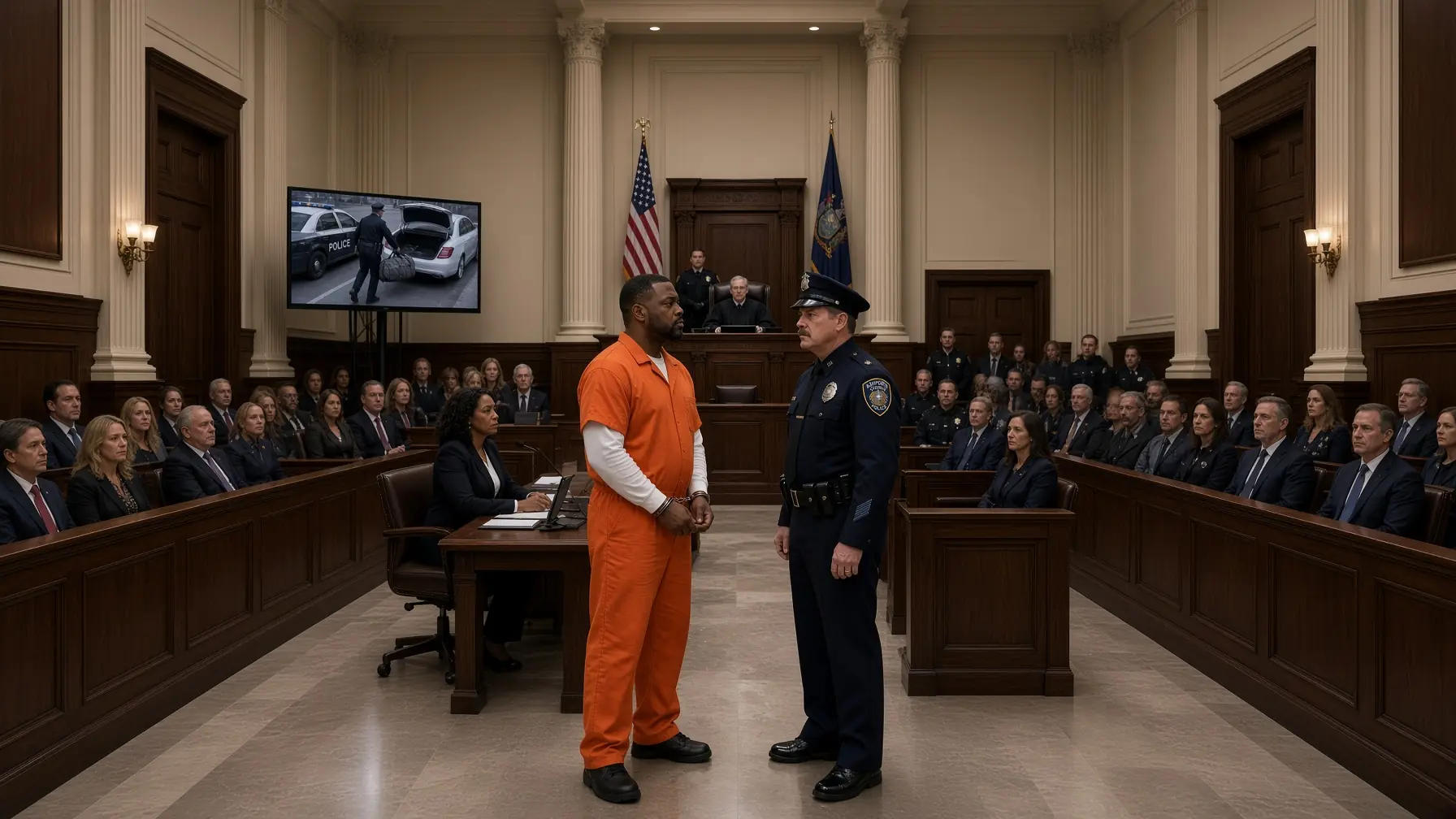
The screen lowered.
The lights dimmed.
The video began.
Grainy night footage showed Marcus’s sedan pulling onto the shoulder. The cruiser stopped behind him. Briggs walked to the driver’s side. Mercer moved toward the back of the cruiser, not the trunk.
For several seconds, he disappeared behind the open cruiser door.
Then he stepped out carrying a gray duffel bag.
The courtroom froze.
Mercer walked toward Marcus’s car, looked once toward Briggs, then lifted the trunk and placed the bag inside.
He stepped back.
Waited.
Then leaned in again, as if discovering it.
No one breathed.
The video continued in cold silence.
Marcus felt his hands tighten beneath the table.
There it was.
The lie outside his body.
Proof that did not need him to sound convincing.
Proof that could not be shaken, exhausted, intimidated, or accused of having an attitude.
Mercer stood suddenly.
“That’s not real.”
The judge snapped, “Sit down.”
Briggs’s face had gone gray.
The prosecutor stared at the screen, then down at her notes, as if the paperwork might rearrange itself into innocence if she looked hard enough.
Lydia turned toward the officers.
“You said the trunk was already open.”
Neither answered.
“You said you saw the bag inside.”
Silence.
The judge’s voice cut through the room.
“Sergeant Briggs. Officer Mercer. You will remain seated.”
Mercer started to speak again.
Two bailiffs moved closer.
That was when Marcus stood.
Lydia looked at him, then gave one small nod.
He reached inside his jacket and removed a leather credential case.
He opened it.
A gold federal shield caught the courtroom light.
“My name is Marcus Hale,” he said, voice steady. “I am a federal investigator assigned to a joint public corruption task force. For eight months, I have been assisting an investigation into evidence planting, unlawful searches, and coordinated false arrests involving officers in Ashford County.”
The courtroom erupted.
The judge struck the bench with his gavel.
Marcus did not look away from Briggs and Mercer.
“Sergeant Briggs and Officer Mercer have been targets of that investigation since March.”
Briggs shot up.
“You set us up.”
Marcus looked at him.
“No. You stopped my car. You opened my trunk. You planted the bag. You lied under oath.”
Mercer’s face twisted.
“You were bait.”
“I was driving home from work,” Marcus said. “You provided the rest.”
The judge ordered both officers detained pending investigation.
The prosecutor asked for a recess, her voice shaking slightly.
The judge granted it.
Bailiffs placed cuffs on Briggs first.
Then Mercer.
The sound of metal closing around their wrists moved through Marcus like an old echo returning to the correct room.
Mercer stared at him with naked hatred.
Briggs looked not angry, but stunned, as if the universe had violated an agreement he thought he had with it.
Men like Briggs did not believe consequences were impossible.
They believed consequences were for other people.
By afternoon, all charges against Marcus were dismissed.
Outside the courthouse, reporters crowded the steps so tightly that deputies had to form a path. Microphones rose toward his face.
“Agent Hale, how long were you investigating the department?”
“Were the officers connected to other false arrests?”
“How many people were framed?”
“Why did you keep your identity secret?”
Marcus stopped near the bottom step.
He had imagined this moment many times during sleepless nights, but the reality felt heavier. Cameras loved a reveal. They loved the twist. They loved the idea that corrupt officers had accidentally framed the one man who could bring them down.
But Marcus could not enjoy it.
Not fully.
He thought about the holding cell.
The television headline.
The people who had looked at him and seen a criminal because two officers wrote it down.
He leaned toward the microphones.
“I was lucky,” he said.
The reporters quieted.
“I had training. I had resources. I had people who knew where to look. Most people targeted by corrupt officers do not. If this could happen to me, it has already happened to others. That is where the work begins.”
Then he walked away.
The work began faster than anyone expected.
Once Briggs and Mercer were arrested, the first crack opened.
Then another.
Then another.
A records clerk came forward with copies of evidence logs that did not match arrest reports. A retired patrol officer admitted certain teams used “insurance bags,” weapons and drugs kept off-book in case an arrest needed help becoming solid. A former assistant prosecutor revealed she had questioned multiple Briggs cases years earlier and been told not to damage relationships with the department.
Old cases were pulled from storage.
Boxes filled hallways.
Names emerged.
Darnell Shaw, arrested with a gun found under his passenger seat after a traffic stop with no camera footage.
Luis Ortega, charged after cash appeared in his van during a drug investigation that produced no drugs.
Henry Bell, who took a plea because his public defender told him no jury would believe him over two officers.
Tanya Brooks, a rideshare driver accused of carrying stolen electronics that later traced back to an evidence locker.
The pattern was not random.
It was business.
Briggs had built the system.
Mercer had helped run it.
Others had looked away, benefited from it, or told themselves they were not close enough to be responsible.
Marcus read the files late into the night.
Sometimes he had to stop because the anger became too large to use safely.
One line from Mercer’s cooperation statement stayed with him.
We picked people who already looked guilty to somebody.
That was the whole machine in one sentence.
Not guilty.
Looked guilty.
To somebody.
Somebody with power.
Somebody with a badge.
Somebody with a report template and a prosecutor willing to trust what came stamped from the department.
Lydia Grant joined the conviction review team.
No one was more surprised than she was.
At first, she said she did not have time. Then she read the first three case files and stopped arguing with destiny. She moved into a temporary office near the courthouse, sleeves rolled up, hair clipped back, surrounded by boxes and coffee cups.
Marcus found her there one night at 1:00 a.m.
She had a file open in front of her and both hands pressed to her temples.
“Bad one?” he asked.
“They’re all bad.”
He sat across from her.
She pushed the folder toward him.
“Eighteen-year-old kid. Pled to possession of a weapon. Briggs claimed he saw the handle under the seat. Body cam turns off thirty-eight seconds before the search. Kid said the gun wasn’t his. Nobody believed him.”
Marcus opened the file.
“What happened to him?”
“Served three years. Came home. Couldn’t get work. Violated parole. Back inside.”
Lydia leaned back.
“When I first met you, part of me thought, here we go again. Another client saying cops planted evidence.”
Marcus looked up.
“And now?”
“Now I wonder how many times I heard the truth and didn’t have enough time, money, or imagination to prove it.”
The room went quiet.
Marcus did not comfort her too quickly.
Some guilt deserved to be felt long enough to change a person.
Finally, he said, “You proved mine.”
“Because there was a camera.”
“Because you looked for it.”
She nodded slowly.
“I should have looked harder before.”
“Yes,” Marcus said. “And now you are.”
That was all either of them needed.
The first exoneration happened five months after the trial.
Henry Bell walked out of prison under a gray sky with his daughter waiting at the gate. She had been eight when he went in and thirteen when he came out. For a moment, they stood looking at each other like time had made them strangers and blood was trying to repair the distance.
Then she ran to him.
Henry folded around her and broke.
Marcus watched from beside a government sedan, far enough away that the family would not feel observed. Lydia stood beside him, crying silently and pretending the wind was the reason.
“He lost five years,” she said.
“Yes.”
“How do you pay that back?”
“You don’t,” Marcus said. “You tell the truth, and you stop pretending that is enough.”
Briggs and Mercer went to trial the following spring.
Mercer had cooperated, but not out of conscience.
Out of fear.
He testified against Briggs, naming officers, routes, methods, evidence sources, and prosecutors who should have asked harder questions. His voice shook when he described the night they stopped Marcus. He claimed he did not know Marcus was a federal investigator.
Nobody cared.
The point was not that they had planted evidence on the wrong man.
The point was that there was no right man.
Briggs remained defiant.
He said the investigation was political.
He said crime was hard and officers had to make decisions under pressure.
He said people like Marcus did not understand the street.
Marcus listened from the back row and thought of the gray duffel bag in his trunk.
The jury convicted Briggs on every major count.
Mercer received a reduced sentence for cooperation but still went to prison.
Two supervisors resigned.
One evidence technician was indicted.
Three old convictions were vacated within the first year.
More followed.
The city paid settlements it could not hide behind legal language anymore.
At sentencing, the judge addressed Briggs directly.
“You did not merely break the law,” she said. “You manufactured guilt. You turned innocent citizens into defendants, then allowed the machinery of the state to grind them down while you stood behind a badge.”
Briggs looked at the table.
For once, he had no report to write.
No narrative to control.
No trunk to open.
The sentence was long.
Not long enough for everyone he had harmed.
But long enough for the city to understand that something real had broken open.
Years later, Marcus still remembered the moment the traffic camera footage played in court.
Not the reveal of his badge.
Not the reporters.
Not even the cuffs going onto Briggs and Mercer.
The footage.
That gray, grainy, unblinking image of Mercer carrying the bag toward his trunk.
It stayed with him because it showed how small injustice can look while happening.
No thunder.
No music.
No dramatic confession.
Just a man in uniform carrying a bag through a patch of streetlight.
A movement that took less than ten seconds.
A lie that could have cost Marcus decades.
He kept a printed still from the footage in his office.
Not the frame where the bag entered the trunk.
The frame before it.
His car pulled over on the shoulder.
The cruiser behind it.
The city quiet.
A normal night, still pretending to be normal.
People asked him why he kept that image.
He always answered the same way.
“To remember how quickly power can rewrite a life.”
The Ashford review continued for years.
Some cases could not be fixed.
Evidence had been lost.
Witnesses had died.
People had moved, disappeared, given up, or built new lives around old damage. Justice, when it arrived late, often arrived with empty hands and a folder full of apologies.
Marcus hated that part.
He hated the phrase remedy unavailable.
He hated telling families that the truth was clear but the legal path was not.
He hated seeing men walk free with names cleared but years gone, children grown, marriages broken, jobs lost, bodies aged behind walls.
But he kept going.
So did Lydia.
So did Evan, the coworker who had posted Marcus’s bail and later admitted he had not known whether to believe him until the traffic footage appeared. Marcus did not resent him for that. Trust is easy in slogans. Harder when a headline has already made your friend look guilty.
Evan joined the foundation Marcus started two years later.
They called it The Clear Record Project.
It funded emergency evidence retrieval for people claiming police misconduct: traffic footage, business cameras, dispatch logs, badge data, body camera gaps, parking records, cell tower information, anything that could vanish before an underpaid lawyer had time to ask.
The project’s first motto was Lydia’s sentence.
Look harder.
It was printed on the wall of their small office in plain black letters.
Marcus visited the old roadside stop on the third anniversary.
Same hour.
9:47 p.m.
He drove alone, pulled onto the shoulder, and turned off the engine.
For a while, he sat in silence and watched passing headlights move across the windshield.
He could still feel the old panic if he let himself.
The trunk click.
The handcuffs.
The cruiser cage.
The television headline.
Guys like him fold.
Marcus smiled faintly in the dark.
They had been wrong about that.
But the smile faded quickly.
Because too many people had folded.
Not because they were weak.
Because the weight placed on them had been designed to break ordinary lives.
A plea deal can look like survival when the truth has no camera.
A false charge can become a permanent fact when the report is typed cleanly enough.
A planted gun can be heavier than a person’s entire history.
Marcus opened the glove compartment and took out a small envelope.
Inside was a copy of the first exoneration order from Henry Bell’s case. Henry had given it to him after the hearing and said, “Keep it somewhere you can see what the work is for.”
Marcus read the first line again beneath the dim car light.
Conviction vacated.
Two words.
They looked so small for something so large.
He placed the paper back in the envelope.
Then he drove home.
The next morning, he stood before a room full of young investigators.
Some federal.
Some state.
Some public defenders.
Some journalists invited because Marcus believed cameras and notebooks were sometimes the only reason truth survived long enough to reach a courtroom.
He showed them the traffic footage.
No dramatic introduction.
No music.
Just the video.
Mercer carrying the bag.
Planting it.
Pretending to find it.
When the clip ended, Marcus looked at the room.
“Corruption rarely announces itself,” he said. “It behaves like procedure.”
A few people wrote that down.
Good.
He continued.
“Bad officers do not only rely on fear. They rely on our laziness. They rely on prosecutors trusting reports. They rely on defense attorneys being overworked. They rely on cameras being requested too late. They rely on judges seeing uniforms before patterns. They rely on citizens believing the story is already written.”
He stepped aside so the frozen image remained visible behind him.
“Our job is to interrupt the story before the lie becomes permanent.”
After the session, a young public defender approached him.
“I lost a case last month,” she said. “My client kept saying the drugs were planted. I didn’t believe him enough.”
Marcus looked at her.
“What are you going to do now?”
She swallowed.
“Pull the body cam. Check nearby businesses. Look for gaps.”
“Good.”
“What if I’m too late?”
“Then be early next time.”
It was not gentle.
But it was true.
On the fifth anniversary of the traffic stop, Henry Bell spoke at a city hearing on evidence reform.
He stood at the podium with his daughter in the front row, now nearly grown.
“I used to think justice meant someone saying sorry,” Henry said. “Now I think justice means building a system where the next man does not need a miracle camera to be believed.”
Marcus sat in the back and listened.
That sentence did more than any speech he had ever given.
Because Henry had paid for the lesson.
And people listen differently when the person speaking carries the scar.
The city eventually passed the Hale Evidence Integrity Act.
It required immediate preservation of nearby public camera footage after contested searches. It created penalties for unexplained body camera gaps. It mandated independent evidence locker audits. It gave defense counsel faster access to location-based video. It did not solve everything.
No law does.
But it made certain lies harder to tell cleanly.
That mattered.
Years later, the story became familiar enough that people shortened it.
A Black man got framed for bank robbery.
Then the cops learned he was federal.
Traffic camera caught everything.
Dirty cops went to prison.
That version was true.
It was also too easy.
Marcus always told the longer version when he could.
He talked about the first night in the holding cell.
The public defender who looked tired but kept digging.
The traffic technician who answered a subpoena before the footage was overwritten.
The coworker who posted bail.
The sister who believed before evidence existed.
The wrongfully convicted men who did not get headlines until someone else’s trap broke open.
He talked about the danger of letting twists satisfy people more than repairs.
Because the twist was not the point.
The point was the machinery.
Briggs and Mercer had not invented corruption from nothing. They had found places where the system looked away and built a business there. Every ignored complaint became permission. Every missing camera became strategy. Every plea deal became proof that the method worked.
Marcus’s case changed things because the lie ran into a camera.
But he never forgot the darker truth.
Without that footage, the badge in his pocket might not have saved him fast enough.
Without Lydia asking one more question, the footage might have disappeared.
Without Evan posting bail, Marcus might have sat longer while the story hardened.
Without Denise believing him, he might have forgotten what his own name sounded like when spoken with love instead of accusation.
Justice was never one thing.
It was a chain.
And every weak link mattered.
In his office, Marcus kept three objects.
The traffic camera still.
Henry Bell’s vacated conviction order.
And a small gray zipper pull from the duffel bag, preserved after trial.
The bag itself had gone into evidence storage, but the zipper pull had been released after appeals ended. It was ordinary. Cheap metal. Scratched along one side.
Visitors noticed it last.
They always asked why it mattered.
Marcus would look at it, then at the person asking.
“Because sometimes a whole lie hangs from something small.”
That was the lesson he carried.
Not fear.
Not bitterness.
Not even victory.
Memory.
The kind that stays alert.
The kind that refuses to let a clean report erase a dirty act.
The kind that understands a man driving home from work can become a suspect in one minute, a defendant in one night, and a prisoner for years unless somebody, somewhere, refuses to accept the first version handed to them.
Marcus Hale did not think the night would change his life.
He was wrong.
It changed his life.
Then it changed cases.
Then laws.
Then the way young lawyers learned to ask for footage before believing a report.
It changed the way prosecutors in Ashford spoke about officer testimony.
It changed the way some officers looked at their own body cameras.
It changed the way families with old convictions called and said, “Please look again.”
And every time Marcus heard those words, he remembered the trunk opening in the dark.
He remembered Mercer’s smile.
He remembered Briggs saying guys like him fold.
He remembered sitting in the back of that cruiser, watching two men stand near a lie they thought would become his future.
They were wrong.
The lie did not become his future.
It became evidence.
And evidence, once seen clearly, has a strange power.
It can wake the sleeping.
Free the buried.
Expose the protected.
And turn one quiet road at 9:47 p.m. into the place where a corrupt machine finally made the mistake of being watched.