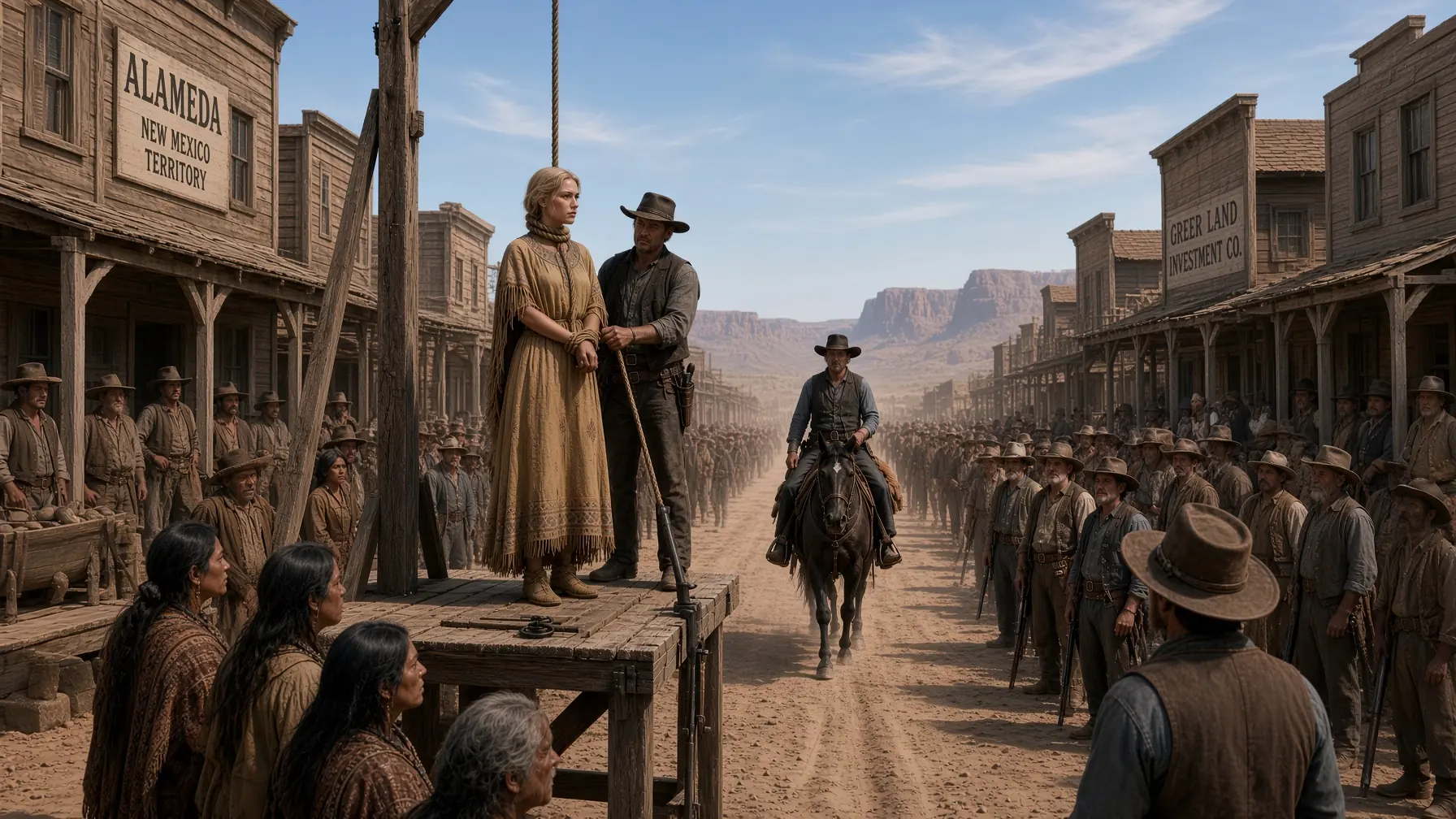
Arizona Territory, 1885, had learned how to make heat feel personal. By noon, the sun pressed against Red Hollow so hard that wagon rims burned the hands, horses crowded the narrow strips of shade beside buildings, and dust floated over Main Street like pale smoke. Nearly every person in town had gathered around the wooden gallows standing beside the courthouse. At the center of the platform, with a rope already resting against her throat, stood twenty-four-year-old Abigail Hart.
Three nights in the town jail had left Abigail’s cream dress gray at the hem and wrinkled across the sleeves. Her wrists were bound in front of her with rough cord, and strands of brown hair clung damply to her cheeks. She could feel people staring from beneath hats, parasols, and shaded storefronts, waiting to see whether fear would finally make her beg. Abigail refused to give them the satisfaction.
Until one week earlier, most of Red Hollow had known her as the quiet daughter of a schoolmaster. Her father had died from pneumonia four years before, and her mother followed him the previous winter after months of illness. Abigail had spent her adult life helping at the mission school, reading letters for miners who could not read, and bringing food to families when the mines shut down. No one had ever accused her of being dangerous until she admitted she loved a man the town believed she should fear.
His name was Mateo Begay. His mother had been Diné, his father a Mexican vaquero from Sonora, and Mateo belonged comfortably to neither world the white men of Red Hollow understood. He worked cattle, broke horses, guided freight wagons through dry country, and could read a trail across stone where another man saw nothing but dust. In town, people called him half-breed when they thought he could not hear and outlaw when they wanted permission to hate him.
Mateo rarely answered either word. He had learned before turning fifteen that arguing with a man determined to despise you usually wasted breath. He preferred horses because frightened animals rarely lied about why they were afraid. A horse kicked because it hurt, ran because it feared something, and trusted because eventually someone had earned it.
Abigail first met him seven months before the hanging, beside a dry wash north of Red Hollow. The rear axle on her wagon had cracked while she was carrying books and lamp oil back from a trading post, leaving her stranded nearly six miles from town. Two ranch riders passed her without stopping, claiming they needed to beat the storm. Mateo stopped without being asked.
He dismounted from a bay mare with white along one foreleg and examined the broken axle. “You’re not getting that wheel home the way it is,” he told her. Abigail looked at the dark clouds gathering over the mesas and asked whether he had any better news. Mateo smiled slightly and said, “I usually save that until after the bad news proves useful.”
He repaired the axle using rawhide, a strip of iron from an old cinch buckle, and a piece of mesquite he cut to fit beneath the wagon bed. Abigail watched his hands work and asked how he learned to fix things that did not appear fixable. Mateo shrugged and told her poor men either learned repairs or learned to walk. She laughed before she had time to decide whether she should.
That laugh stayed with him. So did the way she thanked him without lowering her voice when three riders passed them on the road back to Red Hollow. Abigail saw Mateo again at the well two mornings later, then outside the livery, then buying coffee from the general store. Before long, chance stopped explaining the meetings.
They talked beneath the cottonwoods south of town where the river narrowed in summer. Abigail brought books, and Mateo brought coffee strong enough to stain tin cups. She taught him passages from poems he pretended not to like, while he showed her how to tell whether rain was coming by watching the underside of clouds over the mountains. Neither of them said love until the town had already decided that was what it was.
Red Hollow had one church, two saloons, a blacksmith shop, a jail, and enough gossip to fill whatever space water could not. A white woman speaking privately with a Native cowboy was already considered reckless. A white woman loving him openly was something different. By spring, strangers had begun watching Abigail when she crossed the street.
Sheriff Caleb Rusk watched more closely than anyone. He was forty-six, heavy through the shoulders, with a thick mustache and the habit of resting his thumb against his gun belt whenever he wanted people to notice the badge. He had brought Abigail firewood after her mother died and started appearing at her door with reasons that became less convincing each visit. When he finally asked her to marry him, Abigail said no.
Rusk smiled as if she had misunderstood the question. Abigail thanked him for his concern and repeated herself. He left politely, but humiliation settled somewhere deep inside him and hardened. Two months later, he saw Mateo leaving the road near Abigail’s home after sunset.
From that evening forward, Caleb Rusk discovered reasons to call Mateo dangerous. He told saloon owners that Mateo had been seen near stolen cattle. He warned merchants that he might be connected to raiders south of the border. He mentioned Abigail whenever possible, always with the careful tone of a man pretending concern for a woman whose choices he wanted to punish.
The opportunity arrived when twelve horses disappeared from the Broken Crown Ranch. The ranch belonged to Gideon Strake, the wealthiest cattleman in that part of Arizona and one of Sheriff Rusk’s closest friends. Strake owed Mateo nearly four months of wages for a winter cattle drive. Paying him would have cost money, while blaming him cost nothing.
A saddlecloth marked with Strake’s brand appeared behind Abigail’s shed the following morning. One of Mateo’s silver conchos was supposedly discovered near a canyon where three of the missing horses had crossed. A bartender named Luther Dane swore he saw Abigail handing Mateo a folded map two nights before the theft. Luther had been drunk enough that evening to fall asleep beneath his own card table, but no one asked about that.
Rusk arrived at Abigail’s house with three deputies. He searched without asking and emerged twenty minutes later holding the saddlecloth like a preacher displaying proof of sin. Abigail told him she had never seen it before. Rusk answered that disappointment made people say unfortunate things.
Mateo heard about the warrant before the sheriff found him. Two deputies cornered him at a cattle camp in the Black Hills and fired before giving him a chance to surrender. Mateo shot one man’s rifle from his hand, escaped through a wash, and disappeared into country Rusk’s men could not read. By sunset, the sheriff was telling Red Hollow that only guilty men ran.
Abigail was arrested for aiding him. Her trial took place inside the church because the courthouse roof was being repaired, though no one appeared troubled by sentencing a woman beneath a wooden cross. Judge Horace Bell spent forty-seven minutes hearing testimony and less than five considering it. Mateo was absent, which allowed every accusation against him to become convenient fact.
“You admit meeting this man secretly?” Judge Bell asked. Abigail stood between two deputies and answered, “I met Mateo because half this town would have made our lives miserable if we met openly.” Someone near the back muttered that she had no shame. Abigail turned toward the voice and said, “Not about him.”
Judge Bell leaned forward. “Did you love Mateo Begay?” Sheriff Rusk watched from beside the church wall, expecting fear to finally silence her. Abigail looked directly at the judge. “I still do.”
That answer changed the room. People who had been pretending the case concerned stolen horses suddenly stopped pretending. Judge Bell’s mouth tightened, Gideon Strake stared at Abigail with open disgust, and Sheriff Rusk smiled. The verdict had probably been decided before she entered the church, but now everyone felt justified.
Abigail was convicted of assisting a fugitive and conspiring against territorial authority. Neither charge normally carried a death sentence. Judge Bell nevertheless declared her actions an act of violent betrayal against the peace of the county and ordered her hanged at noon the following day. No one in the church asked when loving an accused man had become punishable by death.
Red Hollow began gathering before breakfast. Farmers came from nearby homesteads, miners abandoned morning shifts, and ranch hands leaned against hitching rails with tobacco tucked into their cheeks. Some came because public hangings were rare. Others came because cruelty becomes easier when enough people call it entertainment.
Deputy Nathan Webb entered Abigail’s cell shortly before eleven thirty. He was twenty-one and had joined the sheriff’s office because his father believed a badge might keep him out of trouble. Nathan brought Abigail water twice during her imprisonment and had listened quietly when she asked whether Mateo had been captured. Each time, Nathan told her no.
Now he carried the rope. His hands trembled while unlocking the cell. Abigail noticed and said, “You don’t have to pretend this feels right.” Nathan looked at the floor. “Feeling doesn’t change orders.”
“It changes men.”
Nathan lifted his eyes then. For a second, Abigail saw exactly how young he was. He opened his mouth as though he might answer, but footsteps sounded in the hallway and Sheriff Rusk appeared. Whatever courage Nathan had almost found disappeared behind silence.
They walked Abigail onto Main Street. The crowd parted as she passed, and a few people who had known her since childhood looked away. Mrs. Dunley, whose youngest son Abigail had taught to read, covered her mouth with both hands. Gideon Strake sat proudly on a black stallion near the saloon, his silver watch chain bright against his vest.
Abigail climbed the gallows stairs without assistance. The rope scraped her throat as Nathan placed it over her head. He whispered, “I’m sorry.” Abigail answered quietly, “Then remember that.”
Sheriff Rusk stepped to the front of the platform and raised one hand. Conversations faded until only horses, flies, and the dry wind could be heard. Rusk announced that Abigail Hart would die for aiding an outlaw, obstructing justice, and betraying the safety of decent citizens. Nobody mentioned stolen horses anymore.
He turned toward her. “Last words?” Abigail looked past him toward the town she had called home all her life. She saw the schoolhouse roof, the general store porch, the church where her father once taught children on Sunday afternoons, and dozens of faces waiting for death.
“Yes,” she said.
Her voice was quiet, forcing people to listen. “I never betrayed Red Hollow.” She looked at Sheriff Rusk. “I simply stopped confusing the men who control it with the people worth loving.”
A murmur rolled through the crowd. Judge Bell shifted uncomfortably near the courthouse steps. Rusk’s face remained still, but something dangerous moved behind his eyes.
Abigail continued. “If Mateo stole those horses, show the truth and punish him for theft. If I helped him steal them, prove it and punish me for that.” She lifted her chin against the rope. “But if you are hanging me because I loved a man you already decided was beneath you, at least have the courage to call this what it is.”
Nobody cheered.
That silence enraged Rusk more than resistance might have. He walked close enough that his shoulder blocked the crowd from seeing his mouth. “You could have had a respectable life.”
Abigail stared at him.
“With you?”
Rusk’s jaw tightened.
She gave him the smallest smile.
“I said respectable.”
Two hundred and fifty yards north of Red Hollow, Mateo Begay lay flat behind a ridge of sandstone with a Winchester resting against his shoulder. Blood had dried along the torn sleeve of his gray shirt where a bullet had grazed him during the night. His bay mare, Estrella, stood behind the rocks breathing hard after nearly ten hours of riding.
Beside him crouched Isaiah Freeman, a Black scout who had spent six years with cavalry units before deciding he was tired of helping officers receive medals for directions he gave them. Isaiah was fifty-eight, gray around the beard, narrow in the face, and famous for complaining through situations most men considered too dangerous for conversation. He had found Mateo near dawn and listened to the plan exactly once.
Then he called it suicidal.
After another minute, he agreed to help.
Through the rifle sight, Mateo could see Abigail standing beneath the beam. His breathing changed when Nathan placed the noose around her neck. Isaiah noticed and whispered, “If your hands start shaking, tell me before you waste the last good idea either of us has.”
“They’re not shaking.”
“Your jaw is.”
“That doesn’t aim the rifle.”
Isaiah looked toward the gallows. “Wind is moving left to right.”
“I know.”
“Distance?”
“Two hundred forty-eight yards.”
Isaiah studied him.
“You counted?”
“I paced the ridge last night.”
Isaiah grunted. “That is either comforting or deeply concerning.”
On the gallows, Rusk signaled Nathan toward the lever. Nathan looked at Abigail. She closed her eyes, not because she had surrendered but because she refused to let Caleb Rusk be the last thing she saw.
Mateo placed his finger against the trigger.
The rope moved in the wind.
He breathed once.
Twice.
Then the trapdoor dropped.
The rifle cracked across Red Hollow.
The bullet sliced through the rope less than a foot above Abigail’s head. She fell through the opening, struck the lower boards, and rolled hard onto one shoulder as the severed noose whipped past her face. For one suspended second, nobody understood what had happened.
Then the town exploded.
Women screamed and ran toward storefronts. Horses reared against hitching posts, wagons rocked as men dove behind them, and someone fired blindly toward the northern ridge. Sheriff Rusk grabbed the shotgun leaning against the gallows railing.
Mateo fired again.
The shotgun flew from Rusk’s hands.
Wood splintered beside his fingers, and the weapon spun across the platform before falling into the street. Rusk stumbled backward, staring toward the ridge with shock replacing authority.
Then Mateo mounted Estrella.
The bay mare flew down the slope.
Dust streamed behind her as Mateo rode directly toward town, Winchester held low against one thigh. Isaiah remained on the ridge and fired at anything that threatened to become brave enough to aim.
A shot knocked Gideon Strake’s hat into the dirt. Another shattered a wagon lantern beside two of Rusk’s deputies. Isaiah deliberately missed every man by inches, which somehow frightened them more than wild shooting would have.
“Take cover!” someone yelled.
Nobody needed convincing.
Abigail crawled from beneath the gallows platform. Her throat burned where the rope had tightened for less than a second, and one ankle throbbed from the fall. Nathan Webb stood above her staring at the broken rope.
Rusk shouted at him. “Get her!”
Nathan did not move.
“I said get her!”
Abigail looked at the young deputy.
Nathan looked back.
Then he stepped aside.
Mateo reached the gallows at full speed. He leaned from the saddle and shouted Abigail’s name. She ran toward him as gunfire cracked from the rooftops.
A bullet struck the ground behind her. Another passed through the loose fabric near her elbow. Mateo caught Abigail around the waist and pulled her across the saddle in front of him.
For half a heartbeat, neither spoke.
She grabbed his vest.
“You came.”
He looked down at her as Estrella spun toward the southern road. “You sound surprised.”
“I was hoping you were smarter.”
“Terrible day to start.”
Even with the rope still around her neck, Abigail laughed.
It sounded almost like a sob.
Sheriff Rusk drew a revolver from beneath his coat and aimed at Mateo’s back. Nathan saw the movement and finally made the choice he had avoided all morning. He shoved the sheriff’s gun arm toward the sky.
The shot struck the courthouse sign.
Rusk turned on him.
“What the hell are you doing?”
Nathan backed away.
“No more.”
“You’re finished.”
“Maybe.”
Nathan looked toward Abigail riding away.
“But she isn’t.”
Mateo never saw it.
He and Abigail were already moving down Main Street.
Gideon Strake rode from beside the saloon with two ranch hands, trying to block the southern road. One man raised a rifle. Isaiah’s next shot knocked the weapon out of his hands.
Strake drew his pistol.
Abigail reached for the revolver tucked beneath Mateo’s coat.
“What are you doing?”
“Helping.”
“You know how to use that?”
“My father taught school in Arizona.”
Mateo looked confused.
“What does that have to do with guns?”
“Nothing.”
Abigail fired.
The bullet struck the dirt beneath Strake’s stallion. The animal reared so violently that Strake slid backward over the saddle and hit the street hard enough to lose both his pistol and whatever dignity he still had.
Mateo stared at Abigail.
She lowered the revolver.
“I meant to do that.”
“Of course.”
“Mostly.”
Mateo laughed and urged Estrella forward.
Red Hollow disappeared behind them.
For the next four hours they rode through washes, rocky flats, and dry hills where trails disappeared almost as quickly as they formed. Mateo avoided open ground whenever possible, guiding Estrella through narrow passages between red cliffs. Abigail remained in front of him until they reached a creek hidden beneath cottonwoods.
Isaiah waited there with another horse.
He had circled west after leaving the ridge, using an old freight trail that Rusk’s men rarely traveled. When he saw Abigail alive, the tension left his shoulders for the first time that day. Then he noticed the bruising around her throat.
“Miss Hart,” he said.
“Mr. Freeman.”
Isaiah looked at Mateo.
“You know, most men buy flowers.”
Mateo dismounted.
“I was busy.”
“I noticed.”
Isaiah handed Abigail a canteen.
She drank carefully.
“You saved my life too.”
Isaiah shook his head. “I shot a few hats.”
“You shot them very convincingly.”
“That has always been my gift.”
They moved deeper into the canyon before sunset. Isaiah knew of a narrow shelf where rock concealed them from anyone riding along the upper trail. They ate dried meat, beans, and the remains of a loaf Isaiah had stolen from his own kitchen before leaving.
No one lit a fire.
Abigail slept badly.
Every time she drifted off, she felt the trapdoor dropping beneath her feet. Twice she woke grabbing at her throat. The third time, she found Mateo sitting beside the canyon wall with his rifle across his knees.
“You haven’t slept.”
“Neither have you.”
She moved closer.
“Does your arm hurt?”
“No.”
“That means yes.”
Mateo glanced at the blood on his sleeve.
“I’ve had worse.”
“I hate when men say that.”
He looked at her.
“Why?”
“Because having survived worse doesn’t make the current wound disappear.”
Mateo considered the argument.
“That sounds like something from one of your books.”
“It’s something from having eyes.”