Danielle Carter had learned a long time ago that expensive rooms often revealed people more clearly than inexpensive ones.
Money changed posture.
Titles changed voices.
A marble floor could somehow persuade perfectly ordinary people that they had become gatekeepers to a better class of humanity.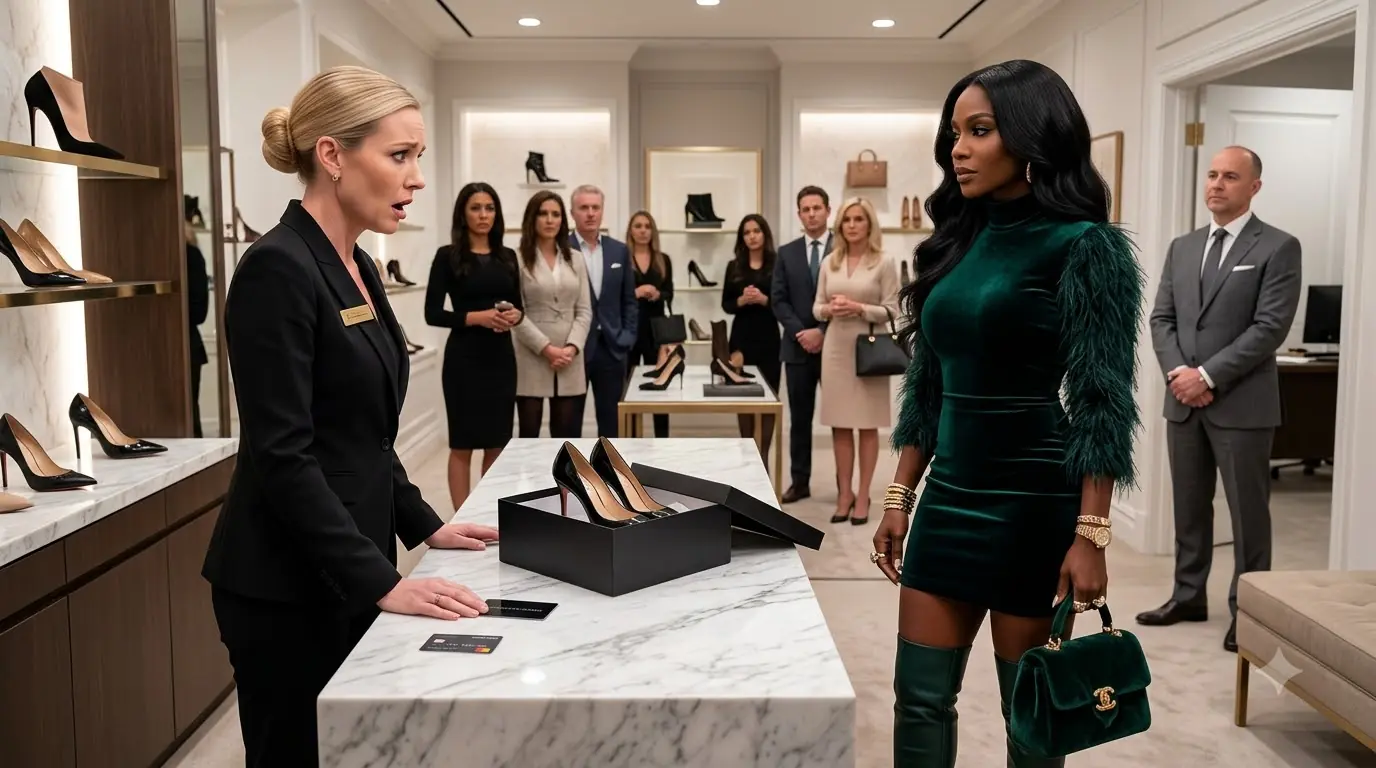
Danielle never fully understood why.
She understood luxury.
Her company had been built around it.
Fine leather.
Hand-finished shoes.
Limited production.
Private fittings.
Stores designed with limestone, pale oak, brushed brass, handwoven rugs, and enough empty space around every product to make one pair of heels look like museum property.
She understood the psychology of exclusivity because she had helped design it.
What she did not believe was that exclusivity should ever become permission for contempt.
That Tuesday afternoon in Manhattan, she decided to test whether her employees understood the difference.
Danielle Carter was thirty-eight years old and the founder, owner, and chief executive of Carter Maison Group, a privately held luxury company that had grown from a single accessories studio in Brooklyn into an international brand operating boutiques in New York, Los Angeles, Miami, Chicago, London, Paris, Toronto, and Dubai.
She had started with handbags.
Shoes came later.
Then small leather goods.
Then jewelry collaborations.
The company had grown quickly because Danielle understood two things extremely well.
Design.
And customer experience.
People could buy beautiful objects almost anywhere.
What they remembered was how they felt while buying them.
Danielle insisted on that principle so often that employees had begun joking about it.
Luxury is not the price tag. Luxury is never making the customer feel like they need permission to belong.
The sentence appeared in training manuals.
In onboarding presentations.
On one wall inside the corporate training center.
Danielle had said it hundreds of times.
Then complaints began arriving.
Not many.
That was what made them easy to dismiss.
One customer said she entered the Madison Avenue flagship and waited almost twelve minutes while three employees assisted people who arrived after her.
Another wrote that an associate asked whether she was “sure” she wanted to see a handbag before unlocking the display.
A third said a manager suggested an outlet location when she asked about a limited-edition boot.
Different days.
Different staff.
Similar language.
There were positive reviews too.
Thousands.
Enough that executives initially treated the complaints as normal friction inside a large retail operation.
Danielle did not.
Patterns often hid inside small numbers.
She asked for complaint logs from the previous eighteen months.
Then sales adjustments.
Returns.
Customer-service escalations.
Security incidents.
Mystery-shopper reports.
One location stood out.
Madison Avenue.
Not catastrophically.
Just enough.
Customers who looked affluent were often greeted within ninety seconds.
Others waited longer.
Complaints involving “availability misunderstandings” were unusually high.
Manager overrides appeared frequently when customers asked about limited inventory.
Then Danielle found a note written by a sales associate after one customer dispute.
Manager advised item should be held for preferred clientele.
Danielle stared at the sentence.
Preferred clientele.
The company had a private-client program.
High-spending customers could receive advance access to new collections and invitation-only appointments.
But the policy did not allow employees to refuse available merchandise to someone simply because they were not already known to the store.
Danielle called regional director Marcus Bennett.
“Who manages Madison?”
“Lauren Whitmore.”
“How long?”
“Three years.”
“Performance?”
“Strong.”
“Sales?”
“Top five nationally.”
“Complaints?”
Pause.
“Some.”
“How many is some?”
Marcus named the number.
Danielle had already seen it.
“Why is she still there?”
“Because most were unverified.”
Danielle looked through the records.
“Unverified means what?”
“Conflicting accounts.”
“Cameras?”
“Not always conclusive.”
“Staff statements?”
“Usually supported Lauren.”
Danielle leaned back.
“Of course they did.”
Marcus became careful.
“What are you thinking?”
“I’m going shopping.”
He laughed.
Danielle did not.
“Seriously?”
“Yes.”
“You want me there?”
“No.”
“Security?”
“No.”
“Danielle.”
“Marcus.”
He knew that tone.
“What do you want me to do?”
“Stay available.”
“That usually means trouble.”
“Hopefully not.”
She ended the call.
At 2:14 p.m., Danielle entered the Madison Avenue boutique alone.
No assistant.
No driver waiting directly outside.
No corporate badge.
No executive escort.
She dressed exactly as she would have if meeting friends for dinner afterward.
A fitted dark emerald velvet mini dress with a high neckline.
Textured feather-like sleeves.
Matching knee-high leather boots.
Long black hair falling in soft waves over her shoulders.
Gold watch.
Stacked bracelets.
Rings.
A dark-green textured handbag with gold hardware.
Elegant.
Expensive.
Unmistakably deliberate.
Danielle did not disguise herself.
That mattered.
She was not pretending to be poor.
She was simply entering without advertising who she was.
The boutique doors opened.
A bell sounded softly.
One sales associate looked up.
Then looked back down at a tablet.
Another employee was helping a white couple examine handbags.
A third spoke to a woman near the shoe display.
Nobody greeted Danielle.
She checked the time mentally.
Five seconds.
Ten.
Twenty.
Danielle walked farther inside.
The store smelled faintly of leather and white tea.
Perfect.
Music volume low.
Lighting correct.
Displays immaculate.
The merchandise presentation team had done excellent work.
Customer reception had not.
Thirty-five seconds.
An associate passed within six feet.
No greeting.
Danielle continued toward the footwear salon.
A blonde manager stood behind the marble counter reviewing something on a tablet.
Lauren Whitmore.
Forty-two.
Perfect black blazer.
Tailored trousers.
Pearl earrings.
Hair secured into a smooth bun.
Gold manager badge.
Danielle had seen photographs.
In person Lauren looked exactly like the performance reports described.
Controlled.
Polished.
Efficient.
She looked up.
Their eyes met.
Lauren smiled.
Not warmly.
Professionally.
“Good afternoon.”
Forty-nine seconds.
Danielle answered:
“Good afternoon.”
“Are you meeting someone?”
Interesting.
Not:
How can I help?
Not:
Welcome.
Are you meeting someone?
“No.”
Lauren’s eyes briefly moved over Danielle’s clothes.
Shoes.
Handbag.
Jewelry.
Then back to her face.
“What can we help you find?”
Danielle gestured toward a pair of black slingback heels displayed on the central shelf.
“Those.”
Lauren looked.
The shoe belonged to the current limited collection.
Black satin.
Narrow heel.
Hand-finished crystal buckle.
Retail price: $2,850.
“What size?”
“Thirty-eight.”
Lauren typed into the tablet.
Danielle already knew inventory.
There were four pairs.
One size 37.
Two size 38.
One size 39.
Lauren looked at the screen.
Then at Danielle.
“That collection is very limited.”
“I know.”
“We generally reserve those pieces for established clients.”
There it was.
Danielle kept her expression unchanged.
“I’d like to try the thirty-eight.”
Lauren smiled.
A little tighter.
“I’m afraid those are currently spoken for.”
Danielle knew that was false.
“Both pairs?”
“Yes.”
“Are they paid?”
Lauren’s eyebrows moved slightly.
“They’re allocated.”