Marcus Ellison had owned forty-three restaurants for eleven years, but on the Friday evening that changed his company, he walked into one of them with seventeen dollars folded inside his pocket.
No corporate credit card.
No tailored suit.
No driver waiting outside.
No assistant carrying a tablet.
No executive badge clipped to his belt.
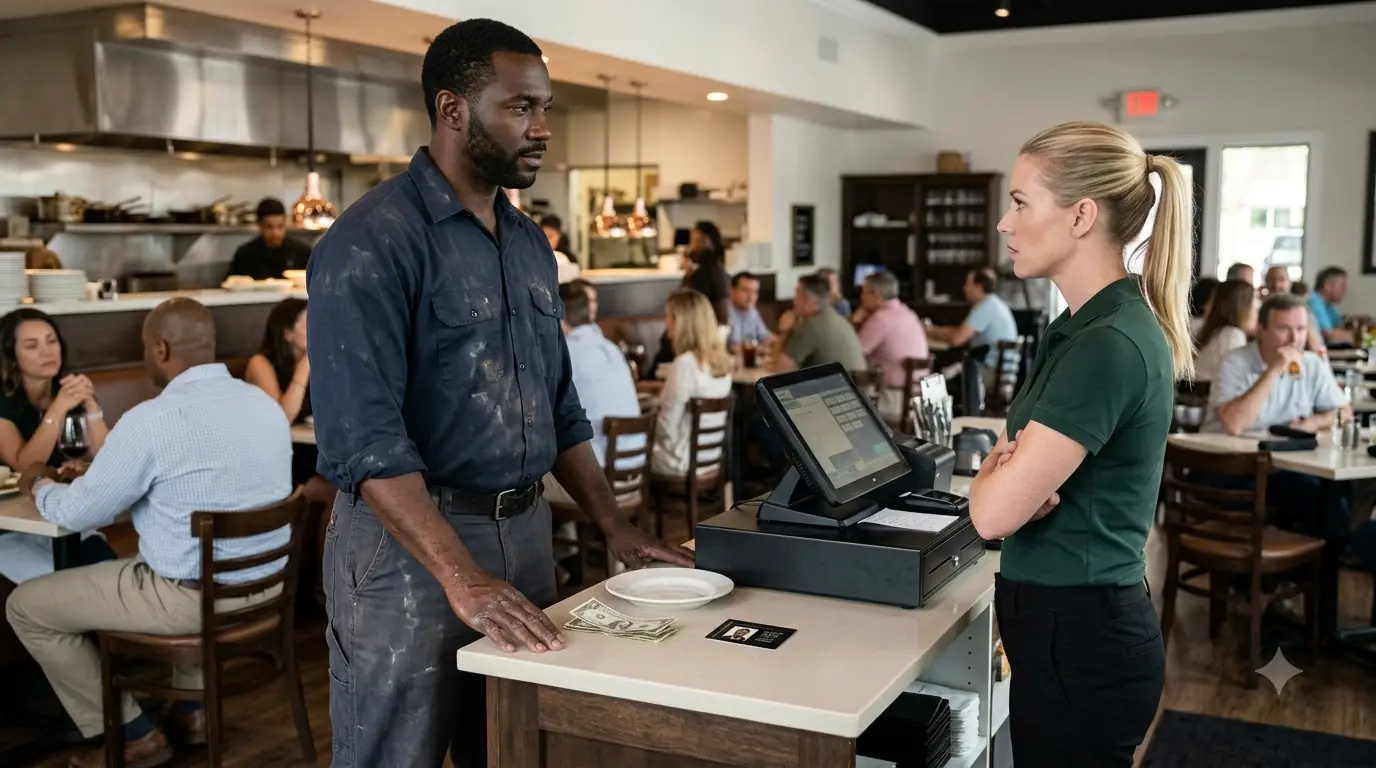
His navy work shirt was stained with dust along the shoulders and chest. Fine gray powder clung to the knees of his charcoal work pants. His construction boots carried dried mud from a bridge site south of Atlanta, and his hands looked exactly the way he wanted them to look.
Rough.
Scarred.
Tired.
Ordinary.
Marcus stood outside Ellison Table & Grill, Midtown, watching customers move behind the restaurant’s tall windows.
He had designed the first location himself sixteen years earlier.
Not the architecture.
He knew nothing about architecture then.
He designed the idea.
Affordable food that still felt worth dressing up for.
Open kitchen.
Real ingredients.
Employees paid above the local restaurant average.
No velvet ropes.
No dress-code theater.
No customer treated like a problem because their clothes were cheap, their accent unfamiliar, their children noisy, or their job visible on their hands.
That last rule mattered personally.
Marcus had not been born into restaurants.
He had been born into work.
His father, Elijah Ellison, repaired concrete structures for the city.
Bridge decks.
Parking garages.
Retaining walls.
Anything cracked by weather, traffic, or neglect.
Marcus spent summers helping him.
At sixteen he learned how concrete dust entered every seam of clothing.
At eighteen he knew the strange ache that appeared between shoulder blades after carrying equipment all day.
At twenty-two he could identify a tired construction worker by the way a man lowered himself into a chair before ever seeing the boots.
Restaurants did not always welcome men like that.
Marcus remembered one particular night with his father.
They had worked fourteen hours repairing storm damage.
Elijah wanted steak.
Not expensive steak.
Just meat, potatoes, and somewhere with air-conditioning.
They entered a restaurant wearing work clothes.
The hostess looked at them.
Then looked toward the dining room.
Then asked if they wanted takeout.
Elijah said no.
She told them there would be a forty-five-minute wait.
Three couples entered after them.
All seated within ten minutes.
Elijah never complained.
That bothered Marcus more than if he had shouted.
They eventually left.
Ate burgers in the truck.
Years later, when Marcus opened his first restaurant, he put one sentence inside the training handbook:
A customer who worked hard enough to arrive dirty deserves the same chair as a customer who worked clean enough to arrive polished.
He had believed the culture survived expansion.
For a long time, perhaps it did.
Then came complaints.
Small ones.
Difficult to prove individually.
A delivery driver said employees ignored him for twenty minutes while serving people who arrived later.
A construction worker claimed he was told the dining room was full although empty tables were visible.
A Black family reported that a manager questioned whether they could afford the minimum charge for a private table they had already reserved.
A woman wearing hospital scrubs said she was asked whether she wanted food “to go” before being allowed to request a table.
Another customer wrote:
It felt like they were deciding whether I belonged before deciding whether they could serve me.
That sentence stayed with Marcus.
Corporate operations investigated.
Midtown management denied a pattern.
Customer satisfaction remained high overall.
Revenue was excellent.
The store ranked fourth companywide.
Regional Vice President Andrew Keller summarized it during a quarterly meeting:
“Busy restaurants generate complaints.”
Marcus looked at him.
“All restaurants generate complaints.”
“Exactly.”
“That doesn't answer whether these complaints resemble each other.”
Andrew shrugged.
“Marcus, we've reviewed them. No substantiated discrimination.”
“Who reviewed them?”
“HR and operations.”
“Through interviews?”
“Yes.”
“Managers know they're being interviewed?”
“Obviously.”
Marcus stared.
Andrew smiled.
“What?”
“If somebody only behaves badly when they believe nobody important is watching, announcing the investigation seems inefficient.”
Three people at the conference table became uncomfortable.
Marcus had already made his decision.
He would go himself.
No warning.
No executive team.
And he would not arrive looking like Marcus Ellison, founder and CEO.
That part was easy.
Thursday afternoon he called an old friend, Terrence Boyd, who managed a bridge rehabilitation company.
“You still need help Saturday?”
Terrence laughed.
“You haven't carried equipment professionally in twenty years.”
“Friday.”
“What?”
“I need one day.”
“Why?”
“Long story.”
Terrence eventually agreed.
Marcus spent Friday under summer sun with a bridge crew repairing expansion-joint concrete.
Nobody gave him symbolic work.
Terrence made sure of that.
Marcus carried bags.
Scraped damaged concrete.
Moved equipment.
Sweated.
By four thirty, he genuinely looked exhausted because he genuinely was.
He showered only his face and hands at the work trailer.
Changed nothing else.
Then drove to Midtown.
Now he stood outside his own restaurant counting cash.
Seventeen dollars.
He had deliberately brought enough for one of the least expensive entrées plus tax.
Not enough to create flexibility if someone tried upselling him.
He opened the door.
Cool air hit his face.
Dinner rush.
Good.
Nearly every table occupied.
Families.
Couples.
Business dinners.
Young professionals clustered near the bar.
The open kitchen moved efficiently beneath stainless-steel lights.
Servers crossed between tables.
Plates looked excellent.
Marcus felt a moment of pride.
Then he reminded himself why he was there.
He joined the counter line.
Two people ahead.
A young couple ordered takeaway.
The cashier smiled.
“Absolutely. Give us about twelve minutes.”
Next came a man wearing a navy suit.
“Good evening, Mr. Coleman.”
Marcus noticed.
Regular customer.
The cashier knew him.
“Your usual?”
“Yes.”
“Perfect.”
Then Marcus stepped forward.
The woman behind the register looked at him.
Her smile vanished.
The change was immediate.
Not subtle.
Marcus recognized her from personnel files.
Lauren Whitmore.
Thirty-four.
Shift manager.
Four years with company.
Promoted twice.
Strong revenue metrics.
Employee retention slightly below average.
One prior written warning for conflict with a delivery contractor.
Customer feedback score: above district mean.
Interesting.
Lauren's gaze moved from his dusty shirt to his pants.
Then boots.
Then face.
“What?”
Marcus paused.
Not “Good evening.”
Not “How can I help you?”
“What?”
He smiled politely.
“Good evening. I'd like the rice plate with grilled chicken.”
She glanced behind him.
Nobody waiting.
Then back.
“For here?”
“Yes.”
Lauren looked toward the dining room.
“No.”
Marcus thought he had misheard.
“Excuse me?”
“We can't seat you.”
He looked around.
A table had just opened near the wall.
Another was being cleared.
“I can wait.”
“No.”
Marcus placed the folded bills on the counter.
“I don't mind waiting.”
Lauren did not touch the money.
Her arms folded.
“You should probably leave.”
Something inside Marcus became very quiet.
He had expected bias.
He had not expected such speed.
“Is there a problem?”
Lauren exhaled as if he were wasting her time.
“We have standards.”
“What standards?”
“Dining standards.”
Marcus looked at his clothes.
Then back.
“Is there a dress code?”
“No.”
“Then what standard am I violating?”
Lauren glanced toward several diners.
Marcus followed her gaze.
People were watching.
Not all.
Enough.
“You're covered in dirt.”
“Dust.”
“Whatever.”
“I worked today.”
“Congratulations.”
The contempt in that single word was almost impressive.
Marcus moved the bills slightly closer.
“I have enough to pay.”
“I can see that.”
“So I'd like to order.”
“No.”
He waited.
She waited too.
The restaurant noise seemed to become distant.
Marcus asked:
“Why won't you serve me?”
Lauren's expression tightened.
“Sir, I am not doing this.”
“Doing what?”
“Arguing.”
“I asked a question.”
“I answered.”
“No. You told me to leave.”
“Which is an answer.”
Marcus nodded slowly.
“Not to the question I asked.”
Someone behind him shifted.
Chair legs scraped somewhere.
Lauren looked toward the room.
Then leaned closer.
“You're making customers uncomfortable.”
Marcus looked around.
Most of the uncomfortable customers appeared uncomfortable because Lauren was humiliating a man publicly.
“Did someone complain?”